
Scheduled agents track competitors across sites, blogs, pricing, news, and job posts. An LLM extracts structured signals, DuckDB stores it, changes get flagged, and a dashboard plus auto weekly reports surface it all,
compete - Competitive Intelligence Platform
Watch every move your competitors make. compete runs scheduled agents over a configurable list of competitors (websites, blogs, pricing pages, news, job postings), extracts structured signals with an LLM, warehouses everything in DuckDB, detects meaningful changes, and serves a polished, responsive dashboard with auto-generated weekly reports.
➜ Live demo · Docs · Write-up






The public demo is fully server-less: every API response is baked to static JSON and served from Vercel at $0 (see ADR 0004). A weekly GitHub Action refreshes the data. Config-driven collection (static/dynamic/RSS/jobs), snapshot-diff change detection, provider-agnostic LLM extraction, a dbt warehouse (staging → marts + tests), a typed FastAPI, a light/dark Next.js dashboard, and weekly markdown→PDF reports - all on free/local tooling.
Screenshots
| Overview (dark) | Competitor detail (dark) | |---|---| | 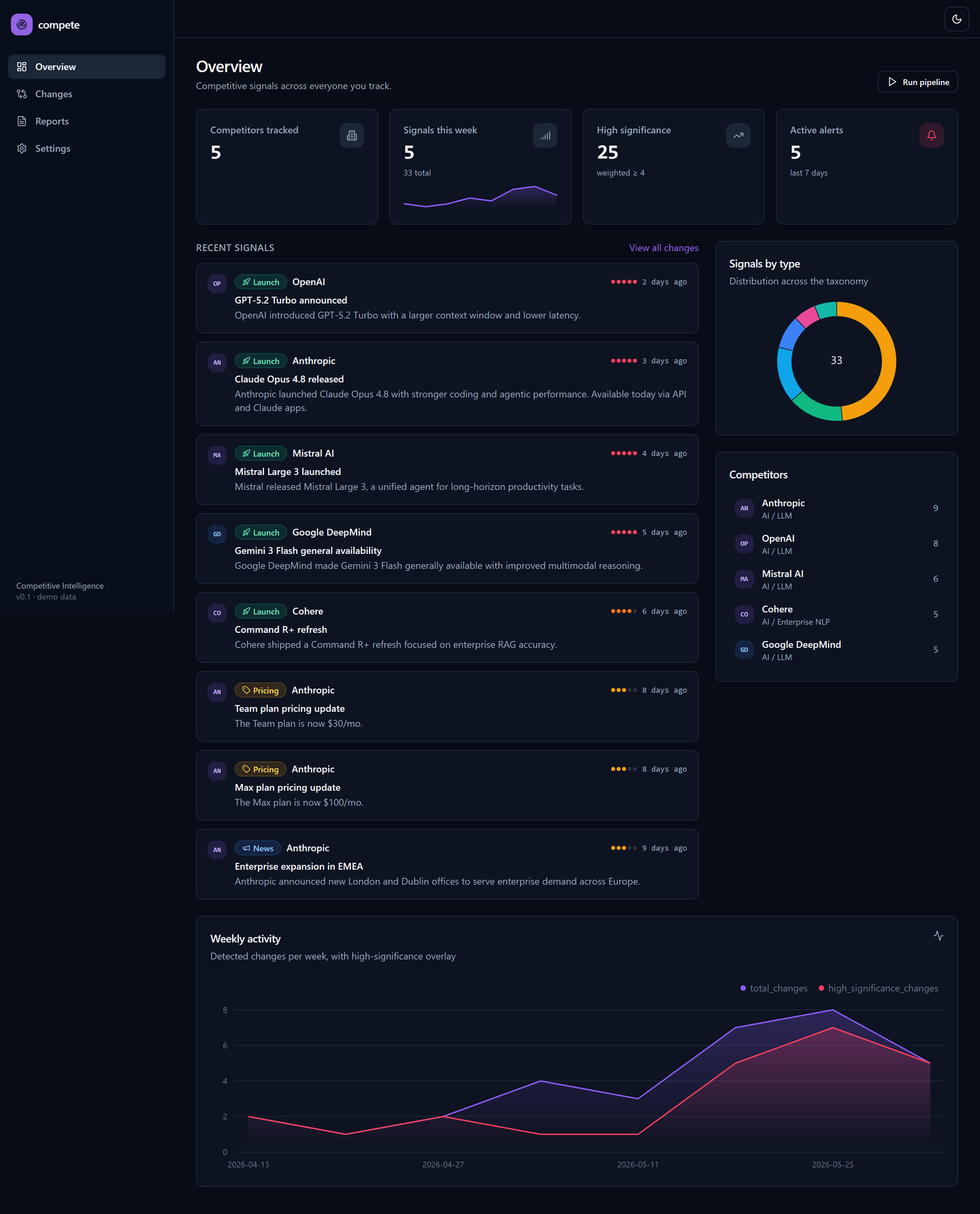 |
| 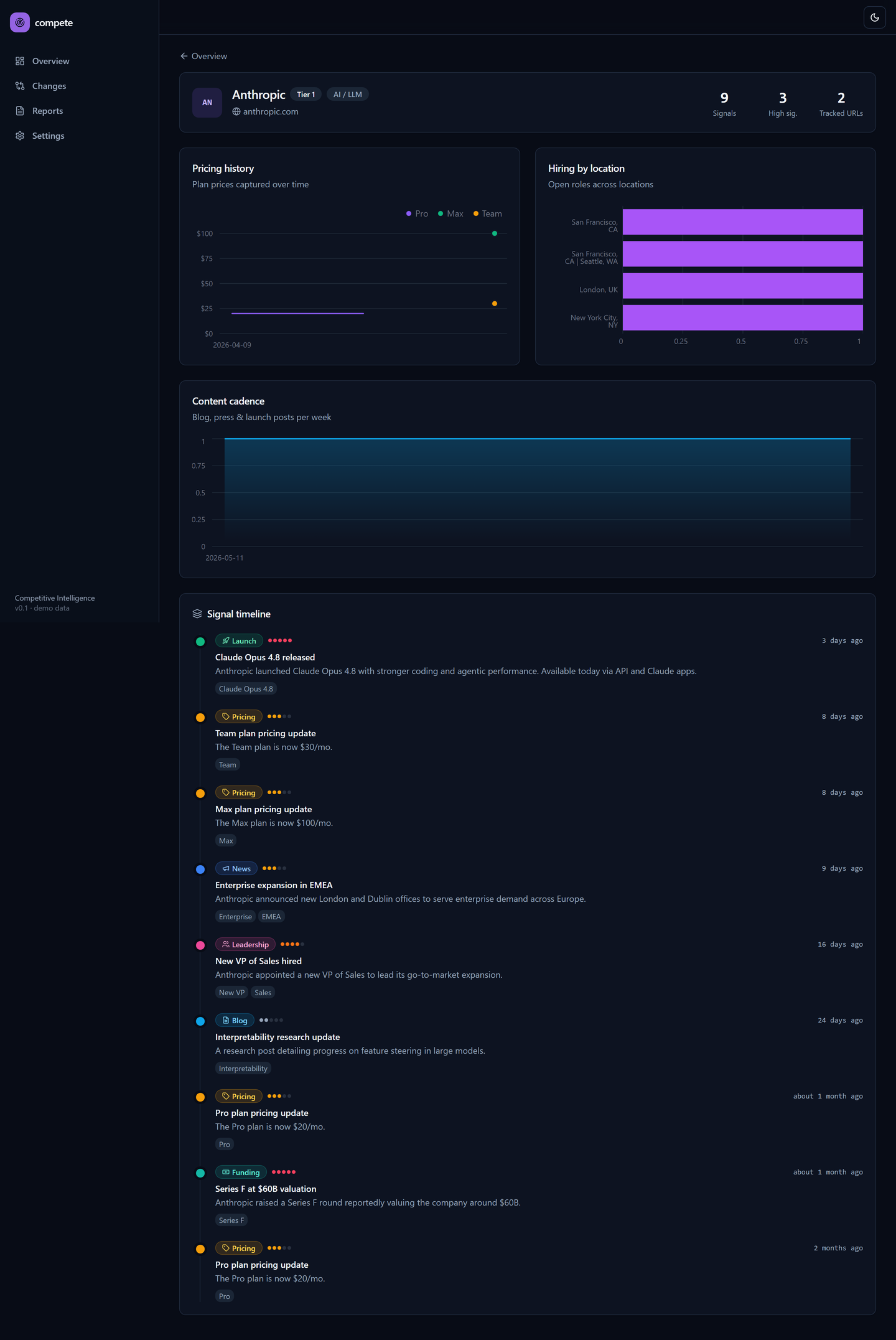 |
|
| Changes (light) | Mobile (dark) | |---|---| | 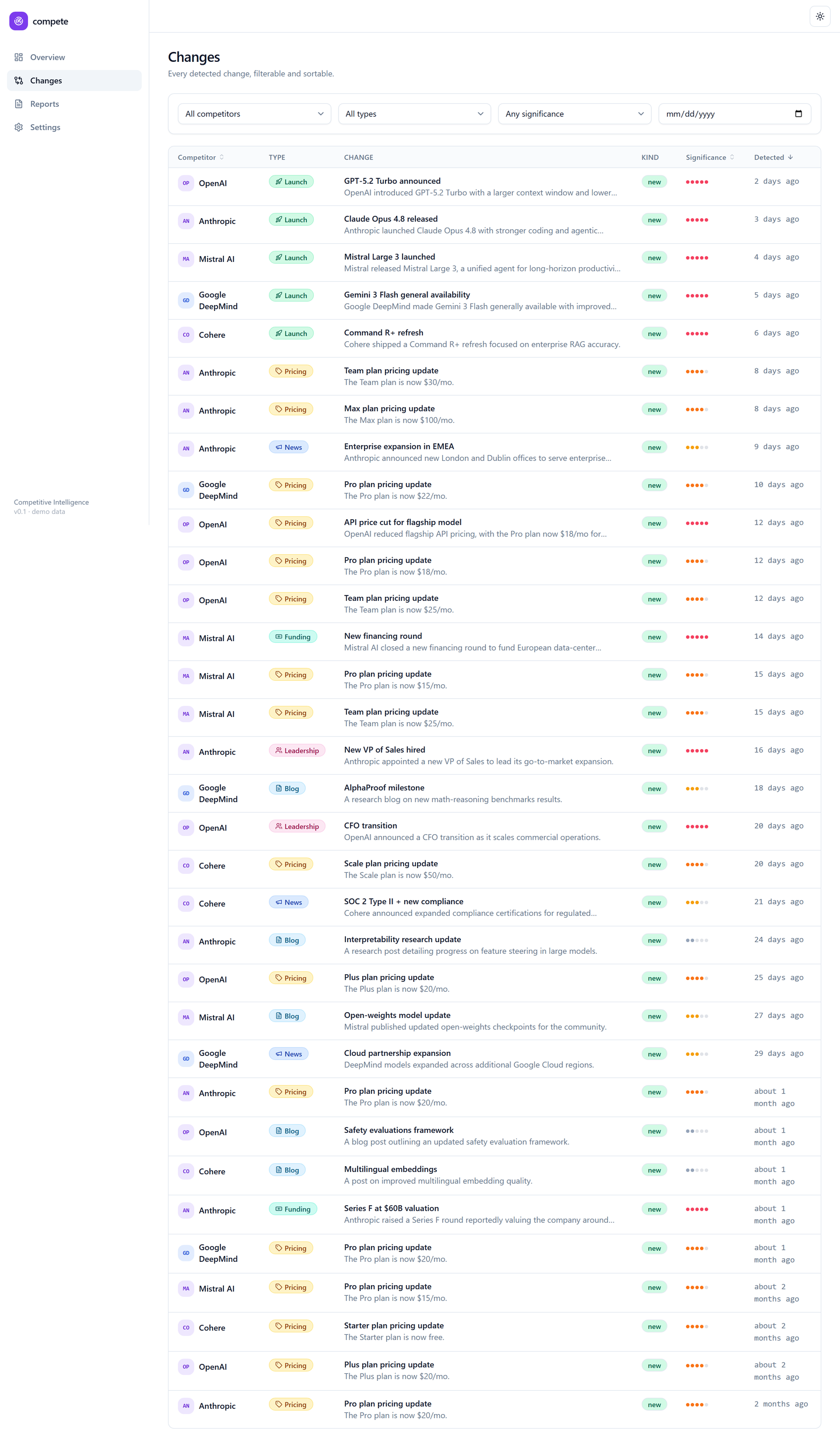 |
| 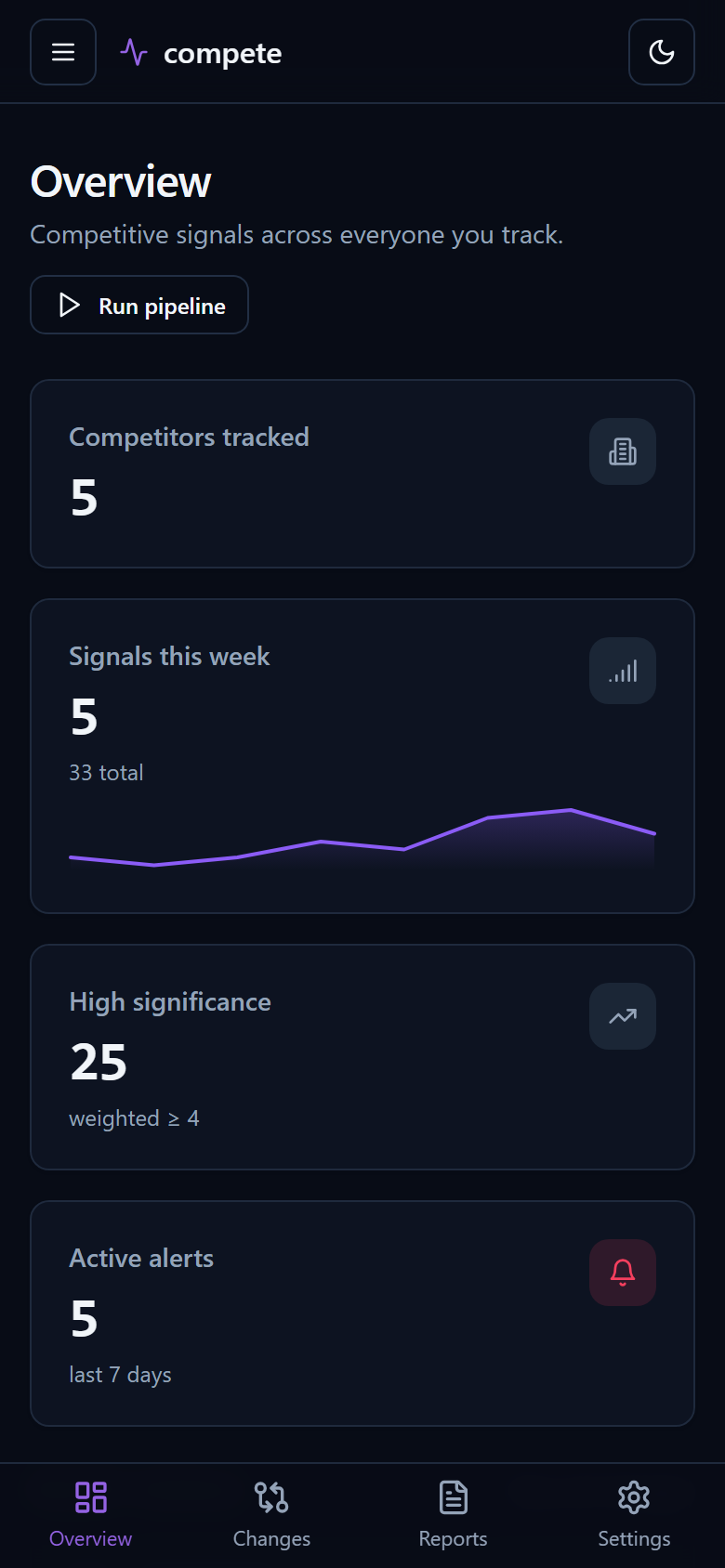 |
|
More in docs/screenshots/ (reports, settings, light/dark).
Tech stack
| Layer | Tooling | |--------------|---------| | Collection | Python, httpx + selectolax, trafilatura, Playwright, feedparser | | LLM extraction | provider-agnostic (Gemini Flash default · Groq · Ollama · mock), instructor structured outputs | | Storage | DuckDB (file-based warehouse) + Parquet raw layer | | Transform | dbt-core + dbt-duckdb (staging → marts, tests, docs) | | API | FastAPI (typed, OpenAPI) | | Frontend | Next.js + TypeScript + Tailwind + shadcn/ui + Tremor |
Optimized for free / open-source tooling throughout.
Quickstart
Requires uv (handles Python 3.12 automatically).
# 1. Install dependencies into a local venv (all extras for the full demo)
uv sync --extra dev --extra dbt --extra api --extra report
2. Configure environment
cp .env.example .env            # Windows: copy .env.example .env
3. Initialize the warehouse + mirror competitor config
uv run compete init-db
uv run compete sync-competitors
4. Collect (fetch tracked URLs → store snapshots), then inspect
uv run compete collect
uv run compete status
5. Run the test suite
uv run pytest
No LLM key is needed for Phases 0-1. Extraction (Phase 2) uses Gemini Flash by default; set GOOGLEAPIKEY in .env, or switch COMPETELLMPROVIDER to groq / ollama / mock.
One-command demo (no keys)
Seed curated, realistic data (5 competitors, signals across all types, pricing history, hiring, weekly reports), build the marts, and start both the API and the dashboard - no API key or live scraping required:
uv run python scripts/demo.py # or: make demoThen open http://localhost:3000 (dashboard) and http://127.0.0.1:8000/docs (API). The script runs npm install for the web app on first use.
Prefer the pieces separately:
uv run python scripts/seed_demo.py --build   # seed + build marts
uv run compete-api                            # API on :8000
cd web && npm install && npm run dev          # dashboard on :3000
Key endpoints: GET /stats/overview, GET /signals, GET /changes, GET /competitors, GET /competitors/{id}/pricing-history|hiring|cadence, GET /reports, GET /reports/{id}/pdf, POST /pipeline/run.
Run the real pipeline
uv run compete run-all                 # sync → collect → extract → dbt → report
uv run compete run-all -p mock -n 5    # offline (mock LLM), capped for a quick demo
Set GOOGLEAPIKEY (Gemini, default) or switch COMPETELLMPROVIDER to groq / ollama / mock. No key is needed for collection or the mock path.
Add a competitor
Edit config/competitors.yaml - no code changes required:
competitors:
  - id: example
    name: Example Inc
    domain: example.com
    industry: SaaS
    tier: 1
    tracked_urls:
      - url: https://example.com/blog
        source_type: static      # static | dynamic | rss | jobs
        signalhint: blogpost
Then uv run compete sync-competitors && uv run compete collect -c example.
Repository layout
pipeline/    collect · extract (llm + embeddings) · detect · report · storage · transform · cli
warehouse/   dbt project (staging → marts, tests, docs)
api/         FastAPI app
web/         Next.js dashboard
config/      competitors.yaml (config-driven)
scripts/     demo · seeddemo · screenshots · inspectmarts
docs/        ARCHITECTURE · DATA_MODEL · AGENTS · RUNBOOK · DEPLOYMENT · adr/
Scraping ethics
Public pages only; honors robots.txt (including Crawl-delay) by default; polite per-host throttling; honest User-Agent; never scrapes behind logins.
Free-tier cost
| Component | Service | Cost | |-----------|---------|------| | Pipeline schedule | GitHub Actions cron | Free | | LLM extraction | Gemini Flash / Groq free tier · Ollama/mock local | $0 | | Embeddings | local hashing (default) or MiniLM | $0 | | Warehouse | DuckDB + Parquet (file) | $0 | | API host | none — responses baked to static JSON (or Oracle/Fly.io for live mode) | $0 | | Dashboard | Vercel Hobby (static) | $0 |
$0 with default/local providers. The public demo needs no backend at all - see DEPLOYMENT and ADR 0004.
Documentation
- ARCHITECTURE - system diagram, data flow, component responsibilities
- DATA_MODEL - every table, lineage, dbt docs
- AGENTS - extraction schema, prompt, retry loop, providers, cost controls
- RUNBOOK - add a competitor, backfill, fix a scraper, rate limits
- DEPLOYMENT - GitHub Actions, Vercel, API host, env/secrets
- ADRs - DuckDB vs Postgres · snapshot-diffing · deterministic pipeline · static-snapshot deploy
- CONTRIBUTING - setup and quality gates
License
Released under the MIT License.


