
TypeScript repository for enterprise blockchain case studies, protocol mappings, and integration patterns.

Enterprise Blockchain Case Studies

 ]()
]() 



TypeScript repository for enterprise blockchain case studies, protocol mappings, and integration patterns.
npm Package
The production-grade modules are published as @psavelis/enterprise-blockchain:
npm install @psavelis/enterprise-blockchainQuick usage:
// Post-quantum key exchange (ML-KEM-768)
import { KyberKem } from "@psavelis/enterprise-blockchain/mpc";
const kem = new KyberKem(); const { publicKey, secretKey } = kem.generateKeyPair("ml-kem-768"); const { ciphertext, sharedSecret } = kem.encapsulate(publicKey, "ml-kem-768");
// STARK settlement layer import {   createDefaultContext,   LedgerService, } from "@psavelis/enterprise-blockchain/stark-settlement";
const ctx = createDefaultContext(); const ledger = new LedgerService(ctx);
// HSM key management import { HsmClient } from "@psavelis/enterprise-blockchain/hsm";
const hsm = new HsmClient(); hsm.initialize({ slotId: "slot-1", label: "my-hsm" });
Available subpath exports:
| Export | Description | | ------------------- | --------------------------------------------------------- | | /mpc | MPC engine, ML-KEM-768, ML-DSA-65, Hybrid KEM, Shamir SSS | | /hsm | PKCS#11 HSM simulator, envelope encryption | | /p2mr | Pay-to-Merkle-Root quantum-safe Bitcoin outputs | | /stark-settlement | 3-tier STARK aggregation, multi-rail settlement | | /protocols | Fabric, Besu, Corda adapter interfaces | | /integrations | SDK clients with circuit breakers | | /shared/telemetry | OpenTelemetry tracing and metrics |
See packages/enterprise-blockchain/README.md for full API documentation.
The repository is organized around reusable domain modules and runnable examples. The focus is operational design: traceability, selective disclosure, credential verification, and reconciliation.
Repository Layout
modules/: Reusable TypeScript modules that model enterprise blockchain capabilities.examples/: Runnable case studies, one folder per scenario.docs/: Research material, presentation assets, and supporting documentation.scripts/: Utility entrypoints for repository workflows.skills/: AI skill files for coding assistants and agents — structured knowledge covering platform selection, privacy patterns, HSM, MPC, traceability, integration adapters, and smart contract patterns.
Included Case Studies
food-recall-response: Recall planning for contaminated or temperature-exposed food lots.consortium-order-sharing: Selective disclosure for shared purchase orders across a consortium.hospital-staffing-clearance: Credential and sanction checks before assigning clinical work.aid-voucher-reconciliation: Voucher settlement and exception reporting for humanitarian aid.
Protocol Projection Examples
In addition to the business scenarios, the repository includes protocol-focused projection examples that show the transaction shapes a team might hand to a real platform runtime.
fabric-traceability-projection: Fabric chaincode-style invocations for recall and shipment events.besu-order-privacy-projection: Besu privacy-group contract calls for selective disclosure.corda-clearance-flow-projection: Corda flow/state payloads for staffing clearance decisions.
MPC and Key Management Examples
Three examples cover off-chain cryptographic techniques that complement the ledger-based scenarios.
mpc-sealed-bid-auction: Sealed-bid procurement auction using additive secret sharing across three competing suppliers.mpc-joint-risk-analysis: Cross-institution aggregate credit-risk reporting with secret-shared inputs and threshold checks.quantum-resistant-key-sharing: Threshold key distribution with Shamir secret sharing (3-of-5) and hash-ladder anchoring.
HSM Key Management Examples
Three examples show hardware security module patterns for production blockchain deployments.
hsm-transaction-signing: EC P-256 key generation and ECDSA-SHA256 signing of equity trade orders (Apex Capital scenario).hsm-key-ceremony: Root key ceremony combining HSM signing with 3-of-5 Shamir threshold custodianship (GlobalNet consortium).hsm-envelope-encryption: DEK/KEK envelope encryption for sensitive trade documents stored on a shared ledger (TradeFin platform).
Post-Quantum Cryptography Examples
Three examples demonstrate NIST-standardized post-quantum algorithms (FIPS 203/204).
kyber-kem-key-exchange: ML-KEM-768 key encapsulation for quantum-resistant key establishment.hybrid-kem-settlement: X25519 + ML-KEM-768 hybrid KEM for defense-in-depth key exchange.quantum-safe-payment: End-to-end quantum-safe payment flow using hybrid KEM and ML-DSA-65 signatures.
STARK Settlement Layer
The stark-cross-border-settlement example demonstrates a complete settlement layer built on recursive STARK proofs using StarkWare's Stone prover.
Key features:
- 3-tier proof aggregation: Base proofs (per-transaction) → Tier-1 proofs (128 batch) → Tier-2 block proofs (8,192 transactions)
- Stone prover integration: Production-grade STARK proof generation via Docker gRPC service
- Cairo circuits: State transition, Tier-1 aggregator, and Tier-2 block circuits in Cairo
- ML-DSA-65 signatures: All transactions signed with NIST FIPS 204 post-quantum signatures
- Multi-rail settlement: Parallel settlement across Solana (VersionedTransaction), Bitcoin (PSBT), and fiat (ISO 20022 pain.001)
- Hexagonal architecture: Clean separation between domain logic, application services, and infrastructure adapters
| Adapter | Use Case | Docker Required | | ------------------------ | --------------------------------- | --------------- | | StoneProofAdapter | Production STARK proofs | Yes (8GB+ RAM) | | StarknetProofAdapter | Pedersen hashing with starknet.js | No | | FlexibleMockStarkAdapter | Fast demos and unit tests | No |
Running with Stone prover:
# Start the Stone prover service
docker compose up stone-prover -d
Run example with real STARK proofs
npm run example:stark-settlement -- --real-prover
Live Demo
Interactive web application demonstrating STARK-based settlement with real-time proof generation, multi-rail settlement, and post-quantum cryptography.
Scenario SelectionChoose from enterprise scenarios including food recall settlement, aid voucher reconciliation, cross-border FX, and MPC sealed-bid auctions. Select settlement rails (Solana, Bitcoin, or Fiat) and toggle between mock and real Stone prover. |
Live Proof GenerationWatch real-time 3-tier STARK proof aggregation with step-by-step progress visualization. Live logs stream proof commitments, state roots, and settlement rail confirmations as they happen. |
Settlement ResultsView final block proof with verification status, multi-rail settlement confirmations, and security verification badges. Copy proof IDs and state roots for external verification. |
|
|
|
|
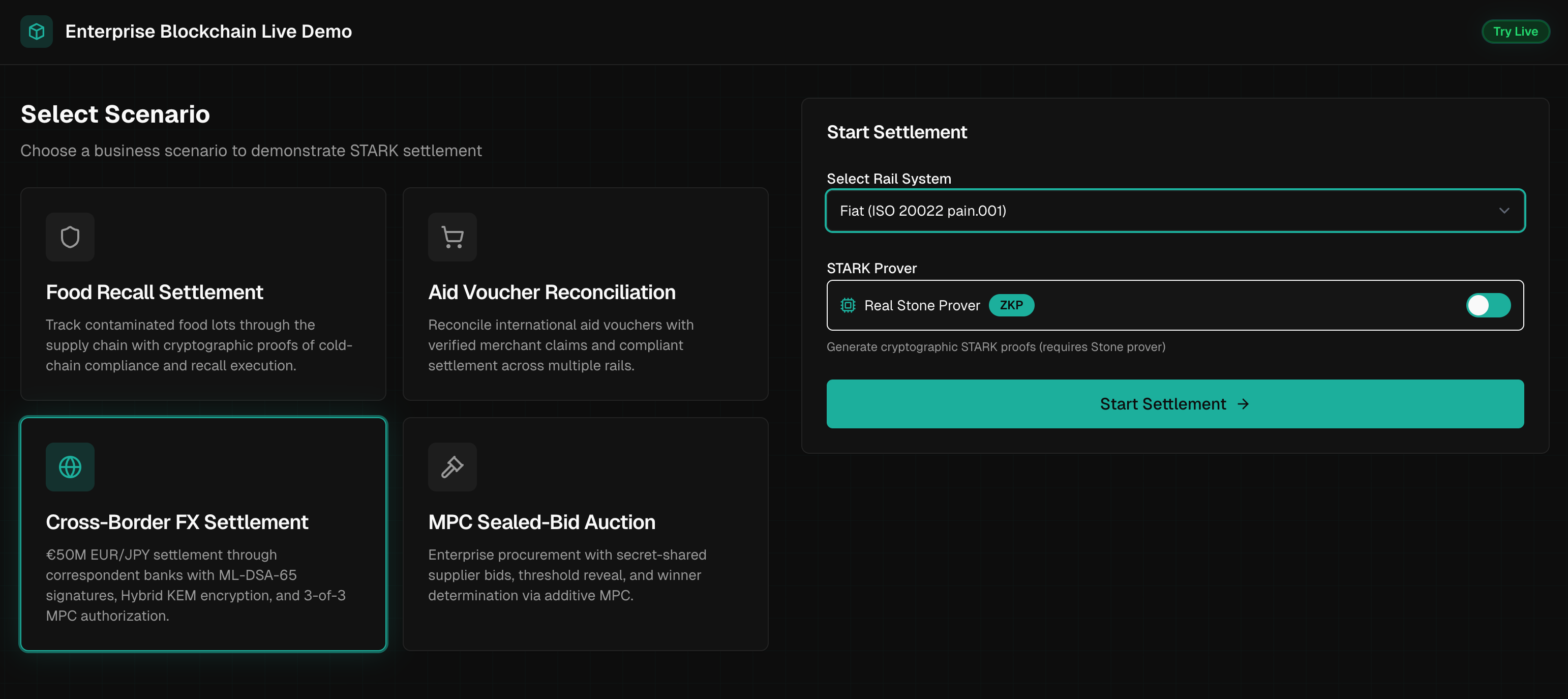
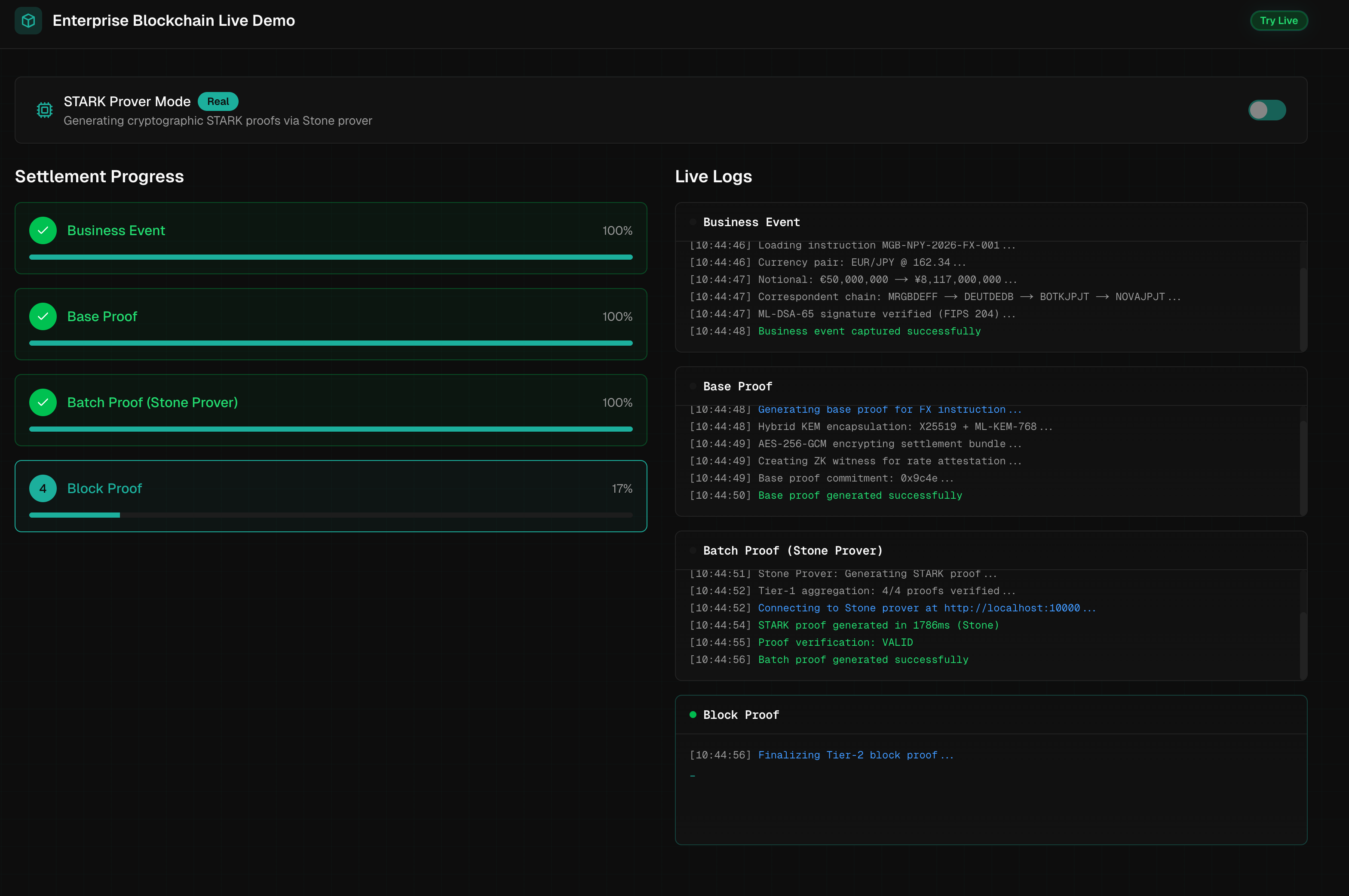
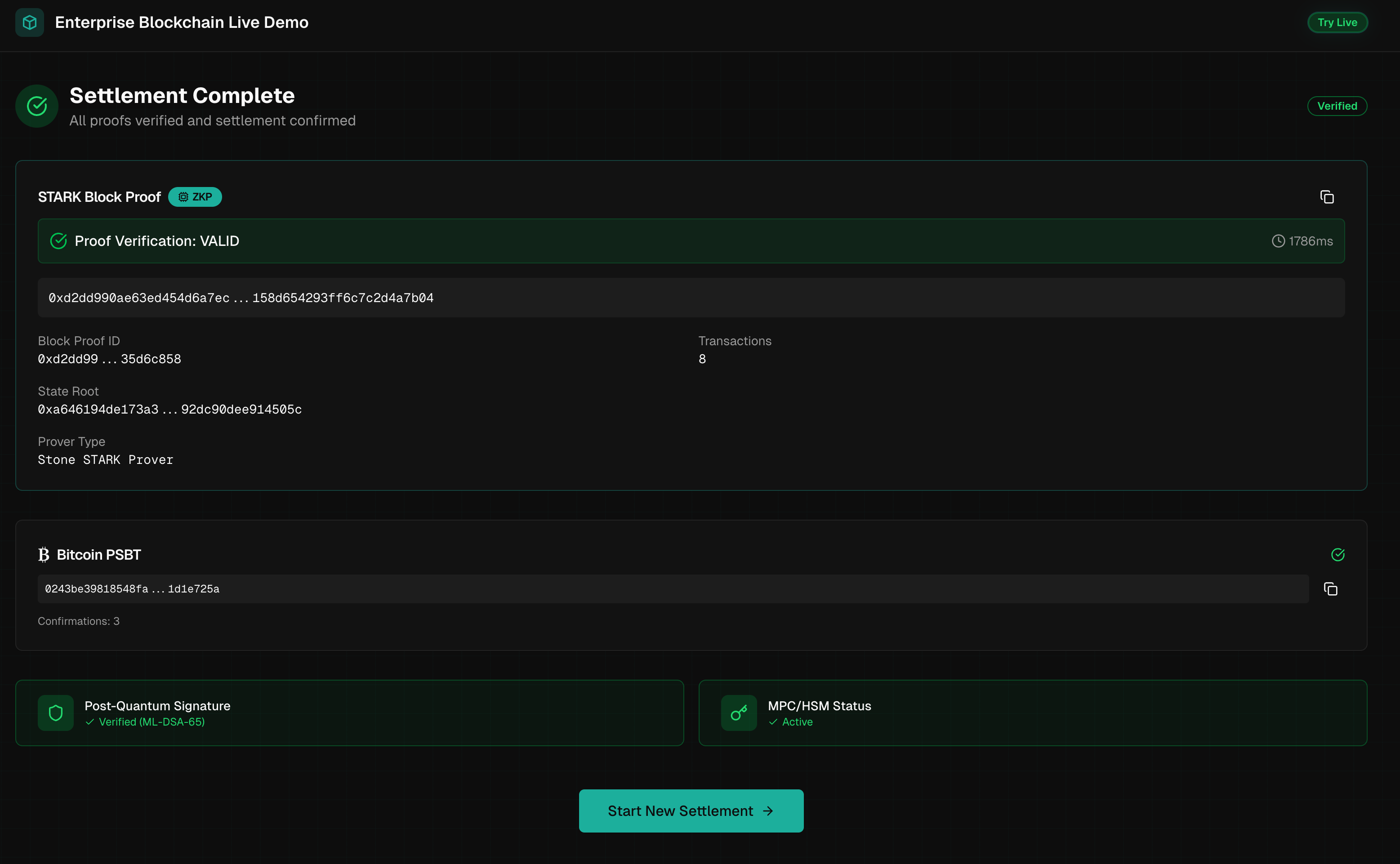
Run the demo:
cd demo
npm install
npm run dev
Open http://localhost:3000 to explore the interactive settlement flow.
For production-grade STARK proofs with the Stone prover, see demo/README.md for Docker setup and full infrastructure mode.
Quick Start
# Clone with submodules (required for Foundry contracts)
git clone --recursive https://github.com/psavelis/enterprise-blockchain.git
cd enterprise-blockchain
Or if already cloned without --recursive:
git submodule update --init --recursive
npm install npm run typecheck npm run test npm run examples npm run demo:adapters npm run demo:integrations
You can also run individual scenarios:
npm run example:food-recall
npm run example:order-sharing
npm run example:staffing-clearance
npm run example:aid-reconciliation
npm run example:fabric-projection
npm run example:besu-projection
npm run example:corda-projection
npm run example:fabric-gateway
npm run example:besu-ethers
npm run example:corda-rest
npm run example:mpc-auction
npm run example:mpc-risk-analysis
npm run example:quantum-key-sharing
npm run example:hsm-tx-signing
npm run example:hsm-key-ceremony
npm run example:hsm-envelope-encryption
npm run example:kyber-kem
npm run example:hybrid-kem
npm run example:quantum-safe-payment
npm run example:quantum-safe-merkle-root-payment
npm run example:stark-settlement
Infrastructure
Local development uses Docker Compose to provision blockchain nodes and observability services.
Quick Start
# Start all services
make up
Run smoke tests
make smoke
View service status
make ps
Stop services
make down
Service Endpoints
| Service | Port | URL | | ------------- | ----- | ---------------------- | | Besu RPC | 8545 | http://localhost:8545 | | Fabric Peer | 7051 | localhost:7051 | | Corda RPC | 10006 | localhost:10006 | | Jaeger UI | 16686 | http://localhost:16686 | | Prometheus | 9090 | http://localhost:9090 | | OTEL Receiver | 4318 | http://localhost:4318 |
Telemetry
Run examples with distributed tracing enabled:
export OTELEXPORTEROTLP_ENDPOINT=http://localhost:4318
export OTELSERVICENAME=my-service
npm run example:food-recall
Traces appear in Jaeger at http://localhost:16686.
Available Make Targets
| Target | Description | | ------------- | ----------------------------- | | make up | Start all blockchain services | | make down | Stop and remove containers | | make smoke | Run smoke tests | | make verify | Run full CI validation | | make logs | Tail logs from all services |
See skills/infrastructure-reference.md for container topology, security hardening, and observability architecture.
Design Goals
- Keep the examples close to operational problems faced by consortiums, regulators, and platform teams.
- Show where blockchain changes system behavior: auditability, provenance, privacy boundaries, and cross-organization coordination.
- Keep the repository small enough to study and structured enough to present.
Protocol Adapters
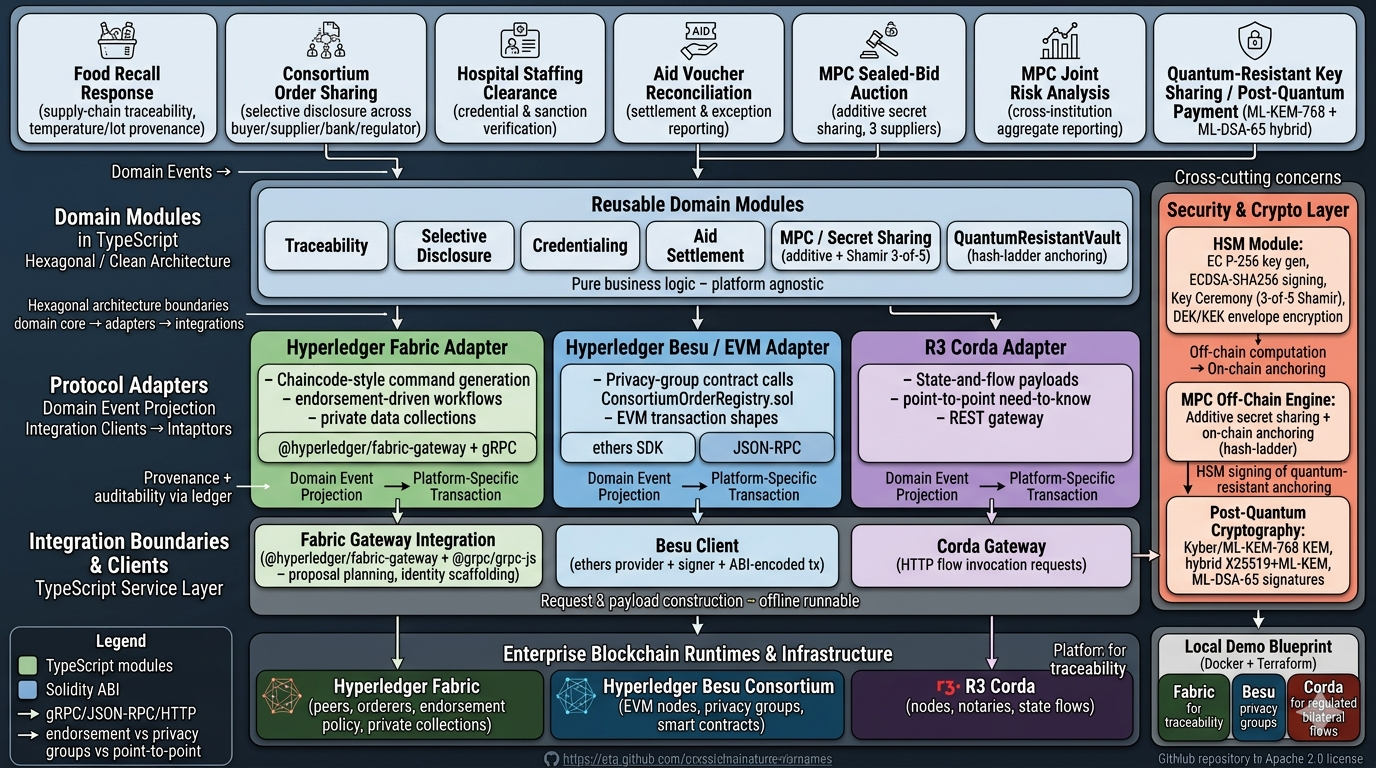
The repository includes protocol adapters that map domain events into platform-specific transaction shapes.
modules/protocols/fabric/: Chaincode-style command generation for endorsement-driven workflows.modules/protocols/besu/: EVM/Besu-style contract call generation for consortium deployments.modules/protocols/corda/: State-and-flow style command generation for point-to-point regulated workflows.
MPC Module
modules/mpc/:MPCEngine(additive secret sharing) andQuantumResistantVault(Shamir threshold sharing, hash-ladder anchoring). MPC operates off-chain; results can be anchored on-chain via the Besu adapter'sanchorOrderpattern, or via a custom transaction in a Fabric chaincode.
Integration Sketches
The repository also includes integration clients and request builders that show how a TypeScript service can move from domain logic to submission boundaries.
modules/integrations/fabric-gateway/: Fabric Gateway-oriented proposal planning and identity scaffolding.modules/integrations/besu-client/:ethers-based transaction encoding for Besu or other EVM-compatible consortium networks.modules/integrations/corda-gateway/: REST-oriented request shaping for Corda-style workflow gateways.
The SDK choices are real:
- Fabric uses
@hyperledger/fabric-gatewayplus@grpc/grpc-js. - Besu uses
etherswith a contract ABI undercontracts/. - Corda is demonstrated through an HTTP gateway boundary, which is the practical TypeScript integration model in most teams.
Documentation
- Research notes live under
docs/research/. - Presentation material lives under
docs/presentation/as a Marp deck. - Architecture and platform guidance live under
docs/architecture/. - Each example folder includes a small scenario brief.
For guided reading and presentation prep, use docs/study-guide.md.
Quality Gates
Enterprise blockchain systems demand correctness guarantees that exceed typical application standards.
Cryptographic operations (MPC additive shares, Shamir threshold reconstruction, ML-KEM encapsulation, ML-DSA signing) produce silent failures when implemented incorrectly—no runtime exception, just compromised security.
Protocol adapters must generate transaction shapes that precisely match Fabric chaincode, Besu contract ABIs, and Corda flow expectations. Hexagonal architecture boundaries prevent infrastructure concerns from leaking into domain logic, preserving testability and protocol portability.
These quality gates enforce reproducibility across every example, maintain architectural invariants, and catch regressions before they reach any environment.
Local Verification Command
Run the full quality gate locally before committing:
npm run verifyThis aliases npm run ci:core, which executes five sequential checks:
npm run format:check && npm run lint && npm run typecheck && npm run test && npm run examples| Step | Script | Tool | Description | | ---- | -------------- | ----------------------------- | ------------------------------------------------------------------------------------------------------ | | 1 | format:check | Prettier | Validates consistent formatting across all source files | | 2 | lint | ESLint + typescript-eslint | Static analysis on modules/, examples/, scripts/, tests/ with --max-warnings=0 | | 3 | typecheck | tsc --noEmit | TypeScript strict mode validation (strict, noUncheckedIndexedAccess, exactOptionalPropertyTypes) | | 4 | test | Node.js native test runner | Executes node --import tsx --test tests/*/.test.ts | | 5 | examples | scripts/run-all-examples.ts | Runs every case study, protocol projection, MPC, HSM, and PQC demonstration |
All five checks must pass. Any failure blocks the pipeline.
CI/CD Enforcement
The GitHub Actions workflow (.github/workflows/ci.yml) runs on every push to main/master and every pull request. It executes four parallel matrix jobs:
- Core validation (
npm run ci:core): Format, lint, typecheck, tests, primary examples - Protocol projections (
npm run ci:protocol-projections): Fabric, Besu, Corda projection entrypoints - Demo scripts (
npm run ci:demos): Adapter and integration client demonstrations - Integration examples (
npm run ci:integration-examples): Fabric Gateway, Besu ethers, Corda REST sketches
npm ci for deterministic installs. PRs receive automated status comments summarizing suite results. The npm run verify command is the single source of truth—passing locally guarantees CI success.
Detailed Quality Criteria
- Formatting & style: Prettier enforces consistent whitespace, trailing commas, and quote style across TypeScript, JSON, and markdown
- Linting: ESLint with
typescript-eslint/recommendedTypeCheckedcatches type-aware issues; zero warnings tolerated - Type safety: TypeScript strict mode with
noUncheckedIndexedAccessandexactOptionalPropertyTypesprevents null/undefined surprises - Testing: Node.js native test runner validates domain logic, application services, and cross-module interactions
- Example execution: Every demonstration script must run to completion without error, proving each pattern remains functional
- Architectural compliance: Domain layers import no infrastructure; adapters implement ports without leaking protocol details; no circular dependencies
- Contribution hygiene: Conventional Commits required; PRs address single concerns; no dead code, unused imports, or commented blocks
Blockchain-Specific Gates
These gates exist because blockchain bugs are expensive and often irreversible:
- MPC correctness: Additive secret sharing and Shamir reconstruction rely on precise field arithmetic—off-by-one errors silently corrupt computations
- Protocol fidelity: Fabric endorsement policies, Besu gas estimation, and Corda flow serialization require exact transaction shapes; malformed payloads fail at network boundaries
- Quantum-resistance invariants: ML-KEM and ML-DSA implementations must preserve ciphertext/signature lengths and decapsulation semantics across refactors
- Selective disclosure properties: Audience projections and audit proof hashes must remain deterministic; any drift breaks cross-party verification
- Traceability chain integrity: Lot anchoring and recall assessment depend on consistent hashing—corrupted state roots propagate through supply chain queries
How to Use
- Before committing: Run
npm run verifylocally. All five checks must pass. - On failure: Fix the issue, re-run
npm run verify. Do not push failing code. - Before opening PR: Confirm
npm run verifypasses. CI will re-validate independently. - During review: Reviewers run
npm run verifyto confirm changes integrate cleanly.
examples/config/. The Besu integration uses a contract ABI under contracts/ (e.g., ConsortiumOrderRegistry.sol and its JSON ABI).
Contributing
See CONTRIBUTING.md for development setup, branch naming, commit conventions, and pull request guidelines.
Security
See SECURITY.md for vulnerability reporting.
License
This project is licensed under the Apache License 2.0. See LICENSE for details.


