
Swift implementation of twitter-text library





This is the Swift implementation of the twitter-text parsing library. The library has methods to parse Tweets and calculate length, validity, parse @mentions, #hashtags, URLs, and more.
Setup
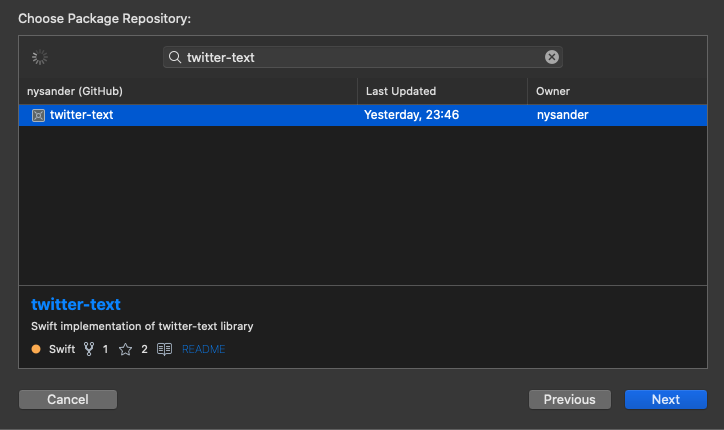
Add twitter-text directly to your Package.swift file:
dependencies: [
    // ...
    .package(url: "https://github.com/nysander/twitter-text.git", from:"0.0.1"),
],
targets: [
.target(name: "Your App", dependencies: [
    /// ...
    .product(name: "twitter-text", package: "twitter-text"),
]),search for https://github.com/nysander/twitter-text.git repository
Conformance tests
To run the Conformance test suite from the command line:
% swift test --enable-test-discoveryYou can also run the tests from within Xcode itself. Open the project file and run the tests are you normally would (Cmd-U).
API
twitter-text 2.0 introduces configuration files that define how Tweets are parsed for length. This allows for backwards compatibility and flexibility going forward. Old-style traditional 140-character parsing is defined by the v1.json configuration file, whereas v2.json is updated for "weighted" Tweets where ranges of Unicode code points can have independent weights aside from the default weight. The sum of all code points, each weighted appropriately, should not exceed the max weighted length.
Some old methods from twitter-text 1.0 have been marked deprecated, such as the various +tweetLength: methods. The new API is based on the following method, -parseTweet:
- TwitterTextParser parseTweet(text:)This method takes a string as input and returns a results object that contains information about the string. TwitterTextParseResults includes:
weightedLength: Int: the overall length of the tweet with code points
permillage: Int: indicates the proportion (per thousand) of the weighted
isValid: Bool: indicates if input text length corresponds to a valid
displayTextRange: NSRange: An array of two unicode code point
displaytextrange here:
Tweet updates
validDisplayTextRange: NSRange: An array of two unicode code point
Issues
Have a bug? Please create an issue here on GitHub!
Authors
Source of inspiration
This library was directly based upon its Objective-C implementation which can be found in twitter/twitter-text repository, written by Satoshi Nakagawa, David LaMacchia and Keh-Li Sheng.
Version 3.1.0 was used as reference. All test case JSON files used in this library are directly copied from said repository to keep consistency and being sure that results are the same.
License
Copyright 2020 Paweł Madej, and other contributors
Licensed under the MIT License


