
Go (Golang) color scales library for maps, charts, data-visualization & creative coding.
colorgrad


Go (Golang) color scales library for data visualization, charts, games, maps, generative art and others.
Support This Project

Index
import "github.com/mazznoer/colorgrad"Custom Gradient
Basic
grad, err := colorgrad.NewGradient().Build()
Custom Colors
grad, err := colorgrad.NewGradient().
    Colors(
        colorgrad.Rgb8(0, 206, 209, 255),
        colorgrad.Rgb8(255, 105, 180, 255),
        colorgrad.Rgb(0.274, 0.5, 0.7, 1),
        colorgrad.Hsv(50, 1, 1, 1),
        colorgrad.Hsv(348, 0.9, 0.8, 1),
    ).
    Build()
Using Web Color Format
HtmlColors() method accepts named colors, hexadecimal (#rgb, #rgba, #rrggbb, #rrggbbaa), rgb(), rgba(), hsl(), hsla(), hwb(), and hsv().
grad, err := colorgrad.NewGradient().
    HtmlColors("#C41189", "#00BFFF", "#FFD700").
    Build()
grad, err := colorgrad.NewGradient().
    HtmlColors("gold", "hotpink", "darkturquoise").
    Build()
grad, err := colorgrad.NewGradient().
    HtmlColors(
        "rgb(125,110,221)",
        "rgb(90%,45%,97%)",
        "hsl(229,79%,85%)",
    ).
    Build()
Domain & Color Position
Default domain is [0..1].
grad, err := colorgrad.NewGradient().
    HtmlColors("deeppink", "gold", "seagreen").
    Build()
Set the domain to [0..100].
grad, err := colorgrad.NewGradient().
    HtmlColors("deeppink", "gold", "seagreen").
    Domain(0, 100).
    Build()
Set the domain to [-1..1].
grad, err := colorgrad.NewGradient().
    HtmlColors("deeppink", "gold", "seagreen").
    Domain(-1, 1).
    Build()
Set exact position for each color. The domain is [0..1].
grad, err := colorgrad.NewGradient().
    HtmlColors("deeppink", "gold", "seagreen").
    Domain(0, 0.7, 1).
    Build()
Set exact position for each color. The domain is [15..80].
grad, err := colorgrad.NewGradient().
    HtmlColors("deeppink", "gold", "seagreen").
    Domain(15, 30, 80).
    Build()
CSS Gradient Format
grad, err := colorgrad.NewGradient().
    Css("deeppink, gold, seagreen").
    Build()
grad, err := colorgrad.NewGradient().
    Css("purple, gold 35%, green 35%, 55%, gold").
    Interpolation(colorgrad.InterpolationCatmullRom).
    Build()
Blending Mode
grad, err := colorgrad.NewGradient().
    HtmlColors("#FFF", "#00F").
    Mode(colorgrad.BlendRgb).
    Build()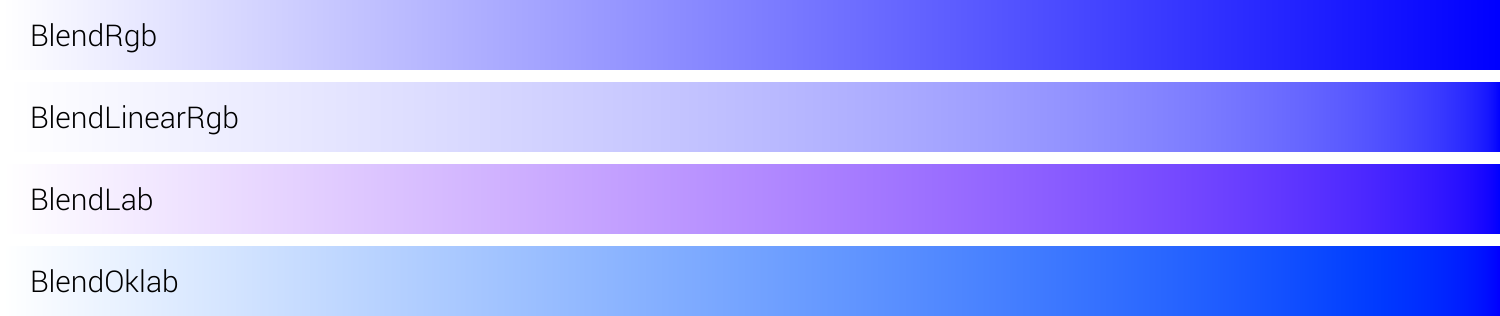
Interpolation Mode
grad, err := colorgrad.NewGradient().
    HtmlColors("#C41189", "#00BFFF", "#FFD700").
    Interpolation(colorgrad.InterpolationLinear).
    Build()
InterpolationLinear 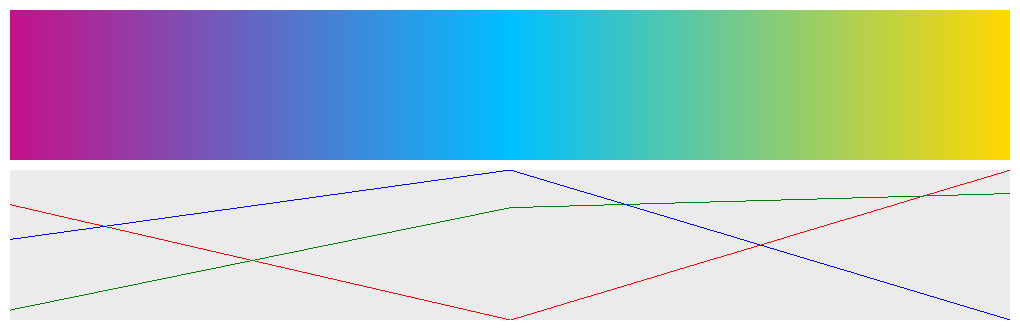
InterpolationSmoothstep 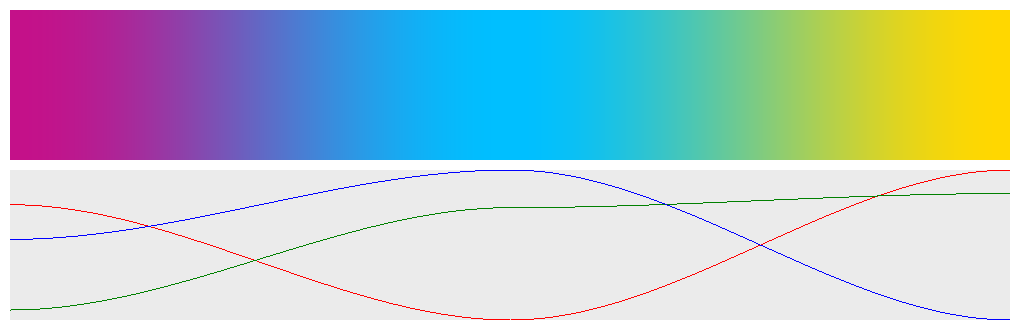
InterpolationCatmullRom 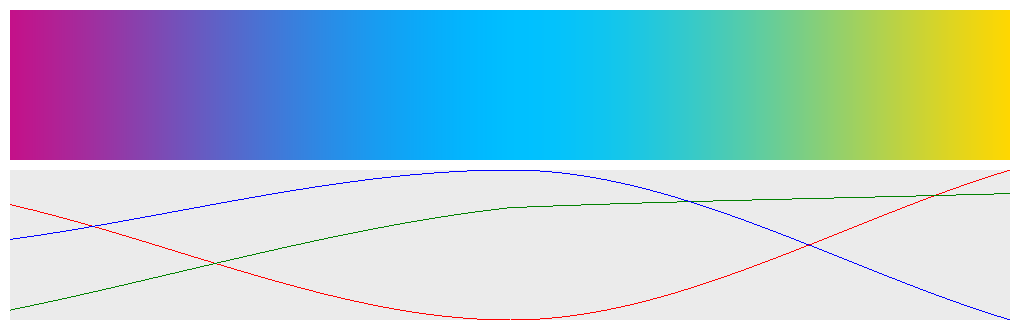
InterpolationBasis 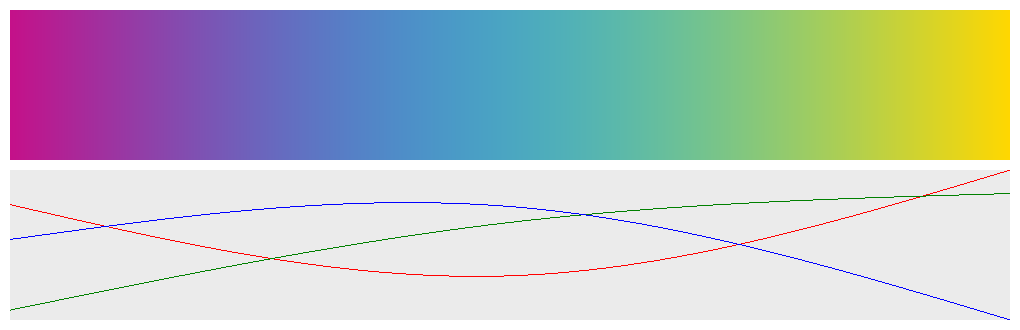
Preset Gradients
See PRESET.md
Parsing GIMP Gradient
import "os"
foreground := colorgrad.Rgb(0, 0, 0, 1) background := colorgrad.Rgb(1, 1, 1, 1) file, err := os.Open("Abstract_1.ggr")
if err != nil { 	panic(err) }
defer file.Close() grad, name, err2 := colorgrad.ParseGgr(file, foreground, background) fmt.Println(name) // Abstract 1

Using the Gradient
Get the domain
grad := colorgrad.Rainbow()
fmt.Println(grad.Domain()) // 0 1
Get single color at certain position
grad := colorgrad.Rainbow()
fmt.Println(grad.At(0.0).HexString()) // #6e40aa fmt.Println(grad.At(0.5).HexString()) // #aff05b fmt.Println(grad.At(1.0).HexString()) // #6e40aa
Get n colors evenly spaced across gradient
grad := colorgrad.Rainbow()
for _, c := range grad.Colors(10) {     fmt.Println(c.HexString()) }
Output:
#6e40aa
#c83dac
#ff5375
#ff8c38
#c9d33a
#7cf659
#5dea8d
#48b8d0
#4775de
#6e40aa
Hard-Edged Gradient
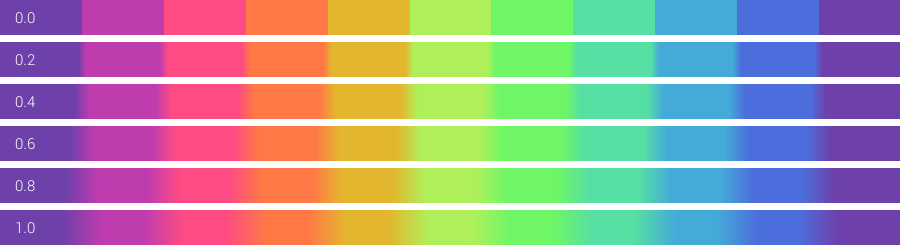
Convert gradient to hard-edged gradient with 11 segments and 0 smoothness.
grad := colorgrad.Rainbow().Sharp(11, 0)
This is the effect of different smoothness.
Examples
Gradient Image
package main
import (     "image"     "image/png"     "os"
"github.com/mazznoer/colorgrad" )
func main() {     grad, _ := colorgrad.NewGradient().         HtmlColors("#C41189", "#00BFFF", "#FFD700").         Build()
w := 1500     h := 70     fw := float64(w)
img := image.NewRGBA(image.Rect(0, 0, w, h))
for x := 0; x < w; x++ {         col := grad.At(float64(x) / fw)         for y := 0; y < h; y++ {             img.Set(x, y, col)         }     }
file, err := os.Create("gradient.png")     if err != nil {         panic(err.Error())     }     defer file.Close()     png.Encode(file, img) }
Example output:
Colored Noise
package main
import (     "image"     "image/png"     "os"
"github.com/mazznoer/colorgrad"     "github.com/ojrac/opensimplex-go" )
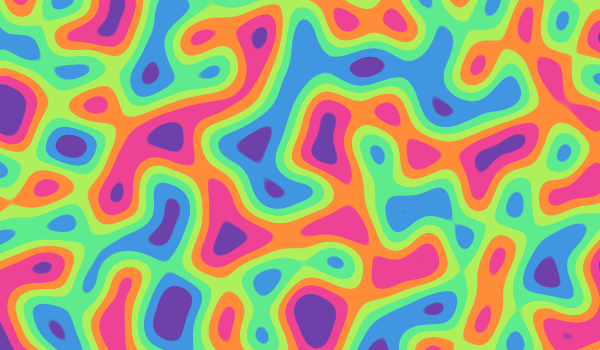
func main() {     w := 600     h := 350     scale := 0.02
grad := colorgrad.Rainbow().Sharp(7, 0.2)     noise := opensimplex.NewNormalized(996)     img := image.NewRGBA(image.Rect(0, 0, w, h))
for y := 0; y < h; y++ {         for x := 0; x < w; x++ {             t := noise.Eval2(float64(x)scale, float64(y)scale)             img.Set(x, y, grad.At(t))         }     }
file, err := os.Create("noise.png")     if err != nil {         panic(err.Error())     }     defer file.Close()     png.Encode(file, img) }
Example output:
Playground
Dependencies
Inspirations
- chroma.js
- d3-scale-chromatic
- colorful's gradientgen.go
Links
- colorgrad-rs - Rust port of this library


