
A sophisticated smart symptom search engine
Last updated Apr 22, 2026
177
Stars
91
Forks
2
Issues
0
Stars/day
Attention Score
58
Topics
Language breakdown
JavaScript 91.4%
Jupyter Notebook 4.7%
Python 2.9%
HTML 0.3%
CSS 0.3%
Shell 0.2%
▸ Files
click to expand
README
Sytora
Sytora is a multilingual symptom-disease classification app. Translation is managed through the UMLS coding standard. A multinomial Naive Bayes classifier is trained on a handpicked dataset, which is freely available under CC4.0.To get started:
- Clone this repo
- Install requirements
- Run the scripts (see below) and npm dependencies
- Get a UMLS license to download UMLS lexica & generate DB (umls.sh)
- Run and check http://localhost:5001
- Done! :tada:
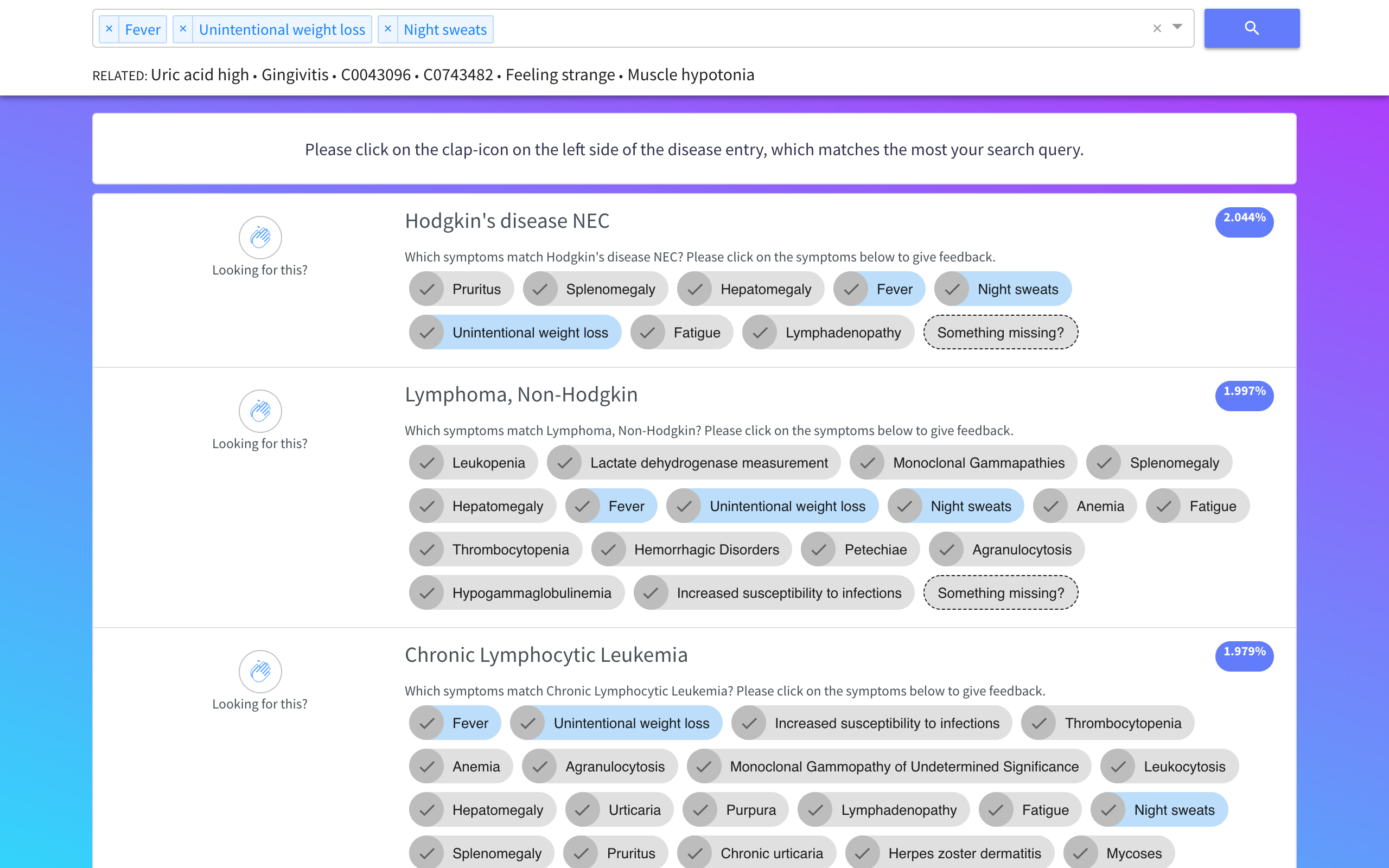
Check out sytora.com for a demo.
Motivation
Finding the right diagnosis cannot be achieved by extracting symptoms and running a classification algorithm. The hardest part is asking the right questions, focusing what is important in the situation, connecting other events, and much more. Despite all this, I have long been exited about writing a symptom-disease lookup system to quickly gather related symptoms to symptoms etc. Not everything the model outputs is nonsense. Actually it helps a lot to quickly get a list of diseases given to a set of symptoms.Data
The data is formatted as CSV files. Example entry:Disease,Symptom
C0162565,C0039239Data sources:
DiseaseSymptomKB.csv: extracted from Disease-Symptom Knowledge Database. This data solely belongs to the respective authors. The authors are not not affiliated with this project.disease-symptom.csv: Manually created by hand. Freely available under CC 4.0.
Install
Training models & generating files from data:- Run
cui2vec-converter.pyto convert to GloVe-format. You need to get the pretrained embeddings first, available here: https://figshare.com/s/00d69861786cd0156d81. Place them in the data folder. - Run
generateLabels.pyto create the option labels for the select fields. Languages are currently hardcoded as list and can be extended if needed. - Run
train.pyto train a MNB classifier (for the disease prediction). Other necessary files are generated, too. - Run
relatedSymptoms.pyto train the model for the autosuggestion feature. This uses cui2vec. Please note that the authors of cui2vec are not affiliated with this code.
flaskapp and npm install. For development npm run watch, for production npm run build.
Flask Service
A small flask app is avaiable to showcase the trained models. cd into theflaskapp folder and start the app
python app.pyDeployment
Make sure to exportREACTAPPENDPOINT with the correct address (e.g. http://yoursite.com)
Get going in ~10 min:
sudo apt update sudo apt install python3-pip python3-dev build-essential libssl-dev libffi-dev python3-setuptools sudo apt install python-pip python-dev sudo apt install nodejs npm pip install flask pandas sklearn numpy pip install Flask-Limiter flask-expects-json pip install more-itertools requests configparser sudo apt-get install nginx supervisor
git clone https://github.com/leanderme/sytora cd sytora/flaskapp && npm i
vi /etc/supervisor/conf.d/sytora.conf sudo supervisorctl reread sudo service supervisor restart sudo supervisorctl status
sudo vim /etc/nginx/conf.d/virtual.conf sudo nginx -t sudo service nginx restart
sytora.conf:
[program:sytora] directory=/root/sytora/flaskapp command=gunicorn app:app -b 0.0.0.0:5001 autostart=true autorestart=true stderr_logfile=/var/log/sytora/sytora.err.log stdout_logfile=/var/log/sytora/sytora.out.logvirtual.conf
server {     listen       80;     server_name  site.com;
location / {         proxy_pass http://127.0.0.1:8000;     } }
don't forget to transfer the umls.db, e.g. scp ./umls.db root@address:/root/sytora/flaskapp/umls/database
Coding quality, security & stability
This project was written very quickly with no performance or stability features in mind; the code base suffered accordingly. Expect things to be cleaned up soon though.Please note that I'm a machine learning hobbyist and a medical student. The code may not in accordance with common conventions.
Acknowledgements
This project is heavily inspired by:- https://github.com/Aniruddha-Tapas/Predicting-Diseases-From-Symptoms
- https://github.com/sekharvth/symptom-disease


