High Performance TCP/UDP/HTTP Communication Component

High Performance Network Framework
Description
- Server Based on IOCP/EPOLL communication model, combined with technology of memory pool, private heap etc., efficient memory management is implemented to support large scale and high concurrent communication scenarios.
- Agent The Agent component is essentially a Multi-Client component that uses the same technical architecture as the Server component. An Agent component object can create and efficiently handle large-scale Socket connections at the same time.
- Client Based on Event-Select/POLL communication model, each component object creates a communication thread and manages a Socket connection. Client components are suitable for small-scale client scenarios.
Document
- HP-Socket Development Guide
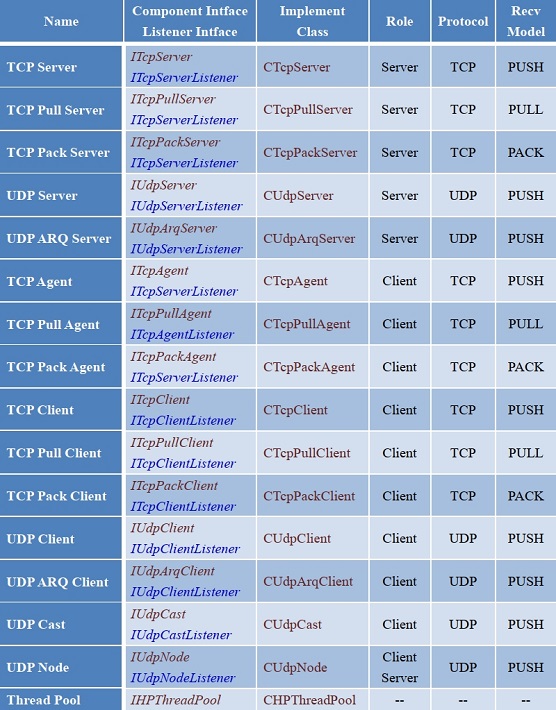
- HP-Socket Class Diagram
- HP-Socket Class Diagram
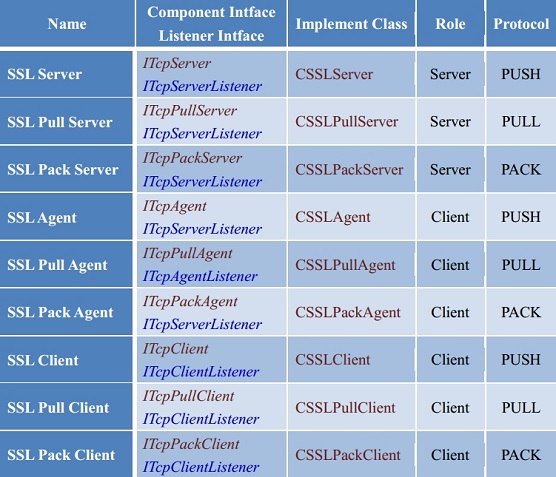
- HP-Socket SSL Class Diagram
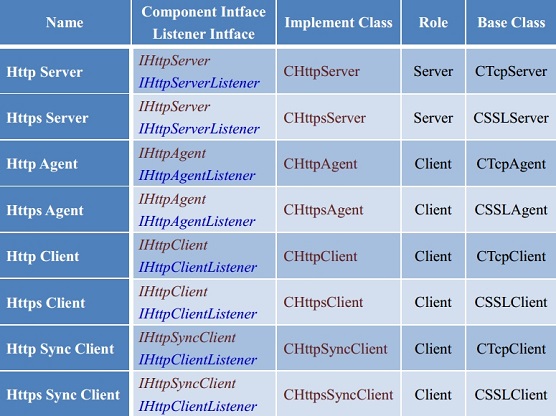
- HP-Socket HTTP Class Diagram
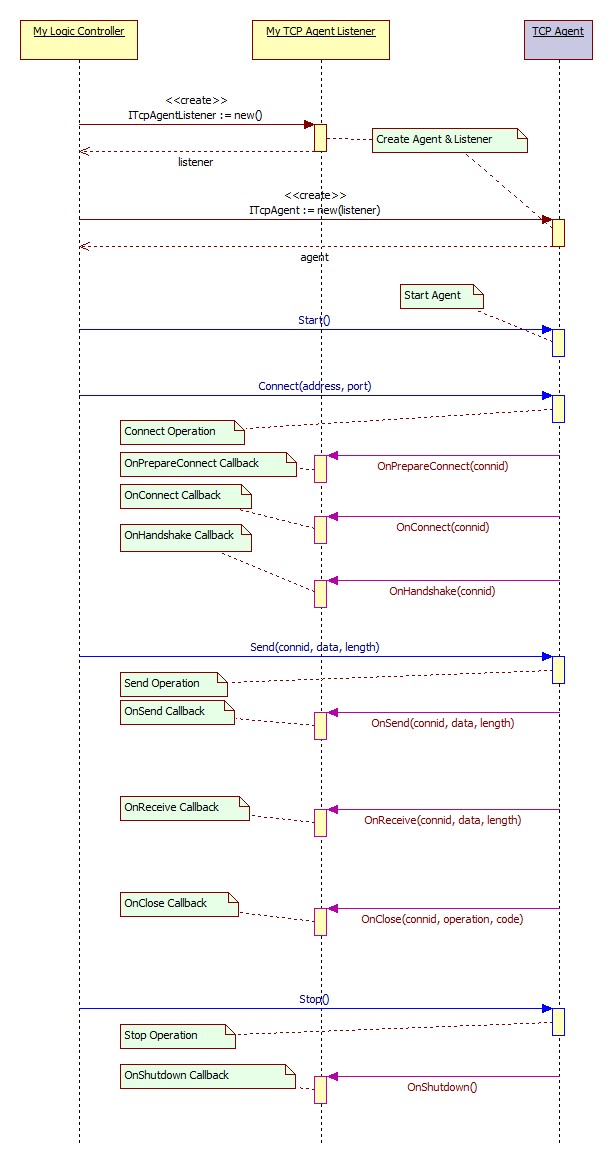
Workflow
- Create listener object
- Create component object (and binding with listener object)
- Start component object
- Connect to dest host (for Agent Component only)
- process network events (OnConnect/OnReceive/OnClose etc.)
- Stop component object (optional: component object will be stopped before destroy in step 7)
- Destroy component object
- Destroy listener object
Example
- C++ Example
C++ #include <hpsocket/HPSocket.h>
/ Listener Class / class CListenerImpl : public CTcpPullServerListener {
public: 	// 5. process network events 	virtual EnHandleResult OnPrepareListen(ITcpServer* pSender, SOCKET soListen); 	virtual EnHandleResult OnAccept(ITcpServer* pSender, CONNID dwConnID, UINT_PTR soClient); 	virtual EnHandleResult OnHandShake(ITcpServer* pSender, CONNID dwConnID); 	virtual EnHandleResult OnReceive(ITcpServer* pSender, CONNID dwConnID, int iLength); 	virtual EnHandleResult OnSend(ITcpServer pSender, CONNID dwConnID, const BYTE pData, int iLength); 	virtual EnHandleResult OnClose(ITcpServer* pSender, CONNID dwConnID, EnSocketOperation enOperation, int iErrorCode); 	virtual EnHandleResult OnShutdown(ITcpServer* pSender); };
int main(int argc, char* const argv[]) { 	// 1. Create listener object 	CListenerImpl s_listener; 	// 2. Create component object (and binding with listener object) 	CTcpPullServerPtr spserver(&slistener); 	 	// 3. Start component object 	if(!s_pserver->Start("0.0.0.0", 5555)) 		exit(1); 	 	/ wait for exit / 	// ... ...  	 	// 6. (optional) Stop component object 	s_pserver->Stop();
return 0; 	 	// 7. Destroy component object automatically 	// 8. Destroy listener object automatically }
- C Example
C
#include <hpsocket/HPSocket4C.h>
// 5. process network events EnHandleResult _HPCALL OnConnect(HPAgent pSender, HPCONNID dwConnID); EnHandleResult _HPCALL OnReceive(HPAgent pSender, HPCONNID dwConnID, int iLength); EnHandleResult _HPCALL OnSend(HPAgent pSender, HPCONNID dwConnID, const BYTE* pData, int iLength); EnHandleResult _HPCALL OnClose(HPAgent pSender, HPCONNID dwConnID, EnHPSocketOperation enOperation, int iErrorCode); EnHandleResult _HPCALL OnShutdown(HP_Agent pSender);
int main(int argc, char* const argv[]) { 	HPTcpPullAgentListener slistener; 	HPTcpPullAgent sagent;
// 1. Create listener object 	slistener = ::CreateHP_TcpPullAgentListener(); 	// 2. Create component object (and binding with listener object) 	sagent    = ::CreateHPTcpPullAgent(slistener); 	 	/ Set listener callbacks / 	::HPSetFNAgentOnConnect(s_listener, OnConnect); 	::HPSetFNAgentOnSend(s_listener, OnSend); 	::HPSetFNAgentOnPullReceive(s_listener, OnReceive); 	::HPSetFNAgentOnClose(s_listener, OnClose); 	::HPSetFNAgentOnShutdown(s_listener, OnShutdown); 	 	// 3. Start component object 	if(!::HPAgentStart(s_agent, "0.0.0.0", TRUE)) 		exit(1); 	 	// 4. Connect to dest host 	::HPAgentConnect(sagent, REMOTEHOST1, REMOTEPORT_1, nullptr); 	::HPAgentConnect(sagent, REMOTEHOST2, REMOTEPORT_2, nullptr); 	::HPAgentConnect(sagent, REMOTEHOST3, REMOTEPORT_3, nullptr); 	 	/ wait for exit / 	// ... ...  	 	// 6. (optional) Stop component object 	::HPAgentStop(s_agent);
// 7. Destroy component object 	::DestroyHPTcpPullAgent(s_agent); 	// 8. Destroy listener object 	::DestroyHPTcpPullAgentListener(s_listener); 	 	return 0; }
Component List
- Basic Components
- SSL Components
- HTTP Components