
Adaptive Kalman filter in Golang
Last updated Apr 28, 2026
98
Stars
25
Forks
0
Issues
0
Stars/day
Attention Score
16
Language breakdown
No language data available.
▸ Files
click to expand
README
Adaptive Kalman filtering in Golang


get github.com/konimarti/kalman- Adaptive Kalman filtering with Rapid Ongoing Stochastic covariance Estimation (ROSE)
- A helpful introduction to how Kalman filters work, can be found here.
- Kalman filters are based on a state-space representation of linear, time-invariant systems:
x(t+1) = Ad x(t) + Bd u(t)y(t) = C x(t) + D u(t)Using the standard Kalman filter
// create filter
	filter := kalman.NewFilter(
		lti.Discrete{
			Ad, // prediction matrix (n x n)
			Bd, // control matrix (n x k)
			C,  // measurement matrix (l x n)
			D,  // measurement matrix (l x k)
		},
		kalman.Noise{
			Q, // process model covariance matrix (n x n)
			R, // measurement errors (l x l)
		},
	)
// create context 	ctx := kalman.Context{ 		X, // initial state (n x 1) 		P, // initial process covariance (n x n) 	}
// get measurement (l x 1) and control (k x 1) vectors 	..
// apply filter 	filteredMeasurement := filter.Apply(&ctx, measurement, control) }
Results with standard Kalman filter
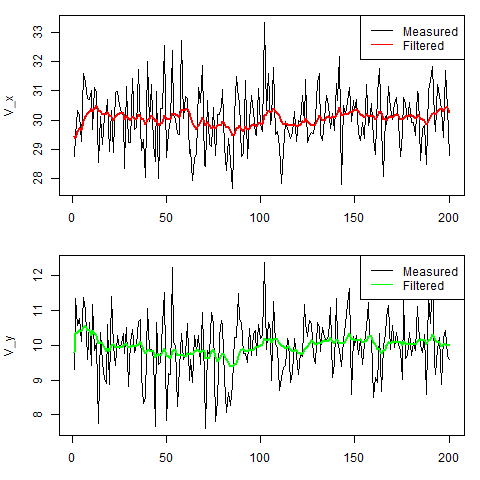
See example here.
Results with Rapid Ongoing Stochasic covariance Estimation (ROSE) filter
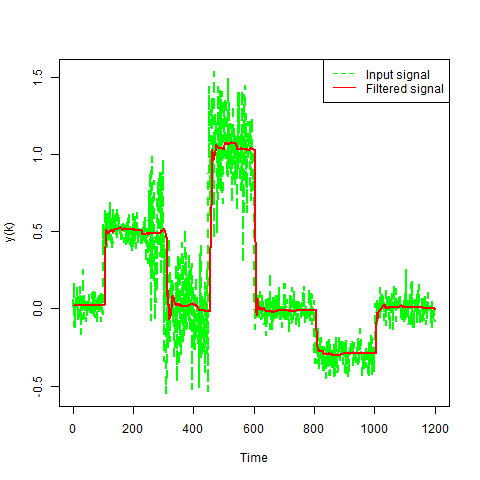
See example here.
Math behind the Kalman filter
- Calculation of the Kalman gain and the correction of the state vector ~x(k) and covariance matrix ~P(k):
^y(k)  = C  ^x(k) + D  u(k)
	dy(k)  = y(k) - ^y(k)
	K(k) = ^P(k)  C^T  ( C  ^P(k)  C^T + R(k) )^(-1)
	~x(k) = ^x(k) + K(k) * dy(k)
~P(k) = ( I - K(k) C) ^P(k)- Then the next step is predicted for the state ^x(k+1) and the covariance ^P(k+1):
^x(k+1) = Ad  ~x(k) + Bd  u(k)
	^P(k+1) = Ad  ~P(k)  Ad^T + Gd  Q(k)  Gd^T
Credits
This software package has been developed for and is in production at Kalkfabrik Netstal.


