this is my repository for the quick draw prediction model project
quick,draw! prediction model
this is my repository for the quick draw prediction model project last updated: 11/20/2017Repo Instructions
python folder:
- contains 3 python files
- Jupyter notebook that runs python codes above. note that there is no data stored in this repo.
- jpeg images used in this readme markdown file.
Introduction:
Google Quickdraw released dataset that contains over 50 million drawings on 5/18/2017. the google quickdraw is an online pictionary game application where...
- user is asked to draw a picture of certain category in 20 seconds
- While user draws a picture, google AI will try to predict what user is drawing
- If google AI predicts what user is drawing, user wins!
- repeat 1-3 6 times.
- XGBoost ensemble method model
- Convolusional Neural Network model
Results
I made 4-way classifier prediction models for both image recognition and country prediction (Total of 4 models). model Accuracy| | image recognition | Country prediction | |:--------------: | :------------------:|:----------------------:| | CNN model | 90.2% | 62.7% | | XGBoost model | 79.1% | 43.8% |
Results of image recognition
Example1: Cat Drawing1 

Example2: Cat Drawing2 
 For image recognition, both CNN and XGBoost models had high prediction accuracy. Since CNN model looks into pixels and XGBoost model looks into features that I calculated, features are engineered differently for each model (meaning models analyze images completely differently). Therefore, they make quite different predictions. For instance, check out Example2 above.
Results of Country prediction
Example1: Dog Drawing from Brasil

For Country prediction, models had lower accuracy than ones from image recognition. The important features from XGboost model indicates that users' country can be identified based on
- amount of information (details) exist within an image
- how fast/slow did users draw their images
- direction of first few strokes
- X,Y ratio of images
Data used:
the dataset that google released contains images and several features related to image. Features include drawing_ID, category(what quickdraw asked to draw), timestamp, whether AI guessed correct or not, user's country and drawing. drawing is represented as a list of list of list. The drawing feature is a list of strokes and stroke is a list of X,Y and time (3 lists within a stroke) the stroke information contains 2 additional dimensions: | typical image | Quickdraw data | |:--------------: | :-----------------:| | 3D (X,Y,color ) | 4D(X,Y,time,stroke)| | a drawing | how user drew a drawing| from this input dataset, I collected image data of CAT, TIGER, LION, DOG for image recognition part of my project. for country preiction part of my project I selected 4 countries: United States, BRASIL, RUSSIA and SOUTH KOREA. I used these 4 countries because these 4 countries had good number of images and they also do not share same alphabet/language. My initial guess was that the way people draw is closely related to how people write.other info:
Image recognition:
- used 120,000 drawings
- drawings were selected randomly
- used total of 31,276 drawings from US, Brasil, Russia and South Korea
- drawings were filtered by country and selected randomly
- drawings consists of cat, tiger, lion and dog.
MODELS
Filters applied to both models
all drawing used in training- were recognized by Google AI correctly
- contains 15 or less strokes
- has final time that is 20000ms or less
- has X and Y ratio where range of Y / range of X =< 1.5
country prediction: [US, BR, RU, KR]
1. XGBOOST
Ran codes that creates 399 new features. Features include: + average number of datapoints per stroke + total time spent on drawing + time per stroke + direction (in radian) of particular stroke + stroke number of the stroke with most data points etc. etc. etc. image recognition model: (maxdepth=1, nestimators=5000, learning_rate=0.25) Highest accuracy (6/27/2017): 79.1222222222 percent country prediction model: (maxdepth=1, nestimators=1000, learning_rate=0.2) Highest accuracy (6/27/2017): 43.7979539642 percent2. Convolusion Neural Network Model
the code I have for CNN applies filtering above and reformat each image into 42 pixel(Y) by 28 pixel(X) format. After this process, my CNN data has 1176 columns per image.CNN structure
- 64 convolusion layers with kernel size 5 by 5
- max pooling layer with pooling size 2 by 2
- 1 layer of feed forward neural network with 100 neurons
- 20% dropout rate was assigned to prevent overfitting
- final activation function = softmax
- 4 output neurons
Keras parameters and codes:
from keras.models import Sequential from keras.layers import Dense, Dropout, Activation, Flatten from keras.layers import Convolution2D, MaxPooling2D from keras.layers.convolutional import ZeroPadding2D from keras.utils import np_utils from keras.models import load_model
model = Sequential() model.add(Convolution2D(64, 5, 5, activation='relu', input_shape=(42,28,1))) model.add(MaxPooling2D(pool_size=(2,2))) model.add(Flatten()) model.add(Dense(100, activation='relu')) model.add(Dropout(.20)) model.add(Dense(4, activation='softmax'))
model.compile(loss='meansquarederror', optimizer='adam',metrics=['accuracy'])
model.fit(Xtrain, ytrain, batchsize=128, nbepoch=30, verbose=1,validation_split=0.2)
image recognition model: (batch_size = 128, epoch = 20) Highest accuracy (6/27/2017): 90.21666666666667 percent country prediction model: (batch_size = 128, epoch = 30) Highest accuracy (6/27/2017): 62.7050053121 percent
Findings:
From XGBoost model's feature importance attributes, found some interesting results about image recognition and country prediction.Image recognition:
The model distinguished images based on how much datapoints exist in first 3 strokes. In other words, the model looked for amount of details that exist within first 3 strokes. Also 4 types of images were distinguishable based on the starting point of drawing and X:Y ratio of image. It looked on direction (slope and direction) of stroke. Somehow, direction of stroke 6 was important when distinguishing cat, tiger, lion and dog drawings.XGBoost model's top10 most important features for image recognition: 1. Ymax 2. datapointpercentagestroke1 3. datapointpercentagestroke2 4. X_0 5. direction_stroke6 6. datapointpercentagestroke0 7. direction_stroke1 8. direction_stroke2 9. totaltimedrawing 10. Y_0
Country prediction:
In order to distinguish user's country, my XGBoost model looked on certain characteristics of images.- amount of information (details) exist within an image
- how fast/slow did users draw their images
- direction of first few strokes
- X,Y ratio of images
XGBoost model's top10 most important features for country prediction: 1. totalnumberof_datapoints 2. time_stroke0 3. direction_stroke2 4. X_0 5. time_1 6. avedatapointsper_stroke 7. direction_stroke0 8. direction_stroke3 9. final_time 10. Ymax all features on this list had above 1% feature importance
What's next?
- work on XGboost model with more pictures and countries.
- dimensionality reduction for ensemble method models. determine useless features and delete them.
- Organize and write cleaner code.
- I wonder what would happen if I add one more convolution layers and pooling layers after my first pooling layer.
Other:
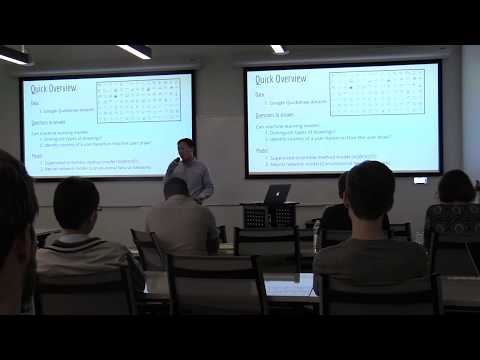
project presentation video DSI capstone project showcase Galvanize Austin 6/22/2017