
Ancestral Sequence Reconstruction in Python
PyASR
Ancestral Sequence Reconstruction in Python
PyASR offers a modern Python interface to PAML ("Phylogenetic Analysis by Maximum Likelihood")--tuned specifically for reconstruction ancestral protein/DNA sequences.
NOTE: PyASR currently only supports protein reconstructions. This is a work in progress.
Basic Usage
import phylopandas as pd
import dendropy as d
import pyasr
Use phylopandas to read a set of ancestor.s
dfseqs = pd.readfasta('test.fasta')
Use dendropy to read in tree.
tree = d.Tree.get(path='tree.newick', schema='newick')
Reconstruct nodes in tree.
tree, dfseqs, dfanc = pyasr.reconstruct(dfseqs, tree, workingdir='test', alpha=1.235)
Write out ancestor dataframe to a CSV file.
dfanc.tocsv('ancestors.csv')
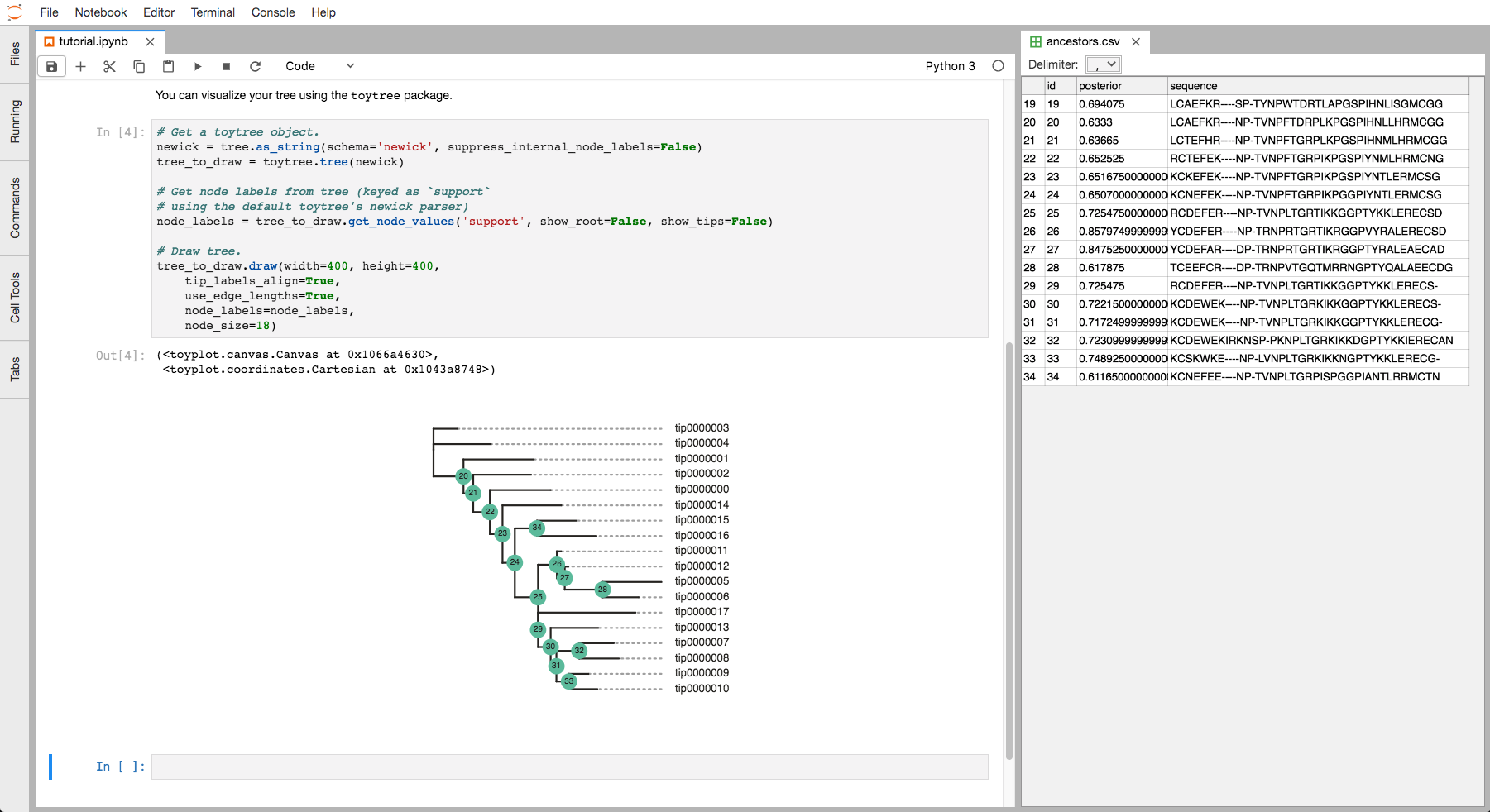
We can visualize the ancestors side-by-side with the tree using inside of JupyterLab thanks to the ToyTree library.
Install
This package is released on PyPi. You can install using pip:
pip install pyasrTo get the development version:
git clone cd pip install -e .Dependencies
The actual reconstruction calculation are done using PAML. This requires PAML to be installed and the codeml/baseml executables exported to your $PATH environment variable. Directions for installing PAML can be found on the PAML website.
The following Python dependencies are required for PyASR to work.
- Pandas
- Biopython
- PhyloPandas
- DendroPy


