
Road to Azure Data Engineer Part-II: DP-201 - Designing an Azure Data Solution
Azure-Certification-DP-201: Designing an Azure Data Solution
Various modules and percentage involved in DP-201.
Exam Pattern
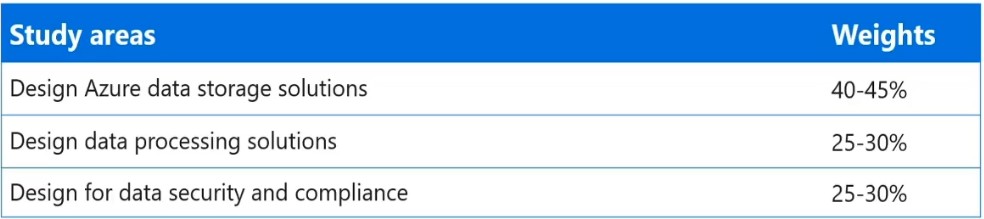
1. Design Azure Data Storage Solutions (40-45%)
- Recommend an Azure data storage solution based on requiremnets
- Design non-relational cloud data stores
- Design relational cloud data stores
2. Design Data Processing Solutions (25-30%)
- Design batch processing solutions
- Design real-time processing solutions
3. Design for Data Security and Compliance (25-30%)
- Design security for source data access
- Design security for data policies and standards
Pillars of Azure Architecture
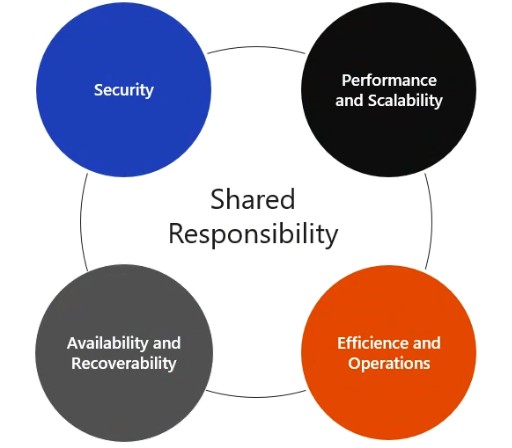
Design for Performance and Scalability
- Scaling
- Performance
- Patterns and Practices
Design for Availability and Recoverability
- Availabilty
- Recoverability
1. Design Azure Data Storage Solutions
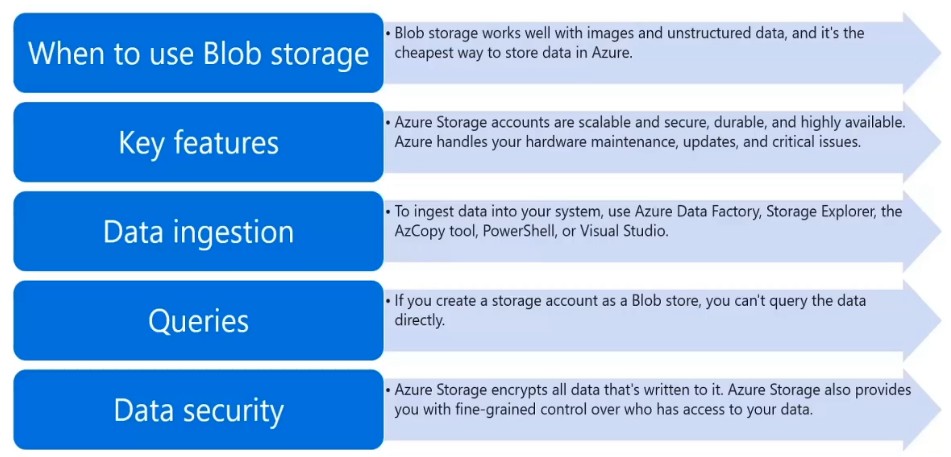
Azure Storage
BLOB
- It is also a backbone for creating a storage account that can be used as a Data Lake storage
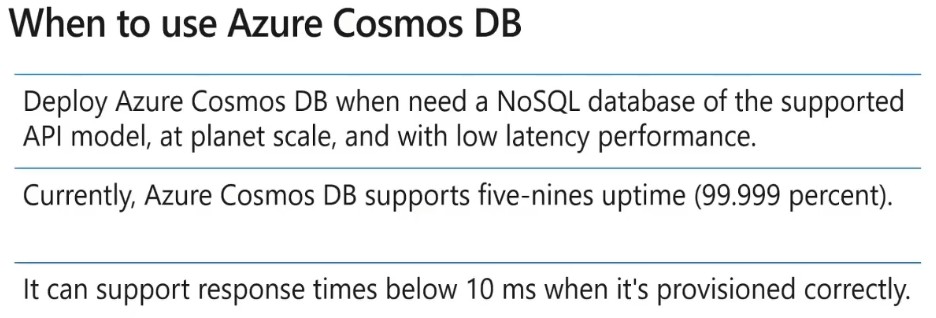
CosmosDB
- Globally distributed and elstically scalable database.
i) Core (SQL) API
- Default API for Azure Cosmos DB
- Can query heirarchical JSON documents with a SQL-like language
- Uses Javascript's type system, expression evaluation, and function invocation.
ii) MongoDB API
- Allows existing MongoDB client SDKs, drivers, and tools to interact with the data transparently, as if they are running against an actual MongoDB database.
- Data is stored in document format, similar to Core (SQL)
iii) Cassandra API
- Using Cassandra Query language (CQL), the data will appear to be a partitioned row store.
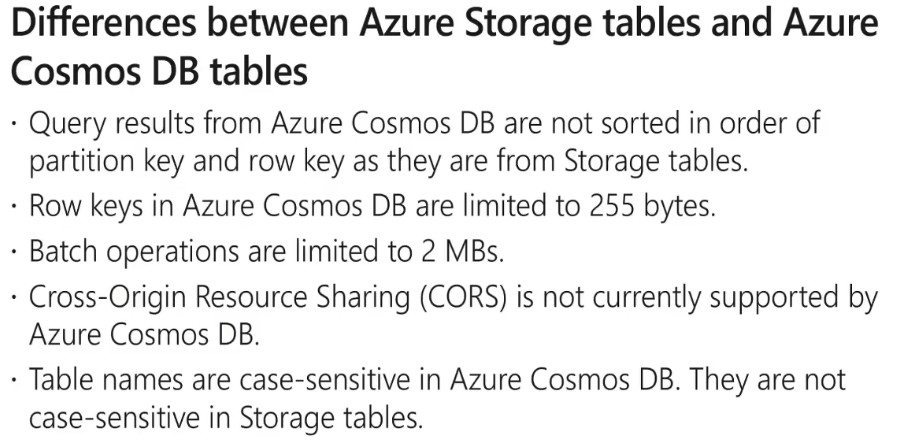
iv) Table API
- The original table API only allows for indexing on the partition and row keys; there are no secondary indexes.
- Storing table data in Cosmos DB automatically indexes all the properties, requires no index management.
- Querying is accomplished by using OData and LINQ queries in code, and the original REST API for GET operations.
v) Gremlin API
- Provides a graph based view over the data. Remember that at the lowest level, all data in any Azure Cosmos DB is stored in an ARS format.
- Use a traversal language to query a graph database, and Azure Cosmos DB supports Apache Tinkepop's Gremlin language.
Analyze the storage decision criteria
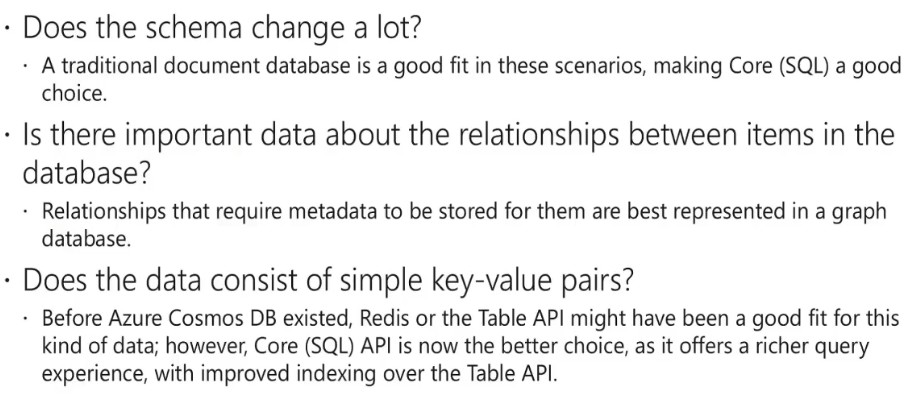
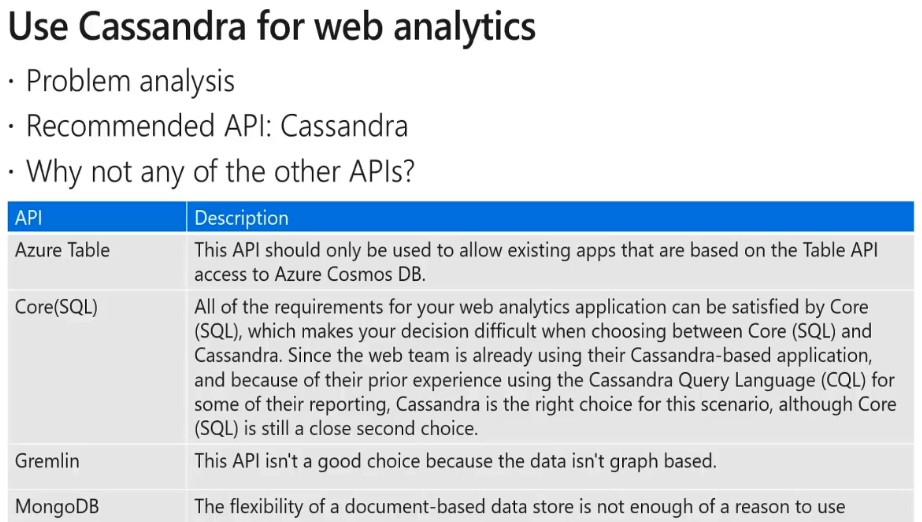
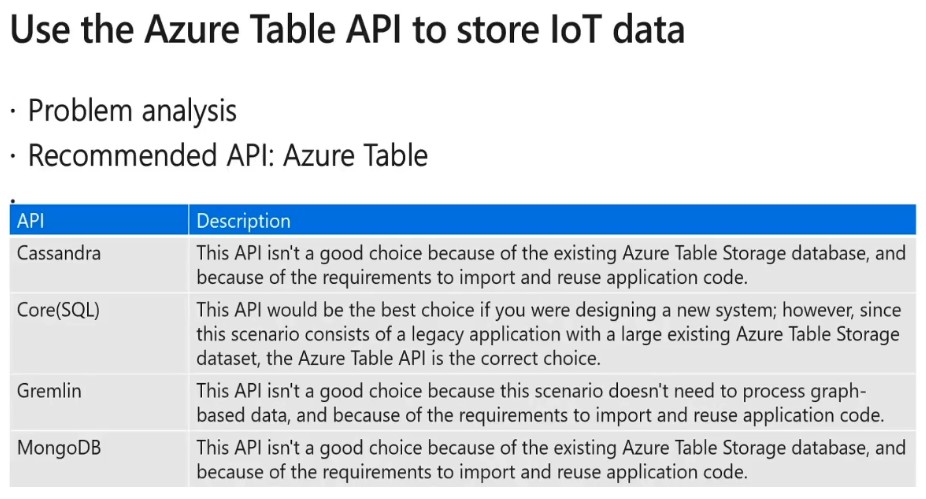
Scenario's to choose different CosmosDB API's
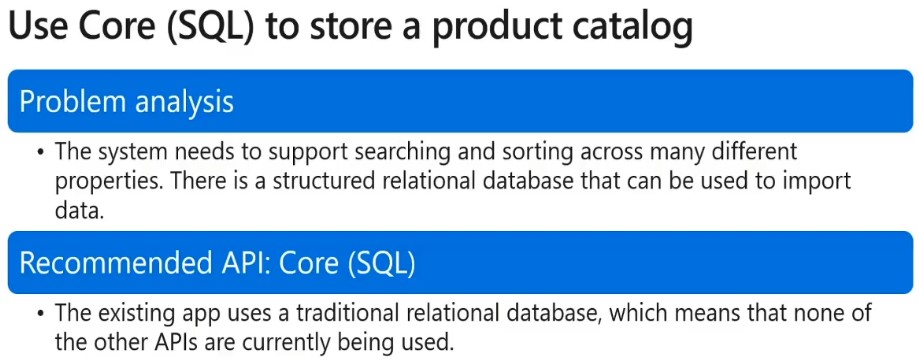
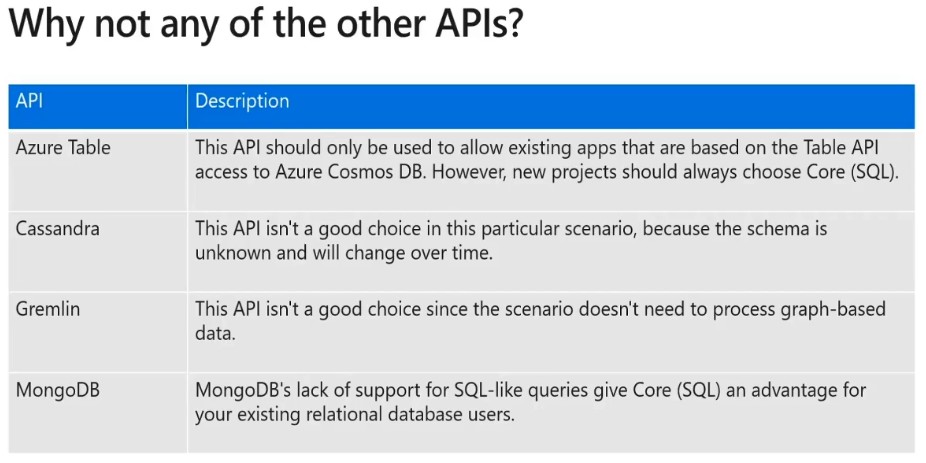
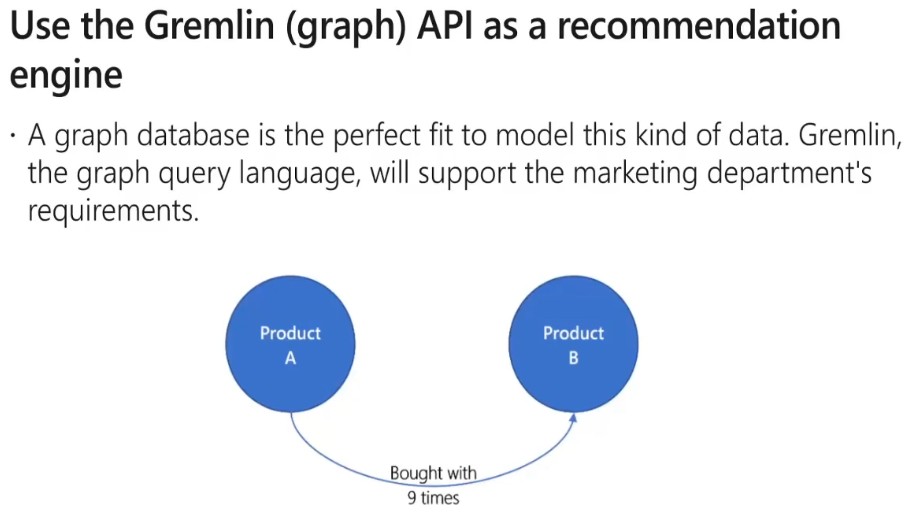
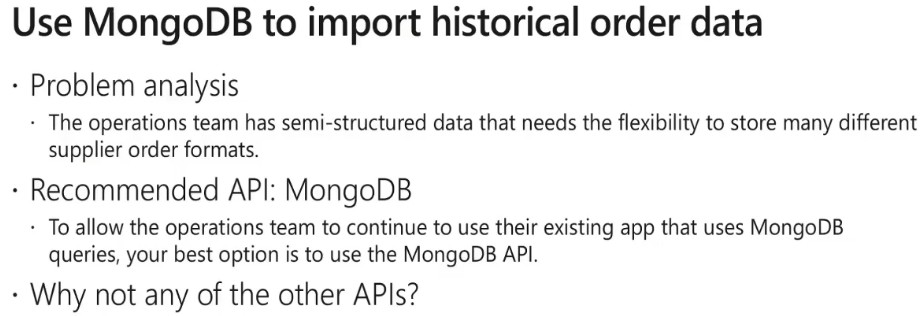
- We are not looking into any relationships so Gremlin is not the right choice - Other CosmosDB API's are not used since the existing queries are MongoDB native and there MongoDB is the best fit
Request Unit Considerations for CosmosDB
- Item size
- Item indexing
- Item property count
- Indexed properties
- Data consistency
- Query patterns
- Script usage
CosmosDB Partition Design
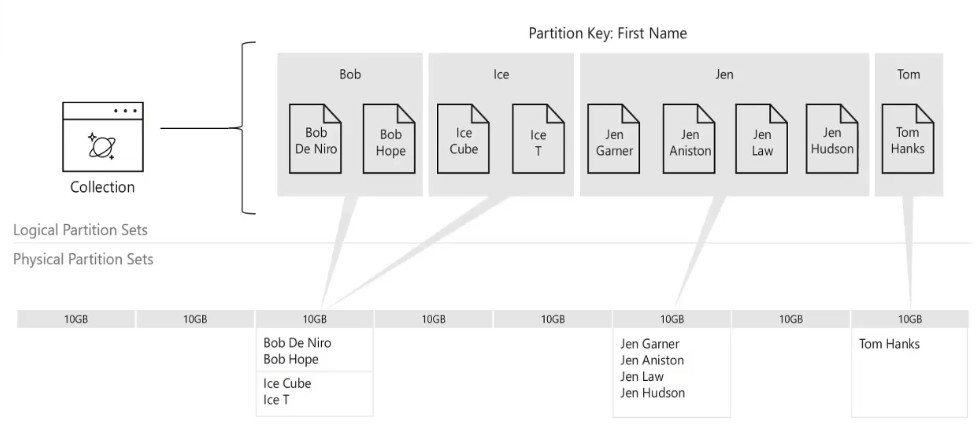
- Items are placed into logical partitions by partition key
- Partition keys should generally be based on unique values
- Ideally the partition key should be part of a query to prevent "fan out"
- Logical partitions are mapped to physiccal partitions
- A physical partition always contains atleast one logical partition
- Physical partitions are capped at 10GB
- As physical partitions fill-up they will seamlessly split
- Logical partitions can not be split
Cosmos DB Change Feed feature
- Enables you to build efficient and scalable solutions for each of the patterns shown below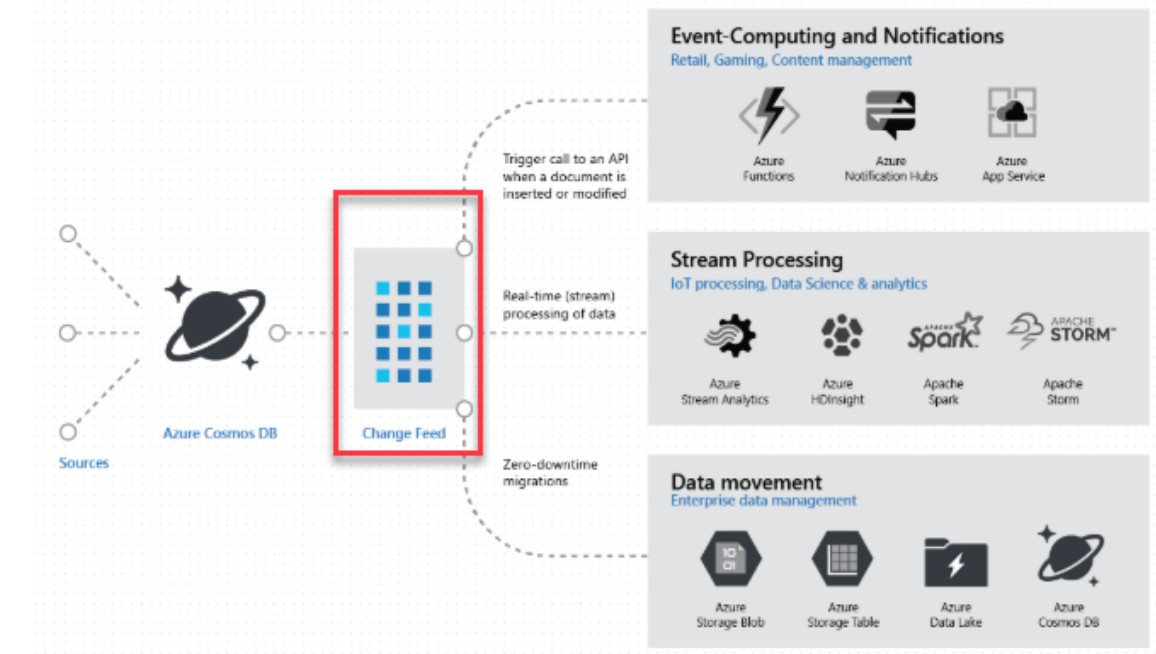
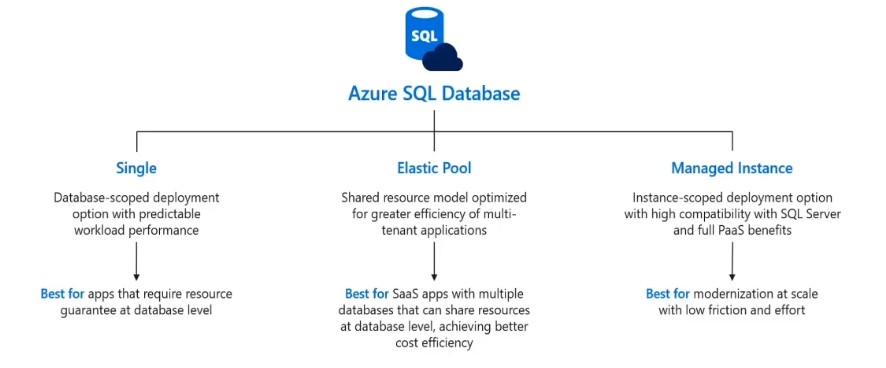
Azure SQL Database hosting options
SQL Security
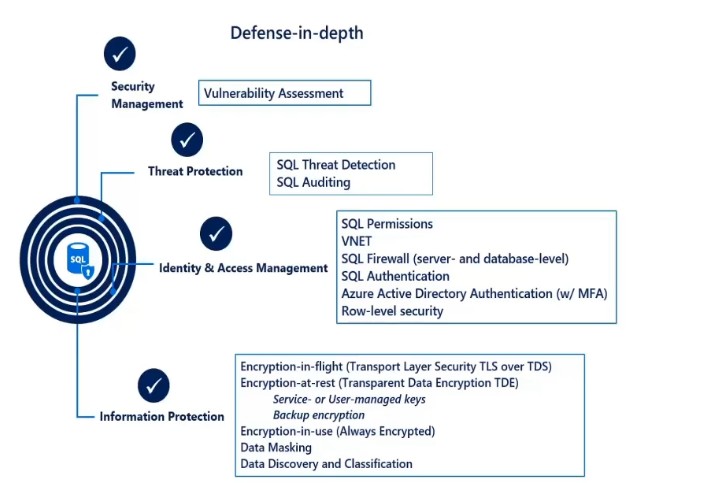
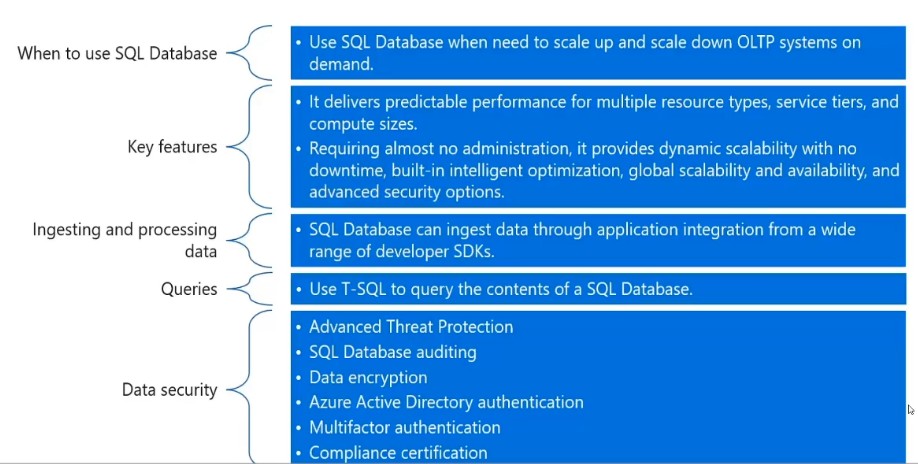
Scenario to choose Azure SQL
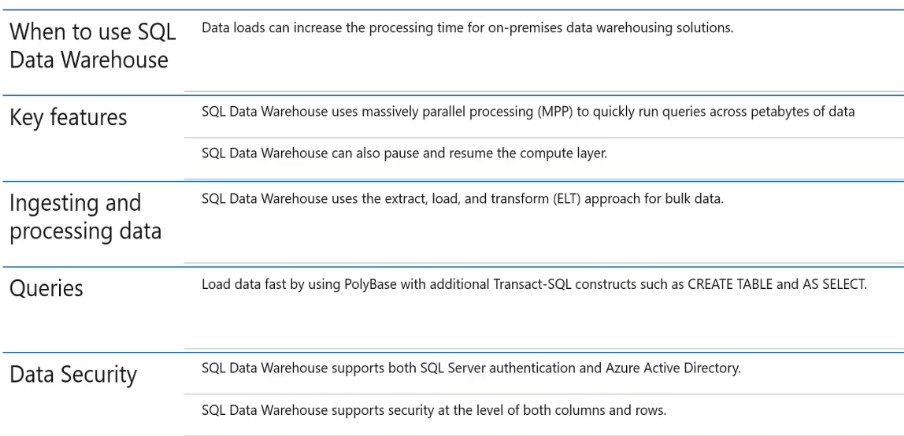
Scenario to choose Azure Synapse
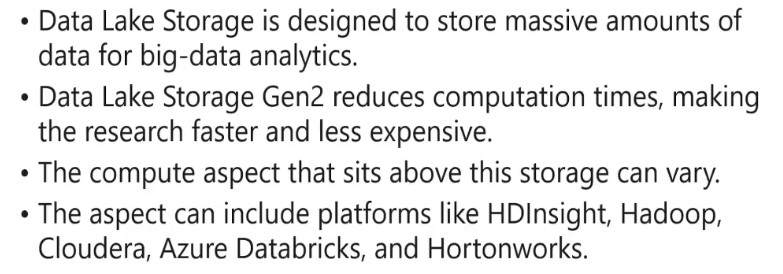
Scenario to choose Azure Data Lake Storage Gen2
Azure Stream Analytics
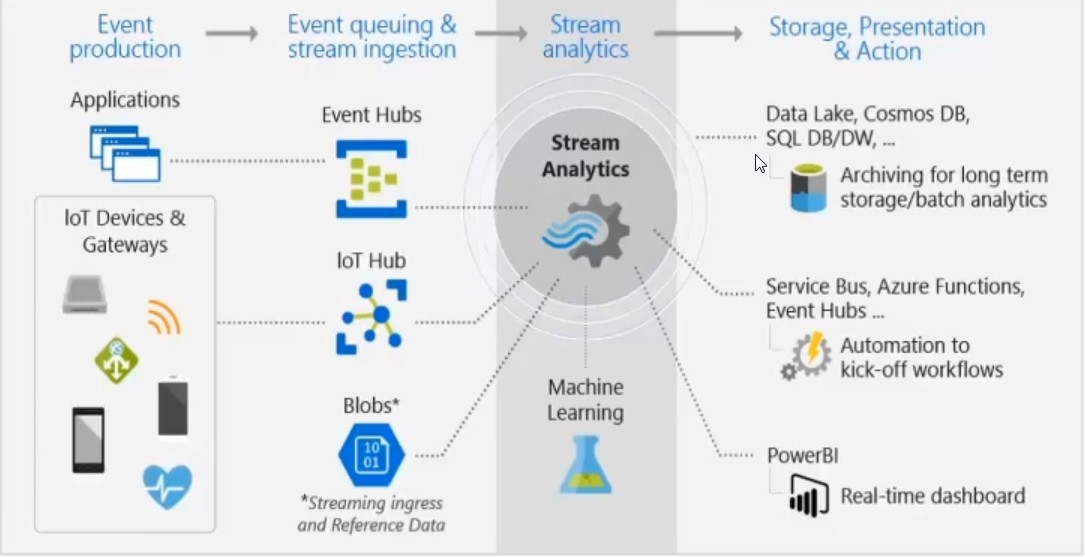
Scenario to choose Stream Analytics
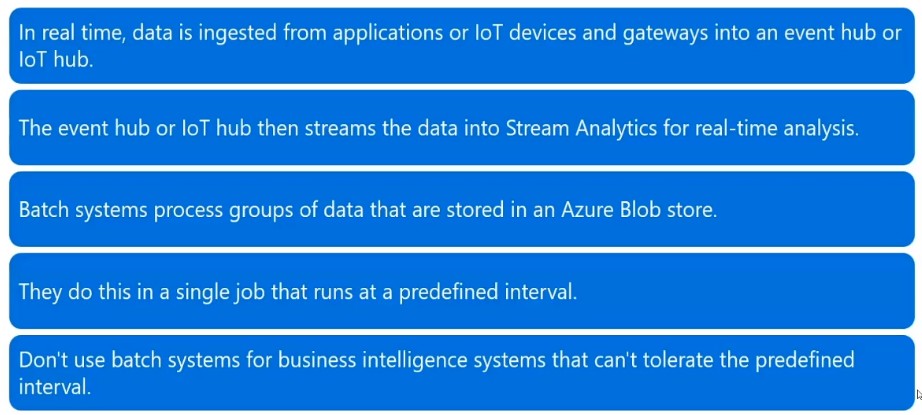
2. Design Data Processing Solutions
Components of Big Data architecture
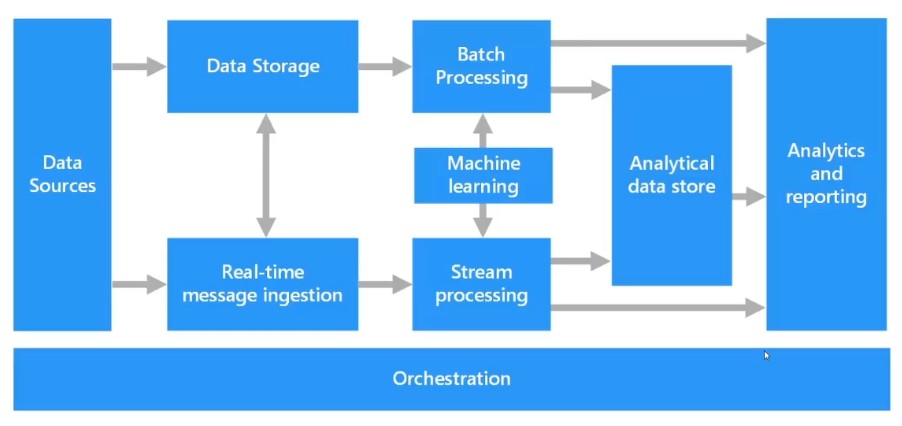
Lambda Architecture
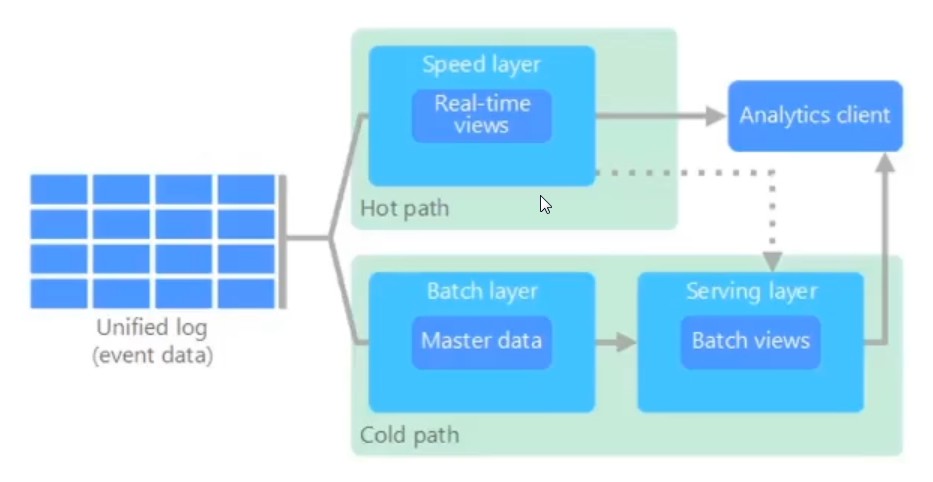
- When working with very large data sets, it can take a long time to run the sort of queries that clients need.
- Often require algorithms such as Spark/ Mapreduce that operate in parallel across the entire data set.
- The results are then stored seperately from the raw data and used for querying.
- Drawback to this approach is that it intoduces latency
- Batch layer (cold path)
- Speed layer (hot path)
Kappa Architecture
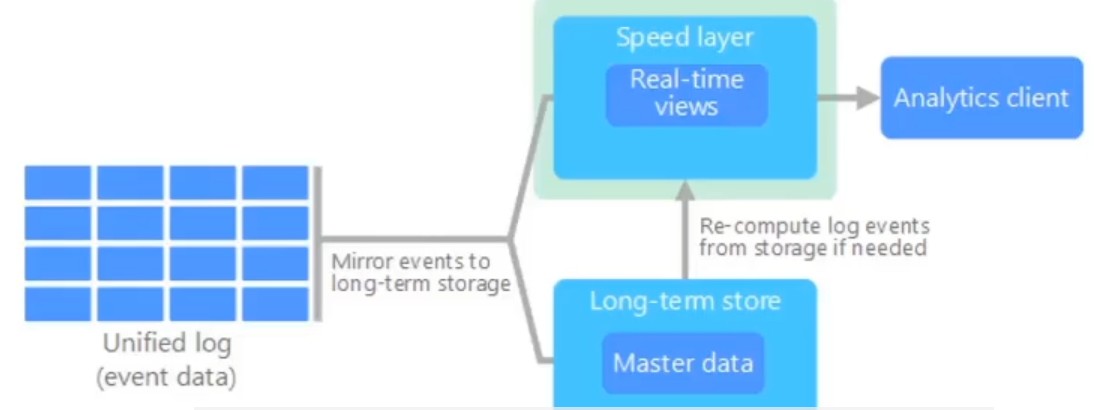
- A drawback to the lambda architecture is its complexity.
- Processign logic appears in two different places - the cold and hot paths - using different frameworks
- This leads to duplicate computation logic and the complexity of managing the architecture for both paths.
- The kappa architecture was proposed by Jay Kreps as an alternative to the lambda architecture.
- All data flows through a single path, using a stream processing system.
IOT
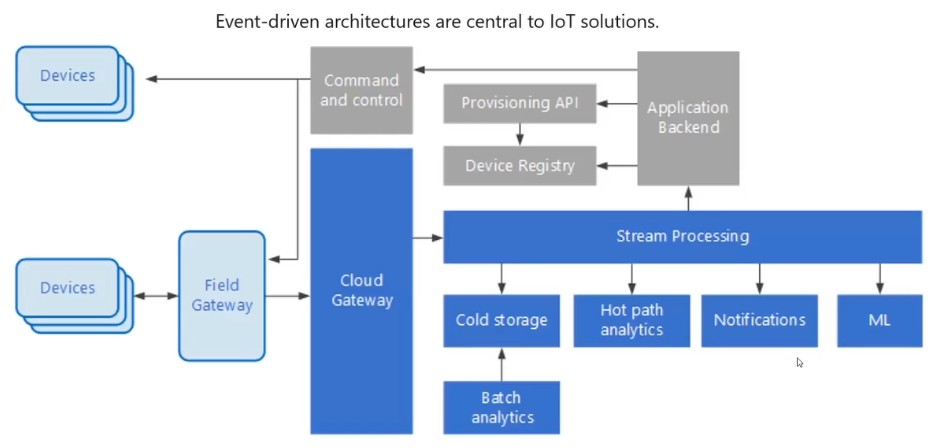
Azure IOT Reference Architecture
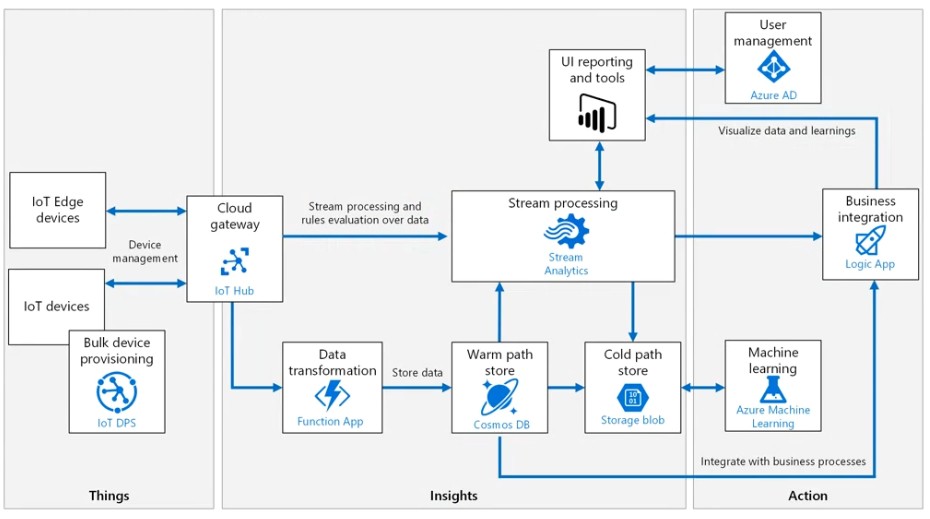
IOT Edge devices: Devices cannot be constantly connected to the cloud in this case IOT edge devices contian some processing analysis logic within it. So that there is no constant dependency for the cloud.
- eg: Shipment containers
Cloud Gateway (IOT Hub): Provides a cloud for a device to connect securely to the cloud and send data. It acts a message broker between the devices and the other azure services.
Batch Processing
Scenario's to use Batch Processing
- From simple data transformations to a more complete ETL (extract-transform-load) pipeline
- In a big data context, batch processing may operate over very large data sets, where the computation takes significant time.
- One example of batch processing is transforming a large set of flat, semi-structured CSV or JSON files into a schematized and structured format that is ready for further querying.
Design considerations for Batch processing
- Data format and encoding
- Orchestrating time slices
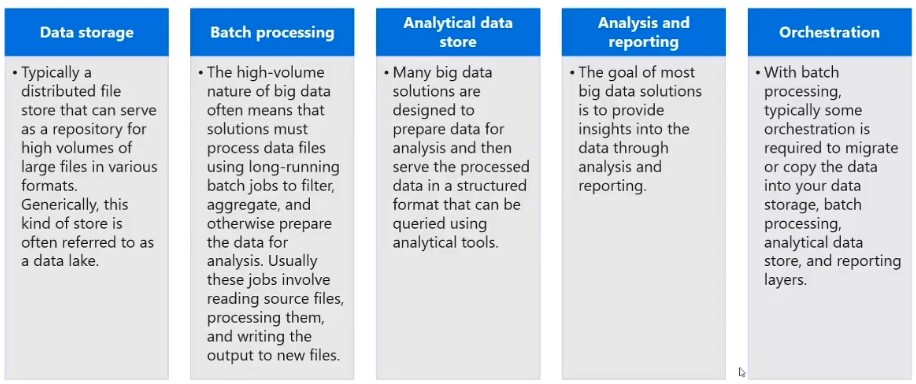
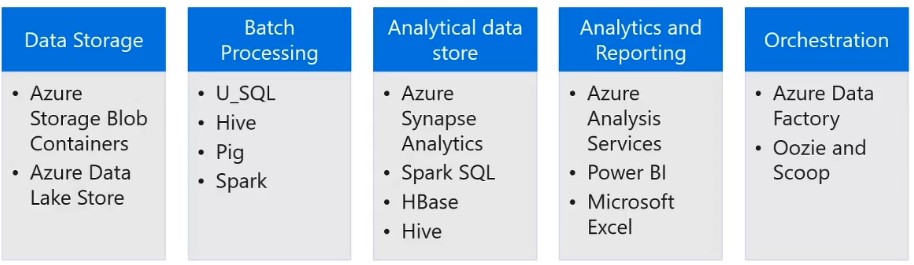
Batch processing Logical components
Batch processing Techmology choices
Batch processing with Azure Databricks
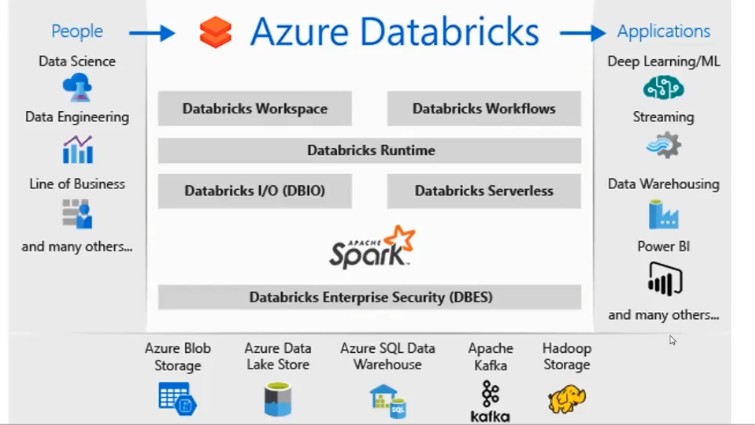
- Fast cluster start times, autotermination, autoscaling
- Built-in integration with Azure Blob Storage, ADLS, Azure Synapse, and other services.
- User authentication with Azure Active Directory.
- Web-based notebooks for collaboration and data exploration.
- Supports GPU-rnabled clusters.
Usage of Azure Databricks
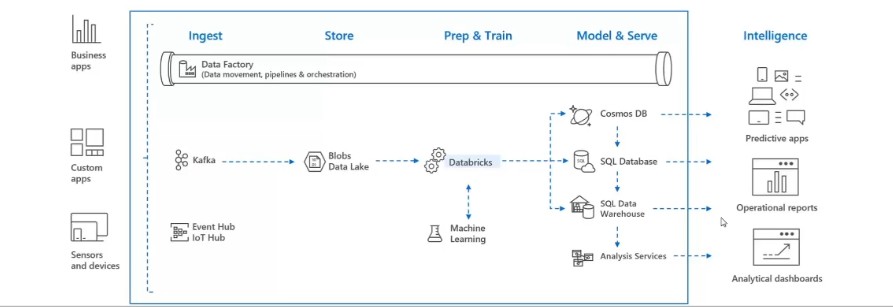
- To read data from multiple data sources such as Azure Blob Storage, ADLS, Azure Cosmos DB, or SQL DW and turn it into breakthrough insights using spark.
Azure Machine Learning
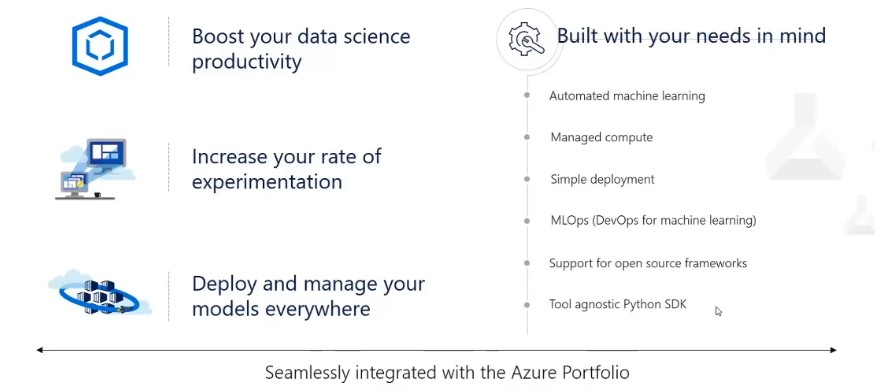
Machine Learning Typical E2E process
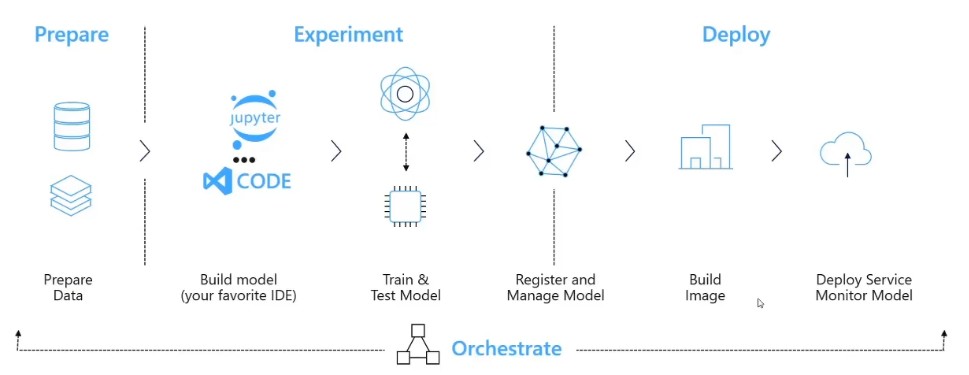
Devops Loop for Data Science
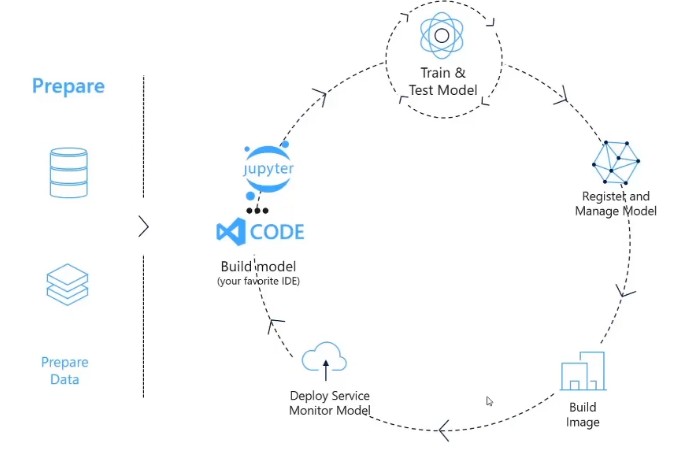
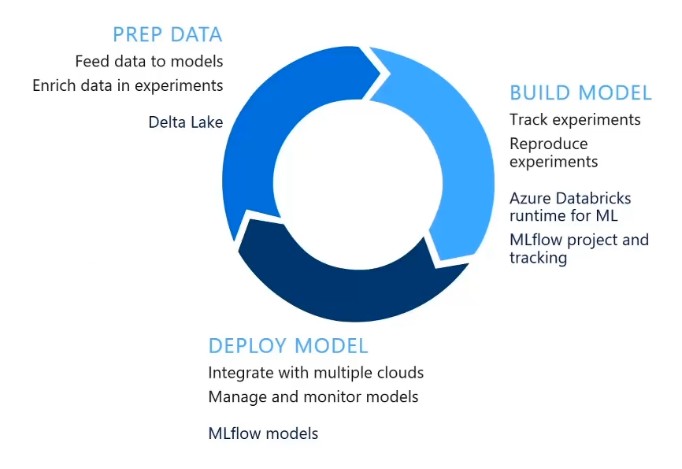
Azure Databricks + Azure ML
- Log experiments and models in a central place
- Maintain audit trails centrally
- Deploy models seamlessly in Azure ML
- Manage your models in Azure ML
Standardizing the ML lifecycle on Azure Databricks
Realtime Processing
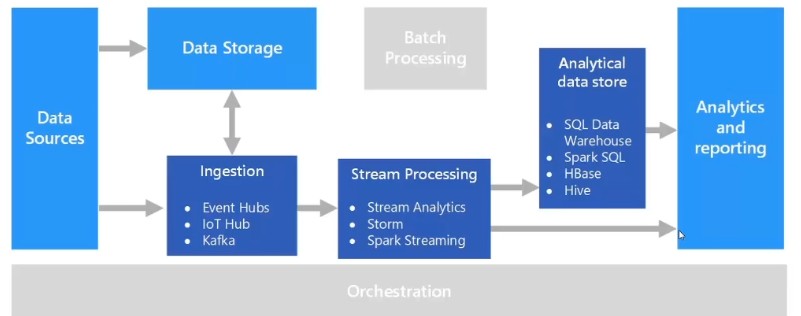
Challenges
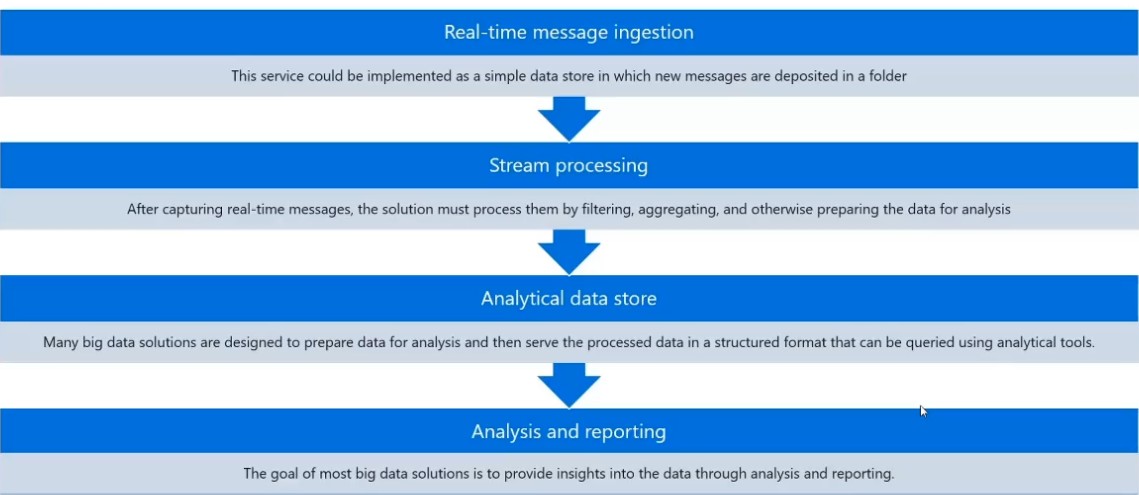
- One of the big challenges of real-time processing solutions is to ingest, process, and store messages in real time, especially at high volumes.
- Procesing must be done in such a way that it does not block the ingestion pipeline.
- The data store must support high-volume writes.
- Another challenge is to act on data quickly such as generating alerts in real time or presenting the data in a real-time (or near real-time) dashboard.
Real Time Processing Architecture - Logical COmponents
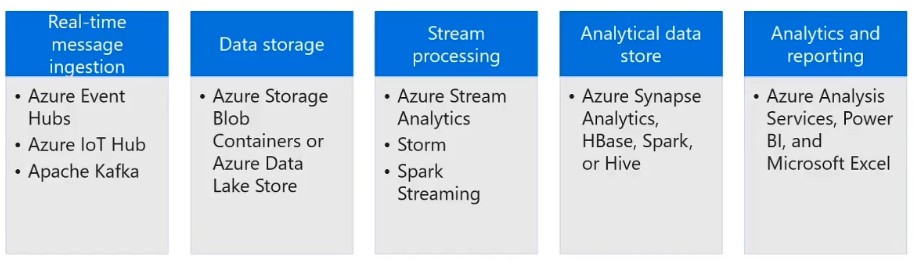
Real Time Processing Techonolgy choices
Azure Data Factory (ADF)
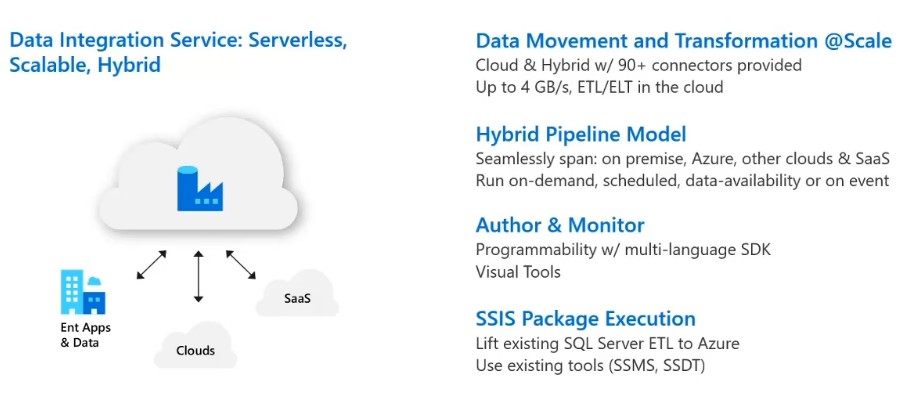
A cloud-based data integration service that allows you to orchestrate and automate data movement and data transformation.
- Connect & collect
- Transform and enrich
ADF Components
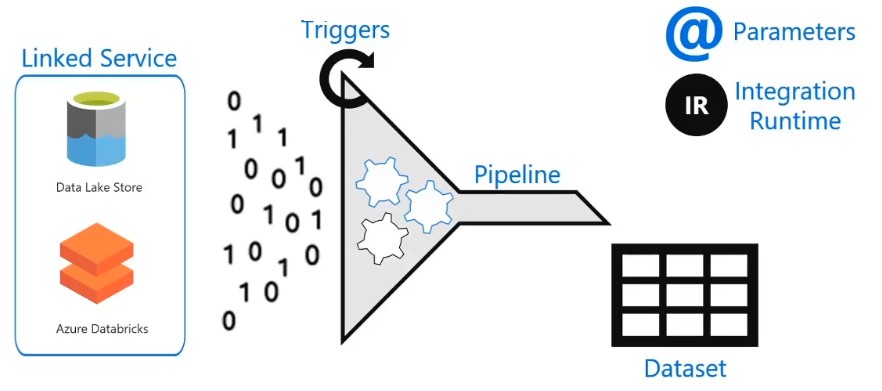
Data Transformation in Azure
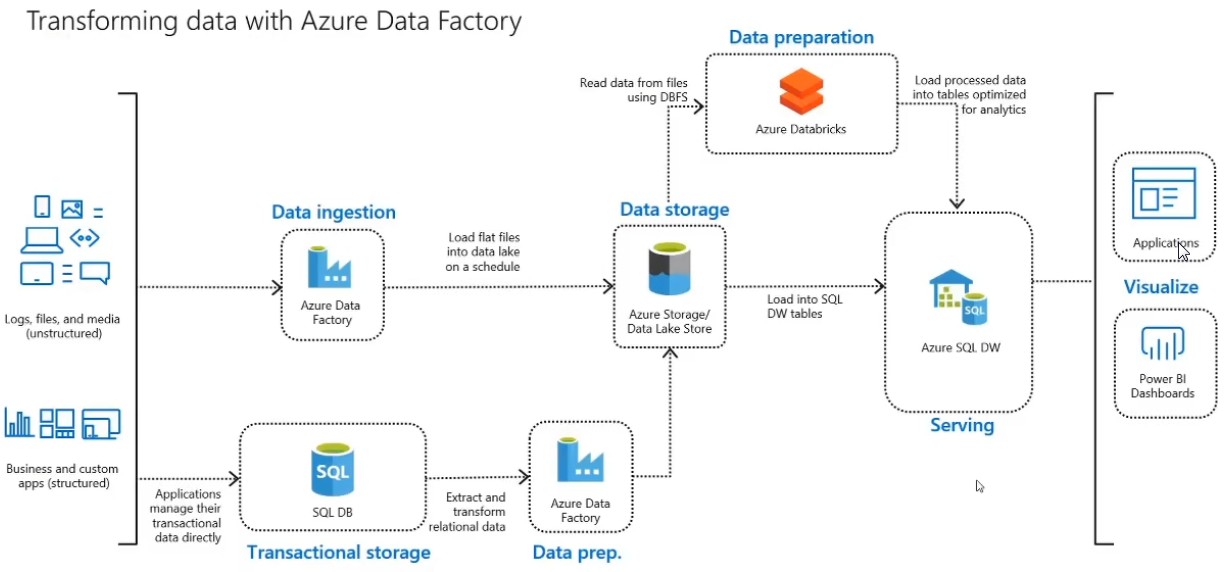
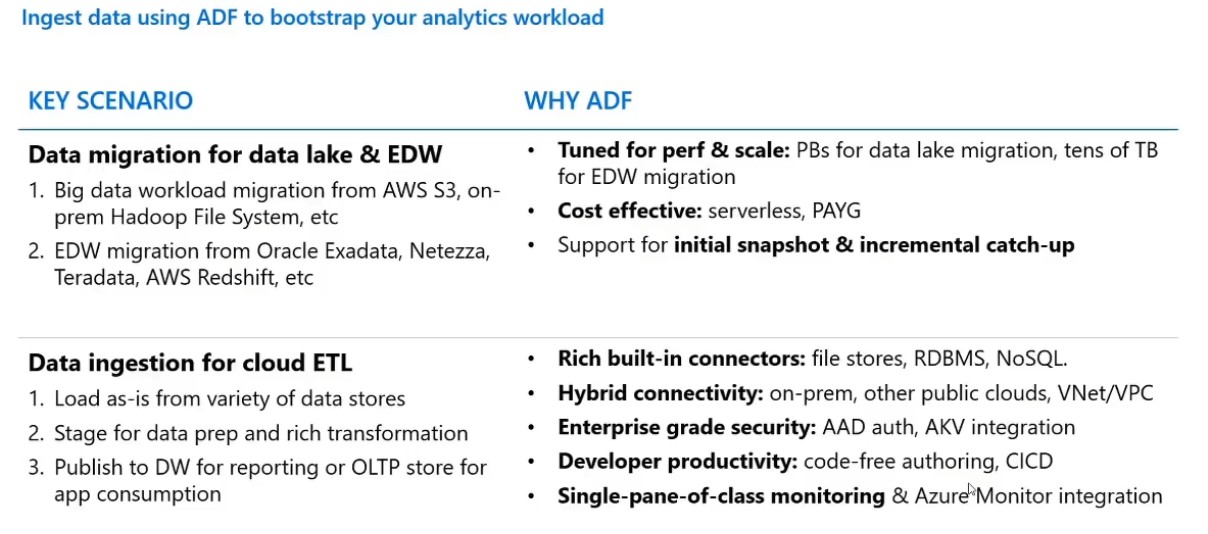
Scenario to use ADF
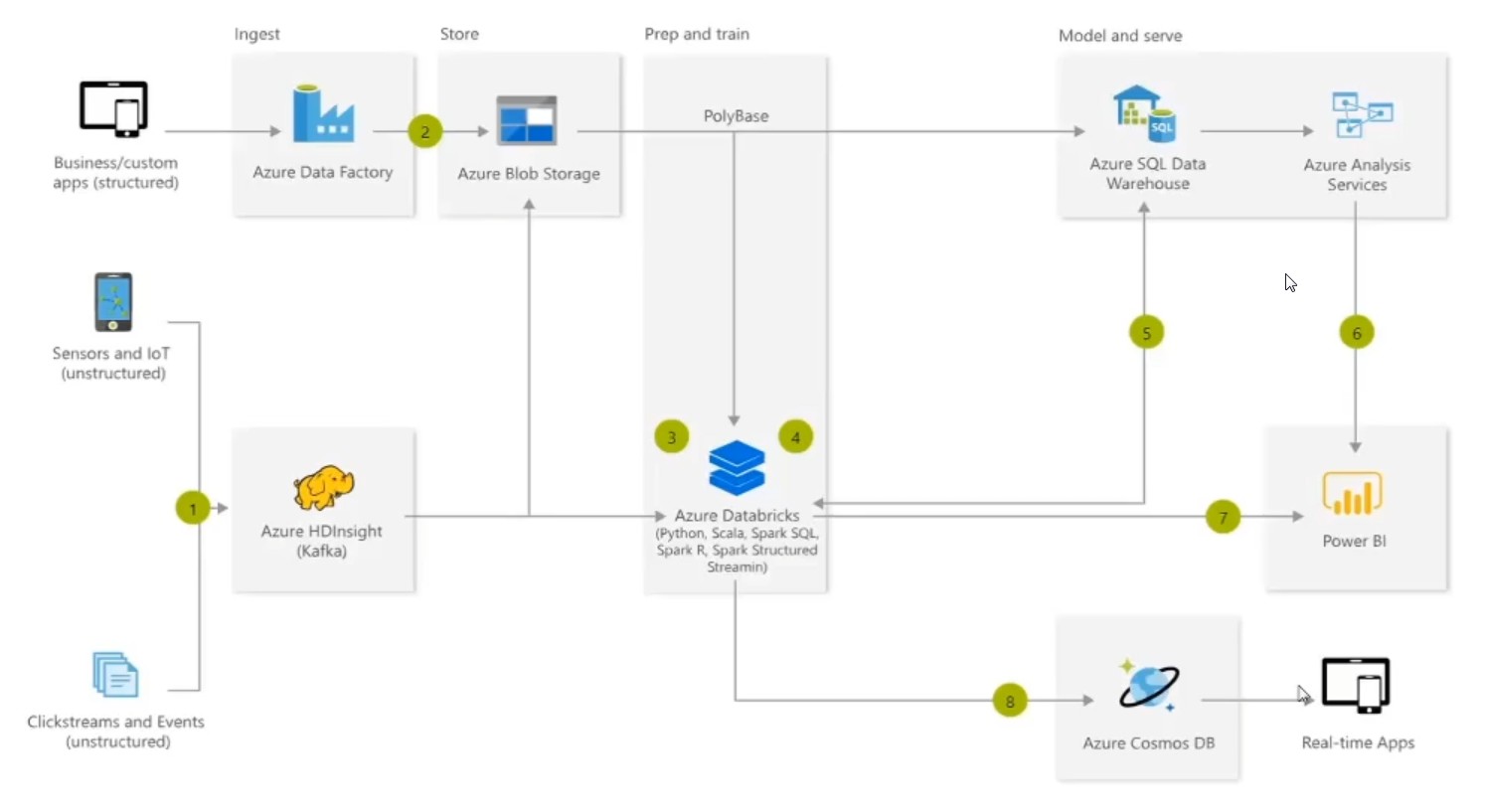
Real Time Analytics
Complexities in Stream Processing
- Complex Data
- Complwx Workloads
3. Design for Data Security and Compliance
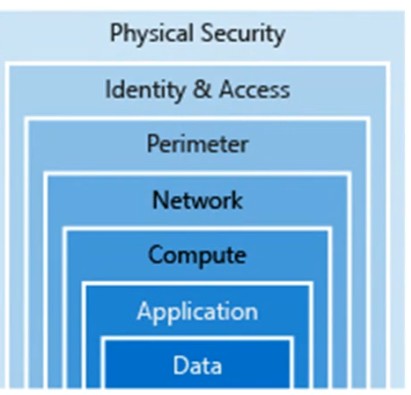
Design for security
Identity Management
Identifying users that access your resources in an important part of security design.
- Identity as a security Layer
- Single sign-on
Infrastructure Protection
Role Based Access Control
Roles are defined as collections of access permissions. Security principals are mapped to roles directly or through group membership.
Role and Management groups:
- Roles are sets of permissions that users can be granted to. Management groups add the ability to group subscriptions together and apply policy at an even higher level.
- Aure AD Privileged Identity Mangement (PIM) is an additional paid-for offering that provides oversight of role assignments, self-service, and just-in-time role activation.
Providing identities to services
An Azure service acan be assigned an identity to ease the management of service access to other Azure resources.
Service Principals:
- It is an identity that is used by a service or application. Like other identities it can be assigned roles.
- When you create a managed identity for a service, you create an account on the Azure AD tenant. Azure infrastructure will automatically take care of authentication.
Securing Azure Storage
- Azure services such as Blob storage, Files share, Table storage, and Data Lake Store all build on Azure Storage.
- High-level security benefits for the data in the cloud:
Encryption at rest - Azure Storage Service Encryption (SSE)
- All storage data encrypted at rest - protected from physical breach
- All data writtern to storage is encrypted with SSE i.e, 256 bit advanced standard AES cipher. SSE automatically encrypts data on writting to Azure storage. This feature cannot be disabled
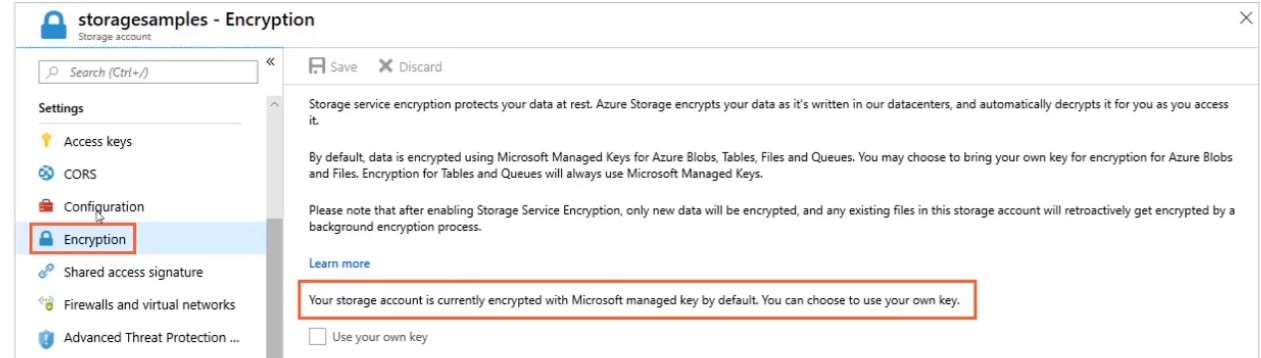
- For VM's Azure lets you encrypt virtual hard-disks by using Azure disk encryption. This encryption uses bitlocker for windows images and uses DEM encrypt for linux.
- Azure key Vault stores the keys automatically to help you contaol and manage disk encryption, keys and secret automatically.
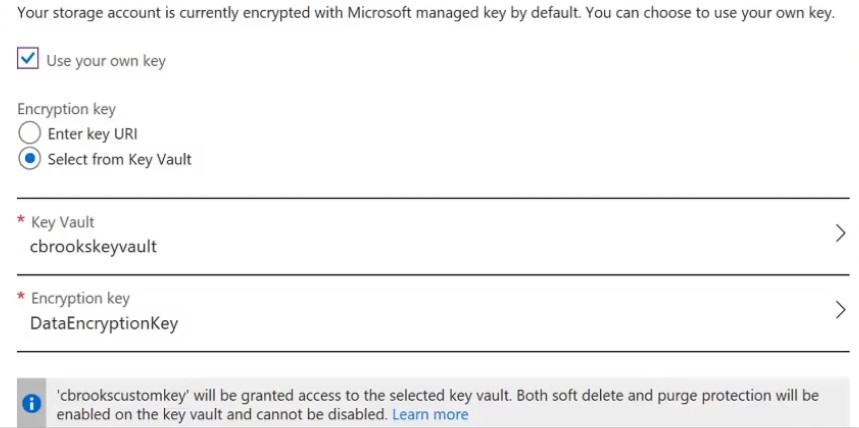
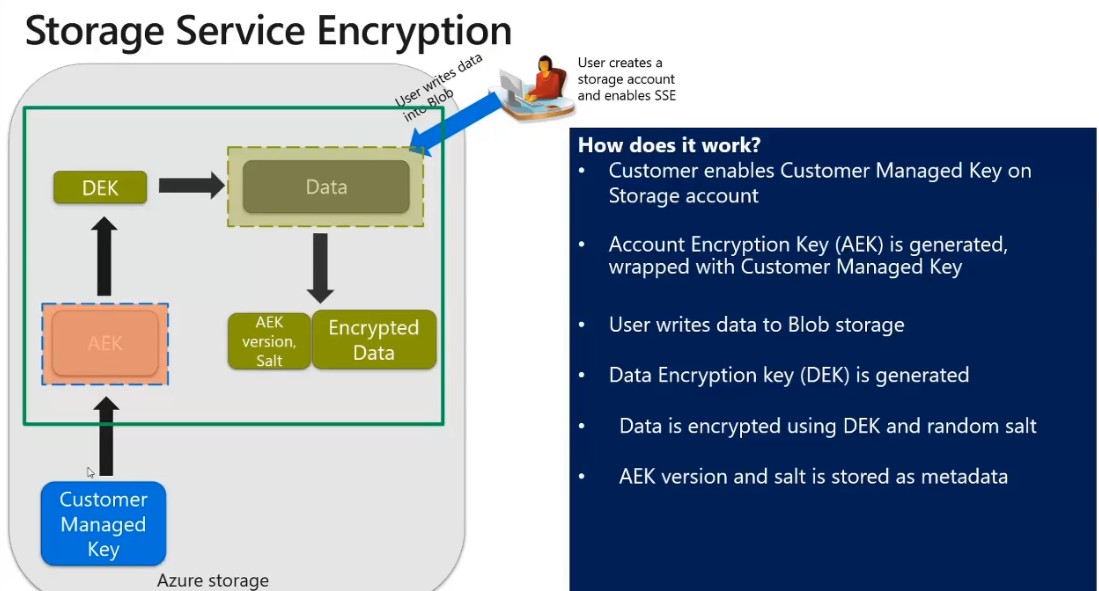
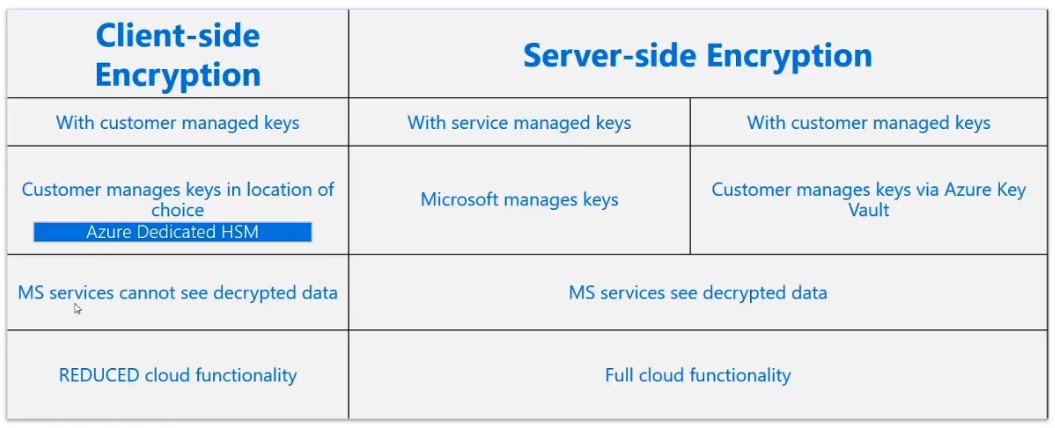
Encryption at rest models
Azure Key-Vault
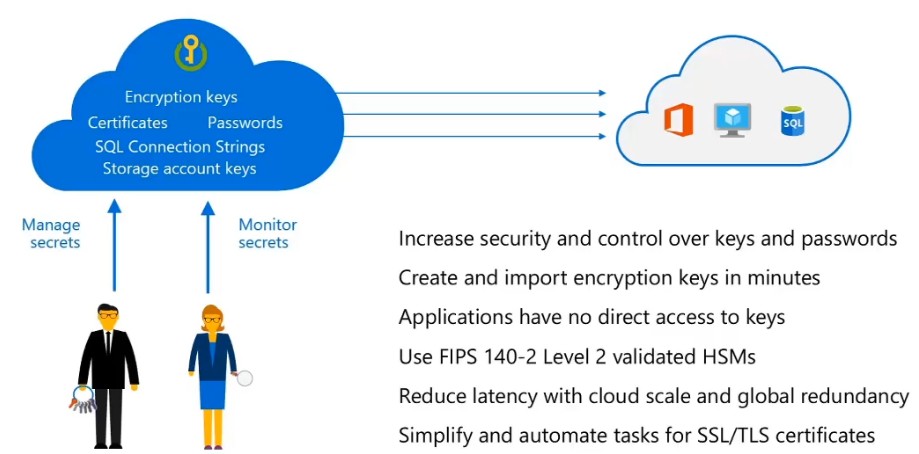
- Safeguard cryptogrpahic keys and other secrets used by cloud apps and services.
Encryption in transit
- Keep your data secure by enabling transport-level security between Azure and the client.
- Always use HTTPS to secure communication over the public internet.
- When you call the REST APIs to access objects in storage accounts, you can enforce the use of HTTPS by requiring secure transfer for the storage account.
Cross Origin Resource Sharing (CORS) support
- Azure Storage supports cross-domain access through cross-origin resource sharing (CORS)
- It is a optional flag that can be applied on storage accounts. The flag adds appropriate headers when you use http requests to retirve resources from storage account.
- It uses HTTP headers so that a web application at one domain can access resources from a server at a different domain.
- By using CORS, web apps ensure that they load only authorizes content from authorized sources.
Identity-Based Access Control for Azure Blob Storage
Grant access to user and service identities from Azure Active Directory
- Federate with enterprise identity systems
- Leverage powerful AAD capabilities including 2-factor and biometric authentication, conditional access, identity protection and more.
Control access with role-based access control (RBAC)
- Grant access to storage scopes ranging from entire enterprise down to one blob container
- Define custom roles that match your security model
- Leverage Privileged Identity Management to reduce standing administrative access.
Managed identities for Azure resources
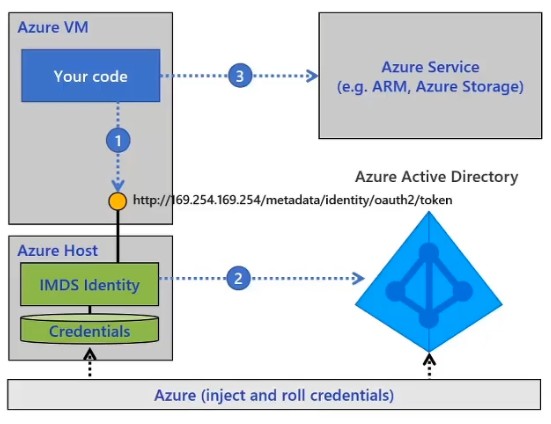
- Auto-managed identity in Azure AD for Azure resource.
- Use the MSI endpoint to get access tokens from Azure AD (no secretes required).
- Direct authentication with services, or retrieve creds from Azure key vault
- No additional charge for MSI.
Managed Shared Access Policies and Signatures
Storage Explorer provides the ability to manage access policies for containers.
- A shared access signature (SAS) provides you with a way to grant limited access to other clients, without exposing your account key.
- Provides delegated access to resources in your storage account.
Types of Shared Access Signature (SAS)
- Service level
- Account level
Immutability Policies
- Support for time-based retention
- Support for legal holds with tags
- Support for all Blob tiers
- SEC 17a-4(f) complaint
Firewall rules
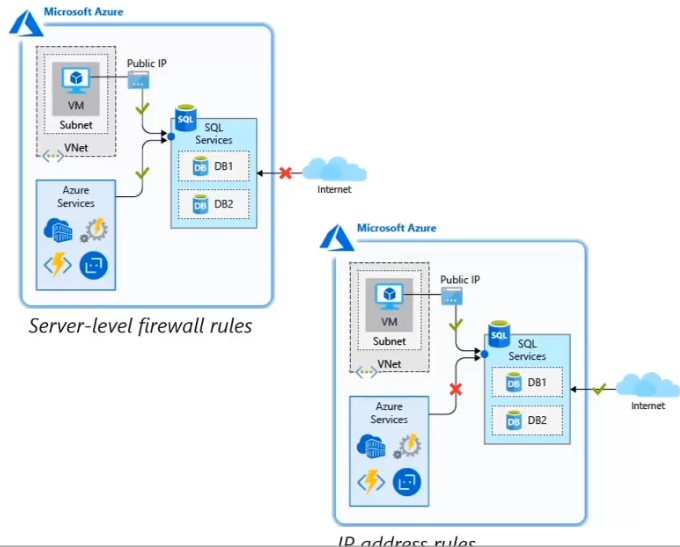
- Azure SQL DB has a built-in firewall that is used to allow and deny network access to both the db server itself, as well as individual db.
- Server-level firewall rules
- Database-level firewall rules
Network Security
Network security is protecting the communication of resources within and outside of your network. The goal is to limit exposure at the network layer across your services and systems
Internet protection:
- By assessing the resources that are internet-facing, and only allow inbound and outbound communication when neccessary. Ensure that they are restricted to only ports/protocols required.
- To isolate Azure services to only allow communication from virtual networks, use VNet service endpoints. WIth service endpoints, Azure service resources can be secured to your virtual network.
- VPN connections are a common way of establishing secure communication channels between networks, and this is no different when working with virtual networking on Azure. Connection between Azure VNets and an on-premises VPN device is a great way to provide secure communication.
Firewalls and VNET access
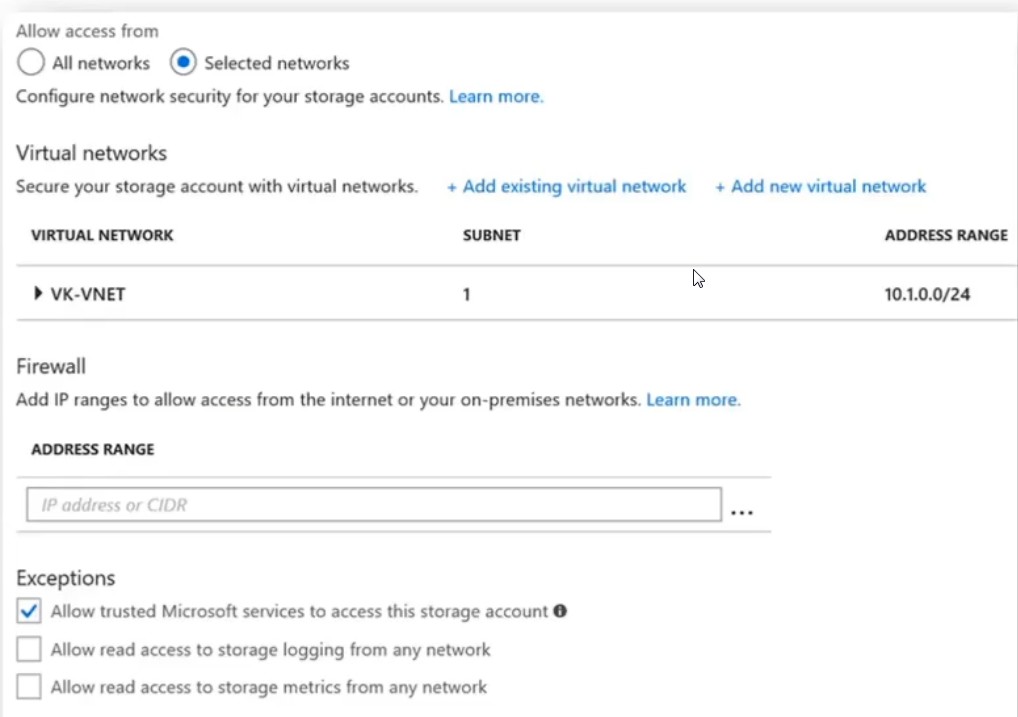
- Storage Firewall
Private endpoints
- Azure private endpoint is a fundamental building block for private link in Azure. It enables service like Azure VM to communicate privately with private link resources.
- It is a network interwork interface that connects you privately and securely to service powered by Azure Private link.
- A private endpoint assigns a private IP address from your Azure Virtual Network (VNET) to the storage account.
- private endpoint enables communication from the same VNet, regionally peered VNets, globally peered VNets, and on-premises using VPN or Express Route, and services powered by private link.
- It secures all traffic between your VNet and the storage account over a private link.
Advanced threat protection for Azure Storage
- An additional layer of security intelligence that detects unusual and potentially harmful attempts to access or exploit storage accounts
- These security alerts are integrated with Azure Security Center.
Secure Azure Cosmos DB Data
- Using Firewal settings
- Add inbound and Outbound networks
Azure SQL database - Secure your data in transit, at rest and on display
- TLS network encryption
- Transparent Data Encryption (TDE)
- Dynamic data masking
Enable Database Auditing
- For SQL Serverm you can create audits tha contain specifications for server-level events and specifications for databse-level events.
- Audited events can be weitteb to the event logs or to audit files
- There are several levels of auditing for SQL Server, depending on government or standards requirements for your installation.
- Azure SQL DB and Azure Synapse Analytics auditing tracks database events and writes them to an audit log in your Azure storage account.
- Enable Threat detection to know any malicious activities on SQL DB or potential security threats.
Use an Azure SQL Database managed instance securely with public endpoints
- A SQL DB managed instance provides a private endpoint to allow connectivity from inside its VNET.
Scenarios where you need to provide public endpoint connection
- The managed instance must integrate with multi-tenant-only PaaS offerings.
- Company policies prohibit PaaS inside corporate networks.
Managed Instance - Lock down inbound and outbound connectivity
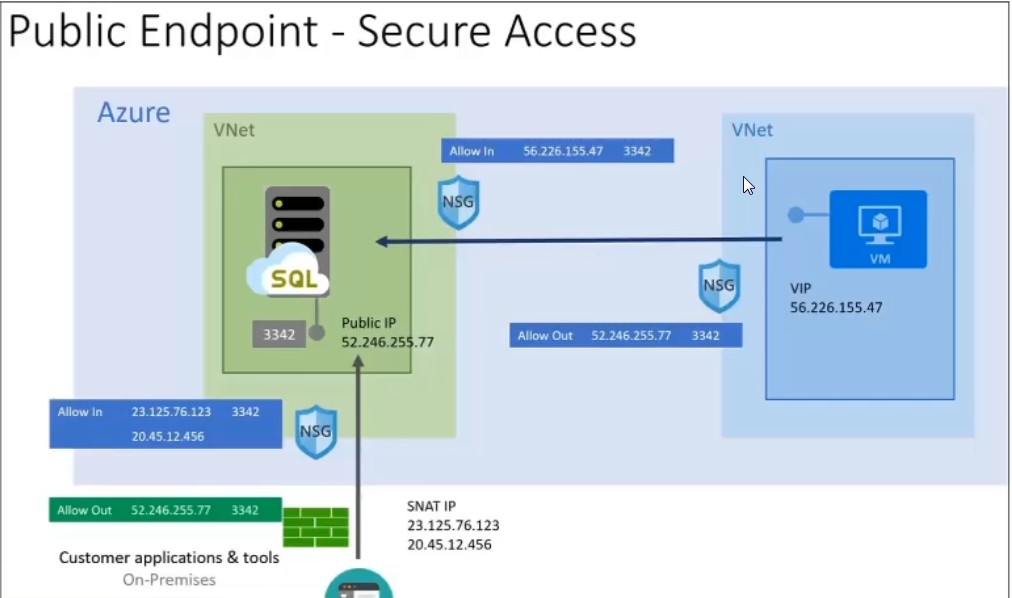
- A managed instance has a dedicated public endpoint address.
- In the client-side outbound firewall and in the NSG rules, set this public endpoint IP address to limit outbound connectivity.
- Use a NSG to limit access to the managed instance public endpoint on port 3342.
Azure SQL Database and Azure Synapse Analytics data discovery & classification
- Discovery & recommendations
- Labeling
- Query result set sensitivity
- Visibility
Discover, classify & label sensitive columns
The classification includes two metadata attributes:
- Lables
- Information Types
Architecture of Azure Data Factory
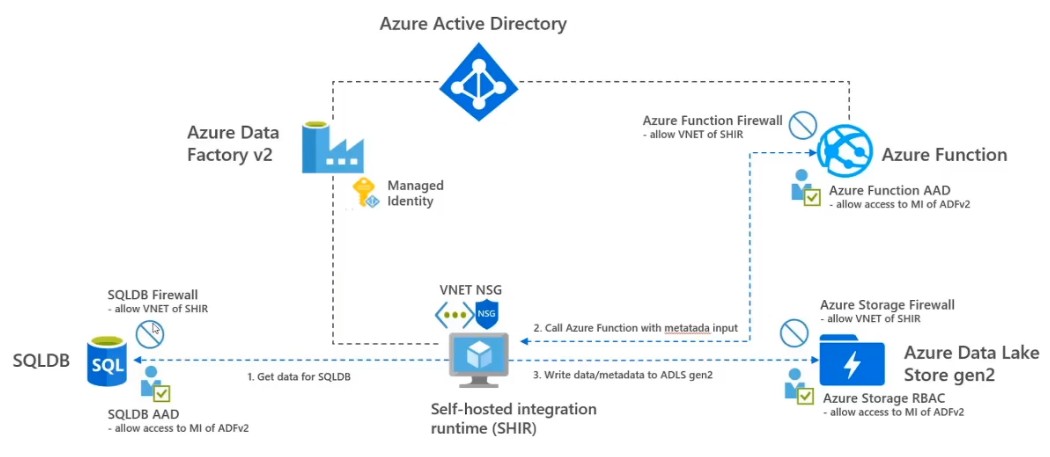
Security aspects that are part of the above architecture
- AAD access control
- Firewall rules
Miscellaneous
Serverless Computing
Containers
- A container is a method running applications in a virtualized environment. The virtualization is done at the OS level, making it possible to run multiple identical application instances within the same OS.
- Azure Kubernetes Service allows you to set up virtual machines to act as your nodes. Azure hosts the Kubernetes management plane and only bills for the running worker nodes that host your containers.
- It is a serverless approach that lets you create and execute containers on demand. You're charged only for the execution time per second.
Performance Bottlenecks
Azure Monitor
- A single management point for infrastructure-level logs and monitoring for most of your Azure services.
- You can query and aggregate data across logs. This cross-source correlation can help you identity issues or performance problems that may not be evident when looking at logs or metrics individually.
- Telemetry can include individual page request times, exceptions within your application, and even custom metrics to track business logic. This telemetry can provide a wealth of insight into apps.
Tips to remember, A day prior to the Exam.
| Azure Service | Type of File | | :---: | :---: | | Azure CosmosDB | Graph Databases | | Azure Hbase and HDInsight | Column Family in-memory key-value store |
| Azure Service | Usage | | :---: | :---: | | Azure Synapse | Data analytics | | Azure Search | Search engine databases | | Azure Timeseries Insights | Time series databases | | Azure Blob | Object store | | Azure FileStorage | Shared files |
Azure Cosmos DB Usage:
- For Real-Time Customer Experiences
- Telemetry stores for IOT
- Migrate NoSQL apps
Azure Cosmos DB Authentication
- It uses two types of keys to authenticate users and provide access to its data and resources.
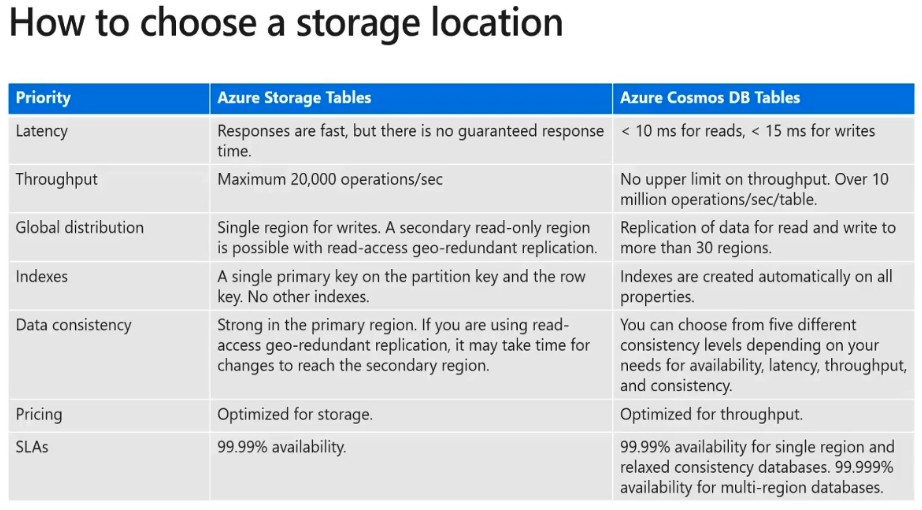
Azure Cosmos DB SLA for Read/Write operation

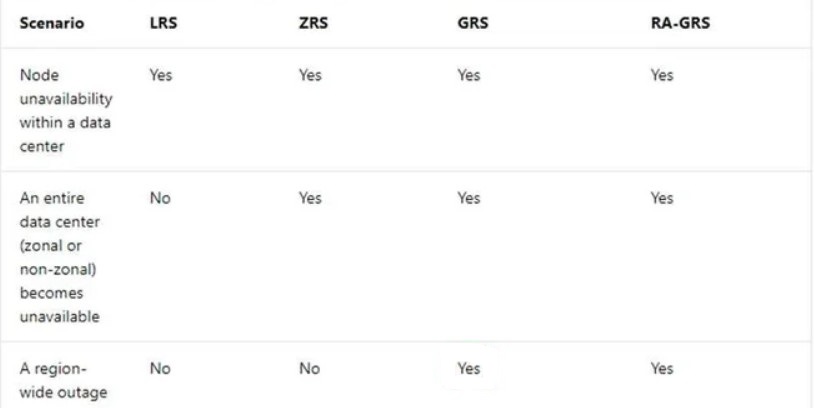
Azure Storage Service
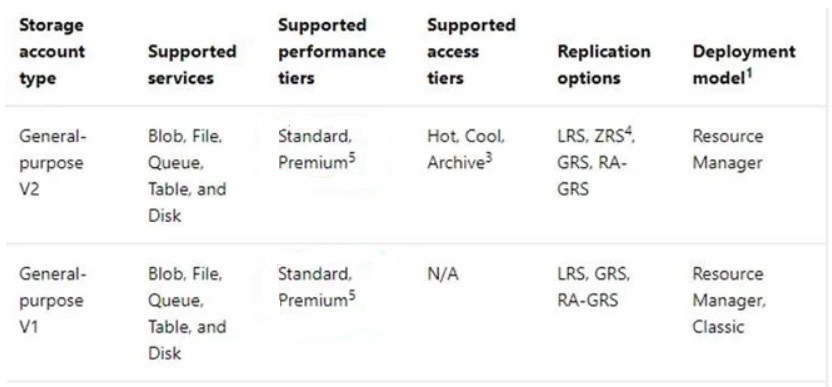
Azure Storage Availability
Azure Data Factory
- Does not store any data except for linked service credentials for cloud data stores, which are encrypted by using certificates.
Azure Databricks (2 types of clusters)
- Interactive clusters are used to analyze data collaboratively with interactive notebooks.
- Job clusters are used to run fast and robust automated workloads using the UI or API.
Azure SQL Database - Security Overview
| LAYER | TYPE | DESCRIPTION | | :---: | :---: | :---: | |Network| IP Firewall Rules| Grant access to databases based on the originating IP address of each request.| |Network| Virtual Network Firewall Rules | Only accept communications that are sent from selected subnets inside a virtual network.| |Access Management| SQL Authentication| Authentication of a user when using a username and password.| |Access Management| Azure AD Authentication| Leverage centrally managed identities in Azure Active Directory (Azure AD).| |Authorization| Row-level Security| Control access to rows in a table based on the characteristics of the user/query.| |Threat Protection| Auditing| Tracks database activities by recording events to an audit log in an Azure storage account.| |Threat Protection| Advanced Threat Protection| Analyzing SQL Server logs to detect unusual and potentially harmful behavior.| |Information Protection |Transport Layer Security (TLS) |Encryption-in-transit between client and server.| |Information Protection |Transparent Data Encryption (TDE) |Encryption-at-rest using AES (Azure SQL DB encrypted by default).| |Information Protection |Always Encrypted |Encryption-in-use (Column-level granularity; Decrypted only for processing by client).| |Information Protection |Dynamic Data Masking |Limits sensitive data exposure by masking it to non-privileged users.| |Security Management| Vulnerability Assessment |Discover, track, and help remediate potential database vulnerabilities.| |Security Management| Data Discovery & Classification| Discovering, classifying, labeling, and protecting the sensitive data in your databases.| |Security Management| Compliance |Been certified against a number of compliance standards.|
Azure SQL - Network Access Controls
|CONTROL |DESCRIPTION| | :---: | :---: | |Allow Azure Services |When set to ON, other resources within the Azure boundary can access the SQL resource.| |IP firewall rules |Use this feature to explicitly allow connections from a specific IP address.| |Virtual Network firewall rules |Use this feature to allow traffic from a specific Virtual Network within the Azure boundary.|
Encryption on Azure
|Type | Technique or service used | Enables encryption of| | :---: | :---: | :---: | | Raw Encryption | - | Azure Storage, VM Disks, Disk Encryption | | Database Encryption | Transparent Data Encryption | Databases and SQL DW | | Encypting Secrets | Azure Key Vault | Storing application secrets |
HDInsight cluster types to run Apache Hive queries
|Cluster Type | Usage | | :---: | :---: | | Interactive Query | To optimize for ad hoc, interactive queries | | Apache Hadoop | To optimize for hive queries used as batch process | | Spark & HBase | Run hive queries |
SQLDW or Synapse
To achieve fastest loading speed for moving data into a DW table
- load data into a staging table. Define the staging table as a heap and use round-robin for the distribution option.
- Has many Unique values
- Does not have Nulls, or has only a few Nulls
- Is not a date column
- Use a Column from Group BY, not from where clause
- Round Robin for small Fact tables
- Hash distributed for large Fact tables
- We create a user-defined restore point before data is uploaded. Delete the restore point after data corruption checks complete.
Simple yet very powerful Hacks:
(You can use these hacks when uncertain about any question or scenario to make quick decisions)- IOT HUb, Event Hub, Blob are the three ways to bring data into Stream Analytics
- Anything related to RBAC Identities majority cases answer would be Service Srincipal
- In MySQL sharding is the best way to partition the data.
- Cosmos DB Partition keys should generally be based on unique values.
- For a Database using a nonclustered columnstore index will improve performance on analytics and not clustered columnstore index.
- You can use Azure Event Hubs, IoT hub, and Azure Blob storage for streaming data input.
- Azure Stream Analytics Supports Azure SQL DB or Azure Blob storage for reference data input.
- Primary key and secondary key grant access to remotely administer the Storage account.
- Event Hubs Capture creates files in Avro format.
- If notebooks are involved with scheduling or autoscale of clusters it is databricks.
- RBAC support for databricks via Premium clusters.
- If their is a question based on IOT Hub or Event Hub probability of the answer being Stream Analytics for processing is maximum.
- If you see the term "Relationship" or nodes and vertices in CosmosDB question by default the option in Gremlin API.
- If heirachical or Big Data related storage involved then ADLS Gen2.
- If flat file related storage then blob.
Note:
- For Labs basic portal knowledge should be sufficient but may vary based on the type of question that appears.
- Labs may or may not be part of your exam.
- Refer DP-200 tips as well.
- SQL Database - Security Overview in Tips section taken from taygan for maintain the flow of readers.


