
Predict age and gender from a first name
AgeFromName 0.0.8
A tool for predicting someone's age, gender, or generation given their name and assigned sex at birth, assuming they were born in the US.Feel free to use the Gitter community gitter.im/agefromname for help or to discuss the project.
Installation
$ pip install agefromname
Overview
This more or less apes the approach of FiveThirtyEight's "How to Tell if Someone's Age When All you Know Is Her Name" article. It includes data collected scraped from the Social Security Administration's Life Tables for the United States Social Security Area 1900-2100 and their baby names data. Code is included to re-scrape and refresh this data in regenerate_data.py. It includes data as far back as 1981.
To use, first initialize the finder
>>> from agefromname import AgeFromName
>>> agefromname = AgeFromName()
You find the probability of someone's gender based on their first name and optionally, the current year, their minimum age, and/or their maximum age.
>>> agefromname.prob_male('taylor')
0.24956599946849847
>>> agefromname.prob_female('taylor')
0.7504340005315016
>>> agefromname.probmale('taylor', minimumage=50)
0.9572157723373936
>>> agefromname.probmale('taylor', currentyear=1930)
1.0
>>> agefromname.probmale('taylor', currentyear=2010, minimum_age=30)
0.8497712563439375
>>> agefromname.probmale('taylor', currentyear=2010, minimumage=30, maximumage=40)
0.7645011554551521
You can even plot the plot, given a current year, the probability someone named Kelsey would be female:
>>> (pd.DataFrame([{'year': year, 'P(Male)': agefromname.probmale('kelsey', currentyear=year)} for year in range(1930, 2015)]) .set_index('year') .plot())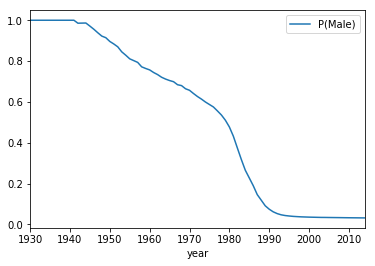
One can perform this computation in bulk for all names. Here, we can see a 95% confidence intervals of how likely people over 18 in 1993 were females given their names:
>>> agefromname.getallnamefemaleprob(currentyear=1993, minimumage=18).iloc[:3] hi lo prob first_name aage 0.648197 0.000000 0.0 aagot 1.000000 0.380786 1.0 aamir 0.398189 0.000000 0.0Now you can use this to get the mode of someone's age, give their first name and gender. Note that their gender should be a single letter, 'm' or 'f' (case-insensitive), and that the first name is case-insensitive as well.
>>> agefromname.argmax('jAsOn', 'm') 1977 >>> agefromname.argmax('Jason', 'M') 1977You can also include an "as-of" year. For example, in 1980, the argmax year for "John" was 1947, while in 2000 it was 1964. Note that if omitted, the current year is used.
>>> agefromname.argmax('john', 'm', 2000)
1964
>>> agefromname.argmax('john', 'm', 1980)
1947
Furthermore, you can exclude people who are younger than a particular age.
>>> agefromname.argmax('bill', 'm', 1980, minimum_age=40) 1934 >>> agefromname.argmax('bill', 'm', minimum_age=40) 1959Getting estimated counts of living people with a giving name and gender at a particular date is easy, and given in a Pandas Series.
>>> agefromname.getestimatedcounts('john', 'm', 1960) yearofbirth 1881 4613.792420 1882 5028.397099 1883 4679.560929 ...We can see corresponding probability distribution using
>>> agefromname.getestimateddistribution('mary', 'f', 1910)
yearofbirth
1881    0.016531
1882    0.019468
1883    0.019143
...
Finally, we can see similar information for generations, as well, using the GenerationFromName class.
>>> from agefromname import GenerationFromName >>> generationfromname = GenerationFromName() >>> generationfromname.argmax('barack', 'm') 'Generation Z' >>> generationfromname.argmax('ashley', 'f') 'Millenials' >>> generationfromname.argmax('monica', 'f') 'Generation X' >>> generationfromname.argmax('bill', 'm') 'Baby Boomers >>> generationfromname.argmax('wilma', 'f') 'Silent' >>> generationfromname.getestimateddistribution('jaden', 'm') Baby Boomers 0.000000 Generation X 0.001044 Generation Z 0.897662 Greatest Generation 0.000000 Millenials 0.101294 _other 0.000000 Name: estimate_percentage, dtype: float64 >>> generationfromname.getestimateddistribution('gertrude', 'f') Baby Boomers 0.259619 Generation X 0.031956 Generation Z 0.009742 Greatest Generation 0.425293 Millenials 0.011412 _other 0.261979 >>> generationfromname.getestimatedcounts('ashley', 'f') Baby Boomers 702.481287 Generation X 29274.206090 Generation Z 141195.016621 Greatest Generation 34.998913 Millenials 652914.233604 _other 0.102625 Name: estimated_count, dtype: float64Caveat Usor
The Social Security Administration records the 1,000 most common male and female baby names + birth counts each year. These may not be fully representative of the entire population, and may not work as well for people whose names aren't historically common among those born in the US or other groups.Be aware that there are people who have near-dogmatic objections to this sort of analysis, especially using a first name to impute a gender.


