
A reproducible ML study of Codeforces difficulty prediction, cold-start limits, temporal validation, and statement-structure features.
Codeforces Difficulty Prediction

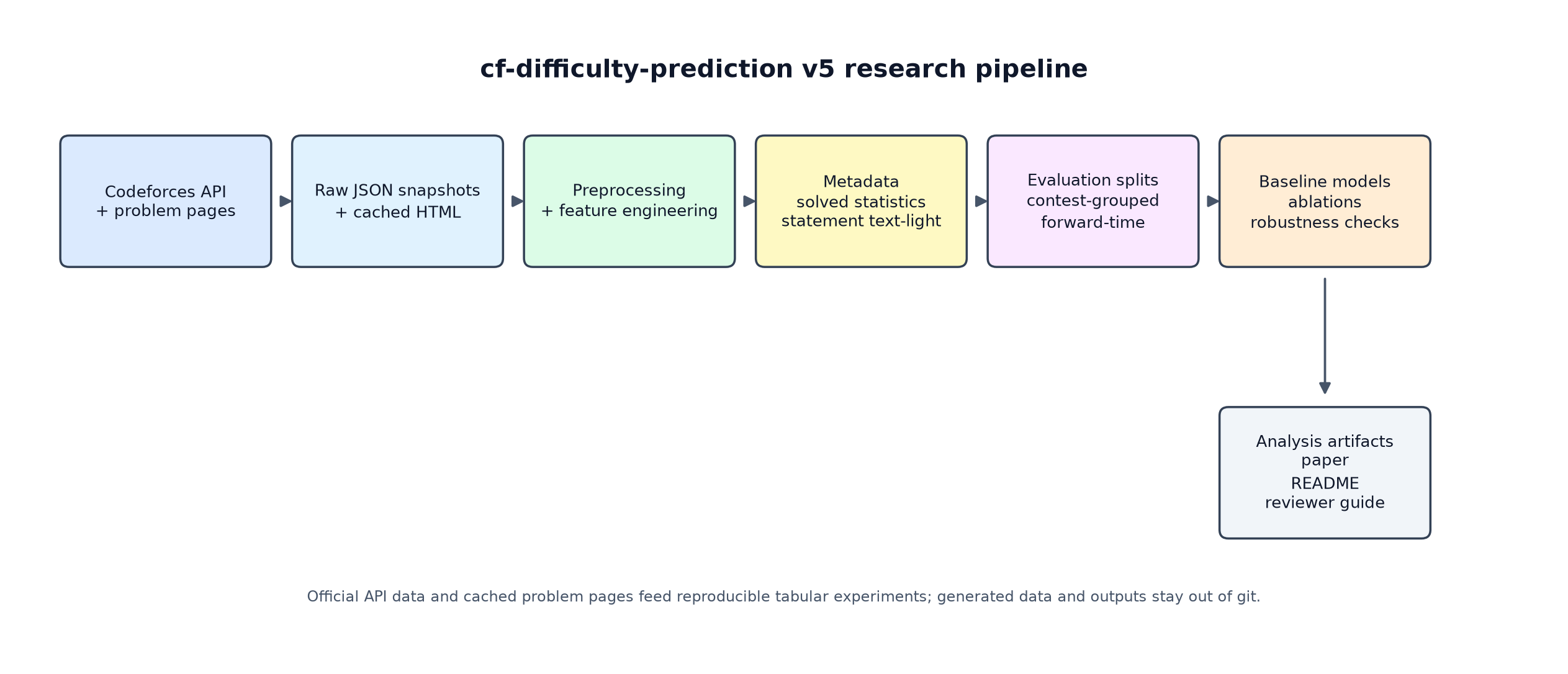
A reproducible v5 research pipeline for predicting Codeforces problem ratings from official API metadata, solved statistics, exposure-aware features, and lightweight statement-structure features.
Quick overview
If you only want the main idea, key results, and how to read the project quickly, see QUICK_OVERVIEW.md.
Cold-start note: Cold-start here means no solved-count behavior, not necessarily strict pre-contest prediction. Tags, metadata, and statement availability may not exactly match a real pre-contest setting.
Useful companion notes:
Project snapshot
| Experiment | Main setting | Best / key result | Interpretation | |---|---|---:|---| | Contest-grouped prediction | HGB full API | MAE 166.9, within +/-200 = 69.7% | Generalizes to unseen contests | | Forward-time prediction | RF full API | MAE 152.5, within +/-200 = 71.2% | Tests chronological generalization | | Solved-only baseline | solved-count only | MAE 227-274 | Strongest simple public signal | | Cold-start prediction | metadata only | MAE 318-332 | New-problem prediction is much harder | | v5 cold-start extension | metadata + text-light | MAE improves by 33.0-42.3 | Statement structure adds cold-start signal | | Rolling temporal validation | full API + age norm | average MAE 146.0 | Best across rolling chronological folds |
Research question
How well can Codeforces problem difficulty be predicted across post-publication and cold-start settings using public metadata, solved-count statistics, exposure-aware features, and lightweight problem-statement structure features?
This project separates two settings:
- Post-publication prediction: solved-count statistics are available after a
- Cold-start prediction: solved-count statistics are unavailable, so the
Cold-start note: Cold-start here means no solved-count behavior, not
necessarily strict pre-contest prediction. Tags, metadata, and statement
availability may not exactly match a real pre-contest setting; the project
treats this limitation explicitly.
Main findings
- The processed dataset contains 10,979 rated
PROGRAMMINGproblems from 1,948
- Ratings range from 800 to 3500.
- Solved-count-only is the strongest simple baseline in both contest-grouped and
- Full API models improve over solved-count-only, showing that metadata and tags
- Removing solved features causes the largest MAE increase in ablation studies.
- Cold-start metadata-only prediction is substantially harder than
- The v5 statement text-light extension improves cold-start prediction beyond
- Statement feature coverage is 99.3%: 10,906 parsed pages out of 10,979 rows,
- Age-normalized solved-count features are useful, but they are only partial
Key figures


Repository structure
configs/                 Experiment configuration
docs/                    Overview documentation assets
paper/                   Final v5 paper, figures, and historical paper artifacts
scripts/                 Local helper scripts
src/cf_diff/             Pipeline modules
tests/                   Unit tests
outputs/paper_tables/    Small committed paper-ready CSV tables
Large generated data, raw API snapshots, cached HTML pages, trained model artifacts, logs, and experiment outputs are intentionally not committed.
Setup
python -m pip install -r requirements.txt
$env:PYTHONPATH = "src"
Reproducible pipeline
Run from the repository root.
python -m cfdiff.fetchapi --output-root data/raw/codeforces --lang en --sleep-seconds 2.1 --timeout 30 --latest-dir data/raw/codeforces/latest
python -m cf_diff.preprocess --raw-dir data/raw/codeforces/latest --interim-dir data/interim --processed-dir data/processed --log-path outputs/logs/preprocess.log
python -m cfdiff.features --config configs/experiment.yaml --input-path data/processed/ratedprogramming_problems.parquet --output-dir data/processed/features --log-path outputs/logs/features.log
python -m cfdiff.splits --config configs/experiment.yaml --input-path data/processed/features/modeltable.parquet --output-dir data/processed/splits --log-path outputs/logs/splits.log
python -m cfdiff.eda --config configs/experiment.yaml --processed-path data/processed/ratedprogrammingproblems.parquet --feature-path data/processed/features/modeltable.parquet --contest-split-path data/processed/splits/contestgroupedsplit.parquet --time-split-path data/processed/splits/forwardtimesplit.parquet --output-dir outputs/eda --log-path outputs/logs/eda.log
python -m cfdiff.baselines --config configs/experiment.yaml --feature-path data/processed/features/modeltable.parquet --feature-columns-path data/processed/features/featurecolumns.json --contest-split-path data/processed/splits/contestgroupedsplit.parquet --time-split-path data/processed/splits/forwardtime_split.parquet --output-dir outputs/baselines --log-path outputs/logs/baselines.log
python -m cfdiff.analysis --config configs/experiment.yaml --feature-path data/processed/features/modeltable.parquet --feature-columns-path data/processed/features/featurecolumns.json --contest-split-path data/processed/splits/contestgroupedsplit.parquet --time-split-path data/processed/splits/forwardtime_split.parquet --baseline-metrics-dir outputs/baselines/metrics --baseline-predictions-dir outputs/baselines/predictions --output-dir outputs/analysis --log-path outputs/logs/analysis.log
python -m cfdiff.ablations --config configs/experiment.yaml --feature-path data/processed/features/modeltable.parquet --feature-columns-path data/processed/features/featurecolumns.json --contest-split-path data/processed/splits/contestgroupedsplit.parquet --time-split-path data/processed/splits/forwardtime_split.parquet --output-dir outputs/ablations --log-path outputs/logs/ablations.log
python -m cfdiff.robustness --config configs/experiment.yaml --processed-path data/processed/ratedprogrammingproblems.parquet --feature-path data/processed/features/modeltable.parquet --feature-columns-path data/processed/features/featurecolumns.json --contest-split-path data/processed/splits/contestgroupedsplit.parquet --time-split-path data/processed/splits/forwardtime_split.parquet --output-dir outputs/robustness --log-path outputs/logs/robustness.log
python -m cfdiff.statementcoldstart --feature-path data/processed/features/modeltable.parquet --statement-feature-path data/processed/statementfeatures/statementfeatures.parquet --output-dir outputs/statementcoldstart --log-path outputs/logs/statementcoldstart.log
v5 statement text-light feature extraction
If statement features need to be regenerated locally:
python -m cfdiff.statementfeatures
  --feature-path data/processed/features/model_table.parquet
  --cache-dir data/raw/codeforces/problem_pages
  --output-dir data/processed/statement_features
  --sleep-seconds 2.5
  --timeout 30
  --log-path outputs/logs/statement_features.log
The extractor resumes from cached pages, so closing and restarting the process does not discard already downloaded problem pages. The raw HTML cache and generated statement feature outputs remain local artifacts.
Browser demo note
The GitHub Pages site includes an illustrative browser-side demo for intuition. It is heuristic, does not run trained research models, and is not part of the reported experiments.
v6 Semantic TF-IDF Extension
v6 is a separate semantic statement-text extension on top of the completed v5 research project. It extends cold-start prediction with classical TF-IDF features extracted from normalized Codeforces problem-statement text.
This is not BERT, transformers, embeddings, LLMs, or deep semantic understanding. It is a lightweight bag-of-words semantic baseline designed to test whether statement text adds signal beyond metadata and v5 text-light structure features.
Standalone v6 paper artifacts:
Main v6 findings:- TF-IDF alone is weak.
- Metadata + TF-IDF improves over metadata only.
- Metadata + text-light + TF-IDF improves over metadata + text-light.
- The improvement is larger on forward-time validation than contest-grouped
- v6 does not replace the canonical v5 full API benchmark; its
fullapireference is a ridge-based internal comparison.
Compact v6 results:
- Contest-grouped: metadataonly MAE 340.5 -> metadataplus_tfidf MAE 311.1.
- Forward-time: metadataonly MAE 365.4 -> metadataplus_tfidf MAE 325.4.
- Contest-grouped: metadataplustext_light MAE 310.6 ->
- Forward-time: metadataplustext_light MAE 335.8 ->
Tests
python -m pytest -qCurrent tested state: 119 passed.
Notes on interpretation
The full API setting is a post-publication reference because solved-count features are observed after problems have accumulated submissions. Cold-start results exclude solved behavior. Statement text-light features are approximate HTML-derived structure features, not semantic embeddings or deep NLP.
For data and artifact availability details, see docs/data_manifest.md.


