
Claude skill that reads a job description and hands back an HTML report — match score, resume tailor, interview predictor, and a should-I-apply verdict.
中文 · English
💼 Job Description Skill
Decode any JD into a full application intelligence report — in 3 steps.







📦 Part of the offer-toolkit-skill — the full job-hunt bundle (JD · Resume · BQ). Install the bundle to get all three in one shot.
An agent skill for reading job descriptions. Give it a JD and your resume, and it hands back an HTML report telling you: whether this job is worth applying to, how well you match it, where the gaps are, what interviews will probably ask, whether the salary is reasonable, and what to do over the next six weeks. A JD is rarely just a recruiting blurb — it's usually the hiring manager's real expectations wrapped in HR boilerplate, and this skill unwraps that.
How it works — just 3 steps
Invoke the skill with anything like "help me with this job" / "walk me through this JD" and you go through exactly:
- Paste the JD — link or full text.
- Give it your resume — three options:
- HTML report auto-opens — a single-file Offer Strategy Report is generated to
~/Desktop/Claude skills/offer-strategy-<slug>.htmland pops open in your browser. Inside: TL;DR verdict, two gauges, the 10 sections below, and in-page Export PDF / Export Markdown buttons.
If you explicitly want only one flow ("only decode this" / "just match score") the skill skips the report and gives you the raw output for that one flow.
Offer Strategy Report · the 10-section framework
Every wizard run ends with a single-file HTML report at ~/Desktop/Claude skills/offer-strategy-<slug>.html. Fixed 10-section spine, plus a TL;DR preamble and a key-metrics gauge block:
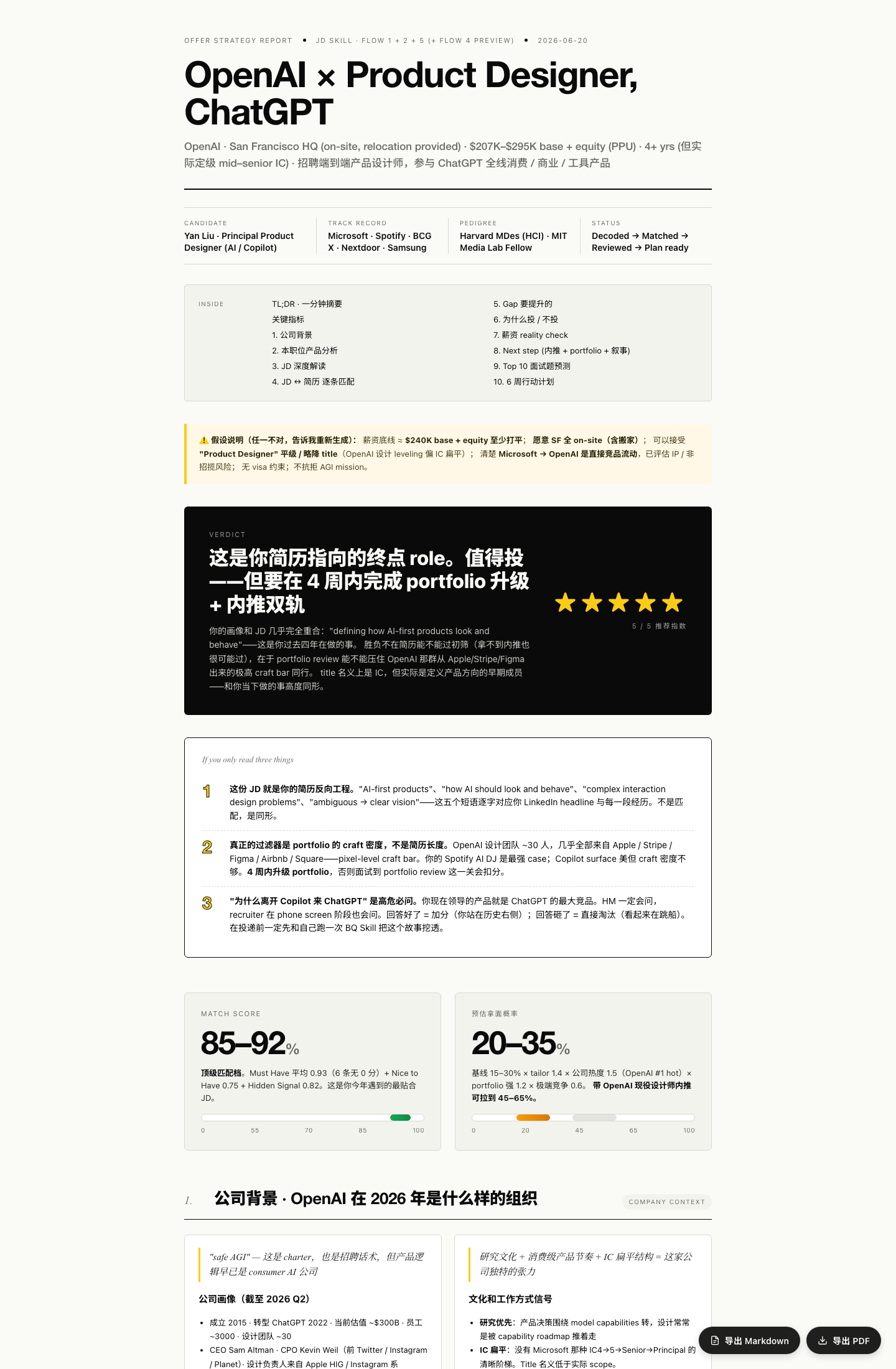
Hero of an actual run — verdict + assumptions + TL;DR + two gauges, plus the in-page Export PDF / Export Markdown buttons in the bottom right.
| # | Section | What it answers | |---|---------|-----------------| | — | TL;DR · one-minute verdict | Should I apply? ⭐ 1–5. | | — | Key metrics | Match Score gauge + Interview Probability gauge. | | 1 | Company background | Who runs this place, what are the cultural signals, what shipped in the last 12–24 months. | | 2 | Product analysis for this role | What product / surface this role owns + the 4 core design challenges + the real scope behind the JD. | | 3 | JD deep decode | Why this JD reads the way it does (5-layer decode + Hidden Signal dictionary hits). | | 4 | JD ↔ resume line-by-line match | Must Have cards + full Match Matrix (3 columns: JD ask / resume evidence / score+gap) + Nice + 10-dim Hidden Signal radar. | | 5 | Gap — what to upgrade | 2–4 gap cards with severity (high/middle) + 4-week mitigation. | | 6 | Why apply / why not | 3 reasons each side. Every "why not" comes with an HM probe response. | | 7 | Salary reality check | JD band + market data + negotiation talking points. | | 8 | Next step | Career arc fit + referral playbook (who, DM template) + portfolio audit (4-week action list). | | 9 | Top 10 interview questions | Interview prediction preview. Full Top 20 + behavior stories → hand off to BQ Skill. | | 10 | 6-week action plan | Week-by-week to-dos: before applying / after applying / before interview. |
The report supports Export to PDF (CJK-safe Noto font embedding) and Export to Markdown (single-file MD download). Spec: frameworks/offer-strategy-report.md · skeleton: examples/offer-strategy-template.html.
Three rules
- Decode before you act — Decoding the JD first is mandatory before doing match or tailor. Matching against the wrong target means the match is wrong.
- Never fabricate — Never invent experience, skills, or numbers the candidate didn't claim. If real evidence is missing, mark it ❌.
- One thing at a time — No mixing. If the decode step left ambiguity, clarify before moving on.
File Structure
job-description-skill/
├── SKILL.md                      # Entry · routing · three rules
├── prompts/                      # Execution prompts for each flow
│   ├── jd-decoder.md
│   ├── match-score.md
│   ├── resume-tailor.md
│   ├── interview-predictor.md
│   └── should-i-apply.md
├── frameworks/                   # Reusable frameworks / rubrics
│   ├── decode-patterns.md        # JD keyword → real intent dictionary
│   ├── match-rubric.md           # Scoring rubric (Must / Nice / Hidden)
│   ├── resume-tailoring.md       # Three-version resume strategy
│   ├── go-no-go.md               # ⭐ rating + interview probability formula
│   └── offer-strategy-report.md  # Final HTML report — sections, visual system, content rules
├── examples/                     # Reference skeletons (no personal data)
│   └── offer-strategy-template.html
└── jd-bank/                      # Local cache of analyzed JDs (gitignored)
    ├── _index.md                 # Index
    └── _jd-template.md           # Starter template for new JDs
How it thinks
- A JD reflects three layers — company signals, the hiring manager's real expectations, and the product / role in question. The skill's job is to see through the HR packaging to those three.
- Decide before you optimize — most candidates keep polishing resumes for the wrong roles. Decide whether to apply at all first.
- Every score has a formula — not magic. Every Match Score and Interview Probability comes from an explicit formula in
frameworks/. Disagree with the premise? You can argue back.
Related skills
Pairs with these two — decode the JD here, then hand off:
- offer-toolkit-skill — the all-in-one bundle (JD · Resume · BQ)
- resume-builder-skill — Resume Builder & Beautifier (11 print-ready templates)
- Behavior-question-skill — Behavioral interview / story bank
See a dream job → JD Skill (decode · match · should-I-apply)
                     ↓ decide to apply
                  Resume Skill (tailor + polish)
                     ↓ get the interview
                  BQ Skill (mine stories · mock interview)
License
MIT — fork it, remix it, ship your own version.
Created by Dreameryanyan · LinkedIn · X · Xiaohongshu


