
[CVPR 2026 Highlight] WorldMM: Dynamic Multimodal Memory Agent for Long Video Reasoning
🌏 WorldMM: Dynamic Multimodal Memory Agent for Long Video Reasoning



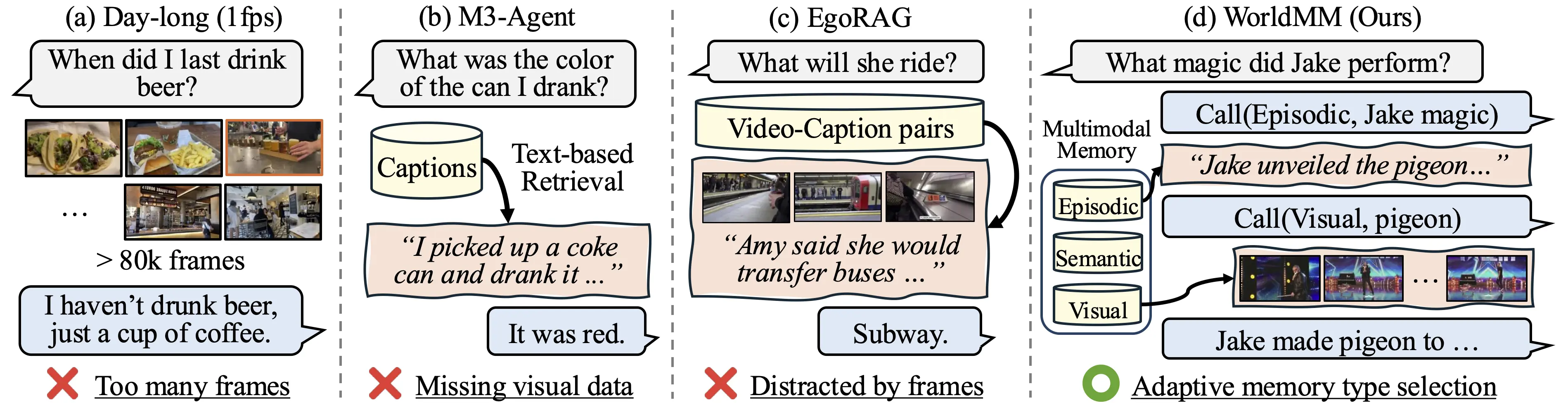
WorldMM is a novel dynamic multimodal memory agent designed for long video reasoning. It constructs multimodal, multi-scale memories that capture both textual and visual information, and employs adaptive retrieval across multiple memories with reasoning.
Get Started
To set up the environment, we recommend using uv for fast and deterministic setup. All dependencies are specified in pyproject.toml and pinned in uv.lock.
1. Clone the Repository
git clone https://github.com/wgcyeo/WorldMM.git
cd WorldMM
2. Run the Setup Script
The setup script will:- Install uv (if not already installed)
- Install all project dependencies
- Download required datasets
bash script/1_setup.sh3. Set Environment Variables (Optional)
To use GPT-family models for preprocessing or evaluation, set your OpenAI API key:export OPENAIAPIKEY="youropenaiapi_key"Preprocessing
Before memory construction and evaluation, preprocess the EgoLife dataset:
bash script/2_preprocess.shAfter preprocessing, the dataset directory is organized as follows:
data/EgoLife/ ├── A1_JAKE/ │ ├── DAY1/ # Video files │ ├── DAY2/ │ └── ... ├── EgoLifeCap/ │ ├── DenseCaption/ # Fine-grained video captions (in Chinese) │ │ └── translated/ # Machine-translated English captions │ ├── Sync/ # Synchronized transcripts + captions │ └── Transcript/ # Audio transcripts └── EgoLifeQA/ └── EgoLifeQAA1JAKE.json # QA annotationsMemory Construction
WorldMM builds three memory modules—episodic, semantic, and visual—to support long-term reasoning, which can be constructed with:
bash script/3buildmemory.shbash script/3buildmemory.sh --step [episodic|semantic|visual]Options
--step <type> # Memory type: episodic, semantic, visual, all --gpu <ids> # GPU IDs to use (default: 0,1,2,3) --model <name> # LLM model for memory construction (default: gpt-5-mini)[!TIP]
To skip memory construction and use the prebuilt WorldMM EgoLife memory metadata, download it from wgcyeo/WorldMM-EgoLife into output/metadata.
Evaluation
Run evaluation on EgoLifeQA with:
bash script/4_eval.sh --retriever-model gpt-5-mini --respond-model gpt-5Options
--retriever-model <m> # Model for retrieval process (default: gpt-5-mini) --respond-model <m> # Model for iterative reasoning and generating answers (default: gpt-5) --max-rounds <n> # Max retrieval rounds (default: 5)gpt-5 and qwen3vl-8b.
Using WorldMM on Other Video Benchmarks
Beyond evaluation on week-long videos, WorldMM also supports evaluation on general video benchmarks. We provide an example pipeline for Video-MME:
bash script/videomme/1_setup.sh bash script/videomme/2_preprocess.sh bash script/videomme/3buildmemory.sh --model gpt-5-mini bash script/videomme/4_eval.sh --retriever-model gpt-5-mini --respond-model gpt-5script/videomme.
Citation
If you find WorldMM helpful, please consider citing our paper:
@inproceedings{yeo2026worldmm, title = {WorldMM: Dynamic Multimodal Memory Agent for Long Video Reasoning}, author = {Yeo, Woongyeong and Kim, Kangsan and Yoon, Jaehong and Hwang, Sung Ju}, booktitle = {Proceedings of the IEEE/CVF Conference on Computer Vision and Pattern Recognition (CVPR)}, month = {June}, year = {2026}, pages = {25599-25609} }Acknowledgments
Our implementation is built upon EgoLife, HippoRAG, and VLM2Vec. We thank the authors for open-sourcing their code and dataset.


