
“The Architect's Field Guide. Featuring The Khan Pattern™ for Adaptive Granularity: stop splitting, start governing.” -Vaquar Khan
📖 Microservices Recipes: The Architect's Field Guide
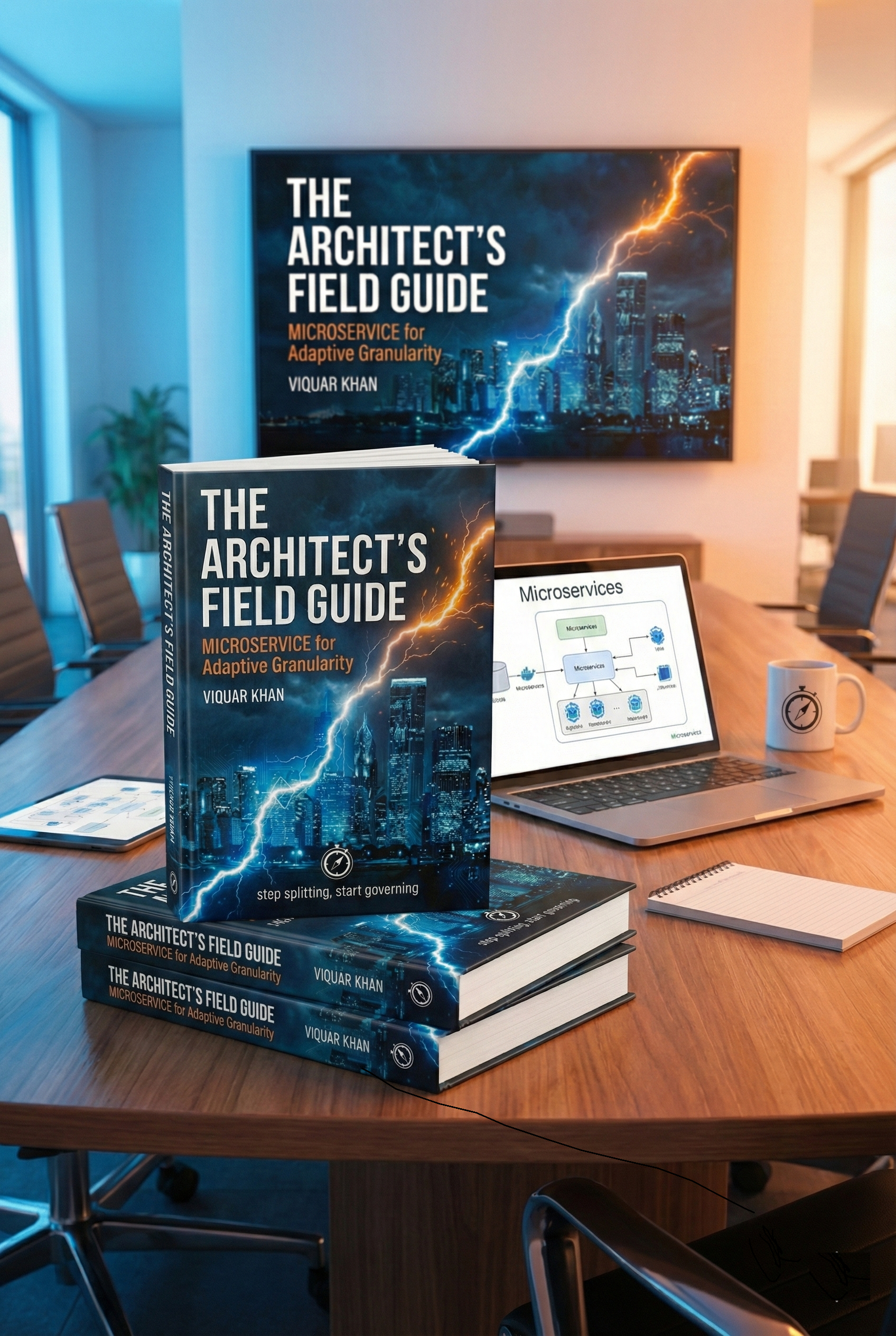
A practical guide to building, scaling, and managing microservices architectures
As defined by Sam Newman in his foundational text Building Microservices, microservices are "small, autonomous services that work together." This definition emphasizes the dual requirements of independence and interoperability.
Featuring Adaptive Granularity Governance: The Khan Microservice Pattern




"Stop splitting, start governing." - Adaptive Granularity Governance: The Khan Microservice Pattern

📋 Table of Contents
📚 Front Matter
- 📖 Preface - The Architect's Mandate
- 👨💻 About the Author - Viquar Khan and Adaptive Granularity Governance
- 🎓 Free Mentorship - 1:1 Sessions with Viquar Khan
- ⚖️ Licensing - MIT for code; CC BY-NC-ND 4.0 for prose and figures
- 🏷️ Naming - Methodology title and attribution
- 📖 Citations Guide - How to Cite This Work Properly
- 📜 Copyright Notice - Copyright and dual license
- ⚖️ Disclaimer - Legal notice
- 🤝 Contributing - How to Contribute
- 📜 Version History - Release lineage
- 📋 Changelog - 2017 to present change log
- 🎓 Free Academic Access - Academic edition notes
- 📄 CITATION.cff - Machine-readable citation metadata
📖 Part I: The Sociotechnical Substrate
Focus: Aligning organization and architecture to prevent the "Distributed Monolith"| Chapter | Title | Description | Read Time | |---------|-------|-------------|-----------| | 1 | The Definition Wars & The Reality of SOA | Understanding microservices lineage and avoiding SOA's mistakes | 15 min | | 2 | The Distributed Monolith and Anti Patterns | Identifying and preventing distributed monolith anti-patterns | 25 min | | 3 | Strategic Decomposition: Domain Driven Design | Applying DDD principles to determine service boundaries | 20 min |
🗄️ Part II: Data Architecture
Focus: Managing data consistency and transactions in distributed systems| Chapter | Title | Description | Read Time | |---------|-------|-------------|-----------| | 4 | The End of ACID | Understanding distributed data consistency challenges | 30 min | | 5 | Distributed Transactions (The Saga Pattern) | Implementing reliable distributed transactions | 25 min | | 6 | The Dual Write Problem | Solving data consistency across service boundaries | 20 min | | 7 | Data Mesh vs. Data Fabric | Modern approaches to distributed data management | 18 min |
🌐 Part III: Inter Process Communication
Focus: Moving bits between services without creating latency storms| Chapter | Title | Description | Read Time | |---------|-------|-------------|-----------| | 8 | The Trinity of Protocols | HTTP/REST, gRPC, and GraphQL communication patterns | 22 min | | 9 | The Rise of eBPF Networking and the Post Sidecar Era | Next-generation service mesh and networking | 28 min | | 10 | Asynchronous Messaging Patterns | Event-driven architecture and messaging strategies | 30 min |
🎯 Part IV: Adaptive Granularity Governance
Focus: Quantitative framework for microservices decomposition (The Khan Microservice Pattern)| Chapter | Title | Description | Read Time | |---------|-------|-------------|-----------| | 11 | Adaptive Granularity Governance: The Khan Microservice Pattern | Origin, RVx Index, and maturity model | 40 min |
🧱 Part V: Resilience Engineering & Advanced Scaling
Focus: Blast-radius control and evidence-based failure injection| Chapter | Title | Description | Read Time | |---------|-------|-------------|-----------| | 12 | Shuffle Sharding & Blast-Radius Minimization | Probabilistic tenant-shard assignment and collision analysis | 55 min | | 13 | Chaos Engineering & Evidence-Based Resilience | Hypotheses, game days, and AWS FIS guardrails | 60 min |
🏗️ Part VI: The Platform Engineering Shift
Focus: Golden paths, policy-as-code, and telemetry economics| Chapter | Title | Description | Read Time | |---------|-------|-------------|-----------| | 14 | Infrastructure as Code at Scale | Modules, drift, Terraform/CDK/Pulumi trade-offs | 58 min | | 15 | Observability 2.0 | OpenTelemetry, X-Ray, wide events, sampling design | 62 min |
🤖 Part VII: The AI Frontier (2026)
Focus: Probabilistic components inside deterministic architectures| Chapter | Title | Description | Read Time | |---------|-------|-------------|-----------| | 16 | Agentic AI Architectures | Tool gateways, Bedrock agents, safety cases | 58 min | | 17 | Retrieval-Augmented Generation at Scale | HyDE, evaluation, ACL-aware corpora | 60 min |
🚀 Part VIII: The Migration Playbook
Focus: Monolith-first discipline and incremental replacement| Chapter | Title | Description | Read Time | |---------|-------|-------------|-----------| | 18 | The Modular Monolith | Schema-per-module, ArchUnit, contraction economics | 55 min | | 19 | The Strangler Fig Pattern | Edge routing, data strangler, parity proofs | 55 min |
📈 Part IX: Organizational Maturity
Focus: KM3 operational assessment| Chapter | Title | Description | Read Time | |---------|-------|-------------|-----------| | 20 | The Khan Microservices Maturity Model (KM3) | Stages, instrumentation, X-Ray sampling | 50 min |
📚 Reference Materials
| Resource | Description | |----------|-------------| | 📖 Glossary | Comprehensive definitions of microservices terms | | ⚡ Quick Reference | Handy reference cards for patterns and practices | | 📚 Bibliography | Curated list of books, articles, and resources |
🎯 What Makes This Book Special
Adaptive Granularity Governance: The Khan Microservice Pattern
At the heart of this book is Adaptive Granularity Governance: The Khan Microservice Pattern (formerly the Adaptive Granularity Strategy): a systematic methodology for determining optimal microservice boundaries. This adaptive framework considers your specific:
Field basis: The methodology is an original synthesis by the author, refined through professional practice. Please cite when you reuse it (CITATIONS.md).
- Organizational maturity and team structure
- Business domain complexity and change frequency
- Technical constraints and operational capabilities
- Evolutionary growth and learning patterns
"The goal is not to build the perfect architecture, but to build an architecture that can evolve toward perfection." - Viquar Khan
Key Features
✅ Practical, Not Theoretical - Every pattern tested in production ✅ Context-Aware Guidance - Solutions for different organizational contexts ✅ Evolution-Focused - Architecture as a journey, not a destination ✅ Anti-Pattern Awareness - Learn from real-world failures ✅ Complete Framework - Design through operations coverage
🚀 Quick Start Guide
For Beginners
- Start with Chapter 1: The Definition Wars
- Read The Preface to understand the book's philosophy
- Progress sequentially through Parts I → II → III
For Experienced Practitioners
- Review the Table of Contents above
- Jump to specific chapters addressing your current challenges
- Use Quick Reference for rapid pattern lookup
For Architects
- Focus on strategic chapters: Ch 2, Ch 3, Ch 7
- Study Adaptive Granularity Governance: The Khan Microservice Pattern (formerly Adaptive Granularity Strategy)
- Review Complete Book Preview for advanced topics
📊 Book Statistics
| Metric | Value | |--------|-------| | Total Chapters | 20 (chapters 1-10 linked in TOC; 11-20 listed without open links) | | Reading Time | ~4.5 hours total | | Content Length | 236,000+ characters | | Code Examples | 50+ practical implementations | | Patterns Covered | 25+ architectural patterns | | Case Studies | Real-world examples from industry leaders | | GitHub Stars | 606 developers | | Repository Forks | 228 active forks | | Author Followers | 1,400+ on @vaquarkhan | | Community Reach | Global developer community |
🌟 What You'll Master
🏗️ Architectural Patterns
- Adaptive Granularity Governance: The Khan Microservice Pattern for adaptive service granularity
- Distributed Monolith identification and prevention
- Domain-Driven Design for service boundaries
- Saga Pattern for distributed transactions
- Event Sourcing and CQRS patterns
- API Gateway and Service Mesh architectures
🔧 Technical Implementation
- Microservices Communication (REST, gRPC, GraphQL)
- Data Management strategies and consistency patterns
- Deployment & Operations with containers and orchestration
- Monitoring & Observability with distributed tracing
- Security patterns and zero-trust architectures
- Testing Strategies for distributed systems
🎯 Real-World Skills
- Conway's Law and organizational design
- Failure Mode Analysis and resilience engineering
- Performance Optimization and scalability patterns
- Migration Strategies from monolith to microservices
- Team Topologies and cognitive load management
- Platform Engineering and developer experience
👨💻 About the Author
Viquar Khan is a Senior Data Architect at AWS Professional Services with 20+ years of expertise in distributed systems. Creator of Adaptive Granularity Governance: The Khan Microservice Pattern, the Service Decomposition Workflow, and the Microservices Maturity Assessment (KM3). Original methodologies by the author; please cite.
Credentials
- 🏆 JSR 368 Expert Group Member (Java Message Service 2.1)
- 📚 Author of "Data Engineering with AWS Cookbook" (Packt, 2026)
- 🌟 7.5M+ developers reached on Stack Overflow
- 👥 1,400+ GitHub followers (@vaquarkhan)
- 🔧 50+ open-source microservices repositories
🌐 Access This Book
📖 Read Online
- GitHub Pages: https://vaquarkhan.github.io/microservices-recipes-a-free-gitbook/
- GitHub Repository: https://github.com/vaquarkhan/microservices-recipes-a-free-gitbook
🎓 Academic Access
- Complete 20-Chapter Edition: Request Free Access for students, faculty, and researchers under my Official Academic License
- Citation Guide: Proper Citation Formats for academic use
- Version History: Release Lineage and evolution
💾 Download Options
- Clone Repository:
git clone https://github.com/vaquarkhan/microservices-recipes-a-free-gitbook.git - Download ZIP: Latest Release
- PDF Version: Available through Academic Access Program
🤝 Community & Support
🌟 Support This Open Knowledge Initiative
If you find this resource valuable, please help me keep it free and accessible:⭐ Star this repository - Help others discover this work 🍴 Fork the project - Build upon these methodologies 📖 Cite properly - Support academic recognition
Get Involved
- 🐛 Report Issues - Found an error or have suggestions?
- 💡 Share Case Studies - Connect with the author to share real-world implementation experiences
- 📊 View Impact - See global reach: 606 stars, 228 forks, 1,400+ followers on @vaquarkhan
- 🔄 See Guidelines - Learn about acceptable contributions
- ⭐ Star this repo if you find it valuable!
Professional Networks
- 🔗 LinkedIn: Microservices Architecture Practitioners Group
- � ResearchGate: Academic Collaboration Hub
Stay Updated
- 📢 Watch this repository for updates
- 🔔 Follow @vaquarkhan for announcements
- 📧 Subscribe to release notifications
📜 License & Usage
This book is released under the MIT License - free for personal and commercial use.
Citation
Khan, V. (2026). Microservices Recipes: The Architect's Field Guide.
GitHub. https://github.com/vaquarkhan/microservices-recipes-a-free-gitbook
🚀 Ready to Begin Your Journey?
Choose Your Path



"The journey of a thousand microservices begins with a single service boundary."
Build better, more scalable systems with proven methodologies. 🚀
How to cite
Machine-readable metadata: CITATION.cff. Full guide: CITATIONS.md.
APA:
Khan, V. (2026). Microservices recipes: The architect's field guide (Version 2.0) [Featuring Adaptive Granularity Governance: The Khan Microservice Pattern]. GitHub. https://github.com/vaquarkhan/microservices-recipes-a-free-gitbookIEEE:
[1] V. Khan, Microservices Recipes: The Architect's Field Guide, ver. 2.0, featuring Adaptive Granularity Governance: The Khan Microservice Pattern. GitHub, 2026. [Online]. Available: https://github.com/vaquarkhan/microservices-recipes-a-free-gitbookCopyright and licensing
Copyright © 2017-2026 by Vaquar Khan.
Adaptive Granularity Governance: The Khan Microservice Pattern, the Service Decomposition Workflow, and the Microservices Maturity Assessment (KM3) are original methodologies by Vaquar Khan; please cite. No trademark is claimed at this time.
| Material | License | |----------|---------| | Source code | MIT | | Book text, diagrams, figures | CC BY-NC-ND 4.0 |
Details: LICENSING.md | COPYRIGHT.md | DISCLAIMER.md | NAMING.md
Last Updated: July 9, 2026 | Original work by Vaquar Khan


