
Indonesia Stock Exchange (IHSG) Deep Learning Trading System
Paperium: IHSG Deep Learning Trading System

System Type: Deep Learning Quantitative Trading\ Target Market: Indonesia Stock Exchange (IHSG)\ Model Architecture: LSTM (Long Short-Term Memory)\ Labeling Scheme: Triple Barrier Method
Paperium is a sophisticated quantitative trading system for the Indonesia Stock Exchange (IHSG). It implements state-of-the-art Deep Learning (LSTM) trained on raw OHLCV sequences, guided by Triple Barrier Labeling, as described in recent financial machine learning research.
Paper: https://arxiv.org/pdf/2504.02249v1
[!IMPORTANT]
Paperium V0 and Paperium V1 still available in the branch section with differnt model architecture
Paperium Ensemble
Go train the paperium v1 xgboost model on paperium-v1 branch and combine it with paperium v2 to get more accurate signaling with entry and dynamic SL/TP, instead of fixed 3%.
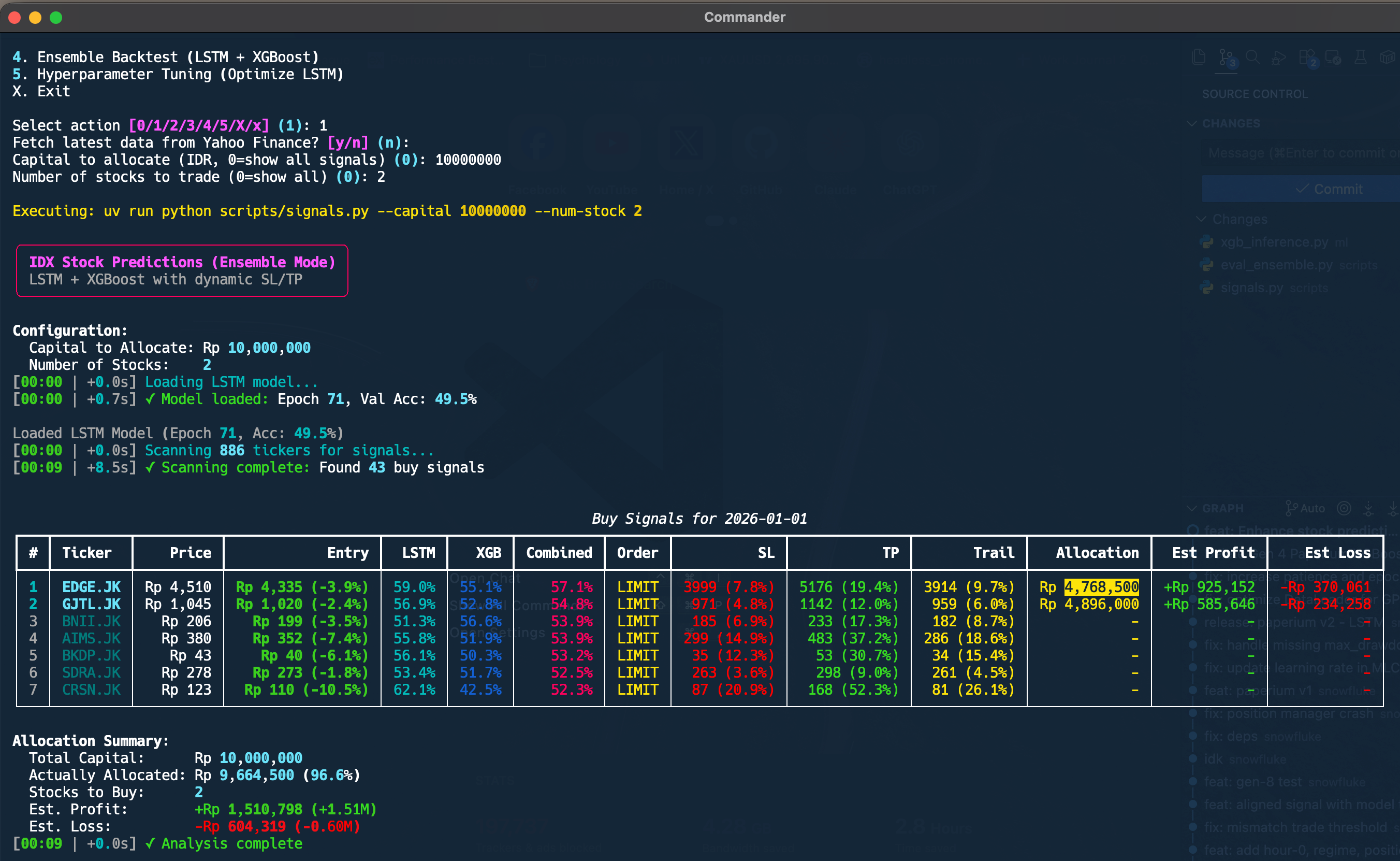
Table of Contents
- Core Philosophy
- Key Innovations
- Architecture
- Quick Start
- Usage Guide
- Model Details
- Data Pipeline
- Training Strategy
- Portfolio Management
- Configuration
- Performance Optimization
- Known Issues & Future Work
Core Philosophy
Paperium has transitioned from traditional ML (XGBoost + Technical Indicators) to Deep Learning on Raw Data. The hypothesis is that neural networks can learn better feature representations from raw price sequences than human-engineered indicators (RSI, MACD, etc.).
By feeding the LSTM raw OHLCV data, we avoid:
- Feature selection bias
- Over-engineering indicators
- Look-ahead bias from complex transformations
Key Innovations
1. Deep Learning Core
Uses a 2-layer LSTM (Long Short-Term Memory) network instead of traditional tree-based models (XGBoost). LSTMs excel at capturing long-term dependencies in time-series data.
2. Raw Data Input
Eliminates "feature engineering" bias. The model learns directly from 100-day sequences of raw Open, High, Low, Close, Volume (OHLCV) data.
3. Triple Barrier Labeling (TBL)
Instead of fixed "Close-to-Close" returns, we use TBL to capture the path dependency of trading.
- Barrier 1 (Profit): +3% gain within horizon
- Barrier 2 (Loss): -3% loss within horizon
- Barrier 3 (Time): 5-day expiration (neutral)
- Result: The model predicts the probability of hitting the profit barrier first
- If High > Entry × 1.03 first → Label 2 (PROFIT)
- If Low < Entry × 0.97 first → Label 0 (LOSS)
- If neither happens by Day 5 → Label 1 (NEUTRAL)
Architecture
Directory Structure
paperium/
├── data/              # Data storage and fetching
│   ├── fetcher.py         - Yahoo Finance API integration
│   ├── storage.py         - SQLite database operations
│   ├── universe.py        - Stock universe definitions
│   └── ihsg_trading.db    - Price data storage
│
├── ml/                # Machine Learning components
│   ├── model.py           - PyTorch LSTM implementation
│   └── features.py        - Sequence generation & TBL logic
│
├── signals/           # Signal generation
│   ├── screener.py        - Liquidity & circuit breaker filters
│   └── combiner.py        - Signal aggregation (Pure ML confidence)
│
├── strategy/          # Portfolio management
│   ├── position_manager.py - Trade state persistence
│   └── position_sizer.py   - Volatility-adjusted sizing
│
├── scripts/           # Executable workflows
│   ├── train.py           - Main training loop (PyTorch)
│   ├── tune_lstm.py       - Hyperparameter optimization
│   ├── eval.py            - Backtesting engine
│   ├── signals.py         - Stock prediction signals (ML-based)
│   ├── eod_retrain.py     - Evening updates (post-market)
│   ├── sync_data.py       - Data synchronization
│   ├── download_ihsg.py   - Index data fetching
│   ├── optimize_tbl.py    - Barrier optimization tool
│   └── clean_universe.py  - Universe filtering
│
├── utils/             # Shared utilities
│   └── logger.py          - Timestamped logging
│
├── models/            # Trained model checkpoints
│   └── best_lstm.pt       - Production model
│
├── run.py             # Main entry point (Interactive CLI)
└── config.py          # System configuration
Component Status
| Component | Status | Notes | | ----------------------- | ---------- | ---------------------------------------- | | Data Fetcher | Stable | SQLite backend with hourly caching | | Screener | Simplified | Blacklist filtering for illiquid stocks | | Feature Engineering | Replaced | Generates sequences + TBL labels | | Model | PyTorch | Saved as best_lstm.pt | | Training | Active | train.py handles loop & early stopping | | Evaluator | Active | eval.py runs walk-forward backtest | | Signal Generator | Active | signals.py with confidence weighting |
Quick Start
1. Installation
# Install dependencies using uv
uv sync
Dependencies: PyTorch, Pandas, NumPy, Rich, yfinance, scikit-learn, SQLite3
2. Initial Setup
# Launch interactive menu
uv run python run.py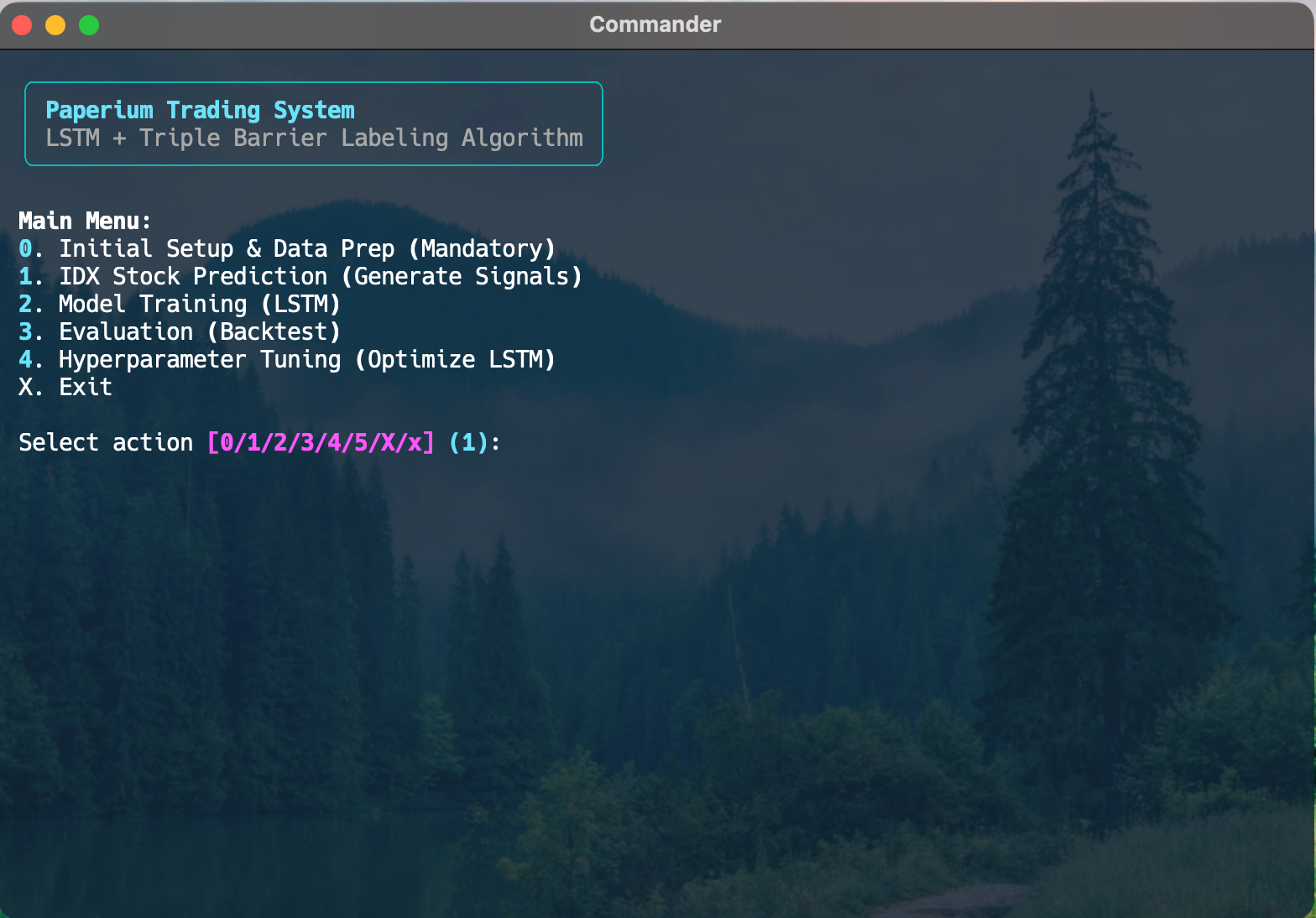
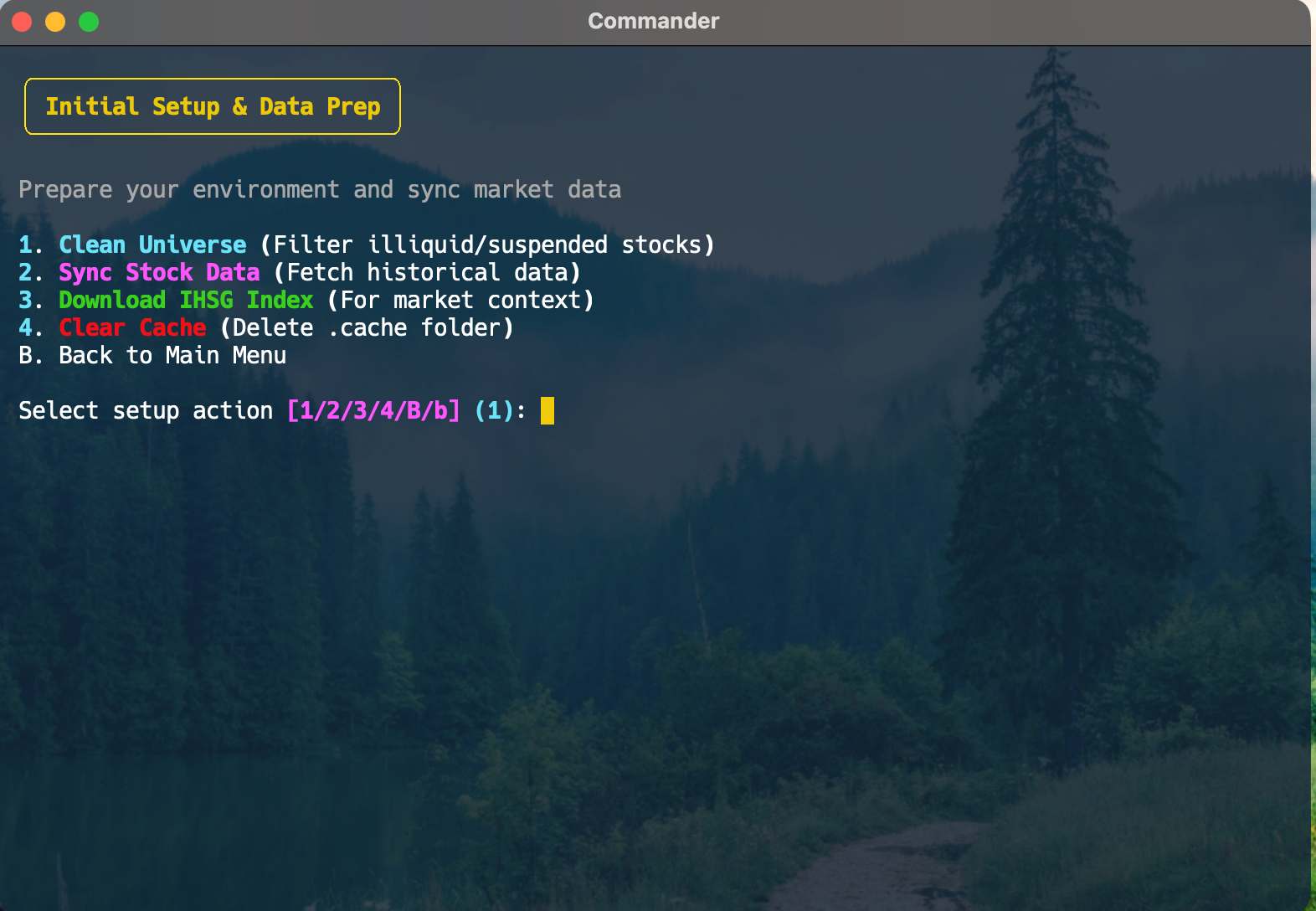
Select Option 0: Initial Setup & Data Prep, then:
- Clean Universe - Filter illiquid/suspended stocks
- Sync Stock Data - Fetch historical data (5 years recommended)
- Download IHSG Index - Market context data
3. Train Your First Model
From the main menu, select Option 2: Model Training
Choose:
- Fresh training: Start new model from scratch
- Retrain: Continue from existing
best_lstm.pt - Set epochs (default: 50)
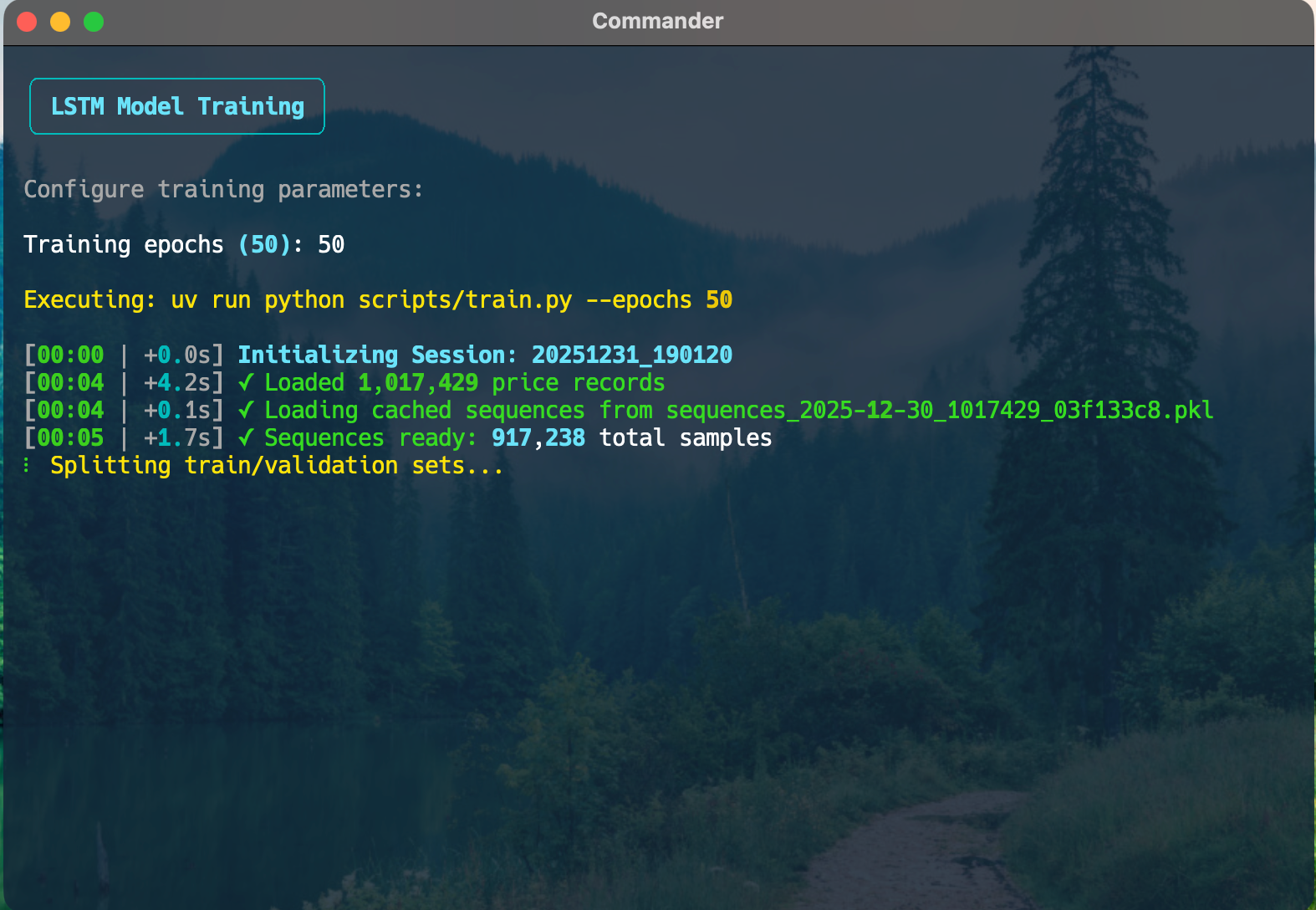
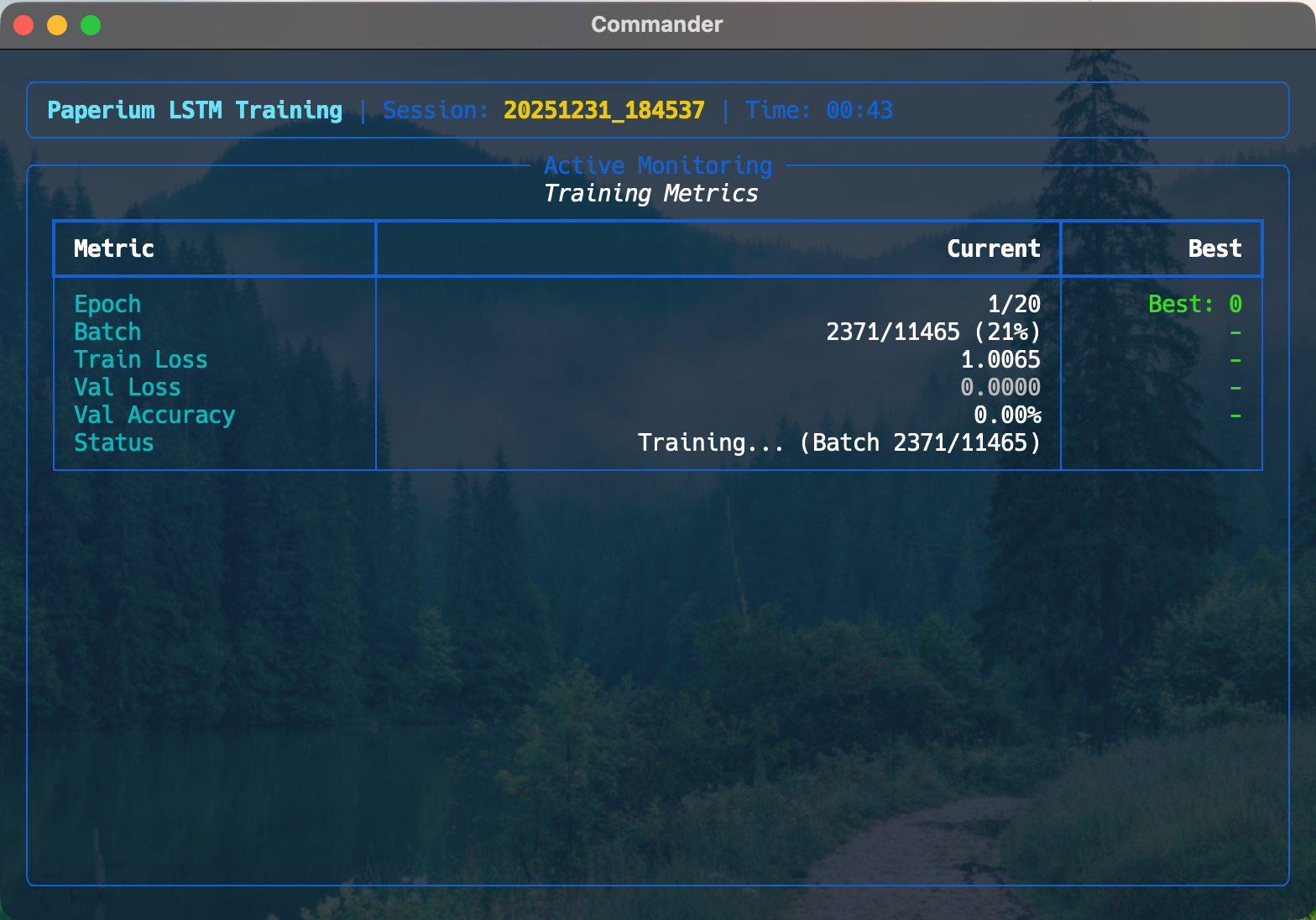
The training dashboard will show:
- Real-time loss/accuracy metrics
- Batch-level progress
- Time elapsed/remaining
- Early stopping status
4. Generate Trading Signals
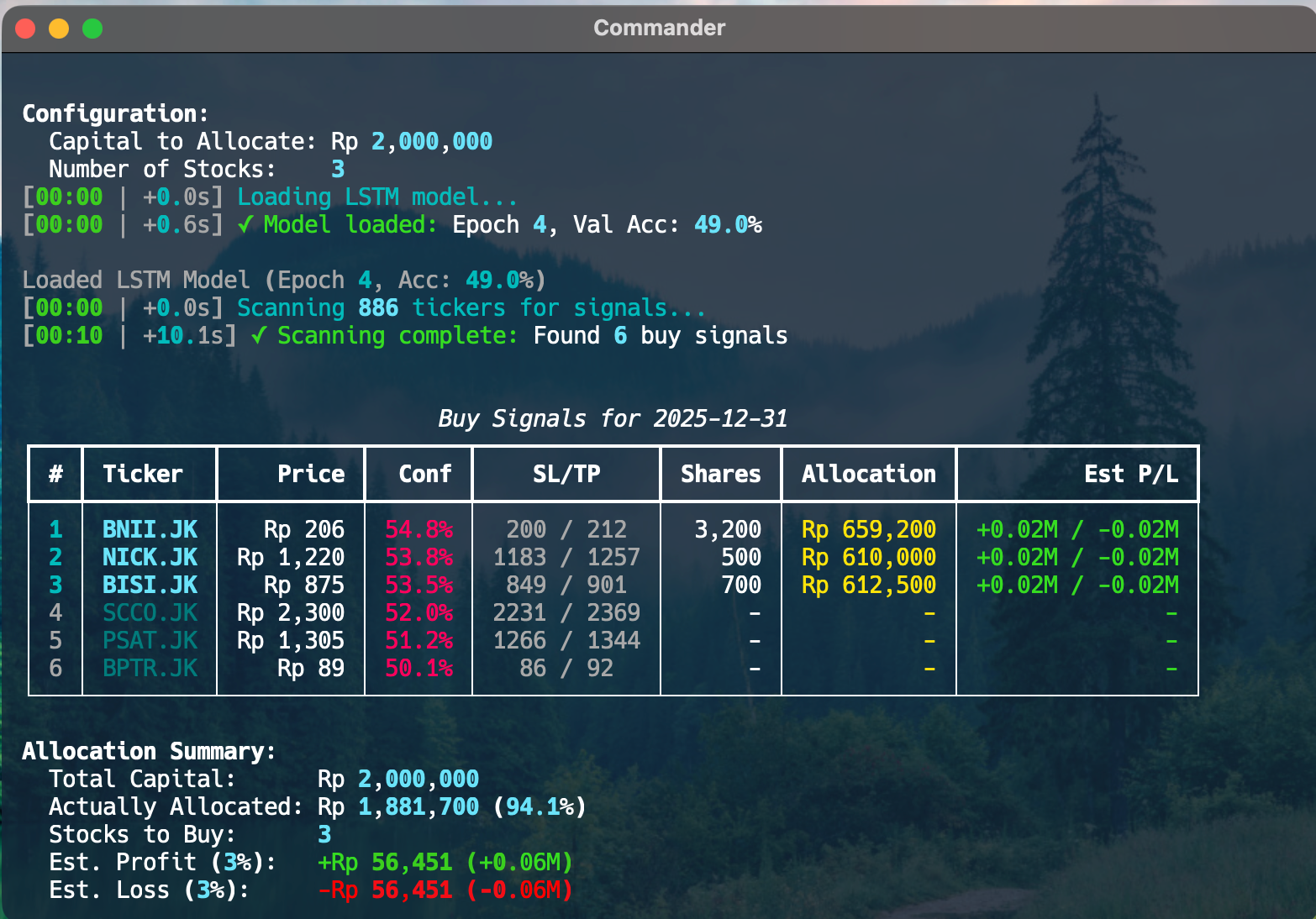
From the main menu, select Option 1: IDX Stock Prediction
This will:
- Load the trained model
- Scan the stock universe (filtered by blacklist)
- Generate ML-based buy signals
- Display predictions with confidence scores
- Optionally allocate capital across top N stocks with confidence weighting
Usage Guide
Main Workflows
Stock Prediction Signals
When: Before market opens (08:30 WIB) or anytime for analysis
# Basic mode - show all signals from database
uv run python scripts/signals.py
Fetch latest data from Yahoo Finance first
uv run python scripts/signals.py --fetch-latest
With capital allocation (confidence-weighted)
uv run python scripts/signals.py --capital 100000000 --num-stock 5
Fetch latest + allocate capital
uv run python scripts/signals.py --fetch-latest --capital 50000000 --num-stock 3
What it does:
- Optionally fetches latest market data from Yahoo Finance
- Runs LSTM inference on all tickers
- Filters blacklisted stocks (illiquid/suspended)
- Ranks signals by confidence (Class 2 probability > 50%)
- With allocation: confidence-weighted capital distribution across top N stocks
Configuration:
  Capital to Allocate: Rp 100,000,000
  Number of Stocks:    5
Buy Signals for 2025-01-01 ┏━━━┳━━━━━━━━┳━━━━━━━━━━━┳━━━━━━┳━━━━━━━━━━━┳━━━━━━━━┳━━━━━━━━━━━━━━┳━━━━━━━━━━━━━━━━━━━┓ ┃ # ┃ Ticker ┃   Price   ┃ Conf ┃   SL/TP   ┃ Shares ┃  Allocation  ┃     Est P/L       ┃ ┡━━━╇━━━━━━━━╇━━━━━━━━━━━╇━━━━━━╇━━━━━━━━━━━╇━━━━━━━━╇━━━━━━━━━━━━━━╇━━━━━━━━━━━━━━━━━━━┩ │ 1 │ BBCA   │ Rp 9,500  │ 72%  │ 9215/9785 │ 4,000  │ Rp 38,000,000│ +1.14M / -1.14M   │ │ 2 │ ASII   │ Rp 5,200  │ 65%  │ 5044/5356 │ 5,800  │ Rp 30,160,000│ +0.90M / -0.90M   │ │ 3 │ BBRI   │ Rp 4,800  │ 58%  │ 4656/4944 │ 4,100  │ Rp 19,680,000│ +0.59M / -0.59M   │ └───┴────────┴───────────┴──────┴───────────┴────────┴──────────────┴───────────────────┘
Allocation Summary:   Total Capital:      Rp 100,000,000   Actually Allocated: Rp 87,840,000 (87.8%)   Stocks to Buy:      5   Est. Profit (3%):   +Rp 2,635,200 (+2.64M)   Est. Loss (3%):     -Rp 2,635,200 (-2.64M)
Key Features:
- Blacklist Filtering: Automatically excludes 72 illiquid/suspended stocks
- Confidence Weighting: Higher confidence signals get larger allocation
- Latest Data: Optional
--fetch-latestensures up-to-date predictions - Flexible Display: Shows all signals or only allocated positions
Model Training
Command line:
# Fresh training
uv run python scripts/train.py --epochs 50
Retrain from best model
uv run python scripts/train.py --epochs 50 --retrain
Resume from specific checkpoint
uv run python scripts/train.py --resume models/session_X/last.pt
Interactive menu:
uv run python run.py
Select: 2. Model Training
Features:
- Real-time training dashboard with batch progress
- Timestamped logging for performance tracking
- Automatic early stopping (patience: 10 epochs)
- Session management (saves to
models/trainingsession<timestamp>/) - Best model saved to
models/best_lstm.pt - Sequence caching (dramatically speeds up subsequent runs)
[00:00 | +0.0s] Initializing Session: 20251231_143022
[00:01 | +1.2s] ✓ Loaded 1,234,567 price records
[00:02 | +0.9s] ✓ Loading cached sequences
[00:03 | +0.8s] ✓ Sequences ready: 45,678 total samples
[00:04 | +1.1s] ✓ Data Loaded: 36,542 train, 9,136 val
[00:05 | +1.2s] ✓ Model ready on device: mps
[00:05 | +0.1s] Starting training for 50 epochs...
╭─ Paperium LSTM Training | Session: 20251231_143022 | Time: 02:15 ─╮ │             Training Metrics                                       │ │ ┏━━━━━━━━━━━━━━┳━━━━━━━━━━━━━━━━━┳━━━━━━━━━━━━━━━━┓               │ │ ┃ Metric       ┃         Current ┃           Best ┃               │ │ ┃ Epoch        ┃           15/50 ┃        Best: 12┃               │ │ ┃ Batch        ┃     127/200 (63%)┃             - ┃               │ │ ┃ Train Loss   ┃          0.8234 ┃             - ┃               │ │ ┃ Val Loss     ┃          0.7891 ┃         0.7654┃               │ │ ┃ Val Accuracy ┃          68.23% ┃             - ┃               │ │ └──────────────┴─────────────────┴────────────────┘               │ ╰────────────────────────────────────────────────────────────────────╯
Evaluation & Backtesting
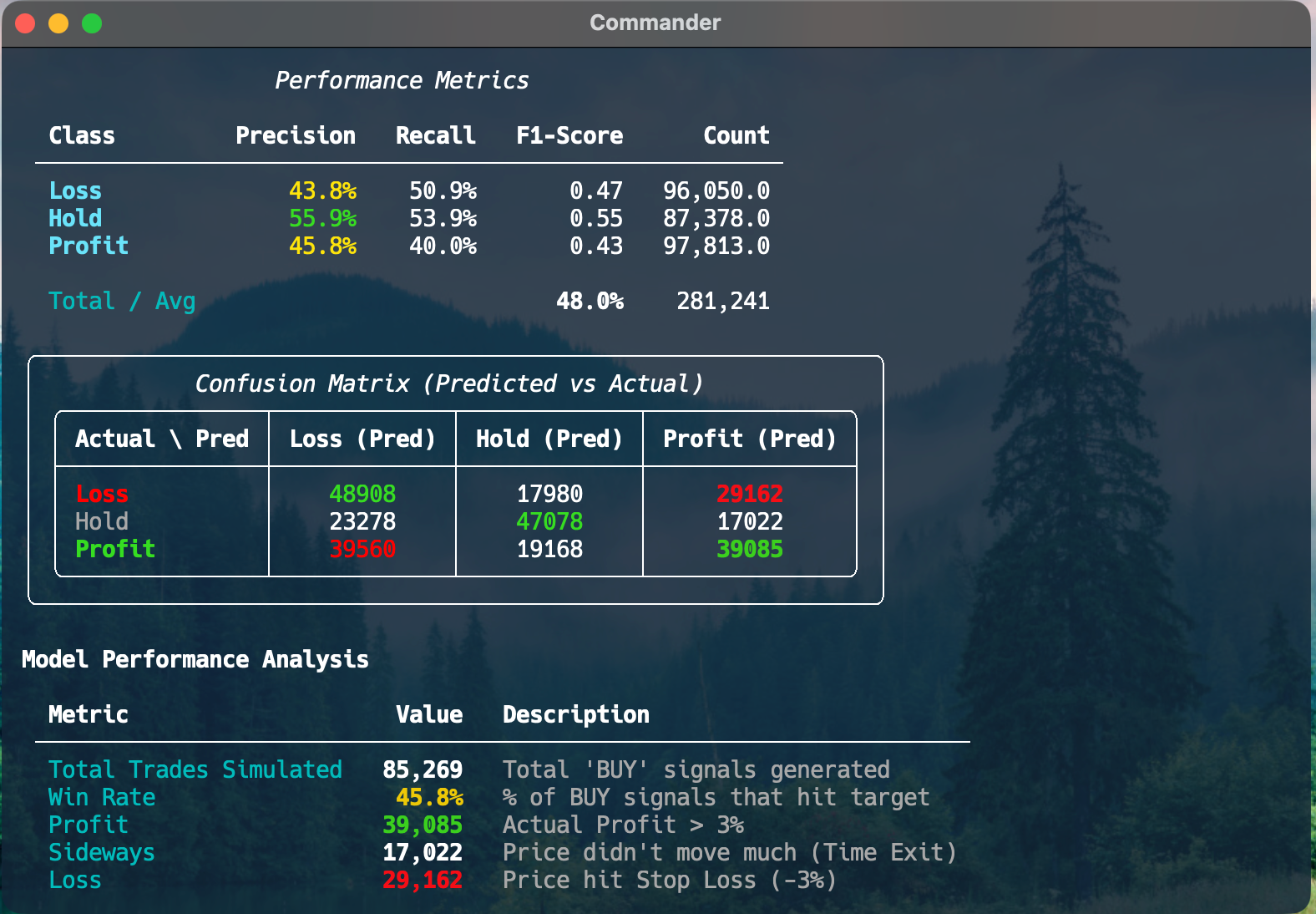
uv run python scripts/eval.py --start 2024-01-01 --end 2025-12-31What it does:
- Walk-forward testing on historical data
- Simulates real trading conditions
- Reports win rate, average return, Sharpe ratio
Hyperparameter Tuning
uv run python scripts/tune_lstm.py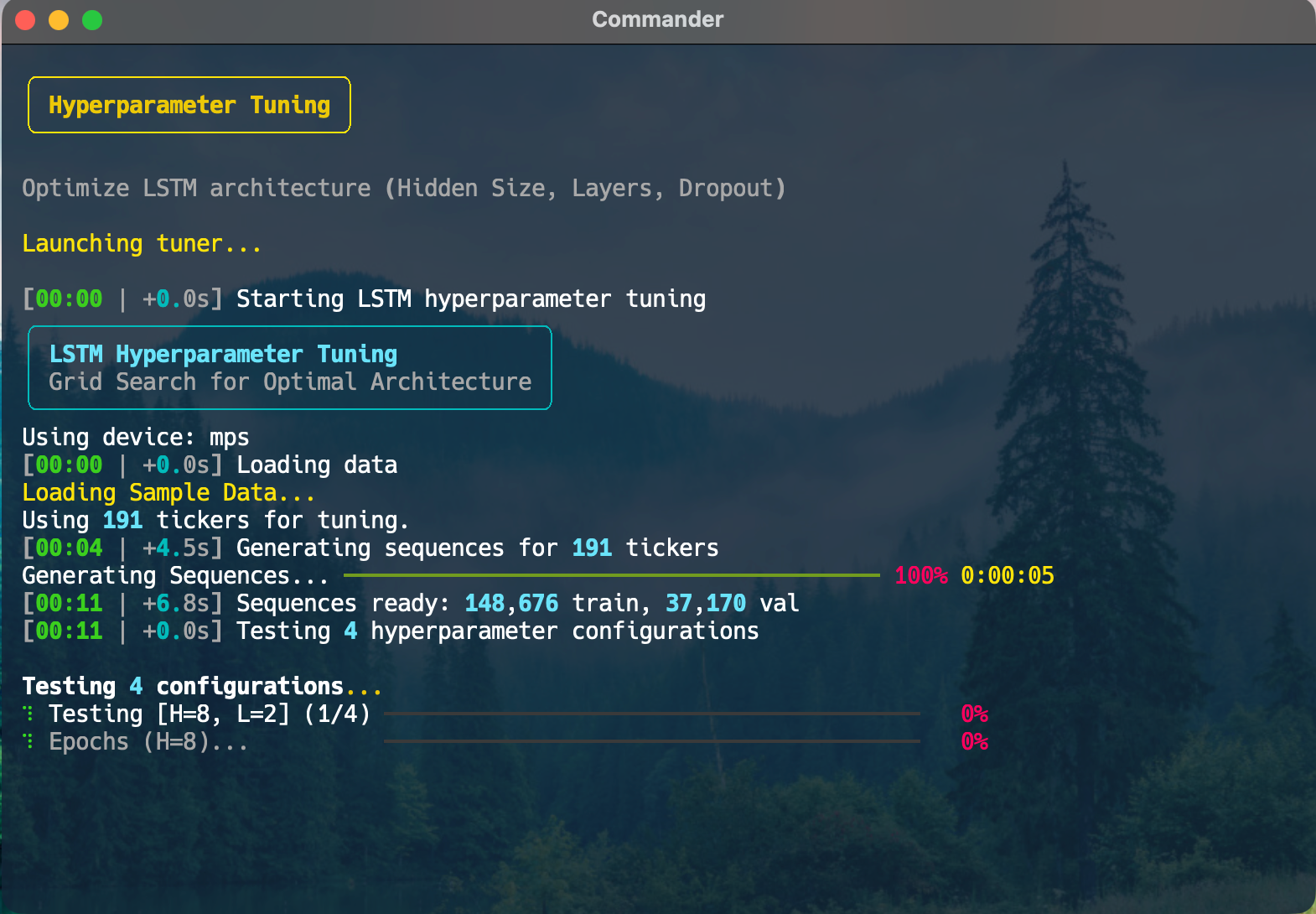
Tests combinations of:
- Hidden sizes: [4, 8, 16, 32]
- Number of layers: [1, 2, 3]
- Dropout rates: [0.0, 0.1, 0.2]
Evening Update (Post-Market)
uv run python scripts/eod_retrain.pyWhat it does:
- Fetches latest EOD data
- Updates position statuses (SL/TP hits)
- Checks if retrain trigger is met
- Optionally retrains model with fresh data
Model Details
LSTM Architecture
Input Shape: (Batch, 100, 5)
- 100 days of lookback
- 5 features: Open, High, Low, Close, Volume (normalized)
Input (100, 5)
    ↓
LSTM Layer 1: hidden_size=8
    ↓
LSTM Layer 2: hidden_size=8
    ↓
Fully Connected Layer
    ↓
Softmax (3 classes)
Output Classes:
- Class 0: LOSS - Hit lower barrier first (-3%)
- Class 1: NEUTRAL - Time expired (5 days)
- Class 2: PROFIT - Hit upper barrier first (+3%)
Why Small Hidden Size?
Financial data is extremely noisy. Large networks (32+ units) tend to overfit. Testing showed hidden_size=8 provides:
- Best generalization
- Fastest training
- Lowest validation loss
Data Pipeline
1. Ingestion
Source: Yahoo Finance API via yfinance
Fetching:
from data.fetcher import DataFetcher
fetcher = DataFetcher(stock_universe)
data = fetcher.fetch_batch(days=1825)  # 5 years
Caching:
- Hourly pickle cache in
.cache/folder - Cache key includes date + hour + ticker hash
- Speeds up repeated fetches from ~5 min to <1 sec
2. Storage
Database: SQLite (data/ihsg_trading.db)
Schema:
CREATE TABLE prices (
    id INTEGER PRIMARY KEY,
    date TEXT NOT NULL,
    ticker TEXT NOT NULL,
    open REAL,
    high REAL,
    low REAL,
    close REAL,
    volume INTEGER,
    createdat TEXT DEFAULT CURRENTTIMESTAMP,
    UNIQUE(date, ticker)
);
Indexing:
idxpricesdateidxpricesticker
3. Normalization
Prices: Normalized relative to first day of 100-day window
normalizedprice = (pricet / price_0) - 1Volume: Log-normalized
normalized_volume = log(volume + 1)4. Sequence Generation
Rolling Window:
- Size: 100 days
- Stride: 1 (overlapping sequences)
- Creates multiple training samples per ticker
def getlabel(entryprice, future_prices, horizon=5, barrier=0.03):
    upper = entry_price * (1 + barrier)  # +3%
    lower = entry_price * (1 - barrier)  # -3%
for day in range(1, horizon + 1):         if future_prices[day]['high'] >= upper:             return 2  # PROFIT         if future_prices[day]['low'] <= lower:             return 0  # LOSS
return 1  # NEUTRAL (time expired)
5. Train/Validation Split
Method: Time-ordered (chronological)
- Training: First 80%
- Validation: Last 20%
Training Strategy
Optimizer & Loss
Optimizer: Adam
- Learning rate: 0.001
- No weight decay
loss = CrossEntropyLoss()(predictions, labels)Batch Size: 64
Early Stopping
Patience: 10 epochs
If validation loss doesn't improve for 10 consecutive epochs, training stops automatically.
Why?
- Prevents overfitting
- Saves compute time
- Best model is already saved
Device Selection
Auto-detects available hardware:
if torch.backends.mps.is_available():
    device = "mps"  # Apple Silicon
elif torch.cuda.is_available():
    device = "cuda"  # NVIDIA GPU
else:
    device = "cpu"
Checkpointing
Auto-save:
models/best_lstm.pt- Best validation lossmodels/trainingsession<timestamp>/best.pt- Session bestmodels/trainingsession<timestamp>/last.pt- Latest epoch
uv run python scripts/train.py --resume models/trainingsessionX/last.ptSignal Generation & Capital Allocation
Confidence-Weighted Allocation
When both --capital and --num-stock parameters are provided, the system allocates capital proportionally to signal confidence:
Formula:
# Calculate weights based on confidence
totalconfidence = sum(signal['conf'] for signal in topN_signals)
weighti = signali['conf'] / total_confidence
Allocate capital
allocationi = totalcapital × weight_i
sharesi = int(allocationi / price_i / 100) × 100  # Round to lots
Example:
If you have Rp 100M to allocate across 3 stocks:
- Stock A (confidence: 75%) → Gets ~43% of capital
- Stock B (confidence: 60%) → Gets ~34% of capital
- Stock C (confidence: 50%) → Gets ~23% of capital
Blacklist Filtering
Automatically excludes 72 illiquid/suspended stocks defined in data/blacklist.py:
from data.blacklist import BLACKLIST_UNIVERSE
if ticker in BLACKLIST_UNIVERSE:     continue  # Skip blacklisted stock
Blacklisted tickers include: Penny stocks, suspended trading, low liquidity, high manipulation risk.
Risk Parameters
Per Position (from TBL):
- Stop Loss: Entry price × 0.97 (-3%)
- Take Profit: Entry price × 1.03 (+3%)
- Max Hold Period: 5 days
- Confidence Threshold: >50% for Class 2 (PROFIT)
estimatedprofit = allocation × tblbarrier  # +3%
estimatedloss = allocation × tblbarrier    # -3%
Configuration
config.py Structure
class DataConfig:
    dbpath = "data/ihsgtrading.db"
    window_size = 100      # Days of lookback
    lookback_days = 1825   # Historical fetch (5 years)
    stockuniverse = IDXUNIVERSE
class MLConfig:     input_size = 5         # OHLCV features     hidden_size = 8        # LSTM units     num_layers = 2         # LSTM layers     num_classes = 3        # LOSS/NEUTRAL/PROFIT     dropout = 0.0     batch_size = 64     learning_rate = 0.001
# Triple Barrier     tbl_horizon = 5        # Days     tbl_barrier = 0.03     # 3% threshold
class PortfolioConfig:     totalvalue = 100000_000  # IDR 100M     max_positions = 10
Tuning Parameters
If win rate is low:
- Increase
tbl_barrier(e.g., 0.04 = 4%) - Increase
tbl_horizon(e.g., 7 days)
- Add
dropout(e.g., 0.1) - Decrease
hidden_size(e.g., 4)
- Increase
hidden_size(e.g., 16) - Add more layers
Performance Optimization
Sequence Caching
Problem: Processing 957 tickers takes 30-60 seconds every training run.
Solution: Cache computed sequences to disk.
Cache Key:
cachekey = f"sequences{dbdate}{rowcount}{config_hash}.pkl"Performance:
- First run: ~45 seconds (cache miss)
- Subsequent runs: ~1 second (cache hit)
- New data added to database
- Configuration changes (window size, TBL params)
Data Fetching
Yahoo Finance caching:
- Hourly granularity
- Stored in
.cache/folder - Reduces API calls from minutes to sub-second
Training Optimizations
Progress tracking:
- Batch-level updates (every 10 batches for training, 5 for validation)
- Prevents UI freezing
- Shows ETA for completion
[00:00 | +0.0s] Initializing Session
[00:01 | +1.2s] ✓ Data Loaded
[00:45 | +44.1s] ✓ Sequences ready
Shows both total elapsed time and step duration.
Known Issues & Future Work
Current Limitations
- Class Imbalance
- Inference Speed
- Static Parameters
optimize_tbl.py for dynamic optimization
Planned Enhancements
- Multi-timeframe analysis - Add intraday data
- Ensemble methods - Combine multiple models
- Reinforcement learning - Adaptive position sizing
- Volatility regime detection - Adjust barriers by market conditions
- Transaction cost modeling - Include brokerage fees
Performance Notes
Optimal Hyperparameters
Window Size: 100 days
- Too short: Misses long-term patterns
- Too long: Overfits to noise
- Small networks prevent overfitting on noisy financial data
- Faster training and inference
- Tested multiple combinations
- Best balance of frequency and win rate for IHSG
Training Time
Dataset: ~45,000 sequences from 887 tickers
Hardware:
- Apple M1 (MPS): ~3 minutes per epoch
- NVIDIA RTX 3080: ~1 minute per epoch
- CPU only: ~10 minutes per epoch
Contributing
This is a research project. Contributions welcome for:
- Additional technical indicators
- Alternative labeling schemes
- Performance optimizations
- Documentation improvements
Disclaimer
This is a research project for educational purposes.
- Trading involves substantial risk of loss
- Past performance does not guarantee future results
- Always perform your own due diligence
- Never trade with money you cannot afford to lose
- The authors assume no liability for trading losses
License
MIT License


