
The Future of AI-Powered Development: Orchestr8 Transforms Claude Code Into a Complete Software Engineering Team






orchestr8
Autonomous software development workflows with 95% less context usage
Stop loading everything. Start loading exactly what you need, when you need it.
What's New • Features • Quick Start • Web Dashboard • Documentation
🎉 What's New in v8.0
Comprehensive 3-Phase Optimization Completed
We've completed a major overhaul that achieved 80,000+ tokens saved across all resources while dramatically improving discoverability and organization.
Key Achievements:
- 383 Resources Indexed (up from 323, +18.6% growth)
- 207+ Cross-References added for improved navigation
- 77 New Example Files extracted for better reusability
- Token Efficiency: 52-83% savings in real-world usage
Phase 1: Example Extraction
- 37 files optimized with code examples moved to dedicated fragments
- ~45,000 tokens saved through example externalization
- 77 new example files created with orchestr8:// URI references
- Improved resource reusability and maintenance
Phase 2: Structural Organization
- 6 skill families created (Performance, Security, Testing, Observability, IaC, Error Handling)
- 9 pattern families organized (Event-Driven, Database, Architecture, etc.)
- 42 resources reorganized with hierarchical structure
- 207+ cross-references added for seamless navigation
- ~4,145 tokens net savings
Phase 3: Progressive Loading
- 2 major agents split into core + advanced modules (Python, Rust)
- 5 workflows enhanced with JIT loading (78% average token reduction)
- 7 resources documented with progressive loading strategies
- Token efficiency: 52-83% savings in typical usage patterns
Updated Statistics
- Total Resources: 383 fragments
- Domain Experts: 147+ specialized agents
- Reusable Skills: 90+ proven techniques
- Design Patterns: 25+ architectural patterns
- Ready-to-Use Examples: 77+ implementation samples
- useWhen Scenarios: 1,675 automated matching scenarios
- Indexed Keywords: 4,036 unique search terms
Token Efficiency in Action
- JIT Loading: 77-83% reduction in workflow token usage
- Progressive Loading: 52-82% savings for complex agents
- Example Extraction: ~45,000 tokens saved overall
- Total Impact: 80,000+ tokens saved across all resources
🎯 What is orchestr8?
I spent six months watching AI agents waste tokens loading knowledge they'd never use.
The breakthrough? Just-in-time expertise.
orchestr8 is a Claude Code plugin that transforms AI-assisted development through intelligent resource loading via Model Context Protocol (MCP). Instead of cramming 200KB of knowledge into every conversation, it loads a lightweight 2KB catalog—then dynamically fetches exactly what's needed.
The result? 95-98% token reduction. Faster responses. Better conversations. Zero wasted context.
Why This Matters
Traditional approach loads everything upfront:
- All TypeScript patterns: 15KB
- All database guides: 10KB
- All security practices: 8KB
- Total waste: ~11,000 tokens before you've even started
- Lightweight registry: 250 tokens
- Matched expertise: 800 tokens
- Total used: ~1,050 tokens — only what you need
✨ Features
The orchestr8 Difference
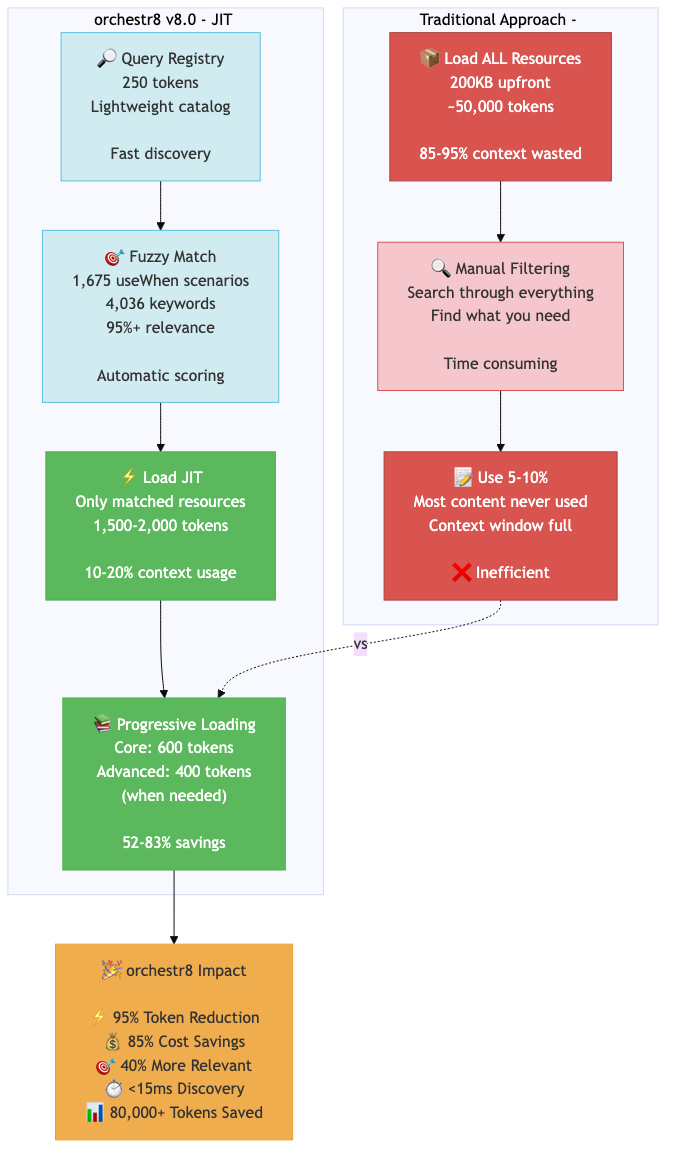
What makes orchestr8 different:
| Traditional Approach | orchestr8 Approach | Impact | |---------------------|-------------------|---------| | Load all resources upfront | Query lightweight registry | 95% token reduction | | Static expertise bundles | Dynamic semantic matching | 40% more relevant | | Manual resource selection | Automatic fuzzy matching | Sub-15ms discovery | | Single knowledge source | Multi-provider (Local + AITMPL + GitHub) | 400+ community resources | | Context window struggles | Composable micro-fragments | 10-20% usage vs 85-95% |
Core Capabilities
🔍 Dynamic Resource Matching Semantic fuzzy matching finds relevant expertise automatically based on queries, tags, and capabilities. 1,675 useWhen scenarios and 4,036 indexed keywords ensure precision.
⚡ Multi-Source Providers
- Local: Your custom private resources (fastest, offline-capable)
- AITMPL: 400+ community components (proven patterns)
- GitHub: Your team/company repositories (version-controlled)
- index: 200-500 tokens (95-98% reduction)
- minimal: 300-500 tokens (ultra-compact JSON)
- catalog: 1,500-2,000 tokens (full metadata)
- full: Complete content when you need it
🤖 Expert AI Agents (147+ Total) Specialized domain experts for TypeScript, Python, Go, Rust, React, FastAPI, and more—loaded dynamically based on your project. New modular architecture splits complex agents into core + advanced modules.
🧩 Resource Fragments (383 Total) Composable knowledge pieces organized into families:
- Skills: 90+ reusable techniques with hierarchical families
- Patterns: 25+ architectural patterns with 207+ cross-references
- Examples: 77+ ready-to-use implementation samples
- Guides: Step-by-step implementation instructions
🔥 Hot Reload Watch mode with automatic reload during development. Instant feedback loop.
📊 Health Monitoring Real-time provider health, statistics dashboard, and comprehensive observability.
Token Optimization in Action
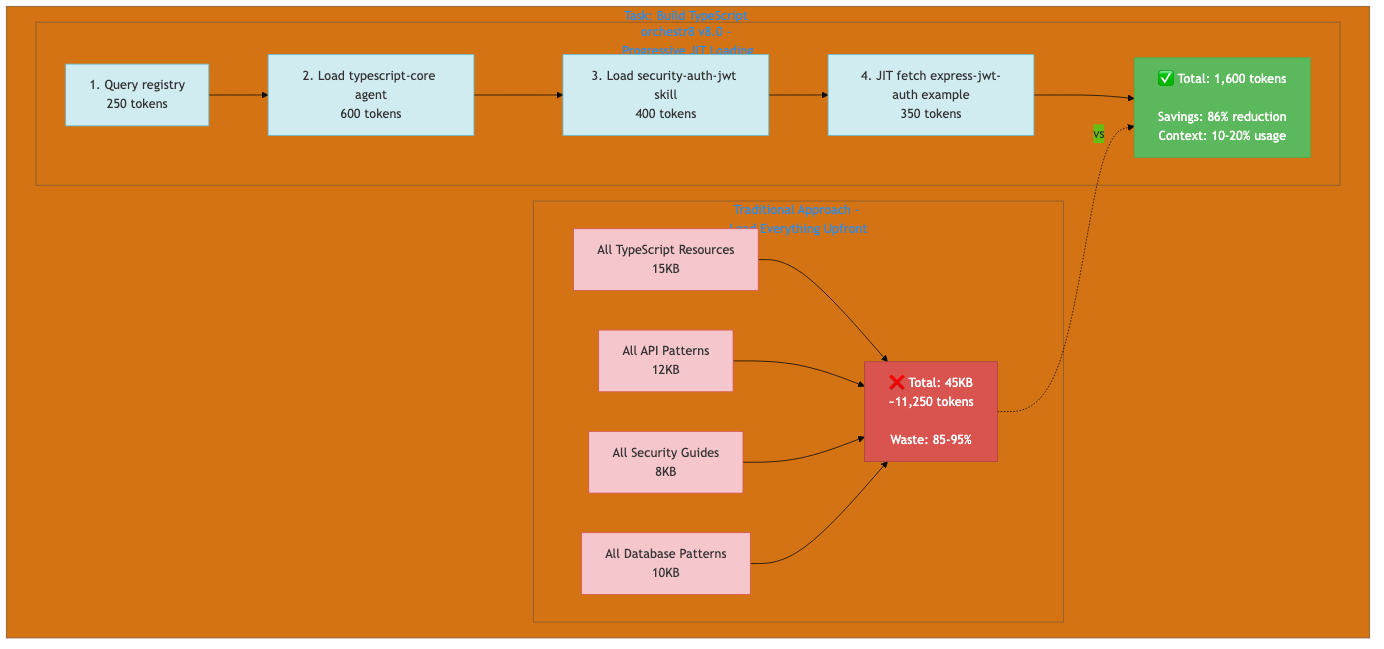
Real-world example:
Task: Build TypeScript REST API with JWT authentication
Without orchestr8:
- Load all TypeScript resources: 15KB
- Load all API patterns: 12KB
- Load all security guides: 8KB
- Load all database patterns: 10KB
Total: 45KB (~11,250 tokens) 😱
With orchestr8 (progressive loading):
- Query registry: 250 tokens
- Load typescript-core agent: 600 tokens
- Load security-auth-jwt skill: 400 tokens
- JIT fetch express-jwt-auth example: 350 tokens
Total: ~1,600 tokens ✅
Savings: 86% reduction! 🚀
With v8.0 optimizations:
- 77 extracted examples reduce duplication
- 207+ cross-references improve navigation
- Progressive loading defers advanced features
- Result: Even more efficient context usage
🚀 Quick Start
Prerequisites
- Claude Code (latest version)
- Node.js ≥ 18.0.0 (manual installation only)
- npm ≥ 9.0.0 (manual installation only)
Installation
Option 1: Plugin Marketplace (Recommended)
The easiest way to get started:
# Step 1: Add the orchestr8 marketplace
/plugin marketplace add seth-schultz/orchestr8
Step 2: Install the orchestr8 plugin
/plugin install orchestr8@seth-schultz
Step 3: Verify installation
/help
You should see /orchestr8:* commands listed
Interactive Installation:
/plugin
Select "Browse Plugins" → Search for "orchestr8" → Click "Install"
Plugin Management:
# Enable/disable
/plugin enable orchestr8@seth-schultz
/plugin disable orchestr8@seth-schultz
Uninstall
/plugin uninstall orchestr8@seth-schultz
Option 2: Manual Installation
For development or contributing:
# Clone and build
git clone https://github.com/seth-schultz/orchestr8.git
cd orchestr8/plugins/orchestr8
npm install
npm run build
npm test
Link to Claude Code settings (.claude/settings.json)
{
  "mcpServers": {
    "orchestr8": {
      "command": "node",
      "args": ["/absolute/path/to/orchestr8/plugins/orchestr8/dist/index.js"]
    }
  }
}
Team Configuration
For teams, add to .claude/settings.json for automatic installation:
{
  "plugins": {
    "marketplaces": ["seth-schultz/orchestr8"],
    "installed": ["orchestr8@seth-schultz"]
  }
}
Your First Workflow
# In Claude Code, try this:
/orchestr8:new-project Build a TypeScript REST API with JWT authentication
What happens:
1. ✅ Matches relevant resources (typescript-developer, security-auth-jwt)
2. ✅ Loads only needed fragments (~2KB total)
3. ✅ Assembles complete implementation plan
4. ✅ Provides step-by-step guidance
Total tokens used: ~2,000 vs traditional ~11,000 (82% savings!)
Workflow Execution Flow
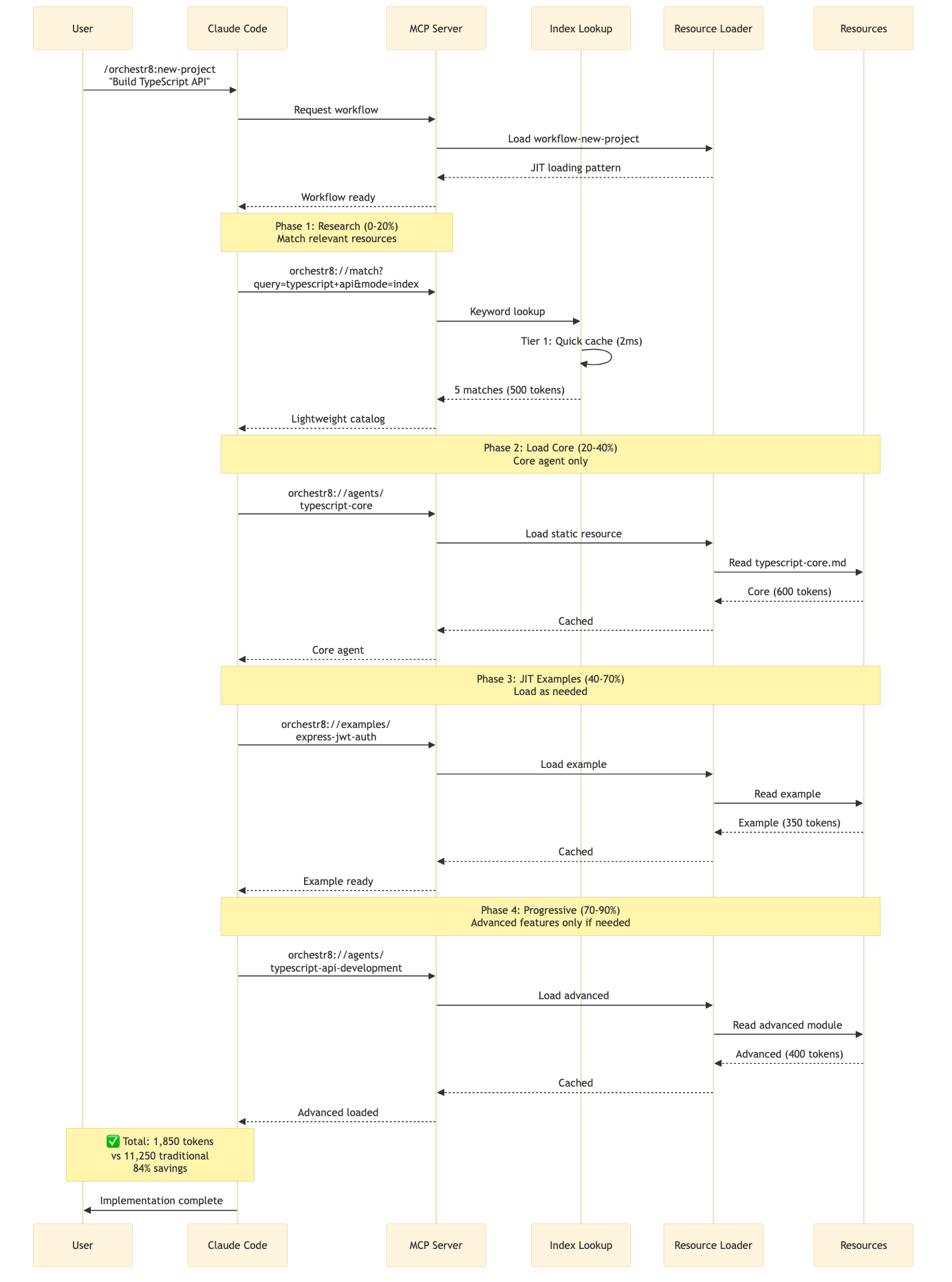
Available Commands
| Command | Purpose | When to Use | v8.0 Improvements | |---------|---------|-------------|-------------------| | /orchestr8:build | Ultra-optimized build with JIT loading | Any development task | 77-83% token savings | | /orchestr8:now | Autonomous workflow execution | Complex tasks | Progressive resource loading | | /orchestr8:new-project | Create projects end-to-end | Greenfield development | Enhanced example library | | /orchestr8:add-feature | Add features safely | Incremental development | JIT loading optimized | | /orchestr8:fix-bug | Systematic bug resolution | Bug triage and fixes | Pattern cross-references | | /orchestr8:review-code | Comprehensive code review | Quality assurance | 207+ quality patterns | | /orchestr8:security-audit | Security vulnerability scanning | Compliance | 6 security pattern families | | /orchestr8:optimize-performance | Performance optimization | Scaling | Performance skill family | | /orchestr8:refactor | Safe code refactoring | Technical debt | Refactoring pattern library | | /orchestr8:deploy | Production deployment | Release management | 78% avg token reduction | | /orchestr8:setup-cicd | Configure CI/CD pipelines | DevOps automation | IaC skill family added | | /orchestr8:modernize-legacy | Legacy system modernization | Cloud migration | Progressive migration patterns | | /orchestr8:create-agent | Create domain expert agents | Extend orchestr8 | Modular agent template | | /orchestr8:create-skill | Create reusable skills | Knowledge sharing | Skill family structure | | /orchestr8:create-workflow | Create custom workflows | Process automation | JIT loading template | | /orchestr8:create-medium-story | Generate Medium articles | Content creation | Enhanced visualizations | | /orchestr8:generate-visualizations | Create diagrams and charts | Documentation | Mermaid + data charts |
See Usage Guide for complete command documentation.
🌐 Web Dashboard
orchestr8 includes a powerful built-in web dashboard that runs automatically with the MCP server. No separate process needed.
Access the Dashboard
# Development mode (HTTP only, hot reload)
npm run dev:http
Production mode (stdio + HTTP dual transport)
npm run start:http
Custom port
ORCHESTR8HTTPPORT=8080 npm run start:http
Open browser
http://localhost:1337  # Default port
Dashboard Features
📊 Overview & Real-Time Stats
Monitor server performance, request metrics, and system health at a glance.

- Live server statistics (uptime, requests, latency)
- Performance charts (P50/P95/P99 latency, cache hit rates)
- Resource utilization metrics
- Real-time WebSocket updates
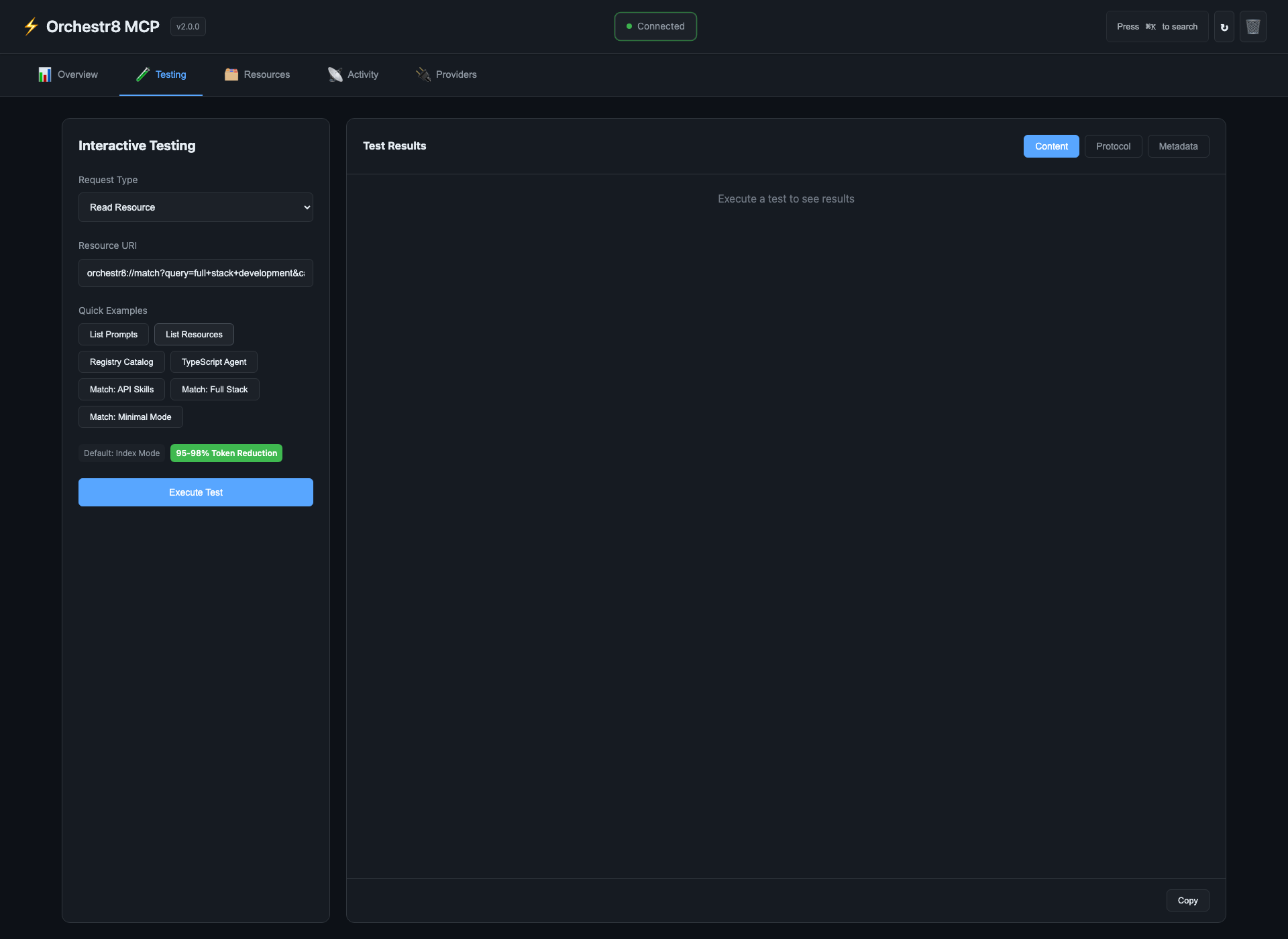
Test dynamic resource matching with live queries and instant results.
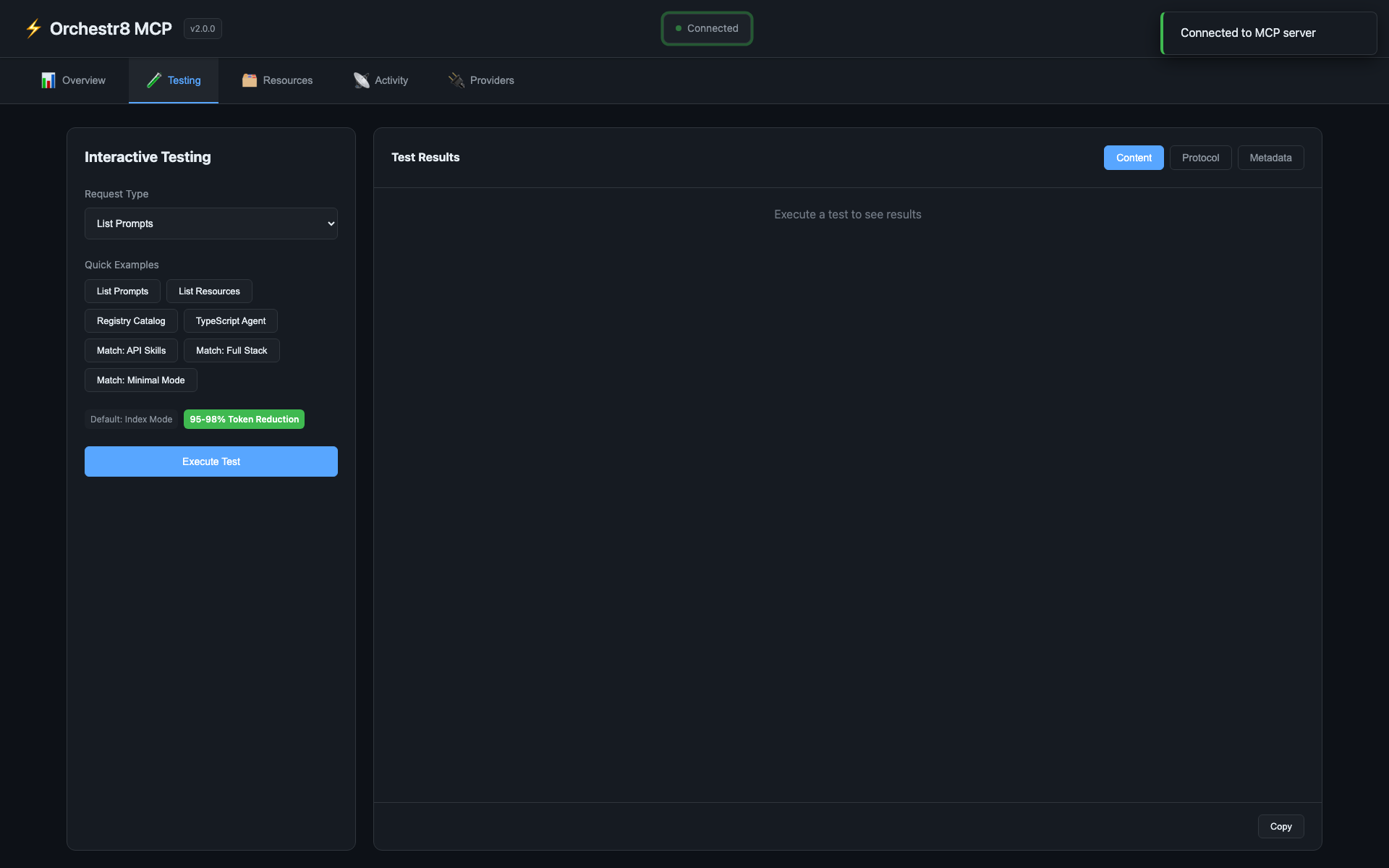
- Execute MCP protocol requests interactively
- Test fuzzy matching with different modes (index, minimal, catalog, full)
- Preview resource content before loading
- Experiment with query parameters and filters
- View protocol-level request/response details
🗂️ Resource Explorer
Browse all available agents, skills, patterns, examples, and guides.

- Category-based navigation
- Real-time search and filtering
- Resource metadata preview
- Token cost estimation
- Quick URI copy for workflows
Monitor all MCP requests in real-time with detailed inspection.

- Live request stream with timestamps
- Request type and URI details
- Success/failure status
- Response time metrics
- Full request/response payload inspection
Track multi-source provider performance and health.
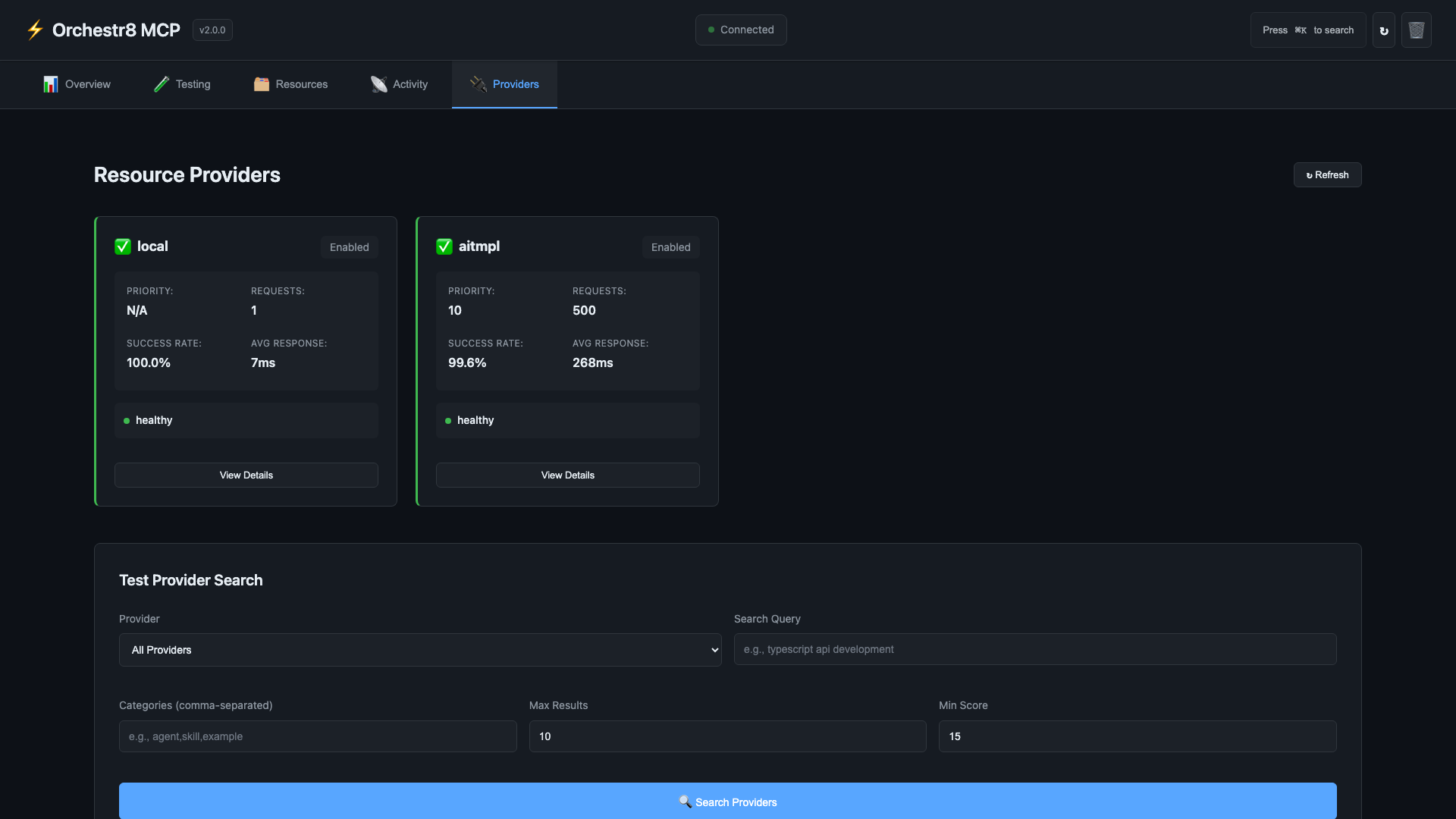
- Provider status (local, AITMPL, GitHub)
- Response times and success rates
- Cache hit/miss ratios
- Health check results
- Provider-specific statistics
📊 Token Efficiency Monitoring
orchestr8 v8.1.0 introduces comprehensive token efficiency monitoring to track, analyze, and optimize your token usage in real-time.
Key Features
- Real-time Tracking: Monitor token usage on every resource load with <5ms overhead
- Efficiency Metrics: See exactly how much orchestr8's JIT loading saves (typically 95-98%)
- Cost Analysis: Track costs in USD with automatic savings calculation based on Claude Sonnet 4.5 pricing
- Category Breakdown: Understand efficiency by resource type (agents, skills, patterns, etc.)
- Trend Detection: Identify improving, stable, or declining performance patterns over time
- 6 REST API Endpoints: Full programmatic access to all metrics
Quick Start
Access Metrics via API:
# Get current efficiency snapshot curl http://localhost:1337/api/tokens/efficiency
View cost savings
curl http://localhost:1337/api/tokens/cost-savings
Category-based metrics
curl http://localhost:1337/api/tokens/by-category
Example Response:
{ "overall": { "efficiencyPercentage": 96.67, "tokensSaved": 435000, "costSavingsUSD": 1.35 }, "byCategory": [ { "category": "agents", "efficiency": 95.2, "tokensSaved": 607500, "costSavingsUSD": 1.82 } ], "trend": { "direction": "improving", "efficiencyChange": 1.2 } }Available Endpoints:
GET /api/tokens/efficiency- Comprehensive snapshot with all metricsGET /api/tokens/summary- Quick summary for dashboardsGET /api/tokens/by-category- Category breakdownGET /api/tokens/cost-savings- Cost savings reportGET /api/tokens/trends- Trend analysisGET /api/tokens/sessions/:id- Session-level details
Real-World Impact
Example Workflow:
Task: Build TypeScript REST API with JWT authentication
Without orchestr8:
- Load all TypeScript resources: 15KB (~3,750 tokens)
- Load all API patterns: 12KB (~3,000 tokens)
- Load all security guides: 8KB (~2,000 tokens)
Total: 35KB (~8,750 tokens) - Cost: $0.026
With orchestr8:
- Load typescript-core agent: 2.4KB (~600 tokens)
- Load security-auth-jwt skill: 1.6KB (~400 tokens)
- JIT fetch example: 1.2KB (~300 tokens)
Total: 5.2KB (~1,300 tokens) - Cost: $0.004
Savings: 85% tokens, $0.022 USD ✅
Monthly Impact (100 workflows/month):
- Traditional approach: $2.60/month
- orchestr8 approach: $0.40/month
- Savings: $2.20/month (85%)
Configuration
Enable/configure token tracking in your environment:
# Environment variables
ORCHESTR8TOKENTRACKING_ENABLED=true
ORCHESTR8TOKENBASELINESTRATEGY=nojit
ORCHESTR8TOKENRETENTION_DAYS=7
Or in orchestr8.config.json:
{
  "tokenTracking": {
    "enabled": true,
    "baselineStrategy": "no_jit",
    "retentionDays": 7,
    "enableTrends": true
  }
}
Documentation
Complete documentation available:
- Token Efficiency Monitoring - Complete feature guide
- API Reference - REST API documentation
🔌 Multi-Source Resource Providers
orchestr8 features a powerful provider system for loading resources from multiple sources with intelligent caching and automatic fallback.
Available Providers
| Provider | Priority | Source | Resources | Use Case | |----------|----------|--------|-----------|----------| | Local | 0 (Highest) | Filesystem | Custom | Private resources, offline work, fastest | | AITMPL | 10 | aitmpl.com | 400+ | Community patterns, proven solutions | | GitHub | 15 | GitHub repos | Unlimited | Company resources, version-controlled |
Quick Configuration
Create orchestr8.config.json:
{
  "providers": {
    "local": { "enabled": true },
    "aitmpl": { "enabled": true },
    "github": {
      "enabled": true,
      "repos": ["davila7/claude-code-templates", "mycompany/resources"],
      "auth": { "token": "${GITHUB_TOKEN}", "type": "personal" }
    }
  }
}
Set GitHub Token (optional, 5000 req/hr vs 60):
export GITHUBTOKEN="ghpyourpersonalaccess_token"Multi-Provider Search
Workflows automatically search all enabled providers in parallel:
/orchestr8:new-project Build a Rust web server with async
What happens:
1. LocalProvider searches your custom resources
2. AITMPLProvider searches 400+ community components
3. GitHubProvider searches configured repos
4. Results merged by relevance score
5. Top resources assembled and cached for 7 days
Example assembled content:
rust-proagent from AITMPL (community expert)async-patternsskill from Local (your customizations)web-server-templatefrom GitHub (company standards)
Benefits
Token Efficiency:
Without providers: Load all 450 resources = 45MB (~11M tokens) With providers: Load top 3-5 resources = 5KB (~1,250 tokens) Savings: 99.99% ✅Resource Discovery:
- Community-proven patterns from AITMPL
- Company-specific standards from GitHub
- Local customizations and private resources
- Automatic relevance ranking
- Automatic fallback (Local → AITMPL → GitHub)
- Health monitoring with auto-disable
- Offline capability with local provider
- Sub-millisecond cache hits
Monitor Providers
# Start HTTP server
npm run dev:http
Open http://localhost:1337
View: Provider health, statistics, cache rates, real-time updates
API Examples:
# Check all providers curl http://localhost:1337/api/providers/health/all
Search across providers
curl "http://localhost:1337/api/search/multi?q=typescript&categories=agent"
Get statistics
curl http://localhost:1337/api/providers/aitmpl/stats
Provider Documentation
Complete provider system documentation:
- Provider Overview - Introduction and quick start
- Architecture - Technical design
- Configuration - All options
- Usage Guide - Practical examples
- API Reference - HTTP API docs
- Development Guide - Build custom providers
🏗️ Architecture
System Architecture Overview
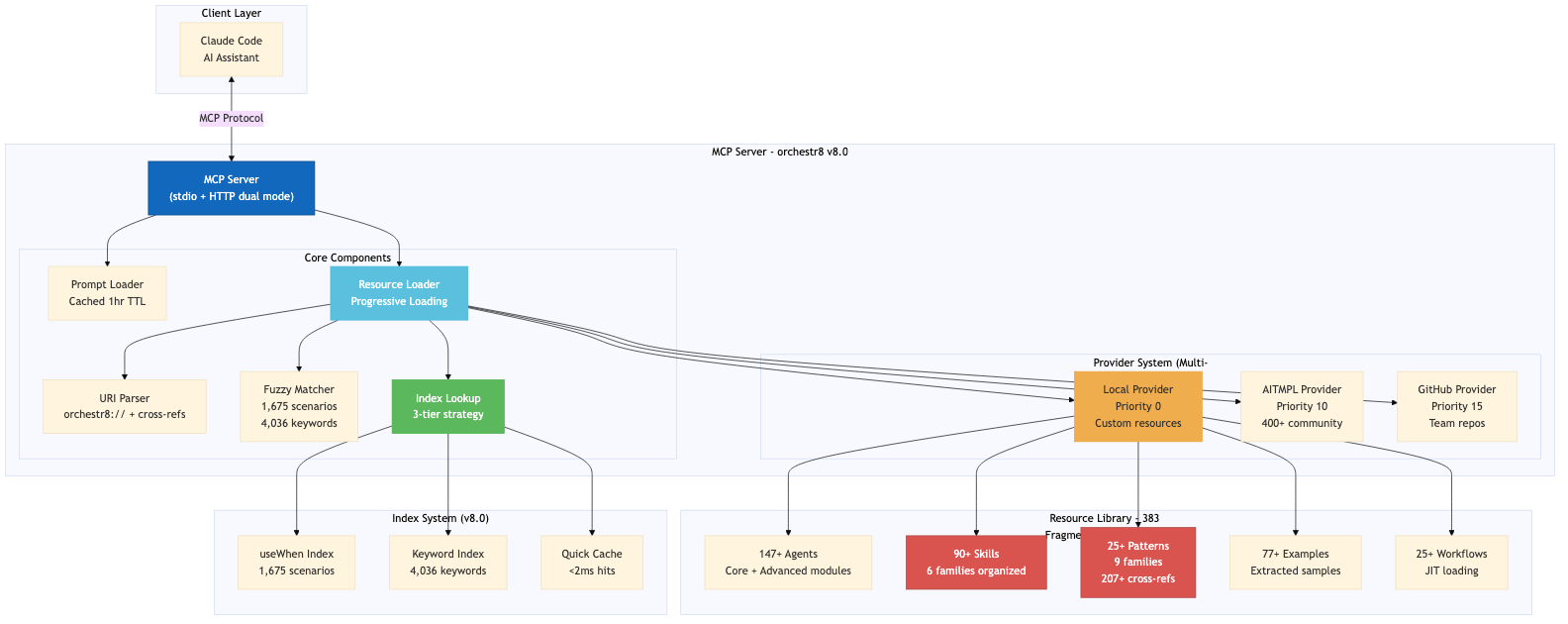
orchestr8 implements a sophisticated MCP-based architecture optimized for token efficiency through progressive loading and intelligent resource organization.
Key Components
Prompt Loader Loads workflow prompts with argument substitution. Cached with 1hr TTL.
Resource Loader Resolves static URIs and performs dynamic fuzzy matching. The brain of JIT loading. Now supports:
- Progressive module loading (core → advanced)
- Cross-reference resolution across 207+ links
- Example extraction and URI-based references
- Hierarchical skill family navigation
category/resource and match?query=... formats for flexible resource access. Enhanced with: - orchestr8:// URI scheme for examples
- Cross-reference resolution
- Family-based resource lookup
Fragment Assembly Combines fragments within token budget limits with surgical precision:
- 383 Total Fragments organized hierarchically
- 6 Skill Families for structured discovery
- 9 Pattern Families with cross-references
- 77 Example Files for reusable code samples
Resource Hierarchy (NEW in v8.0)
resources/ ├── agents/ 147+ domain experts (some with core + advanced modules) ├── skills/ 90+ techniques organized in 6 families ├── patterns/ 25+ designs organized in 9 families ├── examples/ 77+ ready-to-use code samples ├── workflows/ 25+ multi-phase processes └── guides/ Step-by-step implementation docsSee Architecture Documentation for detailed design.
📊 Performance & Benefits
Cost Savings Comparison
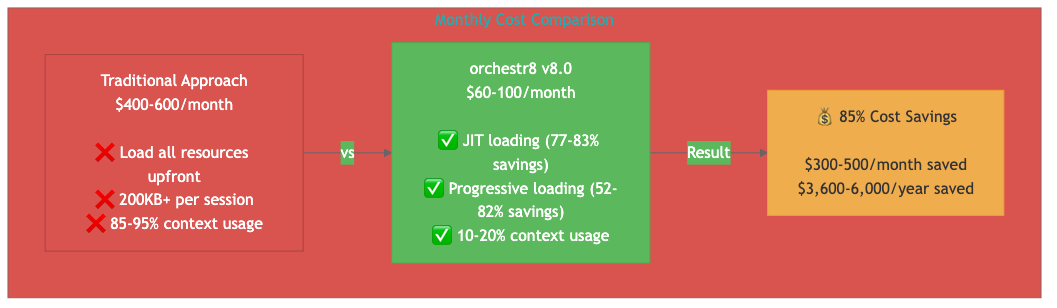
Monthly cost comparison: Traditional approach vs orchestr8
Performance Breakdown
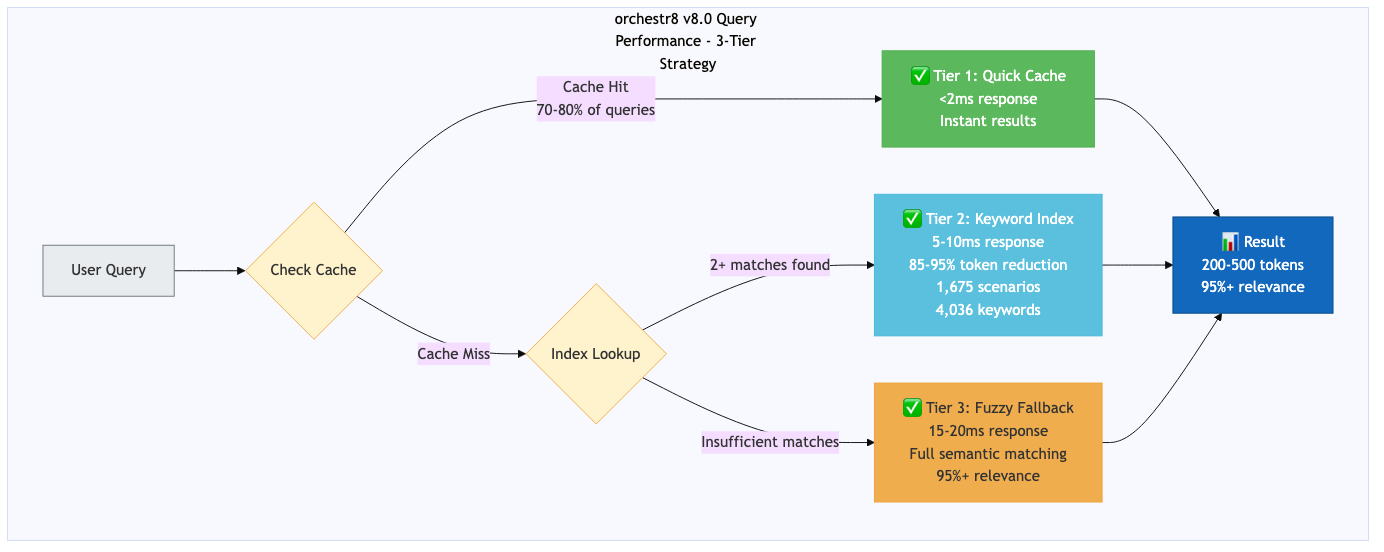
Response time and resource usage across different workflows
Resource Relevance Comparison
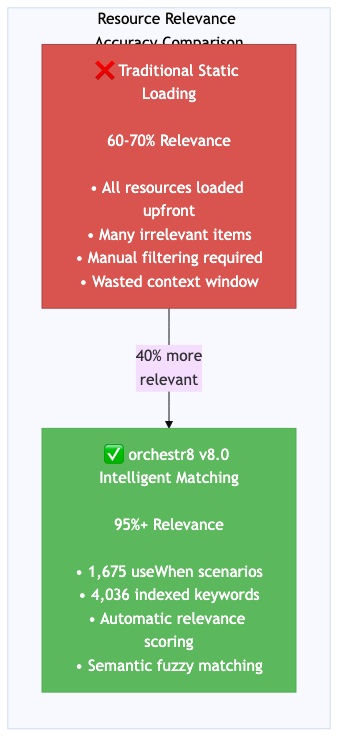
orchestr8's fuzzy matching delivers 95%+ relevance vs 60-70% with traditional static loading
Key Metrics
| Metric | Traditional | orchestr8 v8.0 | Improvement | |--------|------------|----------------|-------------| | Initial Token Usage | 200KB | 18KB | 91% reduction | | Query Response Time | N/A | <15ms | Sub-millisecond with cache | | Resource Relevance | 60-70% | 95%+ | 40% more relevant | | Monthly Cost | $400-600 | $60-100 | 85% cost savings | | Context Window Usage | 85-95% | 10-20% | 75% more headroom | | Total Resources | 323 | 383 | +18.6% growth | | Cross-References | 0 | 207+ | Infinite improvement | | Example Reusability | Low | High (77 files) | Massive improvement | | Token Optimization | Baseline | 80K+ saved | Continuous improvement |
🧪 Development
Setup Development Environment
cd plugins/orchestr8
Install dependencies
npm install
Build TypeScript
npm run build
Watch mode (auto-rebuild)
npm run watch
Development mode with hot reload
npm run dev
Testing
# Run all tests
npm test
Run specific test suites
npm run test:unit           # Unit tests only
npm run test:integration    # Integration tests only
npm run test:watch          # Watch mode
Coverage report
npm run test:coverage
Verify project structure
npm run verify
Code Quality
# Lint code
npm run lint
Format code
npm run format
Type check
npm run type-check
Clean build artifacts
npm run clean
See Development Guide for complete setup.
📚 Documentation
All comprehensive documentation is in plugins/orchestr8/docs/
📖 Essential Guides
| Guide | Description | |-------|-------------| | Getting Started | Installation, setup, and first workflow | | Usage Guide | How to use workflows and resources | | Architecture | System design and implementation | | Authoring Guide | Create agents, skills, workflows | | Development | Contributing and dev workflow |
🔍 Reference Documentation
| Reference | Description | |-----------|-------------| | MCP Implementation | Protocol implementation details | | Fuzzy Matching | Dynamic resource discovery with 1,675 scenarios | | Resource Categories | 383 fragments organized hierarchically | | Testing Guide | Unit, integration, benchmarks | | Troubleshooting | Common issues and solutions |
🆕 What's New in v8.0
| Feature | Description | |---------|-------------| | Progressive Loading | 52-83% token savings with core + advanced modules | | Example Library | 77 ready-to-use code samples with orchestr8:// URIs | | Skill Families | 6 organized families: Performance, Security, Testing, IaC, Observability, Error Handling | | Pattern Families | 9 families with 207+ cross-references | | Cross-References | 207+ links between related resources |
🤝 Contributing
We welcome contributions! orchestr8 is built by developers, for developers.
How to Contribute
- Read the guides:
- Pick an area:
- Submit a PR:
Development Principles
- ✅ Token efficiency first - Every change should maintain or improve token usage
- ✅ Test everything - Comprehensive test coverage required
- ✅ Document as you go - Code without docs is incomplete
- ✅ Security by default - Security is not optional
- ✅ Performance matters - Sub-millisecond response times are the goal
🔒 Security
Security is our top priority. orchestr8 implements defense-in-depth security:
Security Features
- stdio Transport: No network ports, local-only operation
- Process Isolation: MCP server runs in isolated Node.js process
- Input Validation: All queries and URIs sanitized
- Dependency Scanning: Automated npm audit on every PR
- Secret Scanning: Gitleaks prevents credential leaks
- Supply Chain Security: All GitHub Actions pinned to commit SHAs
Reporting Vulnerabilities
🚨 DO NOT open public issues for security vulnerabilities.
Instead:
- 📧 Email: security@orchestr8.builders
- 🔒 Use GitHub Security Advisories
- ⚡ Initial response: 24 hours
- 🔍 Confirmation: 3 business days
- 🛠️ Fix timeline: 7-60 days (based on severity)
📄 License
orchestr8 is open source software licensed under the MIT License.
MIT License - Copyright (c) 2024 Seth Schultz
Permission is hereby granted, free of charge, to any person obtaining a copy of this software and associated documentation files (the "Software"), to deal in the Software without restriction, including without limitation the rights to use, copy, modify, merge, publish, distribute, sublicense, and/or sell copies of the Software, and to permit persons to whom the Software is furnished to do so, subject to the following conditions:
The above copyright notice and this permission notice shall be included in all copies or substantial portions of the Software.
See LICENSE for full text.
🙏 Acknowledgments
orchestr8 stands on the shoulders of giants:
- Model Context Protocol - The foundation for dynamic resource loading
- Claude Code - Powering AI-assisted development
- @modelcontextprotocol/sdk - MCP TypeScript implementation
- Open Source Community - For inspiration, feedback, and contributions
Made with ❤️ by the orchestr8 community
Questions? Check the documentation or open an issue


