
An IPython magic extension for printing date and time stamps, version numbers, and hardware information



watermark
An IPython magic extension for printing date and time stamps, version numbers, and hardware information.
Sections
Examples
[top]
Using watermark in Jupyter notebooks and IPython sessions
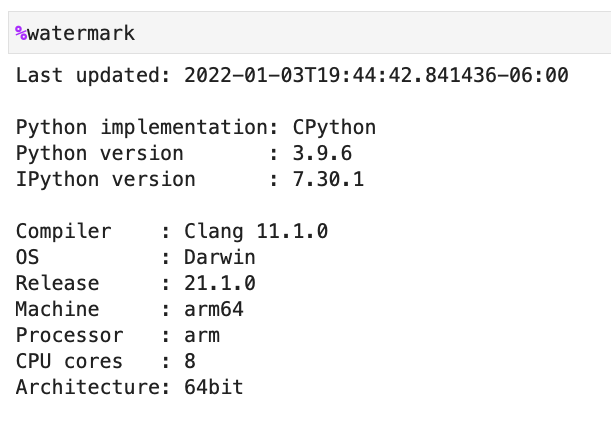
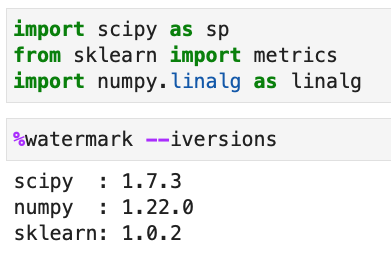
More examples can be found in this Jupyter notebook.

Using watermark as a module
from watermark import watermark
print(watermark())
Last updated: 2022-09-13T16:28:56.177487-05:00
Python implementation: CPython Python version : 3.9.13 IPython version : 8.4.0
Compiler : Clang 13.0.1 OS : Darwin Release : 21.6.0 Machine : arm64 Processor : arm CPU cores : 10 Architecture: 64bit
print(watermark(packages="numpy,scipy"))numpy: 1.23.2
scipy: 1.9.1See help(watermark) for more options.
Installation and updating
[top]
The watermark line magic can be installed by executing
pip install watermarkAlternatively, you can install the latest development version directly from GitHub via
pip install -e git+https://github.com/rasbt/watermark#egg=watermarkNote:
To remove an old watermark installation (installed via the deprecated %install_ext magic extension), simply delete it from the `.ipython/extensions/ directory, which is typically located in a user's home directory.
Usage
[top]
After successful installation, the watermark magic extension can be loaded via:
<pre><code class="lang-python">%load_ext watermark</code></pre>
<br>
To get an overview of all available commands, type:
<pre><code class="lang-python">%watermark?</code></pre>
<br>
<pre><code class="lang-raw">%watermark [-a AUTHOR] [-gu GITHUB_USERNAME] [-e EMAIL] [-ws WEBSITE] [-d] [-n] [-t] [-i] [-z] [-u] [-c CUSTOM_TIME] [-v] [-p PACKAGES] [-co] [-h] [-m] [-g] [-r] [-b] [-w] [-iv]
IPython magic function to print date/time stamps and various system information.
optional arguments: -a AUTHOR, --author AUTHOR prints author name -gu GITHUBUSERNAME, --githubusername GITHUB_USERNAME prints author github username -e EMAIL, --email EMAIL prints author email -ws WEBSITE, --website WEBSITE prints author or project website -d, --date prints current date as YYYY-mm-dd -n, --datename prints date with abbrv. day and month names -t, --time prints current time as HH-MM-SS -i, --iso8601 prints the combined date and time including the time zone in the ISO 8601 standard with UTC offset -z, --timezone appends the local time zone -u, --updated appends a string "Last updated: " -c CUSTOMTIME, --customtime CUSTOM_TIME prints a valid strftime() string -v, --python prints Python and IPython version -p PACKAGES, --packages PACKAGES prints versions of specified Python modules and packages -co, --conda prints name of current conda environment -h, --hostname prints the host name -m, --machine prints system and machine info -g, --githash prints current Git commit hash -r, --gitrepo prints current Git remote address -b, --gitbranch prints current Git branch -w, --watermark prints the current version of watermark -iv, --iversions prints the name/version of all imported modules --gpu prints GPU information (currently limited to NVIDIA GPUs), if available -je, --jupyter_env prints the current Jupyter environment (e.g., Colab, VS Code) --python_installation include information about how Python was installed --check_latest check if the latest packages are installed</code></pre>
Development guidelines
[top]
In line with [NEP 29][nep-29], this project supports:
- All minor versions of Python released 42 months prior to the project, and at minimum the two latest minor versions.
Changelog
[top]
v. 2.6.0 (TBA)
- Adds a new --checkjupyter
flag to report on which notebook environment is used (e.g., Colab, Jupyter Notebook, Jupyter Lab, VSCode). (#102, via contribution by Mariam Zakaria) - Adds a new --checklatest
flag to check whether newer package versions are available. (#102, via contribution by Mariam Zakaria) - Adds a new --pythoninstallation
flag to provide information about how Python was installed. (#102, via contribution by Mariam Zakaria)
v. 2.5.1 (Dec 14, 2025)
- --iversion
packages are now sorted alphabetically. (#102, via contribution by Vijay Lulla) - Extra args to allow printing -d
(current date) and-t(current time) information without needing to use the-u(updated) flag. (#99, via contribution by Daniel Kleine)
v. 2.5.0 (Sep 20, 2024)
- Can now capture imports retrospectively via -iv
more reliably. (#94, via contribution by Martin Perier)
<pre><code class="lang-python">from sympy import solve</code></pre>
<pre><code class="lang-">%load_ext watermark</code></pre>
<pre><code class="lang-">%watermark -iv</code></pre>
Correctly prints sympy: 1.11.1
v. 2.4.3 (May 23, 2023)
- Make py3nvml
installation for GPU info optional. (#92, via contribution by Ben Greiner)
v. 2.4.1 and v 2.4.2 (May 23, 2023)
- PyPI and Conda-Forge packaging fixes.
v. 2.4.0 (May 23, 2023)
- Adds a new --gpu
flag to print out GPU information (currently limited to NVIDIA devices) (#90, via contribution by 907Resident)
v. 2.3.1 (May 27, 2022)
- Upper limit on importlib-metadata caused trouble installing on Python 3.7.
v. 2.3.0 (January 3, 2022)
- Added the following arguments: --githubusername
- for prints author github username,--email- for prints author email,--website- for prints author or project website. (#82, via contribution by joschkazj) - Added a --conda
option to print the name of the current conda environment. (#79, via contribution by Alexander Krasnikov) - It is now possible to inject globals when used outside IPython (#80, via contribution by
<pre><code class="lang-python">import numpy import watermark.watermark as watermark
watermark(iversions=True, globals_=globals())</code></pre>
v. 2.2.0 (February 17, 2021)
- Refactoring such that a watermark()
function now also works outside IPython and Jupyter. Now, the magic%watermarkcallswatermark(). Calling%watermarkvia IPython and Juypter still works as usual. However, in addition thewatermark()function can be used within regular Python for unit testing purposes etc. (#46, via contribution by Tymoteusz Wołodźko)
v. 2.1.0 (November 23, 2020)
- Adopt [NEP 29][nep-29] and require Python version 3.7 or newer. (#63, via contribution by James Myatt)
- Add Python 3.8 and 3.9 to Travis CI builds. (#63, via contribution by James Myatt)
- Fix: Allow setup.py to run without installrequires already installed (#67, via contribution by James Myatt)
- Major refactoring to improve code readability (#64 and 65, via contribution by Bahram Aghaei)
- Use importlib and importlib.metadata to determine package version numbers. (#66, via contribution by James Myatt)
v. 2.0.2 (November 19, 2019)
- Support VERSION
attributes, in addition toversionattributes.
v. 2.0.1 (October 04, 2019)
- Fix 'sklearn'
vs.'scikit-learn'import compatibility.
v. 2.0.0 (October 04, 2019)
- Now uses pkg_resources
as the default method for getting version numbers. - Fixes a whitespace bug when printing the timezone.
v. 1.8.2 (July 28, 2019)
- When no Python library was imported and the --iversion
is used, print an empty string instead of raising an error.
v. 1.8.1 (January 26, 2019)
- Fixes string alignment issues when the -iv
/--iversionflag is used.
v. 1.8.0 (January 02, 2019)
- The -iv
/--iversionflag now also shows package versions that were imported asfrom X import Y
. For example,
<pre><code class="lang-python">import scipy as sp from sklearn import metrics import numpy.linalg as linalg</code></pre>
<pre><code class="lang-">%watermark --iversions</code></pre>
will return
<pre><code class="lang-">scipy 1.1.0 sklearn 0.20.1 numpy 1.15.4</code></pre>
v. 1.7.0 (October 13, 2018)
(Via contribution by James Myatt)
- Shows "not installed" for version of packages/modules that cannot be imported.
- Shows "unknown" for version of packages/modules when version attribute cannot be found.
- Add Python 3.6 and 3.7 to Travis CI builds.
- Add classifiers to setuptools configuration.
v. 1.6.1 (June 10, 2018)
- Now also includes the LICENSE file in the Python Wheels distribution
v. 1.6.0 (January18, 2018)
- Adds a new
-b/--gitbranch parameter that prints the current Git branch.
v. 1.5.0 (August 27, 2017)
- Adds a new
-iv/ --iversions parameter that prints the package names and version numbers of all packages that were previously imported in the current Python session. (Via contribution by Aziz Alto)
v. 1.4.0 (April 18, 2017)
- Adds a new
-r/ --gitrepo parameter that returns the URL of Git remote name "origin". (Via contribution by Lucy Park)
v. 1.3.4 (October 15, 2016)
- Allow fetching scikit-learn's version number via
-p scikit-learn in addition of -p sklearn (the former is deprecated and will not be supported in watermark > 1.7).
v. 1.3.3 (September 1, 2016)
- Includes LICENSE in MANIFEST.in for packaging
v. 1.3.2 (August 16, 2016)
- Fixes an issue where the wrong package info was obtained when using the system level Jupyter within a virtualenv environment. (Via contribrution by Michael Bell)
- Adds a new
-i/ --iso8601 parameter that returns the current date-time string in ISO 8601 format with offset to UTC. For instance: 2016-08-16T18:03:42-04:00. Current caveat: Python < 3.2 requires external libraries for for computing the timezone offset, thus, Python < 3.2 will currently only print 2016-08-16T18:03:42
Adds offsets to UTC to the default date-time string for Python >= 3.2
v. 1.3.1 (June 6, 2016)
- Fixes an issue that caused problems importing watermark using Python 2.x
v. 1.3.0 (May 21, 2016)
- Removed the deprecated the %installext magic so that watermark can now be installed as a regular python package via
pip (Via contribution by Peter Bull)
v. 1.2.3 (January 29, 2016)
- Changed date format to the unambiguous ISO-8601 format
- Ditched the deprecated %install_ext function and made watermark a proper Python package
- Released the new version under a more permissive newBSD license
v. 1.2.2 (June 17, 2015)
- Changed the default date-format of
-d, --date to MM/DD/YYYY, the format DD/MM/YYYY can be used via the shortcut -e, --eurodate.
v. 1.2.1 (March 3, 2015)
- Small bugfix to allow custom time string formatting.
v. 1.2.0 (October 1, 2014)
--watermark command added to print the current version of watermark.
Print author name on a separate line
Fixed bug that day takes the same value as the minute if the -n` flag is used.


