
EdegQuake 🌋 High-performance GraphRAG inspired from LightRag written in Rust; Transform documents into intelligent knowledge graphs for superior retrieval and generation
EdgeQuake
High-Performance Graph-RAG Framework in Rust
Transform documents into intelligent knowledge graphs for superior retrieval and generation





Quick Start
No Rust, no Node.js, no build. Just Docker.
curl -fsSL https://raw.githubusercontent.com/raphaelmansuy/edgequake/edgequake-main/quickstart.sh | shThe wizard guides you through provider selection (OpenAI / Ollama), model choice, and starts the full stack. Open http://localhost:3000 and you're in — no login required (quickstart runs with open API via EDGEQUAKEDEVMODE=true).
Ports: Docker quickstart maps the Web UI to http://localhost:3000. Local make dev defaults to http://localhost:3010 (avoids collisions with other stacks).
Alternative: docker compose directly
curl -fsSL https://raw.githubusercontent.com/raphaelmansuy/edgequake/edgequake-main/docker-compose.quickstart.yml \
  -o docker-compose.quickstart.yml
docker compose -f docker-compose.quickstart.yml up -d
Headless / CI (no interactive terminal):
# OpenAI
EDGEQUAKELLMPROVIDER=openai \
  OPENAIAPIKEY=sk-... \
  docker compose -f docker-compose.quickstart.yml up -d
Ollama (on host)
EDGEQUAKELLMPROVIDER=ollama \
  EDGEQUAKELLMMODEL=gemma4:e4b \
  EDGEQUAKEEMBEDDINGPROVIDER=ollama \
  OLLAMAEMBEDDINGMODEL=embeddinggemma \
  docker compose -f docker-compose.quickstart.yml up -d
| Service | URL (Docker quickstart) | URL (make dev) | |---------|-------------------------|------------------| | Web UI | http://localhost:3000 | http://localhost:3010 | | REST API | http://localhost:8080 | http://localhost:8090* | | Swagger | http://localhost:8080/swagger-ui | http://localhost:8090/swagger-ui* | | Health | http://localhost:8080/health | http://localhost:8090/health* |
\*Local make dev picks free ports starting at 8090 (API) / 3010 (UI); see make status for the bound ports. Verify:
curl -s http://localhost:8080/health | python3 -m json.toolPin a version: EDGEQUAKE_VERSION=0.24.3 sh quickstart.sh
What's new in 0.24.0
Database migration (read this first)
The API never migrates the database. Schema changes are an explicit operator step.
| Situation | What to run | |-----------|-------------| | Fresh install | edgequake migrate once, then start the API (make dev does this for you) | | Upgrade from ≤ v0.22.0 | Backup → migrate dry-run → migrate → migrate --confirm-drop → migrate (applies deferred 142) → start API | | Server exits 78 | Schema behind or newer than the binary — run migrate, then restart |
Irreversible drops (125 KV, 126/131 vectors) need --confirm-drop and a backup; rollback after that is restore-only. Migration 142 asserts empty leftovers (aborts if rows remain; deferred while residue exists).
Full plain-language guide: Migrate to v0.23.0+ · production soak: SPEC-091 upgrade runbook.
Highlights
- SPEC-104 production data-layer monitors — StorageInspector uses
workspace_id+PostgresConfigAGE graph SSOT; no42703/42P01probes; INV-03 dual-read; tenant create 201/200/409. - SPEC-105 legacy cutover assert — census SSOT; unknown
VECTOR_BACKEND→ typed; migration 142; mid-upgrade deferral so expandables soft-exit while residue remains. - Schema — migrations through 142 (0.23.0 stopped at 141).
Performance testing
Publish Acc is medical-mid n=200 (make bench) — not smoke n=40. Latest publish pack (medical-mid-20260802T135513Z): Acc EQ 0.807 vs LR 0.779 (Δ Acc 95% CI [-0.005, +0.059] — statistical tie; L2 incomplete — do not claim EQ beats LightRAG / Acc Beat). Fair cold latency ratio 1.02× (C1COLDv1). Smoke peers remain CI/ablation references only. Required local pre-tag gate: see Release & CD § SPEC-001.
- EQ vs LightRAG Acc Bench — measured scorecard
- BUSINESS_REPORT.md — regenerated by
make bench(n=200) - EXEC_SUMMARY.txt
- peers.json
- Protocol: 000-index · 001-first-principles
- Context: 055 · 063
Authentication (v0.15+)
From v0.15, the API enables authentication secure by default (SPEC-027). Identity lives in PostgreSQL; login requires at least one user with a real password hash.
| Scenario | What to set | |----------|-------------| | Quickstart / demo | Nothing — compose defaults to EDGEQUAKEDEVMODE=true (open API, no login) | | Production with login | Bootstrap admin before first API start (see below) | | Local dev from source | make dev (auth off) or make dev-auth (auth on + demo login hidden) |
Enable login on Docker / production:
export EDGEQUAKEDEVMODE=false
export EDGEQUAKEAUTHENABLED=true
export EDGEQUAKEBOOTSTRAPADMIN_USERNAME=admin
export EDGEQUAKEBOOTSTRAPADMIN_PASSWORD='ChangeMe123!'   # min 8 chars, mixed complexity
export EDGEQUAKEBOOTSTRAPADMIN_EMAIL=admin@example.com   # optional
export NEXTPUBLICAUTH_ENABLED=true
export NEXTPUBLICDISABLEDEMOLOGIN=true
docker compose -f docker-compose.quickstart.yml up -d
The API creates the bootstrap admin on startup. Sign in at http://localhost:3000/login (Docker quickstart) or http://localhost:3010/login (make dev).
Upgrades from pre-v0.15: legacy KV auth:user:* records are imported into PostgreSQL automatically when present.
See Runtime Auth Hardening for master API keys, OIDC, and troubleshooting (GitHub #288).
Ingestion cancel & restart (v0.19+)
From v0.19, cancel and restart are durable (SPEC-057): UI shows Stopping… until terminal Cancelled (not Failed); Pending tasks survive process restart via Postgres claim/lease (FOR UPDATE SKIP LOCKED). See Ingestion cancel and fairness.
First Steps
Upload a document (PDF, TXT, MD):
curl -X POST http://localhost:8080/api/v1/documents/upload \
  -F "file=@your-document.pdf"
Or drag-and-drop in the Web UI at http://localhost:3000 (Docker) or http://localhost:3010 (make dev).
Query the knowledge graph:
curl -X POST http://localhost:8080/api/v1/query \
  -H "Content-Type: application/json" \
  -d '{"query": "What are the main concepts?", "mode": "hybrid"}'
Why EdgeQuake?
Traditional RAG retrieves document chunks by vector similarity alone. This works for keyword lookups but fails on multi-hop reasoning, thematic questions, and relationship queries. Vectors capture similarity but lose structural relationships.
EdgeQuake implements the LightRAG algorithm in Rust: documents are decomposed into a knowledge graph of entities and relationships. At query time, the system traverses both the vector space and the graph structure — combining the speed of embeddings with the reasoning power of graph traversal.
| Metric | EdgeQuake | Traditional RAG | Improvement | |--------|-----------|----------------|-------------| | Query Latency (hybrid) | < 200ms | ~1000ms | 5x faster | | Entity Extraction | ~2-3x more | Baseline | 3x | | Concurrent Users | 1000+ | ~100 | 10x | | Memory per Document | 2MB | ~8MB | 4x |
Features
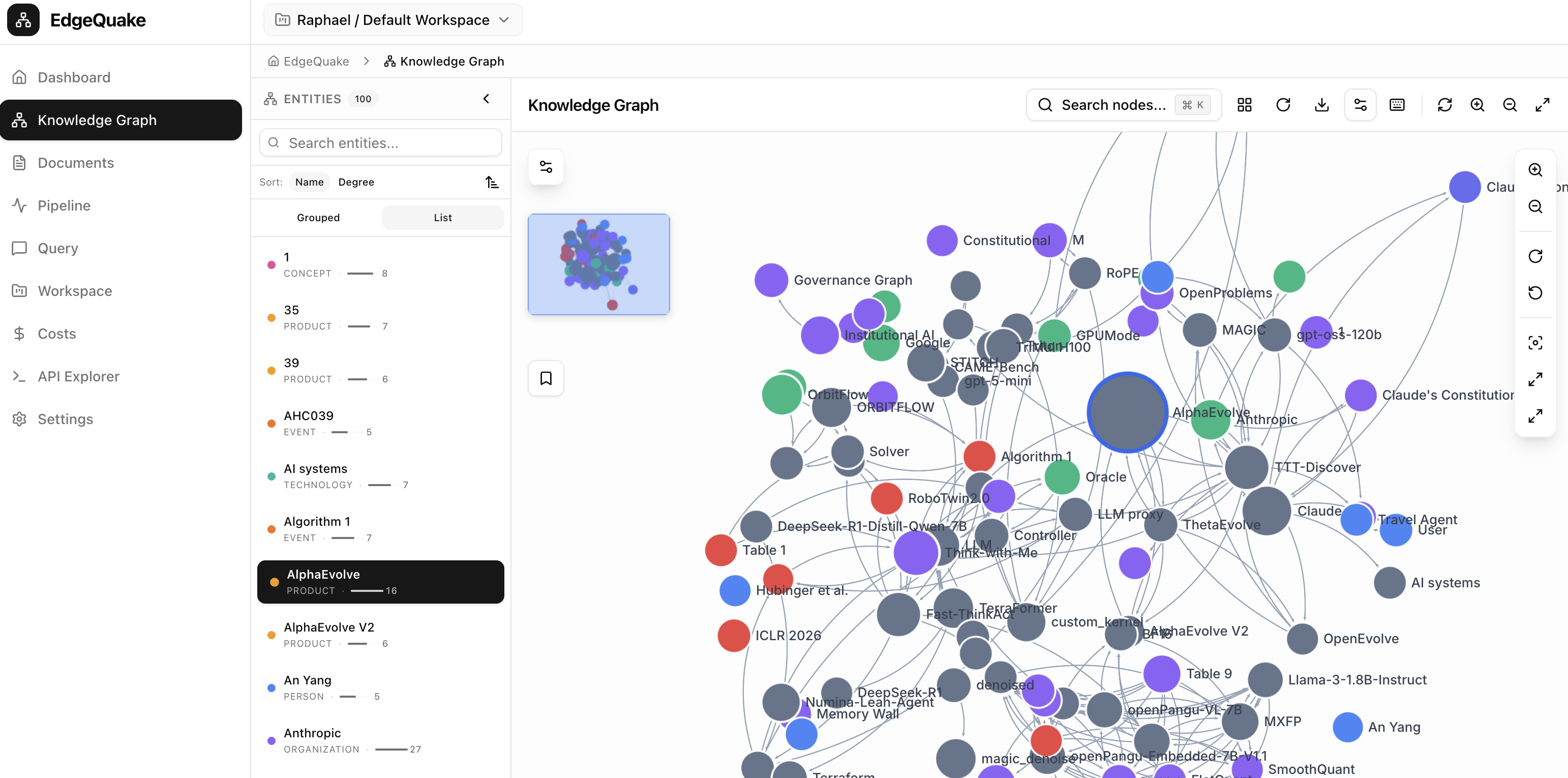
Knowledge Graph
- Entity Extraction — LLM-powered detection of people, organizations, locations, concepts, technologies, and products
- Relationship Mapping — Automatic identification of connections with keyword tagging
- Multi-Pass Gleaning — Second-pass extraction catches 15-25% more entities
- Community Detection — Louvain clustering groups related entities for thematic queries
- Custom Entity Types — 5 domain presets (General, Manufacturing, Healthcare, Legal, Research), up to 50 types per workspace
- Knowledge Injection — Domain glossaries, acronym definitions, and synonym mappings
Query Engine — 6 Modes
| Mode | Best For | Latency | |------|----------|---------| | Naive | Keyword-like lookups | ~100-300ms | | Local | Specific entity relationships | ~200-500ms | | Global | Thematic / high-level questions | ~300-800ms | | Hybrid (default) | Balanced, comprehensive results | ~400-1000ms | | Mix | Weighted vector + graph blend | configurable | | Bypass | Direct LLM (no RAG) | LLM-dependent |
Hybrid RAG (v0.16 / SPEC-046)
Production Hybrid RAG with fail-closed ops and science-grade retrieval defaults:
- PPR-default graph walk — Personalized PageRank expands entity neighborhoods (
EDGEQUAKEGRAPHWALK=bfsescape hatch) - Bipartite dual-node pick — entity∪chunk adjacency for Local / Global / Mix chunk selection
- HNSW fail-closed +
/ready— missing ANN index blocks traffic instead of silent degradation - Intent-gated Mix/Hybrid arms — skip irrelevant retrieval arms; GenAI
rag.retrievalspans - Failed-chunk retry → merge — persist / list / retry extraction failures into the knowledge graph
- Faithfulness sampling — heuristic + optional LLM judge (
EDGEQUAKEFAITHFULNESSJUDGE) - ACC CI gate —
make spec046-accwrites a deterministic AccReport JSON (no API key)
PDF Vision Pipeline
- Text Mode — Fast pdfium-based extraction (default, zero-config, embedded in binary)
- Vision Mode — GPT-4o, Claude, Gemini read each page as an image
- Table Reconstruction — Recovers complex tables that text parsers mangle
- Multi-Column Layout — LLM understands reading order across columns
- Automatic Fallback — Vision failures gracefully fall back to text extraction
Production Ready
- REST API — OpenAPI 3.0, SSE streaming, batch ingestion, health checks
- Multi-Tenant — Fail-closed workspace isolation for query, delete, and recovery
- Auth & Audit — Built-in authentication, authorization, and compliance logging
- PostgreSQL 16/17/18 — Triple-track support with pgvector + Apache AGE
- Multi-Arch Docker —
linux/amd64+linux/arm64, published to GHCR on every release - MCP Integration — Expose capabilities to AI agents via Model Context Protocol
- React 19 Frontend — Real-time streaming, interactive Sigma.js graph visualization, drag-and-drop upload
Architecture
┌─────────────────────────────────────────────────────────────────────┐
│  Frontend (React 19 + TypeScript)                                   │
│  Document Upload · Query Interface · Graph Visualization · Config   │
└──────────────────────────────┬──────────────────────────────────────┘
                               │
                               ▼
┌─────────────────────────────────────────────────────────────────────┐
│  REST API (Axum)                                                    │
│  /api/v1/documents · /api/v1/query · /api/v1/graph                  │
│  OpenAPI 3.0 · SSE Streaming · Health Checks                        │
└──────────────────────────────┬──────────────────────────────────────┘
                               │
              ┌────────────────┴────────────────┐
              ▼                                 ▼
┌──────────────────────────┐   ┌────────────────────────────────────┐
│  LLM Providers           │   │  Storage                           │
│  OpenAI · Anthropic      │   │  PostgreSQL 16 / 17 / 18           │
│  Gemini · Mistral        │   │  ├─ pgvector (embeddings)          │
│  Ollama · LM Studio      │   │  └─ Apache AGE (knowledge graph)   │
│  xAI · Azure · VertexAI  │   │                                    │
└──────────────────────────┘   └────────────────────────────────────┘
Data flow: Document → Chunks → Entity Extraction → Knowledge Graph → Vector + Graph Storage Query flow: Question → Graph Traversal + Vector Search → LLM → Answer with Sources
EdgeQuake is built from 11 Rust crates: edgequake-core, edgequake-storage, edgequake-api, edgequake-pipeline, edgequake-query, edgequake-pdf, edgequake-auth, edgequake-audit, edgequake-tasks, edgequake-rate-limiter, edgequake-observability. LLM providers are handled by the external edgequake-llm crate.
See Architecture Overview and LightRAG Algorithm Deep Dive.
Docker Deployment
Three options depending on your setup:
Option A — API Only (bring your own PostgreSQL)
docker run -d --name edgequake -p 8080:8080 \
  -e DATABASE_URL="postgres://user:pass@your-db:5432/edgequake" \
  -e EDGEQUAKELLMPROVIDER=openai \
  -e OPENAIAPIKEY="sk-..." \
  ghcr.io/raphaelmansuy/edgequake:latest
Option B — Full Stack with Prebuilt Images (recommended)
cd edgequake/docker
cp .env.example .env
docker compose -f docker-compose.prebuilt.yml up -d
| Service | Port | Image | |---------|------|-------| | API | 8080 | ghcr.io/raphaelmansuy/edgequake:0.21.0 (:latest) | | Frontend | 3000 | ghcr.io/raphaelmansuy/edgequake-frontend:0.21.0 (:latest) | | PostgreSQL | 5432 | ghcr.io/raphaelmansuy/edgequake-postgres:0.21.0 (PG18 default) |
PostgreSQL major tags (multi-arch amd64 + arm64):
| Tag | PostgreSQL | |-----|------------| | 0.21.0 / latest / 0.21.0-pg18 / latest-pg18 | PG18 | | 0.21.0-pg17 / latest-pg17 | PG17 | | 0.21.0-pg16 / latest-pg16 | PG16 |
# Pin full stack to this release
EDGEQUAKE_VERSION=0.24.3 docker compose -f docker-compose.quickstart.yml up -d
Pin PostgreSQL major (optional; default tag follows EDGEQUAKE_VERSION → PG18)
EDGEQUAKEVERSION=0.24.3 EDGEQUAKEPOSTGRES_TAG=0.21.0-pg16 \
  docker compose -f docker-compose.quickstart.yml up -d
Also works with latest-pg16 / latest-pg17 / latest-pg18.
Option C — Build from Source
cd edgequake/docker && docker compose up -dEnvironment Variables
| Variable | Default | Description | |----------|---------|-------------| | EDGEQUAKELLMPROVIDER | ollama | openai, anthropic, gemini, mistral, ollama, azure, vertexai | | EDGEQUAKEEMBEDDINGPROVIDER | (same as LLM) | Separate embedding provider for hybrid mode | | EDGEQUAKEMODELSCONFIG | — | Path to custom models.toml (see bundled catalog in repo) | | OPENAIAPIKEY | — | Required for openai | | ANTHROPICAPIKEY | — | Required for anthropic | | GEMINIAPIKEY | — | Required for Gemini Developer API (gemini provider) | | GOOGLECLOUDPROJECT | — | Required for Vertex AI (vertexai provider) | | GOOGLECLOUDREGION | us-central1 | Vertex AI regional endpoint | | GOOGLEAPPLICATIONCREDENTIALS | — | Service account JSON path (Vertex identity auth) | | MISTRALAPIKEY | — | Required for mistral | | OLLAMA_HOST | http://host.docker.internal:11434 | Ollama server URL | | EDGEQUAKE_VERSION | latest | GHCR image tag | | EDGEQUAKEDEVMODE | true (quickstart) | Open API without login — do not use in production | | EDGEQUAKEAUTHENABLED | false (quickstart) | Require JWT/API key on protected routes | | EDGEQUAKEBOOTSTRAPADMIN_USERNAME | admin | First-run admin username when auth is on | | EDGEQUAKEBOOTSTRAPADMIN_PASSWORD | — | First-run admin password (required for login on fresh installs) | | EDGEQUAKEMASTERAPI_KEY | — | Bootstrap key for POST /api/v1/users without JWT | | NEXTPUBLICAUTH_ENABLED | false (quickstart) | Web UI login gate + session handling | | NEXTPUBLICDISABLEDEMOLOGIN | false | Hide “Continue without login” on the login page | | EDGEQUAKECHUNKTIMEOUT_SECS | 180 | Per-chunk LLM timeout (seconds) | | EDGEQUAKEMAXCONCURRENT_EXTRACTIONS | 16 | Max parallel LLM calls | | RUST_LOG | info | Log level |
Vertex AI vs Gemini: gemini uses a static API key (GEMINIAPIKEY). vertexai uses OAuth2 identity (ADC or service account) — not an API key. Local setup:
gcloud auth application-default login   # not: gcloud auth login application-default
export GOOGLECLOUDPROJECT=your-gcp-project
export GOOGLECLOUDREGION=europe-west1   # optional; default us-central1
If ~/.edgequake/models.toml omits vertexai, point at the bundled catalog: export EDGEQUAKEMODELSCONFIG=edgequake/models.toml. See Configuration — Vertex AI.
SDKs
| Language | Link | |----------|------| | Python | sdks/python/ | | TypeScript | sdks/typescript/ | | Rust | sdks/rust/ | | Go, Java, Kotlin, C#, PHP, Ruby, Swift | sdks/ |
Development
For contributors building from source. Most users should use the Quick Start above.
git clone https://github.com/raphaelmansuy/edgequake.git && cd edgequake
make install
cp edgequakewebui/.env.local.example edgequakewebui/.env.local
make dev                        # Start full stack (PostgreSQL + Backend + Frontend)
Web UI defaults to http://localhost:3010 — confirm with: make status
cd edgequake && cargo test --workspace --lib --locked   # Unit / lib suite
cargo clippy --workspace --lib --locked -- -D warnings
cargo fmt --all -- --check
cd .. && make status && make stop
Pre-delivery checklist (v0.19+)
Run these before tagging a release. Prefer Makefile targets — they set required env vars.
# Fast local gates (mirrors CI first principles: fail cheap → compile once → proofs)
make ops17-smoke                # PG extension pin SSOT (pg16/17/18)
make spec046-acc                # SPEC-046 ACC + AccReport JSON
make release-gates              # fmt + workspace clippy + SPEC-006/018 + WebUI + version parity
make test-e2e-lint              # Playwright flake anti-patterns
SPEC-001 LightRAG Acc (local mandatory before tag — not in CI / release_gates.sh):
make bench001-doctor
make bench                      # EQ vs LightRAG Acc n=200 + publish/latest
Optional UI-only (no backend): make test-e2e-ui
| Gate | What it proves | CI workflow | |------|----------------|-------------| | Migration checksum | Immutable SQL lockfile | CI → migration-checksum-guard | | fmt + clippy + lib tests | Code quality | CI → check / test (nextest) | | SPEC-006 / SPEC-018 | Resource + observability proofs | CI + Release Gates | | Invariants + test floor | Reliability floor (≥870 lib) | Test Quality Gates | | SPEC-046 ACC | Hybrid RAG science ACC | SPEC-046 ACC | | SPEC-001 LightRAG Acc | EQ vs LightRAG GraphRAG-Bench Acc (n=200) | Local only (make bench) | | OPS-17 pins | pgvector/AGE pin matrix | PostgreSQL Matrix Nightly |
CI speed principles (see .github/workflows/ci.yml): shared cargo cache across jobs, CARGO_INCREMENTAL=0 + sparse index, --locked, cancel-in-progress, no duplicate workspace lib suite in sibling workflows, release gates skip per-crate clippy / lib re-run when CI already owns them.
See AGENTS.md for the full developer workflow and Release & CD for the release process.
Documentation
| Category | Links | |----------|-------| | Getting Started | Installation · Quick Start | | Tutorials | First RAG App · PDF Ingestion · Multi-Tenant | | Architecture | Overview · Data Flow · Crate Reference | | Deep Dives | LightRAG Algorithm · Query Modes · PDF Processing | | Operations | Deployment · Configuration · Runtime Auth · Monitoring | | API Reference | REST API · Extended API | | Integrations | MCP Server · OpenWebUI · LangChain | | Release & CD | Release Cycle · CHANGELOG |
Full index: docs/README.md
Contributing
EdgeQuake uses a Specification-Driven Development approach. See CONTRIBUTING.md.
- GitHub Issues — Bug reports and feature requests
- GitHub Discussions — Questions and community help
Acknowledgments
EdgeQuake implements the LightRAG algorithm by Zirui Guo, Lianghao Xia, Yanhua Yu, Tu Ao, and Chao Huang. Also inspired by Microsoft's GraphRAG.
License
Apache License, Version 2.0 — see LICENSE. Copyright 2024-2026 Raphaël MANSUY


