
A lightweight, powerful framework for multi-agent workflows and voice agents
OpenAI Agents SDK (JavaScript/TypeScript)


The OpenAI Agents SDK is a lightweight yet powerful framework for building multi-agent workflows in JavaScript/TypeScript. It is provider-agnostic, supporting OpenAI APIs and more.
Core concepts
- Agents: LLMs configured with instructions, tools, guardrails, and handoffs
- Sandbox Agents: Agents paired with a filesystem workspace and sandbox environment for longer-running work
- Realtime Agents: Low-latency voice agents with tools, guardrails, handoffs, and conversation history
- Agents as tools / Handoffs: Delegating to other agents for specific tasks
- Tools: Various Tools let agents take actions (functions, MCP, hosted tools)
- Guardrails: Configurable safety checks for input and output validation
- Human in the loop: Built-in mechanisms for involving humans across agent runs
- Sessions: Automatic conversation history management across agent runs
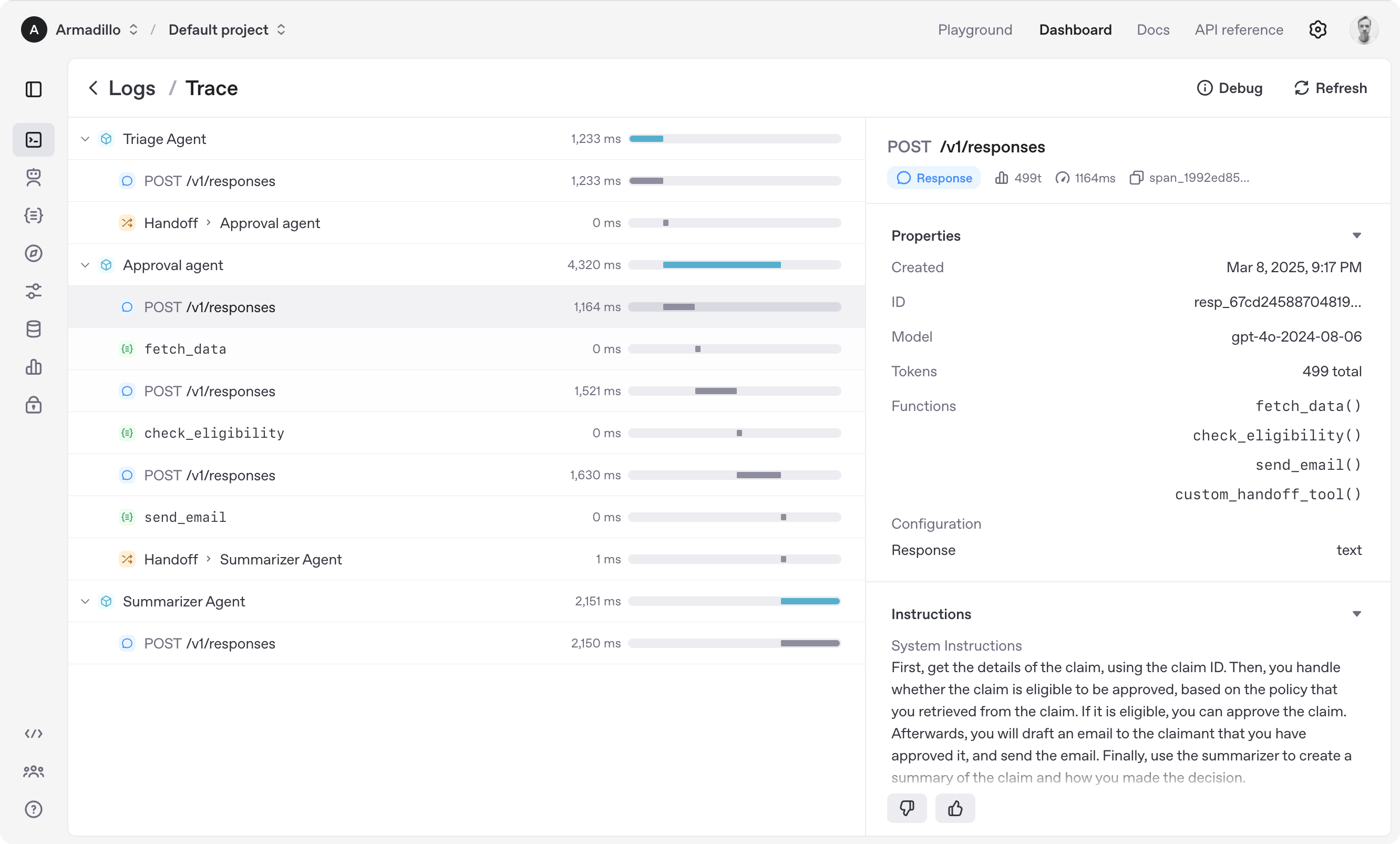
- Tracing: Built-in tracking of agent runs, allowing you to view, debug and optimize your workflows
examples/ directory to see the SDK in action.
Get started
Supported environments
- Node.js 22 or later
- Deno
- Bun
Experimental support:
- Cloudflare Workers with
nodejs_compatenabled
Installation
npm install @openai/agents zodBuild a sandbox agent
Use a Sandbox Agent when the agent should work in a filesystem, run commands, or carry workspace state across longer tasks. Sandbox Agents are in beta.
import { run } from '@openai/agents';
import { gitRepo, SandboxAgent } from '@openai/agents/sandbox';
import { UnixLocalSandboxClient } from '@openai/agents/sandbox/local';
const agent = new SandboxAgent({   name: 'Workspace Assistant',   model: 'gpt-5.5',   instructions: 'Inspect the repo before changing files.',   defaultManifest: {     entries: { repo: gitRepo({ repo: 'openai/openai-agents-js' }) },   }, });
const result = await run(   agent,   'Inspect the repo README and summarize what this project does.',   { sandbox: { client: new UnixLocalSandboxClient() } }, );
console.log(result.finalOutput);
Build a text agent
Use a regular Agent for text-based workflows that do not need a sandbox workspace or Realtime session.
import { Agent, run } from '@openai/agents';
const agent = new Agent({   name: 'Assistant',   instructions: 'You are a helpful assistant.', }); const result = await run(   agent,   'Write a haiku about recursion in programming.', ); console.log(result.finalOutput);
Build a realtime voice agent
Use a Realtime Agent for low-latency, spoken interactions in the browser.
import { RealtimeAgent, RealtimeSession } from '@openai/agents/realtime';
const agent = new RealtimeAgent({   name: 'Assistant',   instructions: 'You are a helpful assistant.', }); // Automatically connects your microphone and audio output in the browser via WebRTC. const session = new RealtimeSession(agent); await session.connect({ apiKey: '<client-api-key>' });
Set OPENAIAPIKEY in your server environment for sandbox and text agents. For browser-based voice agents, use your server to create a short-lived ephemeral client token and pass it to session.connect(...).
Explore the examples/ directory to see the SDK in action.
Acknowledgements
We'd like to acknowledge the excellent work of the open-source community, especially:
We're committed to building the Agents SDK as an open source framework so others in the community can expand on our approach.For more details, see the documentation or explore the examples/ directory.


