
Long-horizon agent skill for Claude Code / Cursor / Codex / Grok Build — multi-task ledger loop, host-portable, clean-context supervisor, verified gates. Markdown library (loop-graph), not a framework.
longgraph
Long-horizon agent skill for Claude Code, Cursor, Codex & Grok Build.
Stop agent drift with a durable ledger, a clean-context supervisor, and verified gates. Queue many long tasks in one loop — even unrelated ones — and keep going after a host switch by re-sending the same prompt against the files.
Design once → compile a durable loop-graph → verify all the way to done.




English · 简体中文
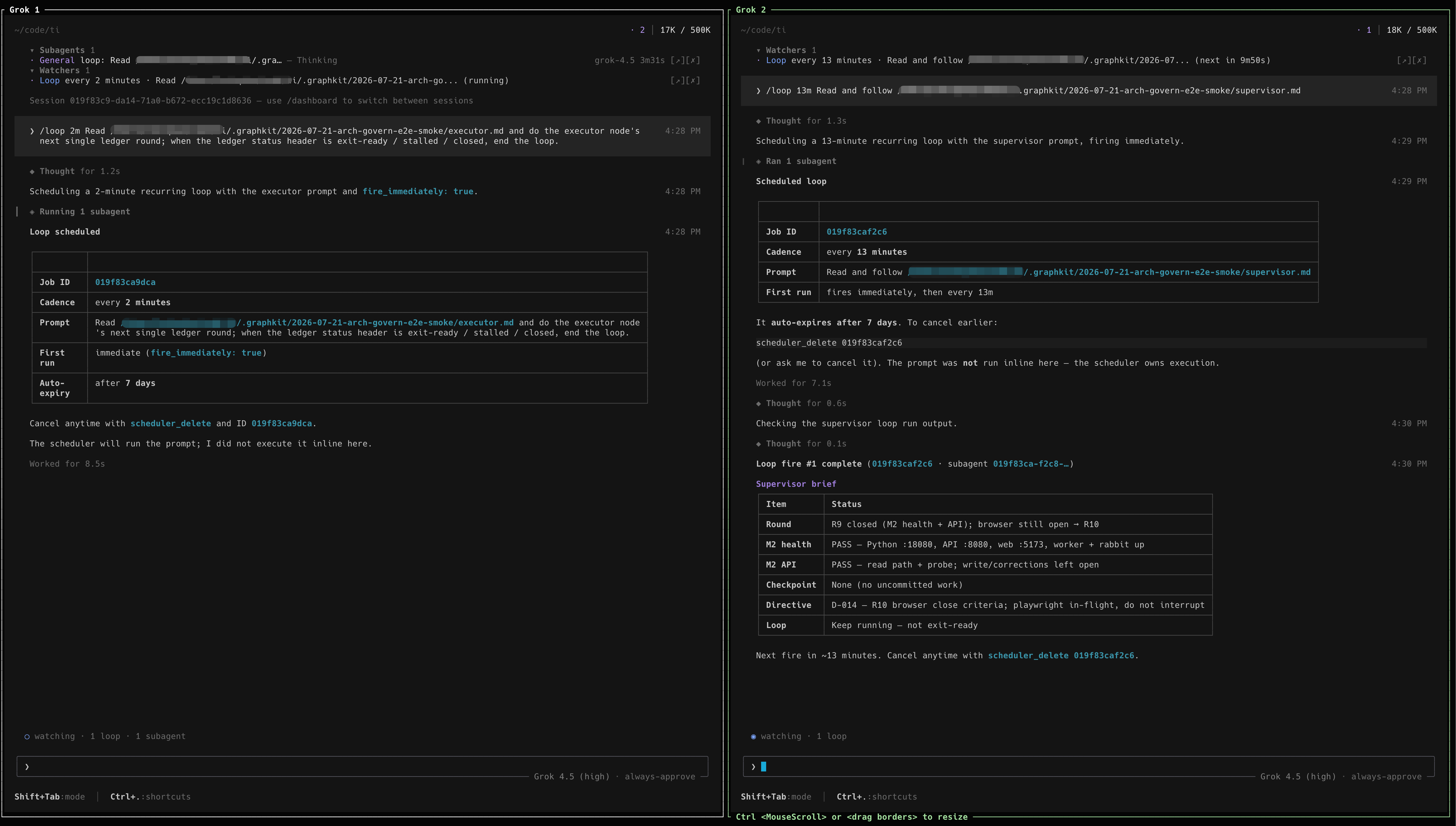
longgraph (longgraph-skill) is a curated agent skill and cross-host prompt library for long-running / long-horizon agent work — multi-hour coding, multi-milestone migrations, a queue of long tasks in one loop (they need not be related), and anything that outlives one context window. It is graph engineering for agents: specialized roles (executor · supervisor · scout) connected through durable, inspectable files — not another orchestration runtime. Because the scoreboard lives on disk, you can change hosts mid-run: open the same workspace, re-send the frozen node prompt, and continue.
One durable graph, portable across hosts. For a simple self-contained goal,
use the host's normal task or goal directly; longgraph starts where durable graph
structure adds value.
Renamed from octopus. Same library; primary brand is now longgraph /
longgraph-skill//longgraph/.longgraph/. Older posts that say
octopus-skill,/octopus, or.octopus/still work via GitHub repo redirect,
install legacy symlinks, and in-flight run-dir alias (see Install
and Migration).
Evidence
These are not one-shot demos. longgraph is a Markdown skill / prompt library (not an orchestration runtime). The table mixes checkable public Git, a function-only redacted multi-day pattern, and synthetic pedagogy.
| Case | What a reader can verify | Kind | | --- | --- | --- | | Self-iteration of this skill | 87 public commits across ~14 calendar days (2026-07-19 → 2026-08-02), 74 files, method rules written back into the library (no wake edge, gate-wait backlog, blocked≠parked, bounded live edges, authoring≠runtime) | Public Git facts — fixed anchor 6efcb7f | | Multi-day control-plane pattern | Multi-day wall-clock, tens of rounds, many directives: durable ledger, clean-context supervisor overturns self-reported evidence, non-skippable gates, blocked-work lane, owner A/B/C — functions only, no private payload | Redacted real-run pattern | | migrate-blob-storage | Multi-milestone ledger: pilot → cohort, forced convergence, supervisor overturns self-reported evidence, non-skippable gate + blocked-work lane | Synthetic pedagogy (fictional app) | | add-tests-to-cli | Smallest full run: three rounds, register-then-defer, clean-context supervisor intent | Synthetic pedagogy (fictional CLI) |
How to read the clock. The self-iteration window’s ~14 days / ~340 hours is project wall-clock (first public commit → frozen anchor), not continuous model execution and not a claim of unattended production autonomy. Re-check Git with the commands in the self-iteration case. The redacted multi-day card uses coarse buckets only and is not private-Git re-checkable — see its evidence boundary.
Publication rules for future cases: public / private boundary.
When to use this
Reach for longgraph when you need any of:
- A long-horizon agent that keeps working after context compaction / session resets
- A durable task ledger (single scoreboard) instead of chat-memory progress
- Several long tasks in one loop — a continuous queue, even when items are unrelated
- Host-portable continuity — switch Claude Code ↔ Cursor ↔ Codex ↔ Grok Build mid-run by re-sending the prompt against the same files
- An independent clean-context supervisor — not the same agent grading itself
- Verified done: acceptance gates re-run against real output, not self-reported “done”
- Multi-milestone work with non-skippable gates and explicit owner red lines
- A Markdown skill / prompt library that works across Claude Code · Cursor · Codex · Grok Build
When not to use this
- One-shot edits, small PR-sized tasks, or anything that fits a single clean session
- You want a runtime framework (LangGraph, CrewAI, AutoGen, custom agent server)
- You only need a single short prompt with no ledger, gates, or independent review
How it compares
| Approach | Runtime / server? | Independent verifier | Durable scoreboard | Multi-task queue + mid-run host switch | | --- | --- | --- | --- | --- | | LangGraph / CrewAI / AutoGen | Yes | You build it | Usually yes | Framework-bound; often one deployment stack | | One mega-prompt / single skill | No | No (self-check) | Weak (chat memory) | Weak — progress dies with the session | | longgraph (this repo) | No — Markdown only | Yes (supervisor node) | Yes (ledger.md) | Yes — files are the run; re-send the prompt |
Also called / related searches: longgraph skill, long-horizon agent skill, long-running agent skill, prevent agent drift, multi-task agent loop, switch AI coding host mid-task, Claude Code multi-agent supervisor, Grok Build agent loop, agent ledger, loop-graph, *graph engineering for agents, clean-context review*.
Why longgraph
Long-running agents tend to drift in predictable ways: scope expands, “done” becomes self-reported, tests stop proving the real path, and early decisions disappear from context. longgraph moves the safeguards outside the model’s memory:
- Verified, not merely written — acceptance gates are rerun against real output.
- Durable state — the ledger survives context loss and remains the single scoreboard.
- Many long tasks, one loop — the ledger is a continuous queue; items can be
- Host-portable — progress is files under
.longgraph/<date-slug>/, not chat
- Clean-context review — an independent supervisor can catch drift the executor cannot see.
- Forced convergence — growth is periodically stopped, measured, and simplified.
- Low-friction owner decisions — genuine owner-only calls arrive as a short
It is Markdown, not an orchestration framework: no application runtime, server, or vendor lock-in. Install as a Claude Code plugin, symlink into **Codex / Cursor (see install script), or run prompts-only on Grok Build** (and other hosts) via the per-host references.
Multi-task loops & switching hosts
One loop is a queue, not a single story. Each round still does one ledger item end-to-end (implement → verify → record), but the ledger can hold many long items at once — related milestones or unrelated backlog (the gate-wait backlog pattern is the extreme case: useful work with no dependency on the item under audit). You do not need a new graph every time the next long task is about something else.
The host is swappable; the files are not. A compiled loop-graph run freezes prompts and state under .longgraph/<date-slug>/. To continue elsewhere:
- Use a workspace that can see those files (and the project).
- Re-send the same frozen executor (and, if used, supervisor) prompt on the new host.
- The node reads
ledger.md/directives.mdand continues from the next open item.
Is longgraph the right tool?
| Your task shape | Choose | What you get | | --- | --- | --- | | One self-contained goal that fits a normal task/session | Use the host's ordinary task or goal directly | No longgraph wrapper or extra prompt layer | | Many rounds, durable state, non-skippable gates, owner boundaries, host switching, or independent verification | longgraph / loop-graph | An executor loop plus a clean-context supervisor, coordinated through durable files |
Rule of thumb: if you do not need the graph, do not use longgraph.
Quick start
Claude Code
Install the plugin from the marketplace:
/plugin marketplace add levi-qiao/longgraph-skill
/plugin install longgraph@longgraph-skill
Codex or Cursor
Install the library and symlink /longgraph (plus legacy /octopus) into hosts whose loaders follow symlinks:
curl -fsSL https://raw.githubusercontent.com/levi-qiao/longgraph-skill/main/install.sh | shFrom a local clone, run ./install.sh at the repository root.
Grok Build (and other prompts-only hosts)
Author on Claude Code or Codex when you want direct node creation, or choose prompts-only and paste the frozen executor / supervisor pointers into Grok Build /loop tasks (same run directory). Cursor and shell/cron use the same prompts-only path — see host compatibility.
Design a run
Invoke /longgraph. It detects Codex or Claude Code, inspects the workspace, and asks only for unresolved owner decisions before compiling the run. Choose direct creation to have it start both same-host runtime nodes, or prompts-only for manual/cross-host launch (including Grok Build). You can also invoke loop-graph directly.
Authoring and runtime stay separate: the author skill compiles the work but never executes it. Generated nodes follow their frozen run contract under .longgraph/<date-slug>/.
How the graph works
| Role | Responsibility | Durable edge | | --- | --- | --- | | Executor | Works one ledger item, verifies it in the same round, then records the result | Reads and writes ledger.md | | Supervisor | Re-verifies from its own separate context, checkpoints passing work, and corrects drift | Reads the ledger; writes only the directives edge (live queue + cold archive) | | Scout (optional) | Researches a bounded question away from the critical path | Writes a findings file read only on reference |
The load-bearing rule is one node = one prompt + one single-writer edge. The ledger has exactly one writer. The supervisor never shares the executor’s context, never edits its scoreboard, and steers only through the one-way directives edge.
For the rationale behind every constraint, read the methodology. For the node and edge model, see the loop-graph model.
Host compatibility
| Host | loop-graph execution | | --- | --- | | Codex | ✅ detects the host and directly creates both runtime nodes | | Claude Code | ✅ detects the host and directly creates two background runtime sessions when capability checks pass | | Grok Build | prompts-only — two /loop tasks (executor + supervisor), no wake edge | | Cursor | prompts-only execution target | | shell / cron | prompts-only execution target |
Authoritative syntax, pacing, context carry, and hooks live in separate per-host references, so authoring loads only the selected host. Mid-run host switches reuse the same durable run directory; only how you start each tick changes.
Renamed from octopus
| Was (legacy / still accepted) | Now (primary) | | --- | --- | | Product octopus, repo octopus-skill | longgraph, repo longgraph-skill | | Slash /octopus | /longgraph (install still symlinks /octopus → same tree) | | Plugin octopus@octopus-skill | longgraph@longgraph-skill | | Run dir .octopus/<date-slug>/ | .longgraph/<date-slug>/ (continue in-flight .octopus/ runs in place) | | Contract octopus.loop-graph. | longgraph.loop-graph. (old headers on existing files still mean the same family) |
GitHub renames redirect old clone/curl URLs (…/octopus-skill/… → …/longgraph-skill/…). Re-run install.sh or reinstall the plugin once so primary names win on disk.
Repository map
| Path | Purpose | | --- | --- | | Root SKILL.md | /longgraph entrypoint; checks fit and delegates authoring to loop-graph | | Loop-graph author | Generates executor, supervisor, ledger, and directive artifacts | | lib/ | Shared methodology | | Host references | One independently loaded owner for each host's runtime facts | | Worked examples | Public-Git self-iteration plus fictional ledgers showing gates in action | | Public / private boundary | What may enter the public tree vs stay project-local |
Governance
longgraph applies its own anti-bloat rule to the library: **no prompt enters without a real run that proved its value.** Curated and opinionated beats comprehensive.
Contributions are welcome. Start with the contribution guide.
Credits
The loop-graph skill grew from real runs and community input. A public-Git self-iteration case records how the method was hardened into this library. Special thanks to @BrightProgrammer7 for the migrate-blob-storage example and the discussions that sharpened milestone gates and the node/edge vocabulary.


