
lua-resty-ffi provides an efficient and generic API to do hybrid programming in openresty/envoy with mainstream languages (Go, Python, Java, Rust, Nodejs, etc.).
lua-resty-ffi
lua-resty-ffi provides an efficient and generic API to do hybrid programming in openresty with mainstream languages (Go, Python, Java, Rust, Node.js, etc.).
lua-resty-ffi depends on nginx thread pool, so you must compile openresty with --with-threads.
Now it supports Envoy!
That means all lua-resty-ffi based libraries (e.g. lua-resty-ffi-grpc) can run on both Nginx and Envoy seamlessly without code changes.
Features:
- nonblocking, in coroutine way
- simple but extensible interface, supports any C ABI compliant language
- once and for all, no need to write C/Lua codes to do coupling anymore
- high performance, faster than unix domain socket way
- generic loader library for python/java/nodejs
- any serialization message format you like
- [x] envoy porting
- [ ] batch polling
- [ ] use spinlock
- [ ] python: support running venv package based on sub-interpreter
- [ ] logging to nginx error.log (aware of file rotation), e.g. python WatchedFileHandler
- [ ] shared_dict API
- Go
- Python
- Rust
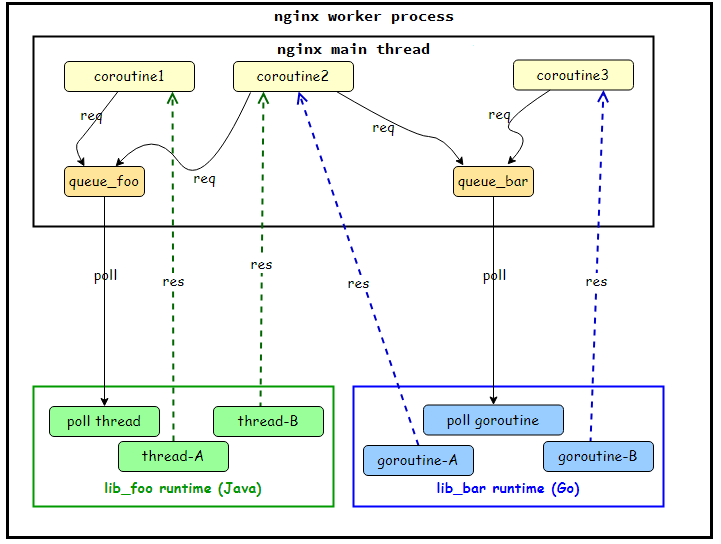
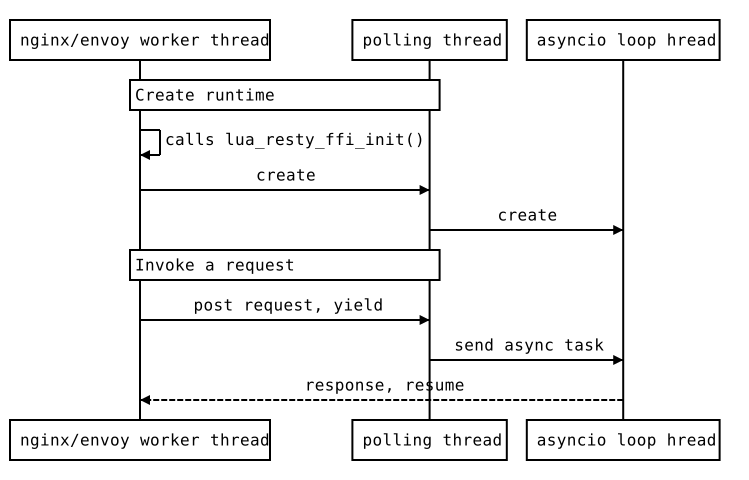
Architecture
Useful blog post:
Implement Grpc Client in Rust for Openresty (Chinese version)
Quickstart
Install lua-resty-ffi via luarocks
- specify your openresty source path in variable
$OR_SRC - ensure openresty source are already configured and built according to your product release
luarocks config variables.OR_SRC /tmp/tmp.Z2UhJbO1Si/openresty-1.21.4.1
luarocks install lua-resty-ffi
Demo
Take golang as an example:
cd examples/go
install golang if not yet, see https://go.dev/doc/install
compile example libraries
make
run nginx
make run
in another terminal
curl http://localhost:20000/echo
ok
envoy
Blog:
http://luajit.io/posts/make-lua-resty-ffi-run-on-envoy/
http://luajit.io/posts/envoy-async-http-filter-lua-resty-ffi-vs-golang/
Repo:
https://github.com/kingluo/envoy/tree/lua-resty-ffi
# compile envoy
cd /opt
git clone https://github.com/kingluo/envoy
cd envoy
git checkout origin/lua-resty-ffi
./ci/runenvoydocker.sh './ci/do_ci.sh bazel.dev'
ln -f /tmp/envoy-docker-build/envoy/source/exe/envoy/envoy /usr/local/bin/envoy
run demo
cd /opt/envoy/examples/lua
PYTHONPATH=/opt/lua-resty-ffi/examples/python/ \
LDLIBRARYPATH=/opt/lua-resty-ffi/examples/python \
LUA_PATH='/opt/lua-resty-ffi/?.lua;;' \
envoy -c envoy.yaml --concurrency 1
curl -v localhost:8000/httpbin/get
envoy.yaml snippet:
http_filters:
  - name: luafilterwithcustomname_0
    typed_config:
      "@type": type.googleapis.com/envoy.extensions.filters.http.lua.v3.Lua
      defaultsourcecode:
        inline_string: |
          function envoyonrequest(request_handle)
            require("resty_ffi")
            local demo = ngx.loadffi("ffigo_echo")
            local ok, res = demo:foobar("foobar", request_handle)
            assert(ok)
            assert(res == "foobar")
            local demo = ngx.loadffi("restyffipython", "ffi.echo?,init", {isglobal = true})
            local ok, res = demo:echo("hello", request_handle)
            assert(ok)
            assert(res == "hello")
          end
Background
In openresty land, when you turn to implement some logic, especially to couple with third-party popular frameworks, it's likely to suck in awkward: make bricks without straw.
- C is a low-level language, with no unified and rich libraries and ecosystems, and most modern frameworks do not support C, instead, they like Java, Python, Go. C is suitable for fundamental software.
- Lua is an embedded and minimal programming language, which means all powers come from the host. In openresty, it means all functionalities come from lua-nginx-modules. Like C, or even worse, you have to reinvent the wheels via cosocket to do modern networking stuff. A lot of
lua-resty-was born, but they are almost semi-finished compared to native lib in other languages. For example,lua-resty-kafkadoesn't support consumer groups,lua-resty-postgresdoesn't support notify and prepared statements, etc. Moreover, most of those authors oflua-resty-stop development at some stage because the lua community is so small and less attractive.
WASM has below shortages, which make it not suitable for openresty:
- no coroutine, which means you need to execute the logic from start to end and block the nginx worker process with arbitrary time
- castrated language support, e.g.
wasmedgewasi_socket.
* Python: You have to use implementations that support WASM, e.g. rustpython.
- complex development, due to sandbox original intention, you have to export a lot of API from nginx
Concepts
Library
In Go and Rust, it means the compiled library, e.g. libffigoetcd.so.
In Python3, it means the loader library libffi_python3.so with native python3 modules.
In Java, it means the loader library libffi_java.so with native Java classes/jar.
In Node.js, it means the loader library libffi_nodejs.so with native nodejs modules.
Library configuration
Configuration of the library, e.g. etcd endpoints, kafka endpoints, etc.
The format could be any serialization format, e.g. json, yaml, as long as it matches the runtime
Runtime
The combination of library and configuration would init a new runtime, which represents some threads or goroutines to do jobs.
You could use the same library with different configurations, which is very common, especially for Java, Python and Node.js.
Request-Response Model
Coupling between nginx worker process and the runtime is based on message exchanges, which contain two directions:
- Request
- the lua coroutine creates a task
- associates the task with the request message, which is C
malloc()char array. Note that
- put the task into the thread-safe queue of the runtime and yield
- the runtime polls this queue
- In Go, due to GMP model, it may block the nginx worker process
- It increases the burden for other languages to provide such API
- Response
malloc() char array)
into the ngxthreadpooldone queue directly and notify the nginx epoll loop via eventfd,
the nginx would resume the lua coroutine then. Note that the response would be
freed by lua-resty-ffi, so no need to care about it in your runtime.
IPC design and Benchmark
Benchmark compared to unix domain socket.
Lua API
local runtime = ngx.load_ffi(lib, cfg, opts)
Load and return the runtime
lib
libdemo.so, the short name is demo).
When the lib is name only or short name, it's searched according to LDLIBRARYPATH environment variable.
cfgconfiguration, it could be string or nil.
optsoptions table.
{
    -- the maximum queue size for pending requests to the runtime.
    -- it determines the throughput of requests if the queue is full,
    -- all following requests would fail.
    max_queue = 65536,
-- denotes whether the symbols loaded from the library     -- would be exported in the global namespace, which is only necessary for python3 and nodejs.     is_global = false,
-- by default, all libraries handles would be cached by lua-resty-ffi     -- because currently, only python and rust could be hot-reload,     -- and java must not be dlclose()     -- unpin is used to enable hot-reload     -- note that it's different from the unload/reload of runtime,     -- which is application-specific behavior, but library unload/reload is     -- done by the linker via dlopen()/dlclose().     unpin = false, }
This API is idempotent. The loaded runtime is cached in an internal table, where the table key is lib .. '&' .. cfg.
This function calls the libffi_init() of the library per key.
It means the same library with a different configuration would initiate a different new runtime, which is especially useful for python3, Java and Node.js.
Example:
local opts = {is_global = true}
local demo = ngx.loadffi("ffipython3",
    [[ffi.kafka,init,{"servers":"localhost:9092", "topic":"foobar", "group_id": "foobar"}]], opts)
local demo = ngx.loadffi("ffigo_etcd", "[\"localhost:2379\"]")
local ok, resorrc, err = runtime:call(req)
Send a request to the runtime and returns the response.
reqthe request string, could be in any serialization format, e.g. json, protobuf, as long as it matches the runtime implementation.
okreturn status, true or false.
resorrcresponse string, could be in any serialization format, e.g. json, protobuf, as long as it matches the runtime implementation. When the runtime returns non-zerorc,okis false, and theresorrcis the returned value by the runtime.
errthe error string, it may exist only ifokis false. It may be nil if the runtime does not return an error.
Note that the method name call could be any name you like, it would be generated automatically by the __index meta function, and only used to denote the request semantics。
Example:
local ok, res
ok, res = demo:produce([[{"type":"produce", "msg":"hello"}]])
assert(ok)
ok, res = demo:produce([[{"type":"produce", "msg":"world"}]])
assert(ok)
ngx.sleep(2)
ok, res = demo:consume([[{"type":"consume"}]])
assert(ok)
ngx.say(res)
local ok, res = runtime:__unload()
Unload the runtime, after that, no request could be sent to this runtime anymore. The runtime would receive a NULL task, and it must terminate everything including the threads. Note that it's asynchronous processing, and the NULL task is appended to the queue, so all pending normal tasks would be handled first.
API provided by the runtime
int libffi_init(char cfg, void tq);
This API is provided by the library to initiate its logic and start the poll thread/goroutine.
cfg is a null-terminated C string, it would get freed by lua-resty-ffi after libffi_init() returns, which may be NULL.
tq is the task queue pointer, used by the below APIs.
Example:
//export libffi_init
func libffi_init(cfg *C.char, tq unsafe.Pointer) C.int {
    data := C.GoString(cfg)
    ...
    go func() {
        for {
            task := C.ngxhttpluaffitask_poll(tq)
            if task == nil {
                break
            }
            var rlen C.int
            r := C.ngxhttpluaffiget_req(task, &rlen)
            res := C.malloc(C.ulong(rlen))
            C.memcpy(res, unsafe.Pointer(r), C.ulong(rlen))
            C.ngxhttpluaffirespond(task, 0, (*C.char)(res), rlen)
        }
    }()
    return 0
}
APIs used by the runtime
void ngxhttpluaffitask_poll(void tq);
Poll the task from the task queue assigned to the runtime.
When it returns NULL, it denotes the runtime was unloaded, the runtime must clean up everything and not access the task queue anymore (because the task queue was deallocated)!
char ngxhttpluaffiget_req(void tsk, int *len);
Extract the request from the task. Note that the request could be NULL, so the runtime must not use this API in this case.
void ngxhttpluaffirespond(void tsk, int rc, char rsp, int rsp_len);
Response to the task.
All the above APIs are thread-safe. So you could use them anywhere in the thread/goroutine of your runtime.
rcreturn status,0means successful, and other values mean failure.rspresponse char array, may be NULL if the runtime does not need to respond to something.rsp_lenthe length of response, maybe0if therspis NULL or\0' terminated C string.
is non-zero, then the runtime may also set rsp and rsp_len` if it needs to return error data.


