
A workout tracking web application for personal use (or family, friends), geared towards running and other GPX-based activities








A workout tracking web application for personal use (or family, friends), geared towards running and other GPX-based activities
Self-hosted, everything included.
Chat with the community on Matrix
Features
- upload workout records (gpx, tcx or fit files)
- keep track of personal daily stats (weight, step count, ...)
- create manual workout records (weight lifting, push-ups, swimming, ...)
- create route segments to keep track of your progress
- keep track of equipment you are using
- check your progress through statistics
- see your "heatmap": where have you been (a lot)?
:heart: Donate your workout files :heart:
We are collecting real workout files for testing purposes. If you want to support the project, donate your files. You can open an issue and attach the file, or send a pull request.
We are looking for general files from all sources, but also "raw" files from devices. The first file type can be edited to remove personal information, but the second type should be as pure (raw) as possible.
Make sure the file does not contain personally identifiable information, specifically your home address! Preferably, share files from workouts that you recorded while travelling.
Be sure to add some metadata in the issue or pull request, such as:
- the activity type (running, swimming, ...)
- the general location's name (city, national park, ...)
- anything relevant, such as whether there is heart rate or cadence data, or any
By donating the files, you grant the project full permission to use them as they see fit.
Getting started
Docker
Run the latest image from GitHub Container Registry (latest and release images are available for amd64 and arm64). The current directory is mounted as the data directory.
# Latest master build
docker run -p 8080:8080 -v .:/data ghcr.io/jovandeginste/workout-tracker:latest
Tagged release
docker run -p 8080:8080 -v .:/data ghcr.io/jovandeginste/workout-tracker:2.0.2
docker run -p 8080:8080 -v .:/data ghcr.io/jovandeginste/workout-tracker:2.0
docker run -p 8080:8080 -v .:/data ghcr.io/jovandeginste/workout-tracker:2
Latest release
docker run -p 8080:8080 -v .:/data ghcr.io/jovandeginste/workout-tracker:release
Run as non-root user; make sure . is owned by uid 1000
docker run -p 8080:8080 -v .:/data -u 1000:1000 ghcr.io/jovandeginste/workout-tracker
Open your browser at http://localhost:8080
To persist data and sessions, run:
docker run -p 8080:8080 \
    -e WTJWTENCRYPTION_KEY=my-secret-key \
    -v $PWD/data:/data \
    ghcr.io/jovandeginste/workout-tracker:master
or read the JWT encryption key from a file:
docker run -p 8080:8080 \
    -e WTJWTENCRYPTIONKEYFILE=/run/secrets/jwtencryptionkey.txt \
    -v $PWD/jwtencryptionkey.txt:/run/secrets/jwtencryptionkey.txt \
    -v $PWD/data:/data \
    ghcr.io/jovandeginste/workout-tracker:master
or use docker compose
# Create directory that stores your data
mkdir -p /opt/workout-tracker
cd /opt/workout-tracker
Download the base docker compose file
curl https://raw.githubusercontent.com/jovandeginste/workout-tracker/master/docker/docker-compose.base.yaml --output docker-compose.base.yaml
For sqlite as database:
curl https://raw.githubusercontent.com/jovandeginste/workout-tracker/master/docker/docker-compose.sqlite.yaml --output docker-compose.yaml
For postgres as database:
curl https://raw.githubusercontent.com/jovandeginste/workout-tracker/master/docker/docker-compose.postgres.yaml --output docker-compose.yaml
curl https://raw.githubusercontent.com/jovandeginste/workout-tracker/master/docker/postgres.env --output postgres.env
Start the server
docker compose up -d
NOTE: If using postgres, configure the parameters in postgres.env.
Natively
Download a pre-built binary or build it yourself (see Development below).
Eg. for v2.0.2 on Linux x86_64:
wget https://github.com/jovandeginste/workout-tracker/releases/download/v2.0.2/workout-tracker-v2.0.2-linux-amd64.tar.gz
tar xf workout-tracker-v2.0.2-linux-amd64.tar.gz
./workout-tracker
To persist sessions, run:
export WTJWTENCRYPTION_KEY=my-secret-key
./workout-tracker
or read the JWT encryption key from a file:
echo "my-secret-key" > ./jwtencryptionkey.txt
export WTJWTENCRYPTIONKEYFILE=./jwtencryptionkey.txt
./workout-tracker
This will create a new database file in the current directory and start the web server at http://localhost:8080.
Screenshots
Login page
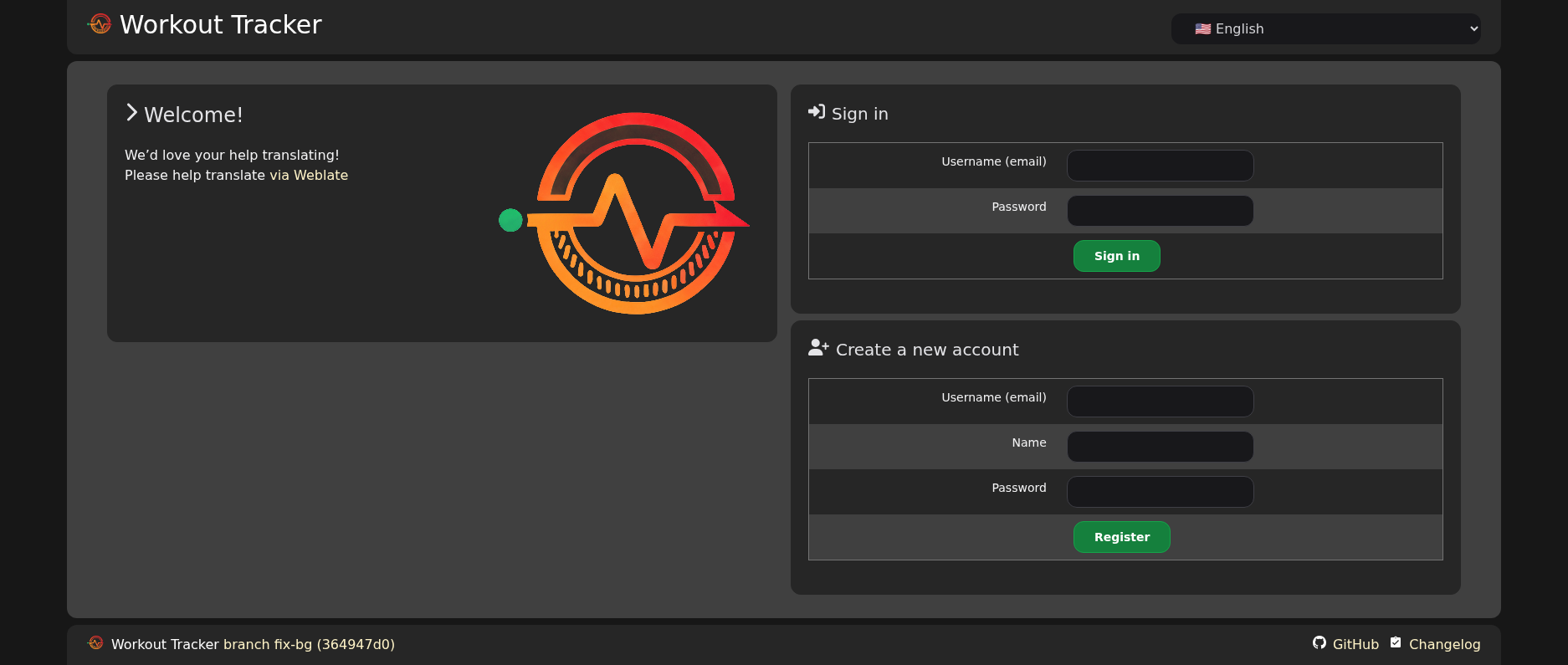
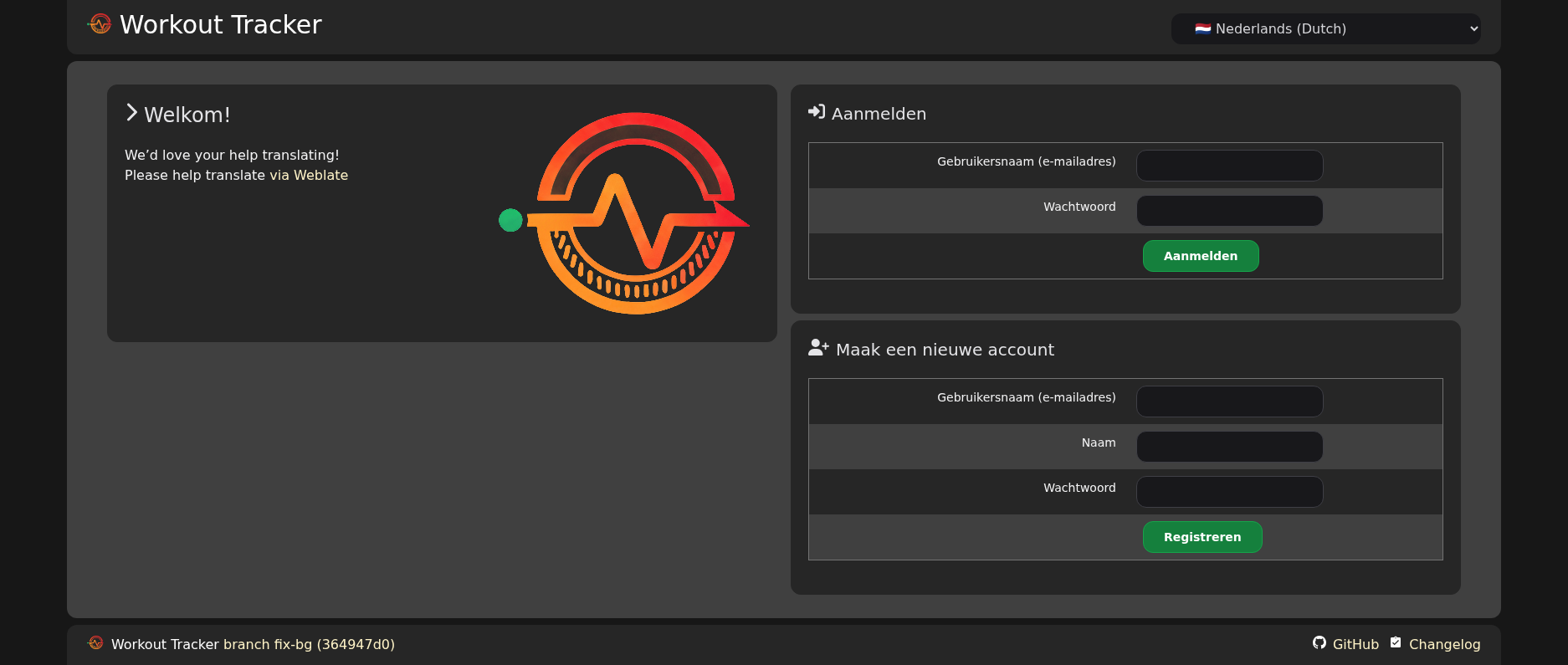
Login / registration form
- new users have to be activated by an admin
- registration can be disabled
Dashboard
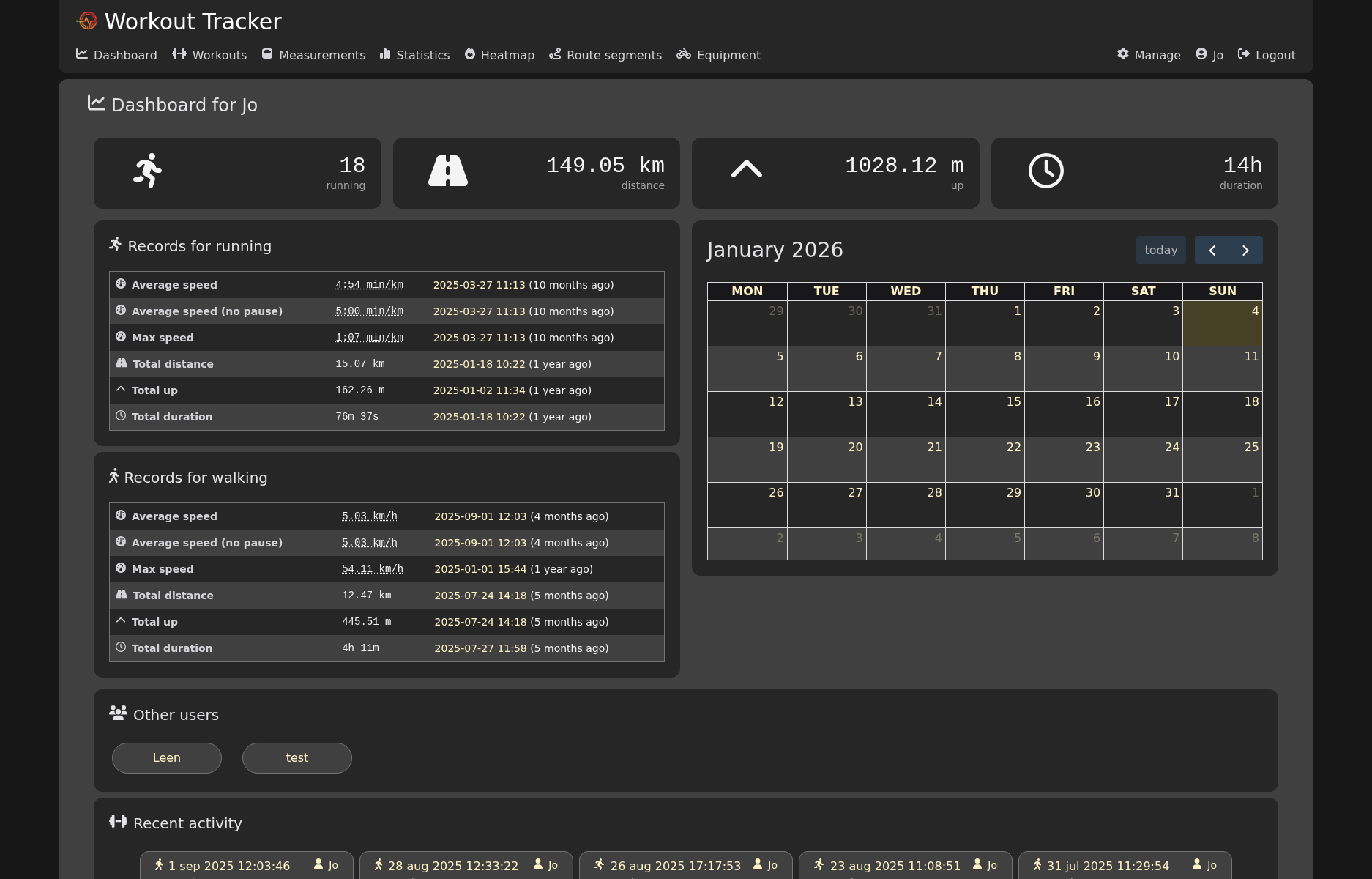
Dashboard view with:
- personal totals
- running records
- a calendar view
- recent activities (by you and other users)
Overview of workouts
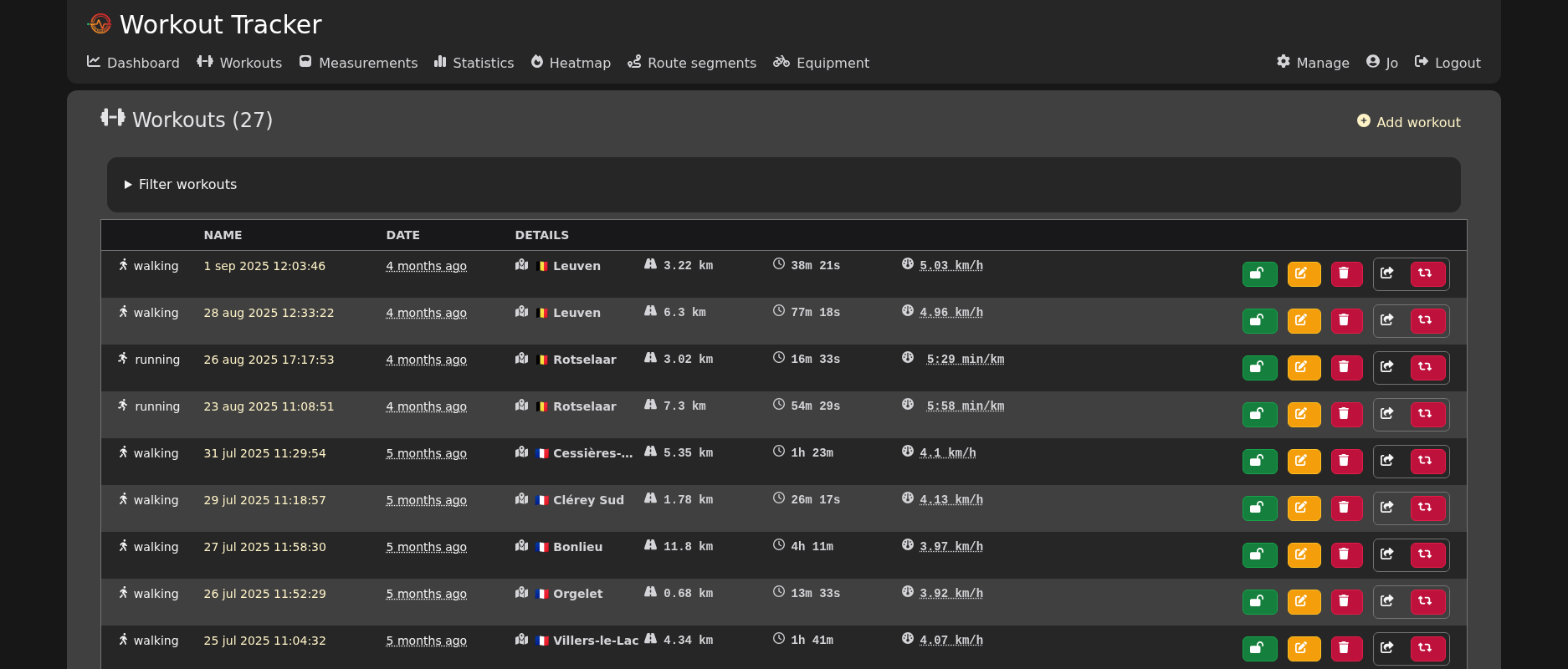
Overview of all your activities, with summaries.
Details of a single workout
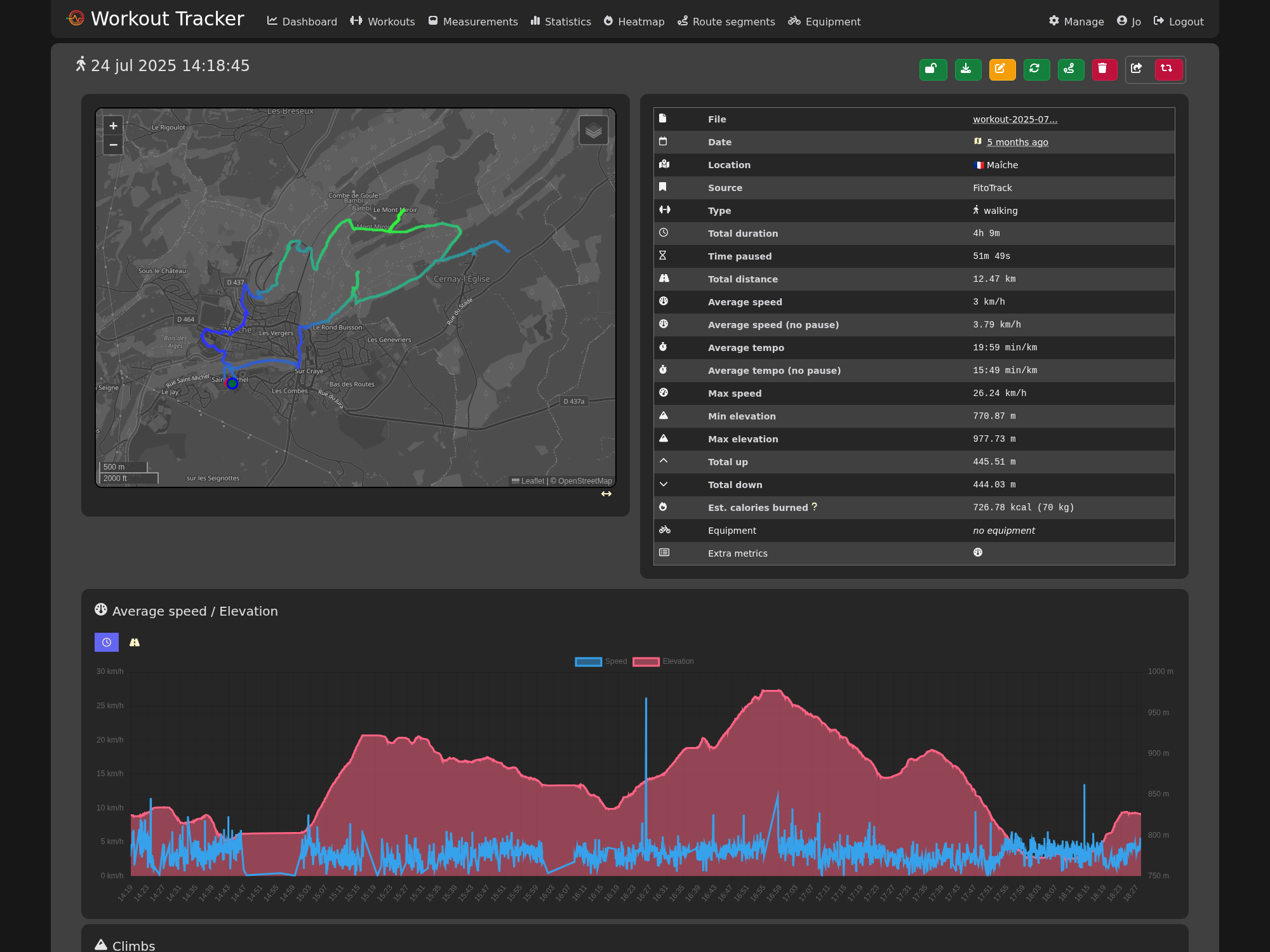
Details of a workout, with:
- a zoomable, dragable map of the GPX track with more details per point
- many summarized statistics
- a breakdown per kilometer or per mile
- track color based on elevation of the segment
- graph of average speed and elevation per minute
- optional graph of heart rate, cadans
Tooltips for even more information
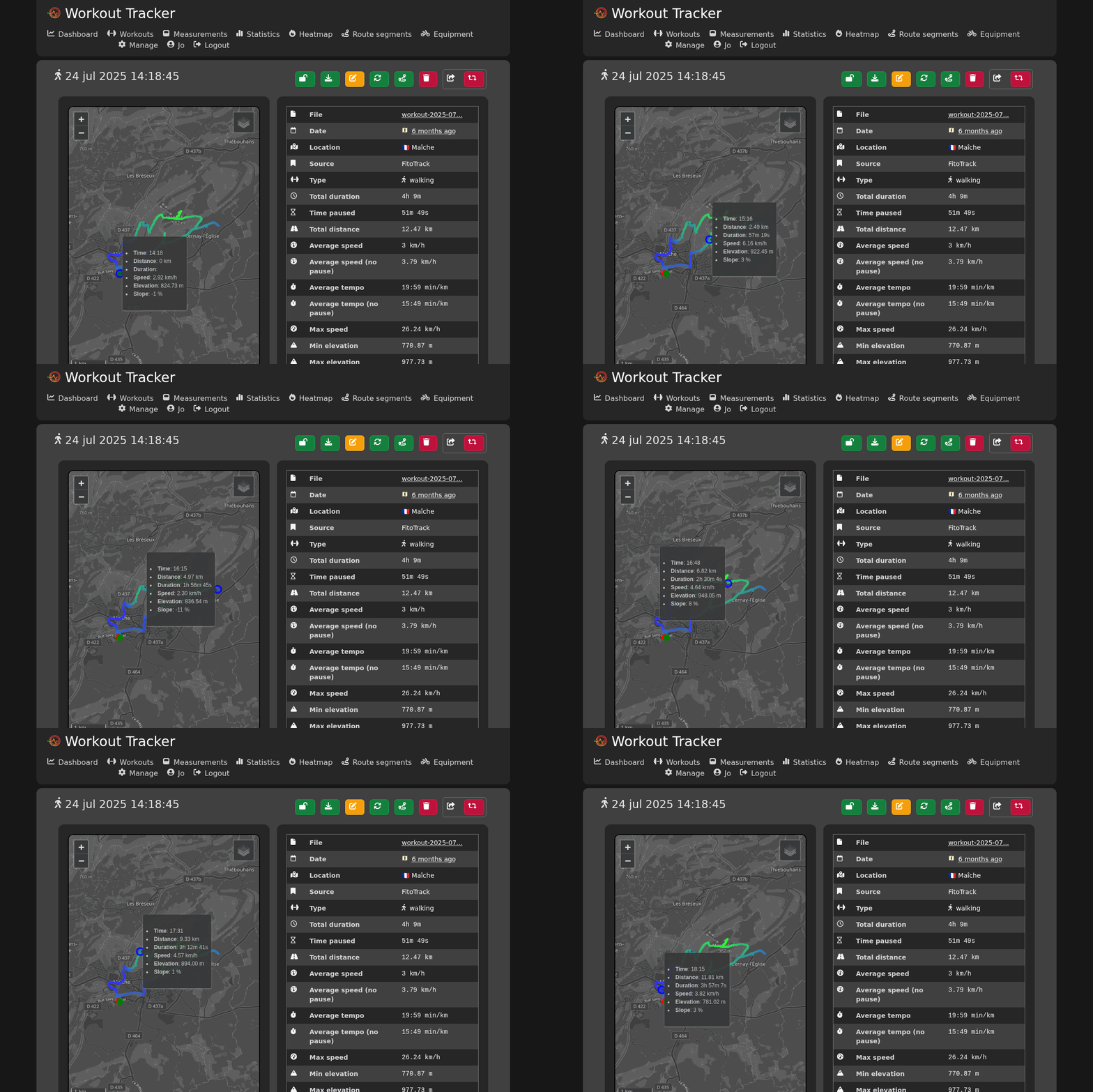
- green and red circle are start and end points of the track
- every point on the track has a tooltip with a summary at that moment
- hover over the breakdown per kilometer to highlight the point
Upload your files
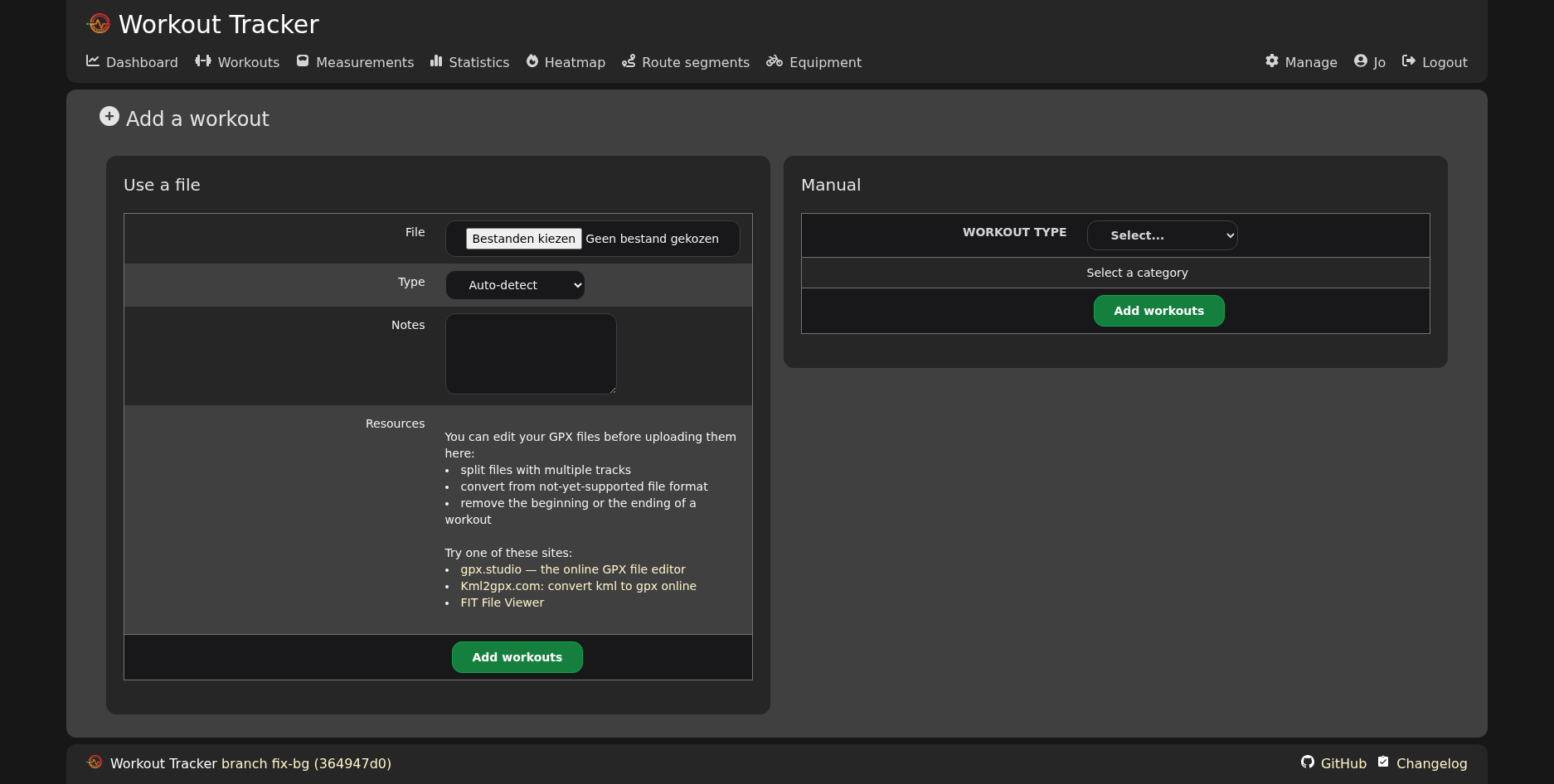
- Upload one or multiple GPX files.
- Pick the type (running, cycling, ...) or let the application guess based on
- The files are parsed when uploaded: statistics and other information are
- Or add a workout manually.

Statistics to follow your progress
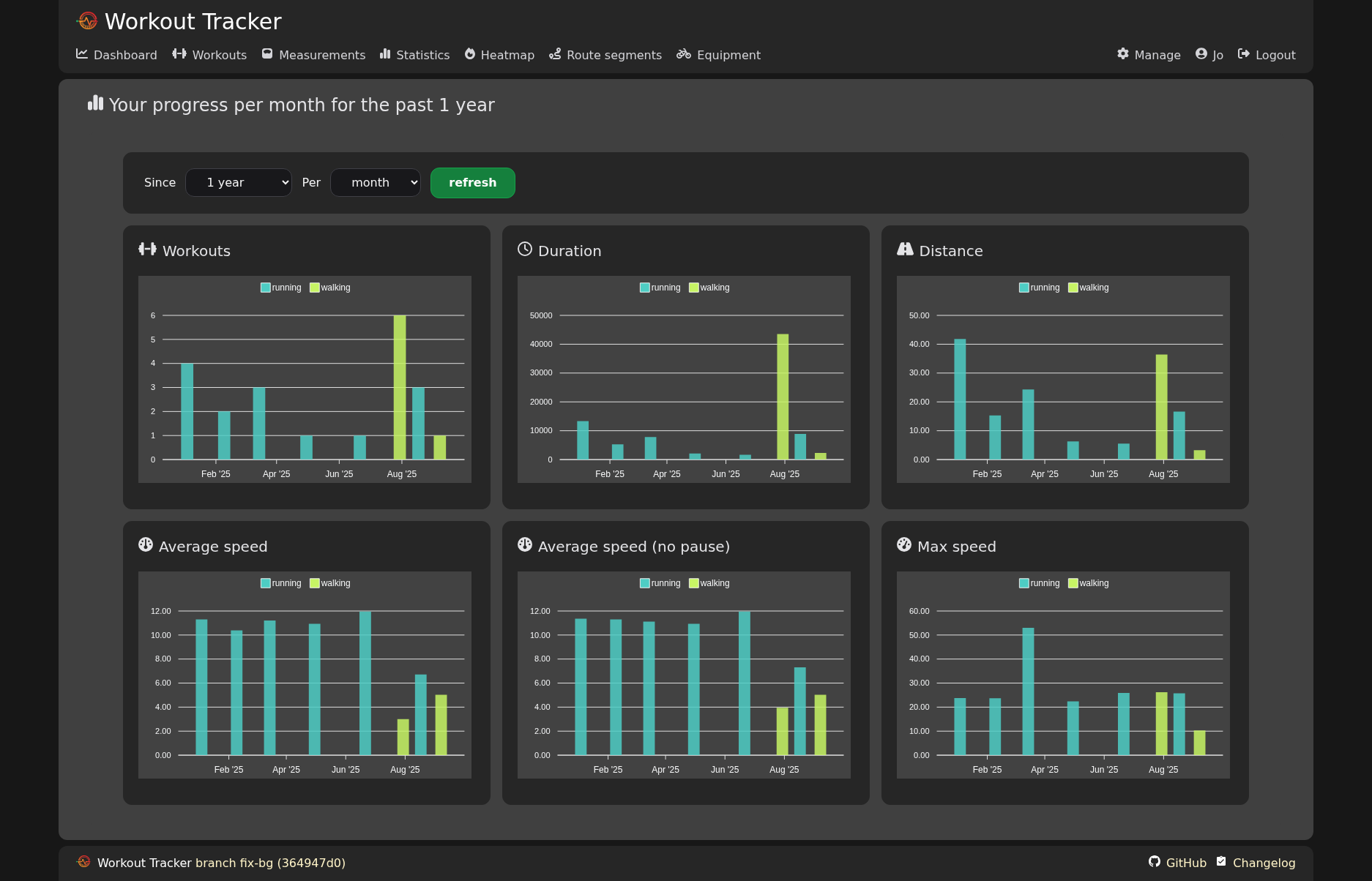
- Graphs showing monthly aggregated statistics.
- Pick different time range or bucket size.
Heatmap: where have you been?
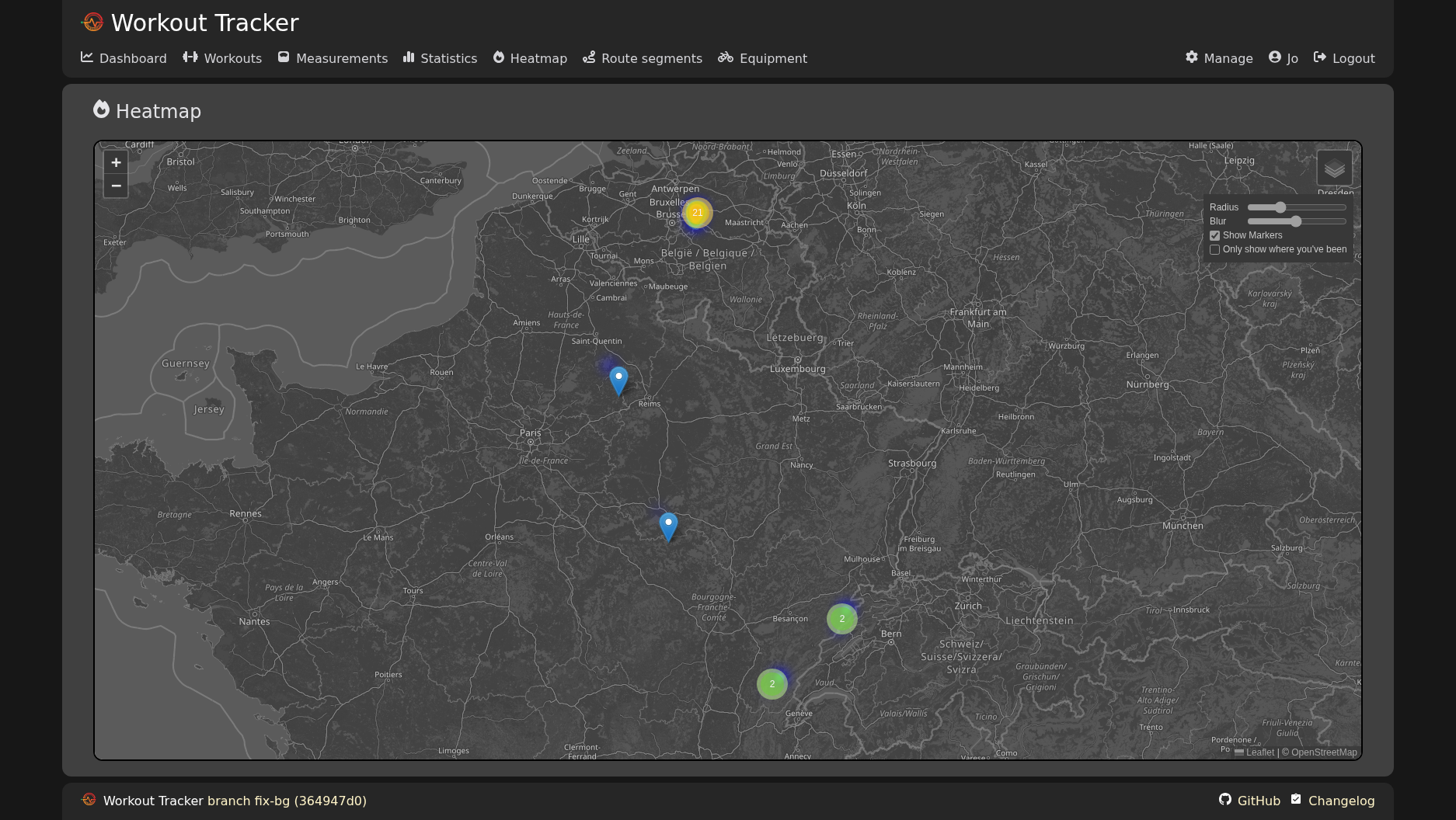
- Pan and zoom through over the map
Daily measurements
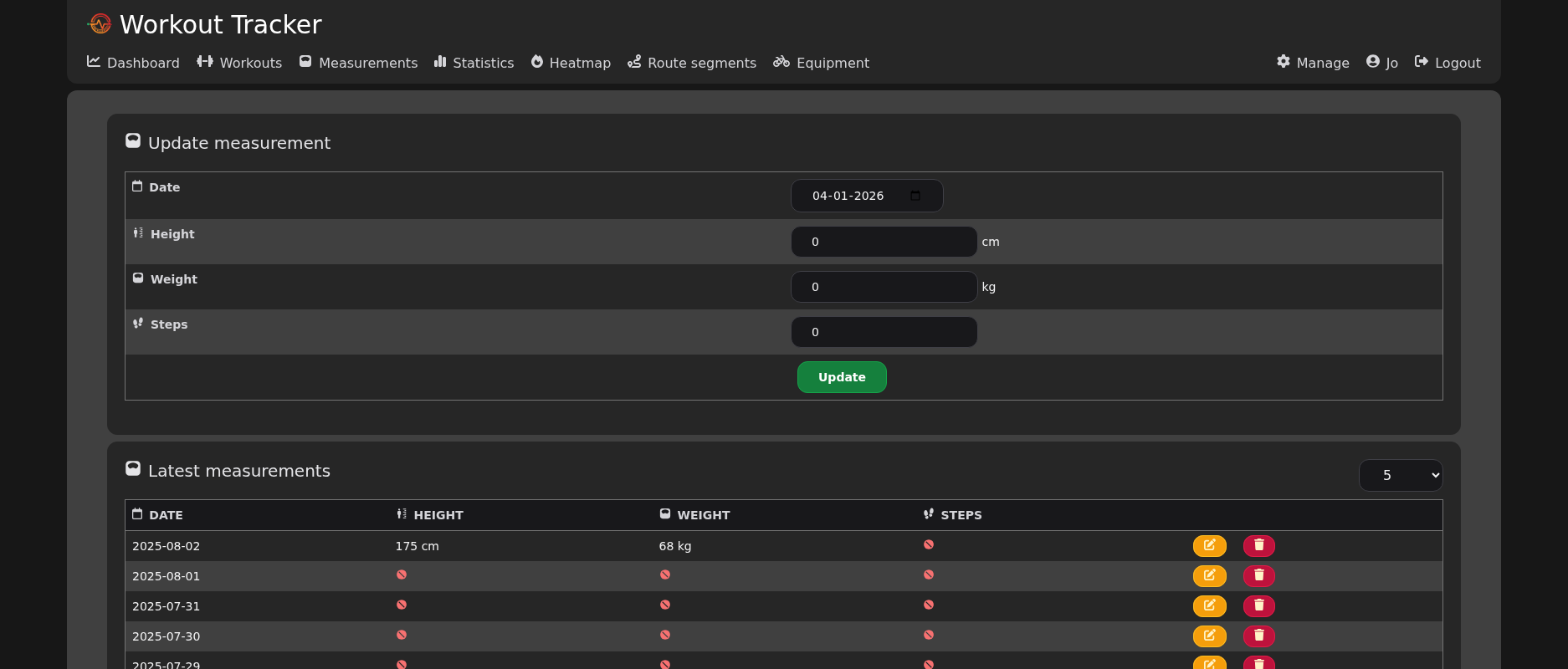
- Keep track of your daily stats, like weight and steps.
- Used to calculate estimated calories burned during a workout.
Basic multi-language support
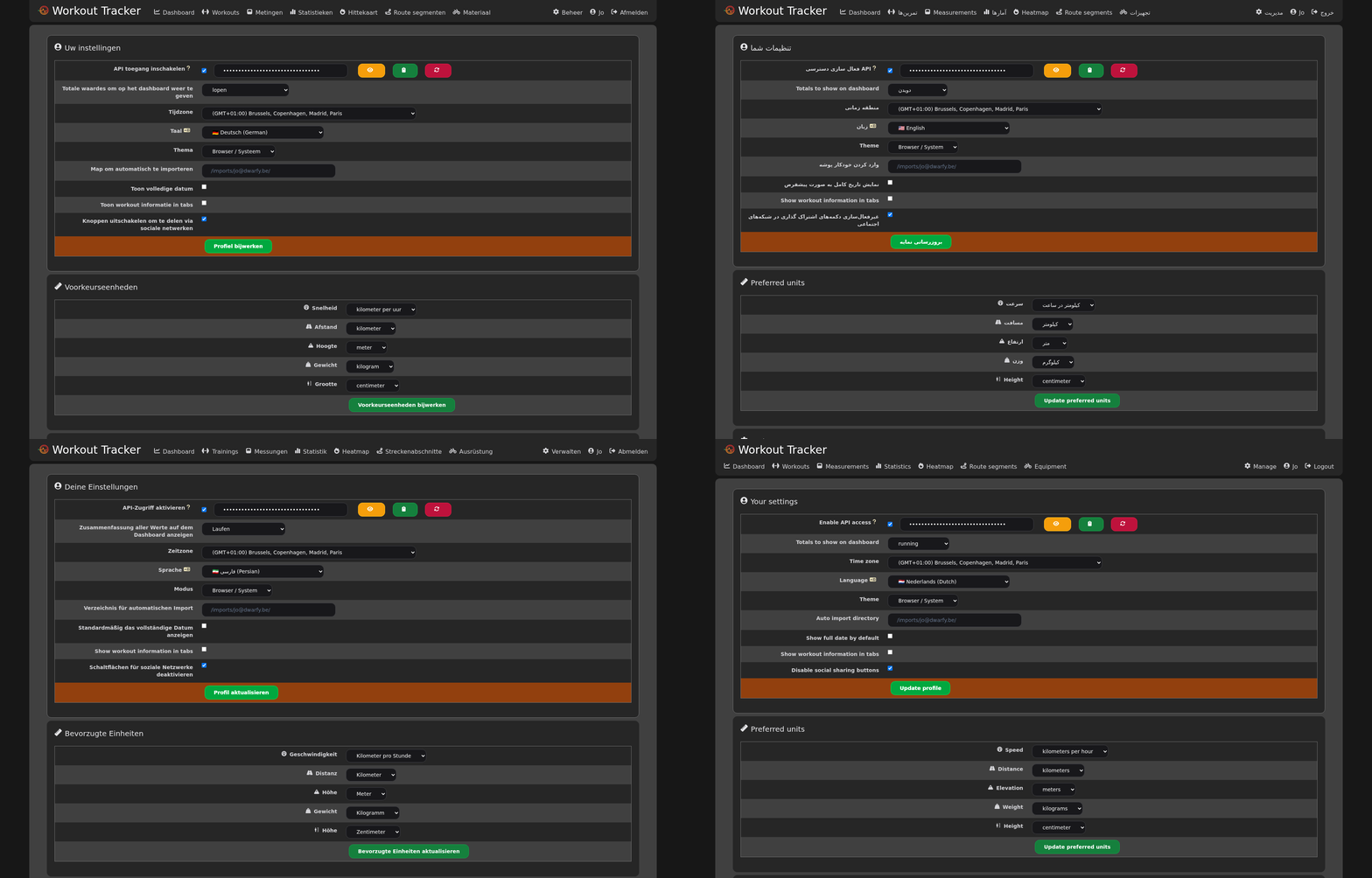
- Support for multiple languages (English, Dutch, German, Spanish, French,
- Switch between (supported) languages
- Use the language configured in the browser (default)
- Re-calculate all previously uploaded workouts (useful while developing)
Responsive design
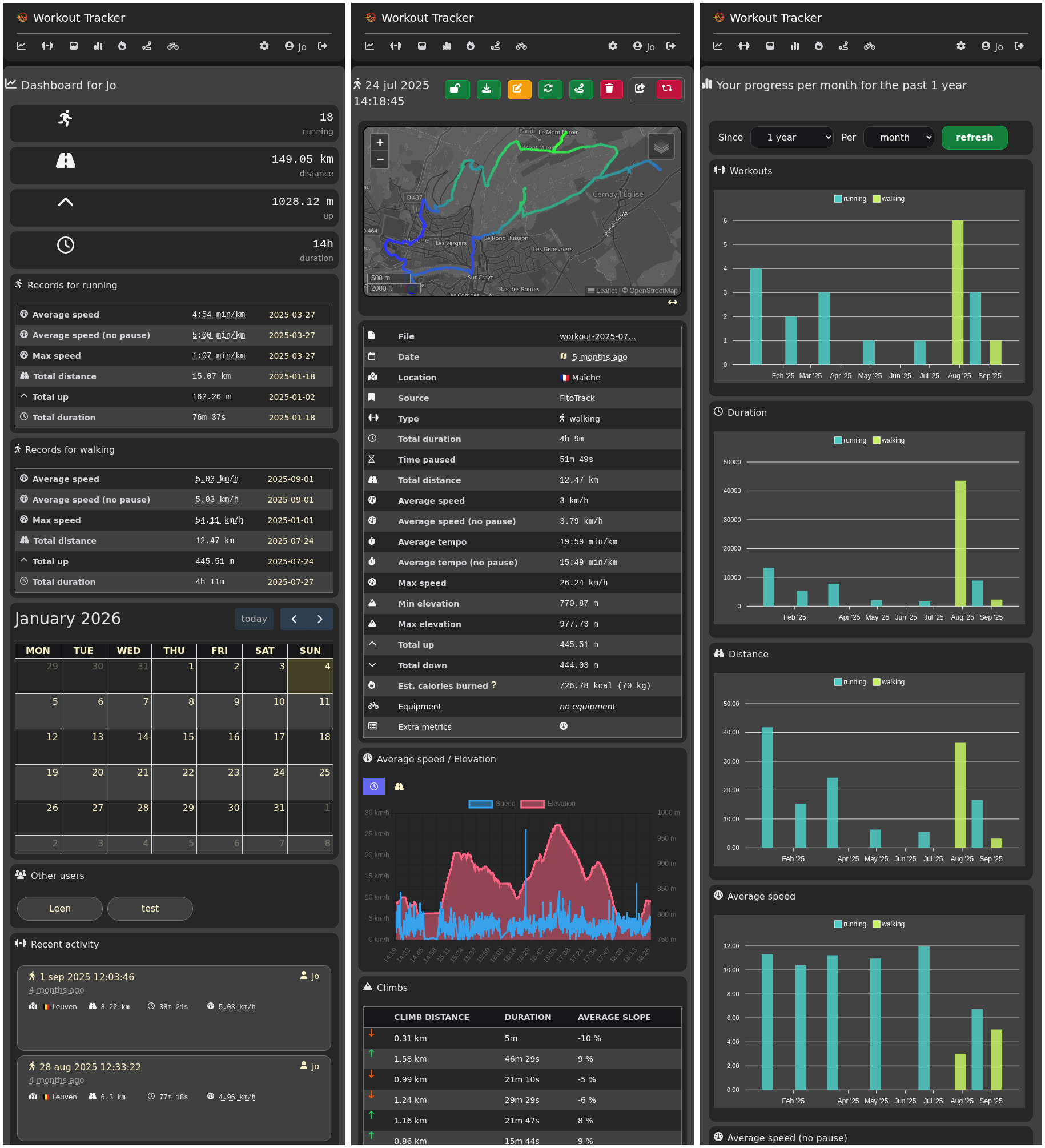
- Usable on small and medium screens
Light and dark mode
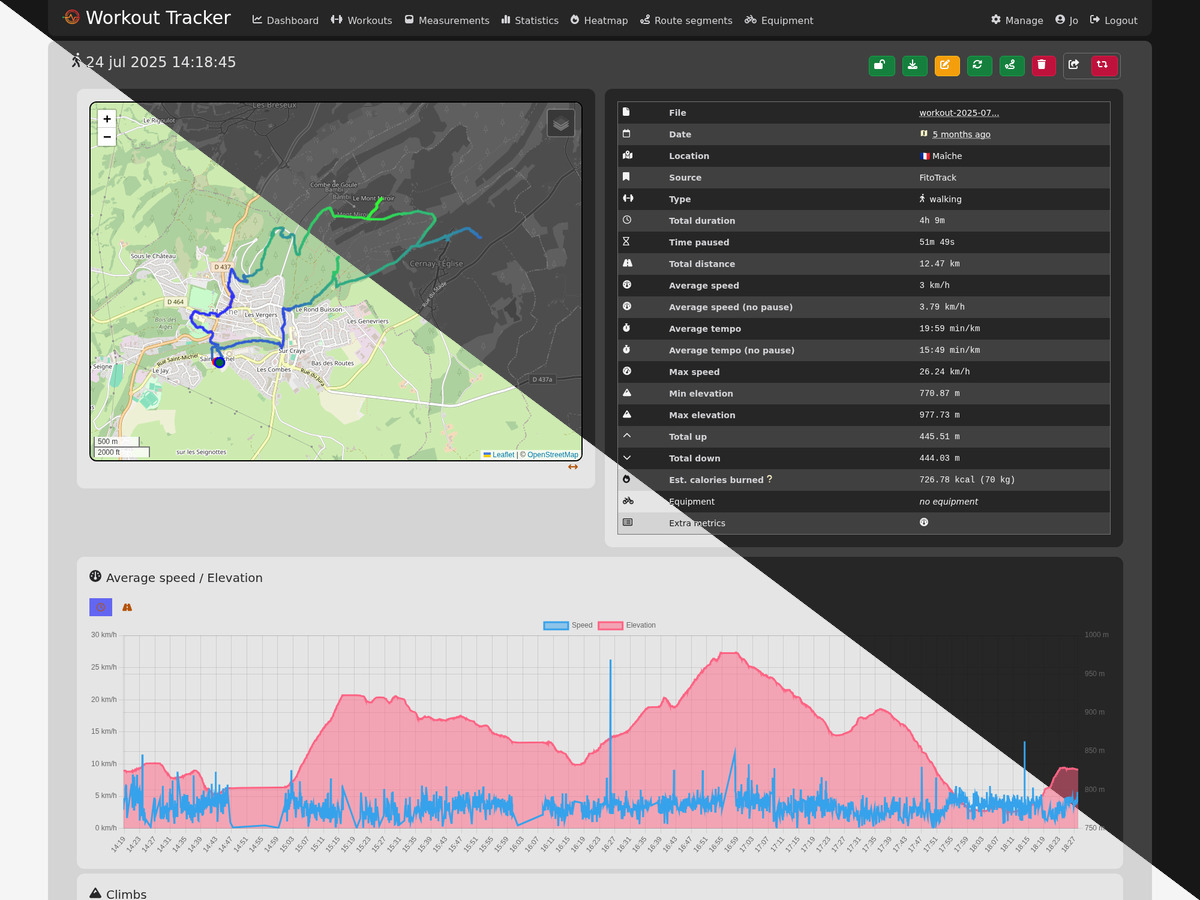
- Browser decides whether to use light or dark mode, based on your preferences
Configuration
The web server looks for a file workout-tracker.yaml (or json or toml) in the current directory, or takes it's configuration from environment variables. The most important variable is the JWT encryption key. If you don't provide it, the key is randomly generated every time the server starts, invalidating all current sessions.
Generate a secure key and write it to workout-tracker.yaml:
echo "jwtencryptionkeyfile: ./jwtencryption_key.txt" > ./workout-tracker.yaml
pwgen -c 32 > ./jwtencryptionkey.txt
or export it as an environment variable:
export WTJWTENCRYPTISee workout-tracker.example.yaml for more options and details.
Other environment variables, with their default values:
WT_BIND="[::]:8080"
WTWEBROOT="/my-workout-tracker"
WT_LOGGING="true"
WT_DEBUG="false"
WTDATABASEDRIVER="sqlite"
WT_DSN="./database.db"
WT_REGISTRATI
WTSOCIALSDISABLED="false"
WT_DEV="false"
WTWORKERDELAY_SECONDS=60
WT_OFFLINE="false"
[!NOTE]
SettingWT_OFFLINEtotrueruns the app without making external geocoding
requests (useful for offline environments or to avoid rate limits). In this
mode, geocoding functions return nil results.
After starting the server, you can access it at
If no users are in the database (eg. when starting with an empty database), a default admin user is created with password admin. You should change this password in a production environment.
API usage
The API is documented using swagger. You must enable API access for your user, and copy the API key. You can use the API key as a query parameter (?api-key=${API_KEY}) or as a header (Authorization: Bearer ${API_KEY}).
You can configure some tools to automatically upload files to Workout Tracker, using the POST /api/v1/import/$program API endpoint.
Daily measurements
You can set or update a daily measurement record:
curl -sSL -H "Authorization: bearer your-api-key" \
  http://localhost:8080/api/v1/daily \
  --data @- <<EOF
{
  "date": "2025-01-13",
  "weight": 70,
  "weight_unit": "kg",
  "height": 178,
  "height_unit": "cm"
}
EOF
Workouts
Manual creation
You can create a workout manually:
curl -sSL -H "Authorization: bearer your-api-key" \
  http://localhost:8080/api/v1/workouts \
  --data @- <<EOF
{
  "name": "Workout name",
  "date": "2025-02-03T10:26",
  "duration_hours": 1,
  "duration_minutes": 10,
  "distance": 13,
  "type": "running"
}
EOF
Generic upload of a file
The generic upload endpoint takes the recording as body. Prepend the path with @ to tell curl to read the data from a file:
If you are uploading a GPX file (default):
curl -sSL -H "Authorization: bearer your-api-key" \
  http://localhost:8080/api/v1/import/generic \
  --data @path/to/recorded.gpx
If you upload FIT files or other file types, including GPX, include a query paramter name:
curl -sSL -H "Authorization: bearer your-api-key" \
  http://localhost:8080/api/v1/import/generic?name=recorded.fit \
  --data @path/to/recorded.fit
FitoTrack automatic GPX export
Read their documentation before you continue.
The path to POST to is: /api/v1/import/fitotrack?api-key=${API_KEY}
Development
Dev Container
Usage
This project contains a pre-built development container ghcr.io/jovandeginste/workout-tracker-dev-container:latest (see .devcontainer/devcontainer.json). Inside the container, just run make build-server serve. After building the project when running it, the app port will be exposed automatically and you can access the app locally on your machine via http://localhost:8080/.
Build
For building the dev container locally, the variables GO_VERSION and NODE_VERSION must be set. Afterwards, the dev container can be built using the Dev Container CLI via devcontainer build --workspace-folder ./.devcontainer-template/ --image-name ghcr.io/jovandeginste/workout-tracker-dev-container. Here's a full example using PowerShell:
$env:GO_VERSION="1.24.1"
$env:NODE_VERSION="22"
devcontainer build --workspace-folder ./.devcontainer-template/ --image-name ghcr.io/jovandeginste/workout-tracker-dev-container
Build and run it yourself
- install go
- clone the repository
go mod vendor
go build -o workout-tracker ./cmd/workout-tracker/
./workout-tracker
This does not require npm or Tailwind, since the compiled css is included in the repository.
Do some development
You need to install Golang and npm.
Alternatively, if you use Nix, you can use the provided flake:
nix develop
or with direnv
direnv allow
Because I keep forgetting how to build every component, I created a Makefile.
# Make everything. This is also the default target.
make all # Run tests and build all components
Install Javascript libraries
make install-deps
Testing
make test # Runs all the tests
make test-assets test-go # Run tests for the individual components
Building
make build # Builds all components
make build-frontend # Builds the frontend assets
make build-templates # Builds the templ templates
make build-server # Builds the web server (includes build-templates)
make build-docker # Performs all builds inside Docker containers, creates a Docker image
make swagger # Generates swagger docs
make track-gif # Generates animated track demonstration (docs/track.gif)

Running it
make serve # Runs the compiled binary
Cleanin' up
make clean # Removes build artifacts
Development
make dev-docker # Runs the server in a docker compose setup
make dev-docker-sqlite # Runs the server in a docker compose setup with SQLite
make dev-docker-clean # Removes volumes created by the dev-docker targets
What is this, technically?
A single binary that runs on any platform, with no dependencies.
The binary contains all assets to serve a web interface, through which you can upload your GPX files, visualize your tracks and see their statistics and graphs. The web application is multi-user, with a simple registration and authentication form, session cookies and JWT tokens). New accounts are inactive by default. An admin user can activate (or edit, delete) accounts. The default database storage is a single SQLite file.
What technologies are used
- Go, with some notable libraries
- HTML, CSS and JS
- Docker
Compatiblity
This is a work in progress. If you find any problems, please let us know. The application is tested with GPX files from these sources:
- Garmin Connect (export to GPX)
- FitoTrack (automatic export to GPX)
- Workoutdoors (export to GPX)
- Runtastic / Adidas Running using
TODO
- write tests!!!!!
- add support for authentication through a reverse proxy
- add support for generic database drivers
- add support for other types of import files (eg. Garmin fit files)


