
Self-hosted, cloud-native Diablo II 1.14d dedicated game server + Battle.net realm server in Zig — a modern PvPGN replacement. Drives the retail Game.exe headless under wine; capacity-aware game-server fleet, Postgres/Redis, Docker & Kubernetes.
d2-dedicated-server: headless, cloud-native Diablo II 1.14d dedicated game server + realm
A self-hosted, open-source Diablo II dedicated game server for retail 1.14d, plus a clean-room Battle.net realm server -- a modern, cloud-native PvPGN replacement you run with Docker / Kubernetes. All in Zig.
Older D2 versions split the server into separate DLLs you could host on their own; in 1.14d the whole server engine is statically linked inside the single Game.exe. We don't reimplement it -- we drive the real engine from an injected Zig DLL, fully headless. The bundled realm server replaces PvPGN, so the unmodified retail client logs in and plays end to end, with no client mods.
**Status: a real 1.14d client logs into the realm, creates/joins a game on the headless
server, and the character spawns in-world -- including two clients in the same game
(multiplayer).** See Status.
Built for containers and Kubernetes. The Windows Game.exe runs under wine with no GUI or display; the realm and gateway are few-MB static binaries that contain no game files. State lives in Postgres + Redis, or just the filesystem. Health/readiness probes, graceful shutdown, and structured stdout logging (JSON optional) make it a first-class cloud-native workload -- docker logs / kubectl logs just work, and logs/metrics drop straight into a Grafana dashboard. A Helm chart and a Docker Compose stack are both in deploy/.
The three packages
The project is three independently-deployable pieces. Two are pure-Zig native binaries (no Windows, no game files -- they scale freely); the third is the injected Zig DLL that drives the real game engine under wine.
realmd: the realm (PvPGN replacement)
src/realm/server/ builds the realmd binary. One pure-Zig process that does the job of all of PvPGN's separate daemons: login/chat, the realm (character select, game create/join), the character database, and a registration endpoint the game-server fleet connects to.
To the retail client it looks exactly like Battle.net: the client logs in over BNCS (the Battle.net chat protocol, login + the version gate) and then talks MCP (the realm protocol: list/select characters, create/join a game) -- and, like real Battle.net, **both run on a single port, 6112**. There is no pvpgn-style fan of client ports. Game-file delivery for the version check uses BNFTP on the same port.
Behind that one client port, realmd also exposes two internal endpoints the game-server fleet uses (never the client): a gs-link (port 6115) the fleet registers over and that routes create/join to a server, and d2dbs (port 6114) the server fetches/saves character bytes from.
Persistence dispatches to fs (default, zero deps), redis (ephemeral sessions/games), or pg (durable chars), so realmd is stateless and horizontally scalable -- all state lives in the backing services. Health/readiness and the admin UI are on :8080; SIGTERM drains cleanly. See src/realm/server/README.md.
d2gs: the headless game server (injected into Game.exe)
src/d2gs.zig + src/engine/ + src/runtime/ build the injected d2gs.dll. It boots the real 1.14d Game.exe as a headless dedicated server and bridges it to realmd. Two layers:
- Survival + optimization patches -- byte-patches that let the Windows engine run with no
- A built-in mod framework -- a registry of pure feature modules that hook the engine (exp
--loaddll your own DLLs alongside d2gs.dll.
On a join the server does not read a shared disk -- it fetches the character over the network from realmd's d2dbs, which serves it from whichever store backend is configured (redis / pg / fs). See src/engine/README.md and src/runtime/README.md.
qqserver: the game-traffic gateway (one IP for the whole fleet)
src/realm/qqserver/ builds the qqserver binary, a pure-Zig, stateless game-traffic gateway. It gives the entire game-server fleet a single public game port (:4000).
When a client joins, realmd hands it a short-lived join token and writes the route for that token (token -> GS pod + real game id) into the shared store (redis). The client connects to qqserver:4000 carrying the token. The gateway reads it, looks up the route, and splices the connection straight through to the owning game server's internal :4000.
Because tokens are realm-globally unique, any gateway pod behind any public IP can resolve any token -- so it needs no session affinity and holds no state of its own. This is what lets the game servers live on internal pod IPs (or the same host on other ports) while clients only ever see one address. (In the lightweight single-binary path, realmd can do this splice in-process and you don't run a separate qqserver at all.)
Plus: the shared realm contract
Underpinning all three, src/realm/shared/ (the realm_shared module) is the realmd<->d2gs wire protocol that both the realm and the game server import, so they agree on the wire by construction.
How it fits together
unmodified 1.14d client (GUI)
                  |                            |
   login + realm  |  (BNCS + MCP on ONE        |  game traffic
                  v   port, like real bnet)    v  (D2Net)
       +----------------------+        +----------------------+
       |  realmd              |        |  qqserver            |
       |  :6112  login, realm |        |  :4000  public game  |
       |  :8080  health / UI  |        |         gateway      |
       +----------+-----------+        +-----------+----------+
            ^   ^      writes token route (redis)  |
  internal: |   +----------------------------------+
  gs-link   |              splice to the owning GS |
  :6115     |                                      v
  d2dbs     |   register + fetch     +----------------------+
  :6114     +------------------------|  Game.exe + d2gs.dll |
                character bytes      |  fleet 1..N          |
                                     |  internal :4000      |
                                     +----------------------+
The client only ever uses two ports: 6112 (login + realm) and 4000 (game). Everything else (gs-link 6115, d2dbs 6114) is internal traffic between the game-server fleet and realmd.
Locally you can skip the gateway (DIRECT mode): the client dials the single GS at :4000 itself. In the cloud (GATEWAY mode) realmd advertises the qqserver entry instead, so the GS fleet stays on internal pod IPs and scales past the node count. Same binaries either way.
Rendered diagrams
The full model lives in docs/architecture/ (LikeC4) and can be browsed live with npx likec4 start docs/architecture. A few views:
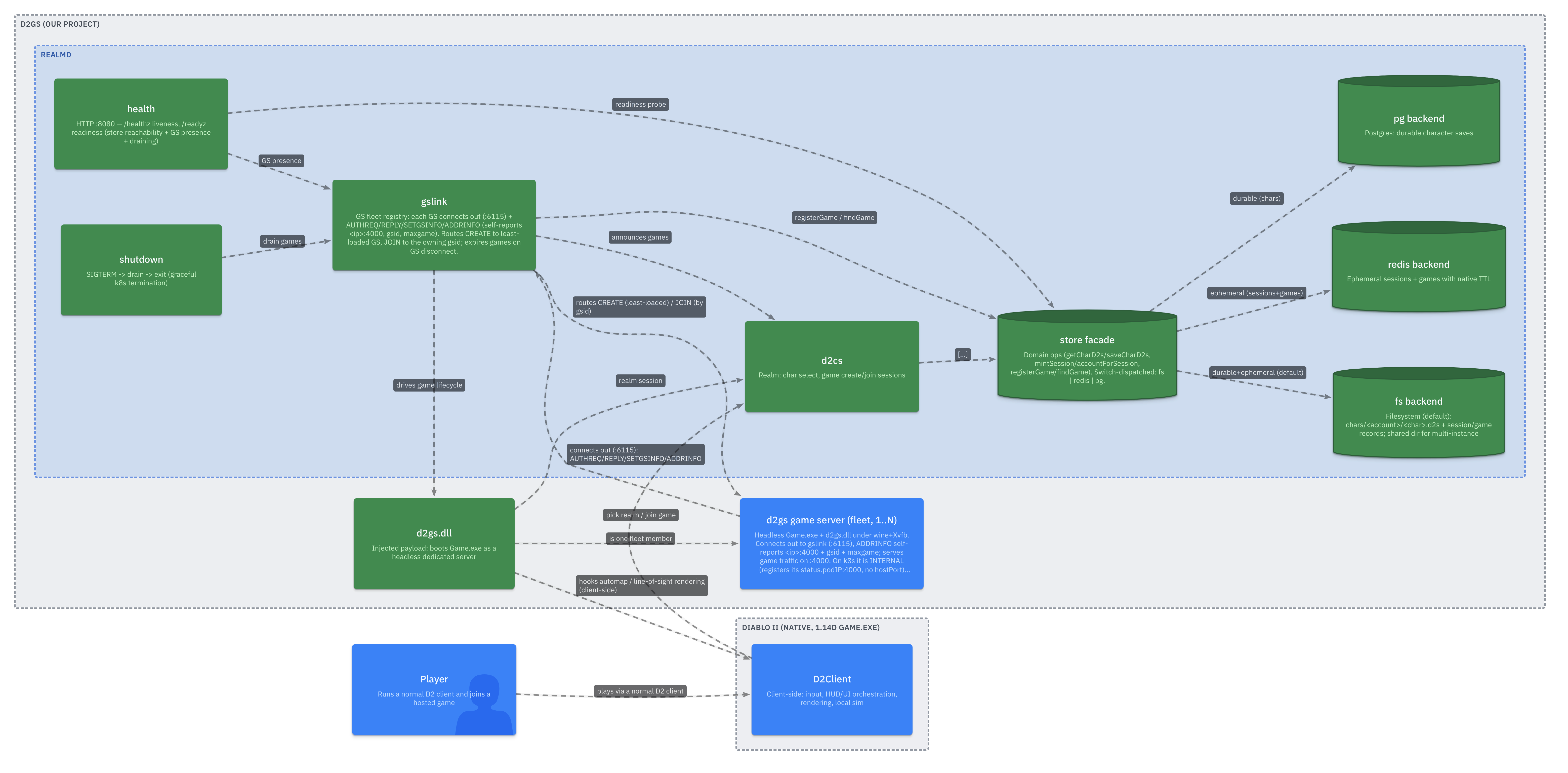
GS fleet -- realmd's gs-link registers many game servers; CREATE routes to the least-loaded, JOIN to the one that owns the game, with persistence behind the fs/redis/pg facade:
d2gs.dll mod framework -- the registry dispatches to pure feature modules; runtime drivers own the engine byte-hooks and fan out; the d2 layer supplies structs, engine calls, and a per-game memory pool:

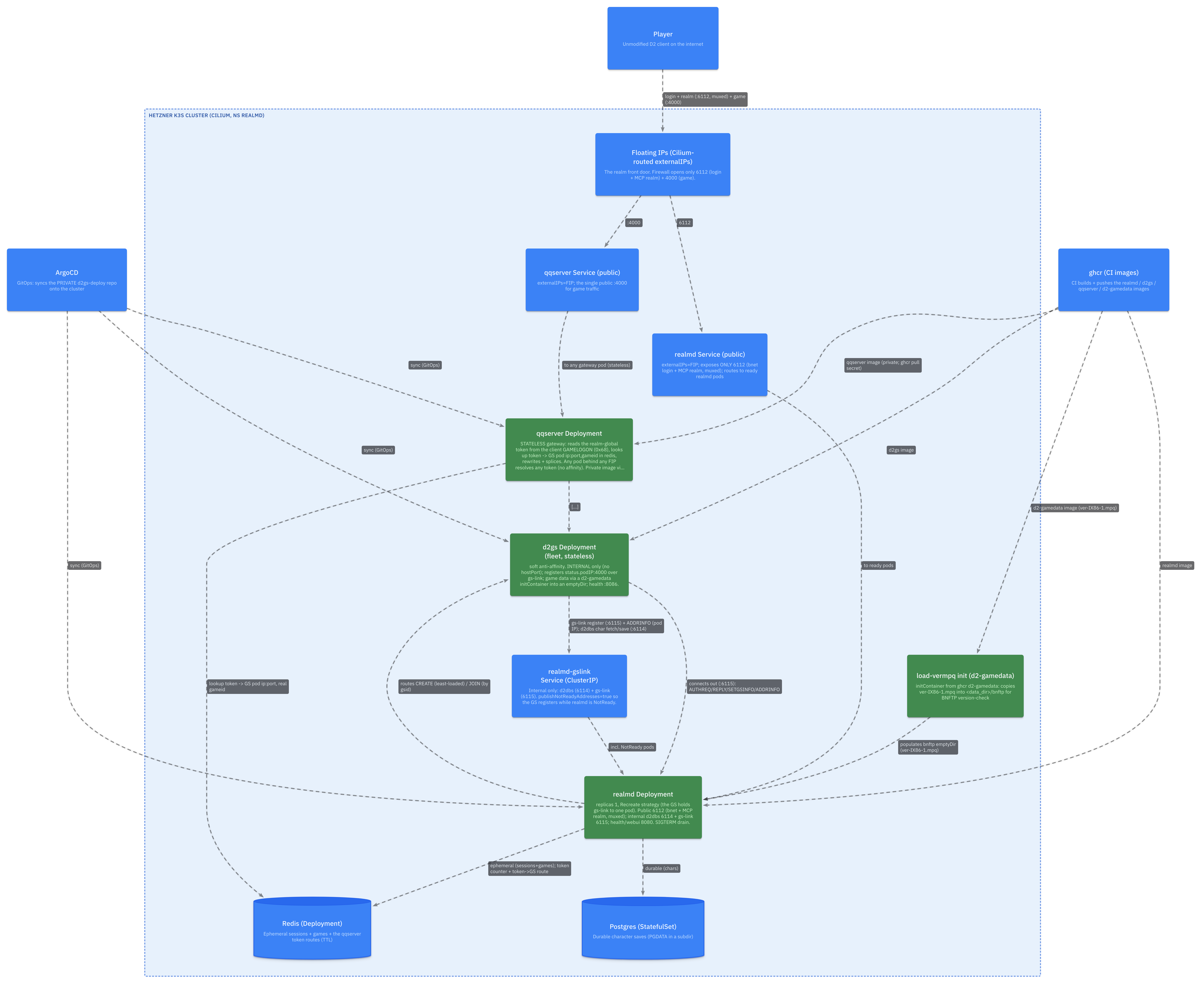
Kubernetes topology -- realmd and qqserver behind public LoadBalancers on stable floating IPs (only 6112 + 4000 open); Redis + Postgres backends; an internal GS fleet whose pods register their pod IP. The player logs in via the LB, then talks all game traffic to qqserver, which splices to the owning GS:
Resource footprint (idle)
The 1.14d engine's main loop busy-spins by default; d2gs frame-paces it, so an **idle game server sits near-zero**. Measured on a real Hetzner k3s node with no players online:
| service | CPU | memory | image | |-|-|-|-| | realmd (login + realm + d2dbs + gs-link) | ~1m | ~6 MiB | scratch, static musl | | qqserver (game-traffic gateway) | ~0m | ~1 MiB | scratch, static musl | | d2gs (wine, headless Game.exe) | ~15m | ~300 MiB | debian + wine32 |
The pure-Zig services are effectively free; the game server's footprint is just wine plus the loaded engine. Postgres/Redis are optional -- fs persistence drops them entirely.
Build
zig build     # -> zig-out/bin/{dbghelp.dll, d2gs.dll, ver-IX86-1.dll}  (x86-windows)
              #    + zig-out/bin/{realmd, qqserver}  (native host binaries)
Deploy
Kubernetes (Helm)
deploy/chart is a Helm chart that deploys the whole fleet -- realmd, the d2gs game-server fleet, qqserver, Postgres, and Redis -- wired together. It is a publishable mirror of a real running cluster, with the cluster-specific IPs/passwords replaced by generic overridable defaults. See deploy/chart/README.md.
helm install myrealm deploy/chart \
  --namespace realm --create-namespace \
  --set realmAddr=203.0.113.10 \
  --set postgres.auth.password=$(openssl rand -hex 16)
Then supply the proprietary game data (a small private dataImage, or the d2-gamefiles PVC fallback) and point realmAddr at the realmd LoadBalancer's external IP. Game traffic runs in one of two modes:
- DIRECT (
gameAddrempty, default): the GS keeps a client-routable address; clients dial it
- GATEWAY (
floatingIPs+gameAddrset): realmd advertises the qqserver entry; the GS is
Useful toggles: postgres.enabled / redis.enabled (use external backends), qqserver.enabled, gameServer.dataImage.repository (ship data via an initContainer instead of a PVC), gameServer.maxGames. The raw manifests behind the chart are also in deploy/ (realmd.yaml, gs.yaml).
Docker Compose
The same realmd image and backends you'd run on Kubernetes, on one host: realmd with Postgres (durable char saves) + Redis (ephemeral sessions/games). Full file at deploy/compose.yaml (it also has a profile-gated gs game-server service); the core is just:
services:
  redis:
    image: redis:7-alpine
  postgres:
    image: postgres:16-alpine
    environment: { POSTGRESUSER: realmd, POSTGRESPASSWORD: realmd, POSTGRES_DB: realmd }
  realmd:
    build: { context: ., dockerfile: deploy/Dockerfile, target: realmd }
    depends_on: [redis, postgres]
    environment:
      REALMDDURABLESTORE: pg          # character saves
      REALMDEPHEMERALSTORE: redis     # sessions + games (native TTL)
      REALMDREDISADDR: redis:6379
      REALMDPGDSN: postgres://realmd:realmd@postgres:5432/realmd
      REALMDLOGJSON: "1"
    ports: ["6112:6112", "6114:6114", "6115:6115", "18080:8080"]
docker compose -f deploy/compose.yaml up --build
curl localhost:18080/readyz # 200 once Postgres + Redis are reachable
also run the headless game server in-compose (needs your D2 1.14d install):
D2GSGAMESRC=/path/to/d2-1.14d docker compose -f deploy/compose.yaml --profile gs up --buildThe gs service is profile-gated because the game files are proprietary (mount them via D2GSGAMESRC). For machine-specific tweaks keep a gitignored deploy/compose.local.yaml and add -f deploy/compose.local.yaml.
Manual (native realmd + wine GS)
# 1) realm server (native). Char data lives in the configured store, not on the GS:
   fs (a data dir, default), or redis/pg via REALMD*STORE.
REALMDDATADIR=./realmd-data ./zig-out/bin/realmd
2) headless game server (wine). Registers over the gs-link and fetches characters
   from realmd's d2dbs over the network -- it does NOT read a shared game-data mount.
wine Game.exe -w -nosound --headless --loaddll Z:\...\d2gs.dll \
    --d2gs --d2gs-boot --realm --create-games \
    --d2cs 127.0.0.1:6115 --d2dbs 127.0.0.1:6114
3) a real client (point its bnet gateway at realmd on :6112, then log in normally)
wine Game.exe -w -skiptobnet --loaddll Z:\...\d2gs.dll --d2gs --bypass-checkrev
./run.sh builds the DLLs and assembles a wine test dir for the injection-only case. The full create+join flow has an end-to-end test: tools/realmd-test/e2e-game.sh (boots realmd + GS, drives two clients to create + join, asserts both characters loaded; needs wine
- a real 1.14d install via
E2EGAMESRC).
Observability
Every service logs structured JSON to stdout (REALMDLOGJSON=1), carrying a per-connection and per-packet trace/span context across realmd and the game servers. Shipped to Loki (via Promtail/Alloy) and paired with Prometheus pod metrics, the whole realm is one Grafana dashboard: deploy/grafana/d2-realm.json.

Its rows cover pod CPU/memory (Prometheus), live state (active games + players in-game, split per game server), realm activity (games created, joins, refusals, qqserver drops, events/min), a GS fleet view (games + load per gsid), a health row (engine halts/faults, pod restarts), and a live log tail -- with deploys annotated on the timelines. The interesting part is that almost none of this needs a metrics endpoint in the engine: the gameplay numbers fall out of the structured logs in Loki. For example, "games created" and "player joins" are just countovertime over the parsed evt field:
sum(countovertime({namespace="realmd", app="d2gs"} | json | evt=gamecreate [$_range]))
sum(countovertime({namespace="realmd", app="d2gs"} | json | evt=playerjoin  [$_range]))
The dashboard is datasource-agnostic: its ${prom} and ${loki} variables are datasource pickers (no URLs, tokens, or namespaces baked in). Import it in Grafana via Dashboards -> New -> Import, upload the JSON, and pick your Prometheus + Loki sources.
How injection works
Game.exe --(loads)--> dbghelp.dll (our proxy) --(--loaddll)--> d2gs.dll [+ your mod DLLs]
                                                                  |
                                                DllMain spawns serverThread:
                                                  bootstrapRealmServer() + realm callbacks
                                                  loop: HandleAnyIncomingPacket
+ TickAllGames + DispatchAndCleanup- Delivery:
Game.exeloadsdbghelp.dllfor its crash handler. Our proxy forwards the real
LoadLibrarys the DLLs passed via --loaddll <winpath> -- that's how d2gs.dll
gets in. No on-disk patch of Game.exe.
- Headless:
--headlessbyte-patches stub the renderers/media loaders and hide the window so
- Server tick: mirrors the engine's own
QSERVER_CoopThreadMain: drain inbound packets, tick
DispatchAndCleanup step is what makes a
joining client actually progress).
Modding
d2gs.dll has a small extensibility surface (src/engine/feature.zig). A **feature is just a Zig module** (a namespace) that opts into a hook by declaring a pub fn of that name -- no base class, no vtable. Dispatch is a comptime inline for over a single registry table that calls a hook only on the features that declare it. Features stay pure behaviour; all config (name, toggle flag, default state) lives in that one registry table.
Hooks a feature can declare include lifecycle (install, postInit, deinit), client frame loops (gameFrame, oogFrame), and the dedicated-server domain (serverTick, gameCreate / gameDestroy, roomInit, expAward to transform XP, packetIn / packetOut, playerJoin / playerLeave). Each gets a per-game context whose allocator is the game's own memory pool, so anything a feature allocates dies with the game. Copy src/runtime/feature/template.zig, add one line to the registry, done.
Shipped features (see src/runtime/feature/): expmod (XP scaling), ubers (Pandemonium / Uber Tristram), arena (server-side PvP rounds), ladder-items, guild-panel, and client-side maphack (omnivision, mapunits, mapreveal) -- the same DLL injects into a real client too. Each is toggled by its --<flag> (Flags).
For mods that need their own native code, the proxy loads any DLL you pass with --loaddll, repeatable -- each runs in-process with full access to the engine at its fixed addresses (image base 0x00400000, no ASLR):
wine Game.exe ... --loaddll Z:\path\d2gs.dll --loaddll Z:\path\yourmod.dll --d2gs ...In the container, drop mod DLLs in /mods (each --loaddll'd after d2gs.dll) or list them in D2GSEXTRADLLS; overlay extra data (mod MPQs, or a loose data/ tree with D2GSEXTRAARGS="-direct -txt") by mounting it at /moddata.
Admin web UI
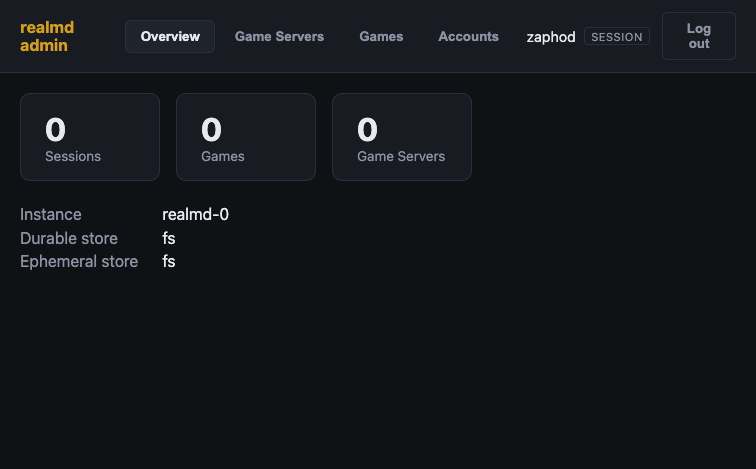
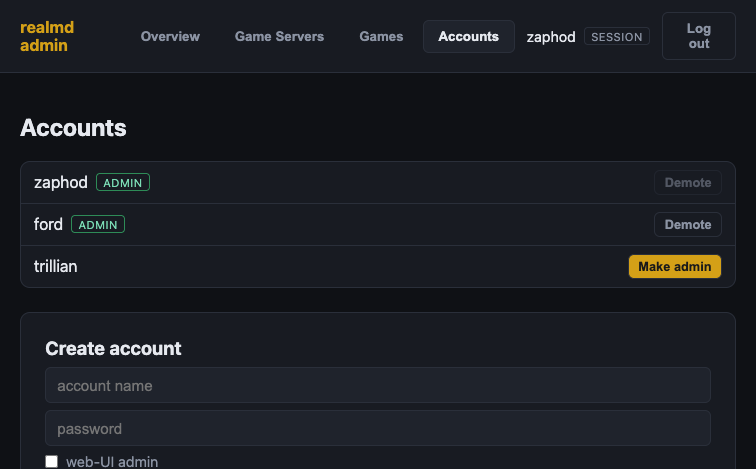
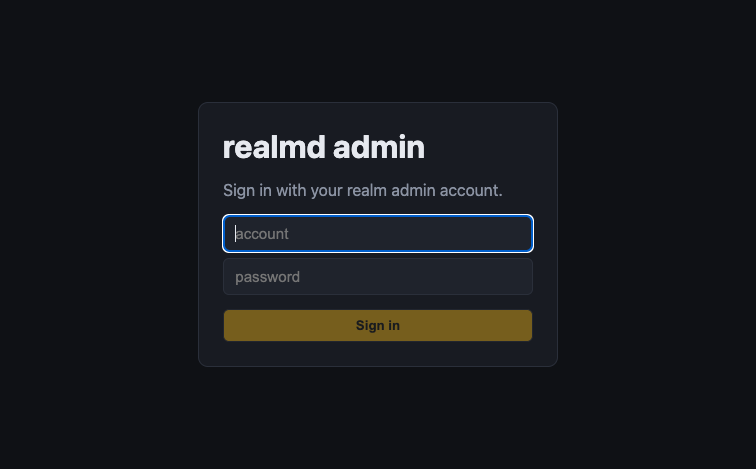
A small Vite + React UI (webui/) over realmd's /admin/* JSON API: fleet/games/accounts at a glance, plus create-account, close-game, and copy-char. It bundles to one self-contained index.html embedded into the realmd binary (zig build realmd-bin -Dwebui=true), served on the health/admin port. Admin-ness is a DB flag on the account -- seed one with realmd create-admin <name> <password> or REALMDADMINBOOTSTRAP, then sign in and promote others from the UI. Or front it with Authentik/oauth2-proxy SSO; a bearer token (REALMDADMINTOKEN) stays for scripts/break-glass. Keep port 8080 behind a port-forward or the authed ingress, never public.
Flags
Passed to Game.exe, read by our DLLs.
Boot / connection:
| flag | effect | |-|-| | --loaddll <path> | (proxy) LoadLibrary an injected DLL; repeatable | | --d2gs | attach + log; install crash/halt/multi-instance guards | | --d2gs-boot | run the engine bootstrap + tick loop (the dedicated server) | | --realm | bootstrap in realm mode (register the realm callback table) | | --create-games | load data tables so the engine can create games | | --realmd <host> | connect to one realm server, deriving gs-link (:6115) + d2dbs (:6114); DNS ok. Env: REALMD_HOST | | --d2cs <ip:port> | connect to realmd's gs-link for create/join dispatch (overrides --realmd) | | --d2dbs <ip:port> | fetch character saves from realmd's d2dbs (overrides --realmd) | | --gs-addr <ip:port> | public address clients dial for this GS's games (self-reported to realmd). Env: D2GSGSADDR | | --max-games <n> | capacity this GS advertises to realmd. Env: D2GSMAXGAMES |
Feature toggles (off by default unless noted):
| flag | effect | |-|-| | --headless | apply survival/no-display patches (run with no GUI) | | --bypass-checkrev | (client) skip the bnet version check | | --no-compress | disable packet compression (debugging) | | --expmod | server: XP scaling | | --ubers | server: Pandemonium / Uber Tristram event | | --arena | server: PvP arena rounds | | --ladder-items | server: ladder-only item content (opt-in; bootstrap-flaky) | | --guild-panel | client: Steeg Stone guild panel | | --omnivision / --mapunits / --mapreveal | client: maphack (see-through, monster/item dots, auto-reveal) |
Client driving / debug:
| flag | effect | |-|-| | --auto-login <acct:pass> | (client) drive login -> char select -> create a game | | --auto-join <acct:pass:game> | (client) drive login -> char select -> join a game | | --bot <name> | run an in-game bot (src/bot/) | | --screenshot | (client) take a screenshot every 3s (headed debugging) | | --pkttrace | log every :4000 client/GS packet id (verbose) | | --suppress-halts | swallow engine asserts instead of exiting (debugging) |
Layout
src/
  dbghelp.zig    dbghelp.dll proxy: injection foothold (--loaddll loader)
  d2gs.zig       d2gs.dll entry: DllMain, flag parsing, server thread + tick loop
  log.zig        logger (stdout + file)
  realm/         the realm: both ends, the gateway, + their shared contract     [README]
    shared/      realmd<->d2gs wire protocol (the realm_shared module)
    client/      GS-side clients of the realm (gs-link/d2dbs, join context)
    server/      realmd binary: login + realm + d2dbs + gs-link, pluggable store
                 (fs/redis/pg), health, graceful shutdown                       [README]
    qqserver/    qqserver binary: stateless token-translating game gateway
    adapter/     store backends (fs/redis/pg) behind the persistence facade
  engine/        bindings into Game.exe's own engine + realm callback table     [README]
    feature.zig  the mod framework registry (one table of features + toggles)
  runtime/       in-process machinery: byte-patches, hooks, fastcall, drivers   [README]
    feature/     the shipped feature modules (survival, maphack, server mods)
  bot/           in-game bot framework (--bot)
  checkrev/      CheckRevision.dll producer for the version-check MPQ           [README]
  test/          client-driving test harnesses (auto-login/join, screenshots)
deploy/
  chart/             Helm chart: realmd + d2gs fleet + qqserver + pg + redis     [README]
  grafana/           the D2 Realm Grafana dashboard (Prometheus + Loki)
  Dockerfile         multi-target image: --target realmd | --target gs
  compose.yaml       local stack: realmd + Postgres + Redis (+ gs profile)
  realmd.yaml        k8s: realmd Deployment + redis/pg + probes + LoadBalancer
  gs.yaml            k8s: game-server StatefulSet
  gs-entrypoint.sh   headless-wine launcher (assembles game dir, loads mods)
docs/architecture/   LikeC4 model (diablo2.c4 + cloud.c4) + exported diagrams (img/)
Other docs: REALM.md, REALMD.md, VERIFY.md, ARENA.md, LEGAL.md.
Status
Working (tested under wine on the unmodified retail 1.14d Game.exe):
- Injection (
dbghelpproxy ->--loaddll->DllMain) + headless survival. - Dedicated server boots, listens on
:4000, ticks stably. realmd: real client logs in, passes the version check (BNFTP file integrity + CheckRevision),
- Create + join a game dispatched to the headless GS.
- Character spawns in-world (loaded from d2dbs, full life/mana, playable).
- Multiplayer: two real clients in one game, visible to each other.
- Verbose join diagnostics compiled in by default;
pkttracegated. - Two headed clients in one wineprefix can trip the bnet gateway-list parser on the second client's
- Harden across restarts + many concurrent games; replace the fixed init delay with a proper
License & legal
Code: MIT. No Blizzard game files are distributed here -- bring your own legit copy of Diablo II. Unofficial, not affiliated with Blizzard. See LEGAL.md.


