
A fast, embeddable limit-order-book & matching engine in Go — plus a microstructure research harness and a WASM-powered animated explainer. MIT.
orderbook
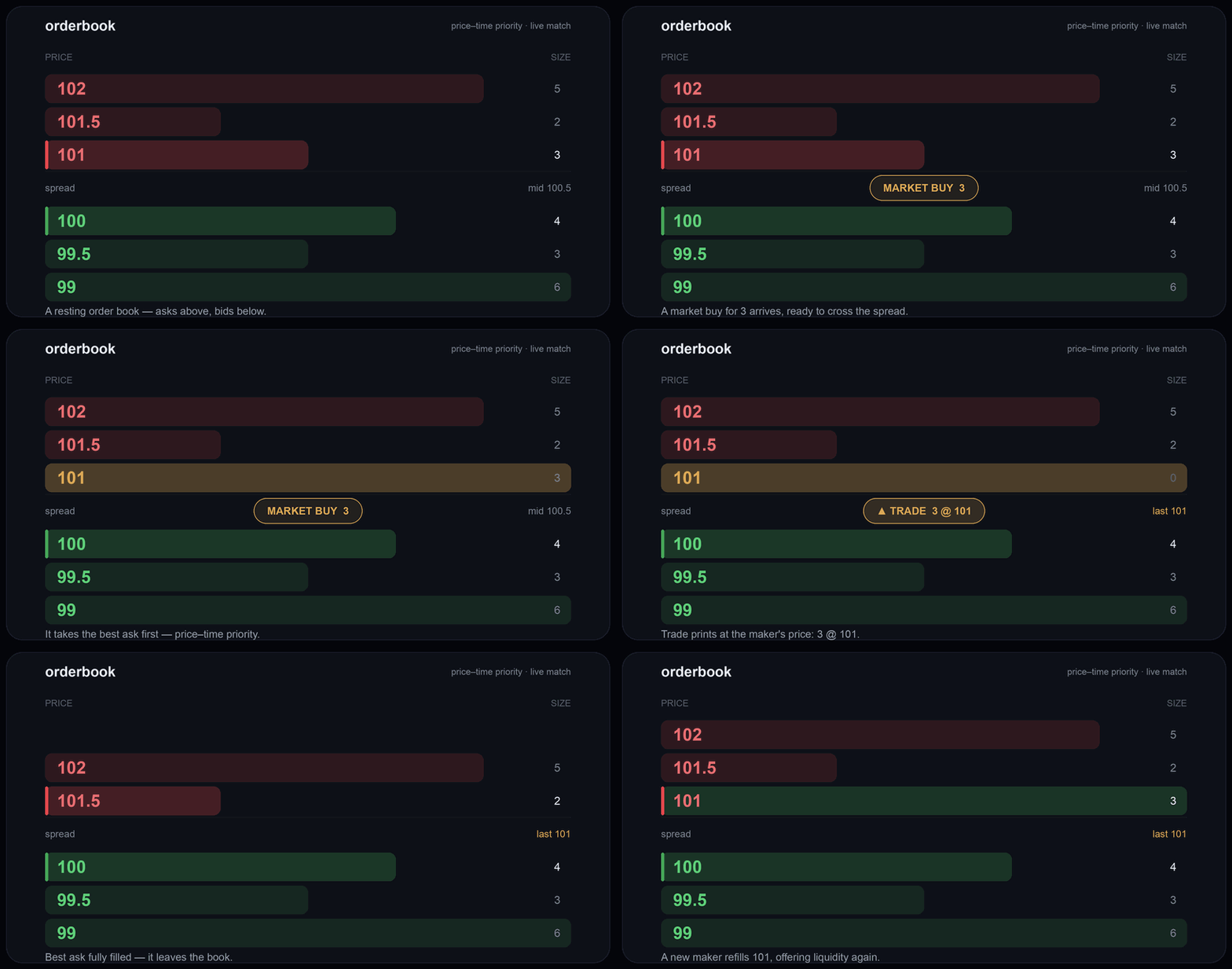
▶ Live demo — the real engine, compiled to WebAssembly, running in your browser · ▶ Live console — a running market with signals and surveillance, every panel titled by the call that produces it.
An embeddable matching core in Go, with a demonstrated network seam: integer-exact pricing, a zero-allocation match path, a lock-free single-writer core, deterministic and machine-checked crash recovery, and a reference order-entry gateway that speaks a frozen binary protocol over TCP. And one document most libraries don't have: an honest account of what production takes and how far this goes (docs/PRODUCTION-READINESS.md).



orderbook is an embeddable Go library — go get it into an exchange, a simulator, or a trading tool. The matching core owns the order book, the matching algorithm, order lifecycle, deterministic sequencing, and market-data snapshots, plus a set of opt-in pre-trade risk & anti-manipulation controls; credit, identity, fees, and wire protocols stay in the layers around it, the same boundary production venues draw. Companion packages cover the rest of that boundary — durable WAL persistence (pkg/wal), market-abuse surveillance (pkg/surveillance), in-process pre-trade admission control (pkg/gateway), and a uniform-price call auction (pkg/auction). Every defensive control is grounded in a real enforcement case or incident, catalogued in docs/THREAT-MODEL.md. The repository also ships a reproducible market-microstructure research harness and an interactive WebAssembly demo that runs the real engine in the browser.
Scope. Embeddable concedes the venue is not here — and no adjective in this README claims what only a deployment can prove. Production readiness is a property of a deployment, not of code: docs/PRODUCTION-READINESS.md is the honest account of what is solid, what is partial, and what is yours. Nobody runs this in production today, and this paragraph will say so until someone does.
What ships: the matching core, durable recovery, an event stream proven to reconstruct the book, an operator kill switch, a frozen binary protocol (docs/PROTOCOL.md), and cmd/obgw — a reference TCP gateway serving both edges: order entry with authentication, per-account outbound streams and gap-free resume across a disconnect, and a public market-data feed with snapshot-plus-delta recovery. Bounded backpressure at every stage. Around it: EngineSnapshot.Digest (the book fingerprint replication and recovery agree on), examples/replication (the drilled primary-backup reference), cmd/obdash (an operator dashboard that is an ordinary subscriber of the venue's own feed), and a live console running the engine, signals and surveillance in the browser.
What does not, and is yours: credential lifecycle (the reference speaks TLS and holds secret digests, never plaintext — but rotation, revocation and expiry are yours, and it says so), multi-symbol routing (order ids and sequences are per-engine, so several symbols means several engines and a router above them), clearing and settlement, and any HA topology — the library ships the seams for primary-backup (deterministic apply, an ordered command log, replay mode, snapshot bootstrap), proves them with a reference example and CI drills (docs/REPLICATION.md), and deliberately not the consensus, because bundling one forces a wrong answer on everybody. See docs/EXCHANGE-ARCHITECTURE.md for why, including the venues that lost quorum getting it wrong.
The engine has never run a live market. **Production-readiness is a property of your deployment, not of this library** — what is offered here is that the pieces you build on are correct, tested, and honest about their edges. docs/PRODUCTION-READINESS.md is the checklist: what ships, what is deliberately absent, what you would have to build — and which gaps no library work can close, because they are properties of your deployment.
Highlights
- Integer-exact pricing. The engine works in
int64ticks and lots; a
Instrument converts decimals only at the API boundary. No
floating-point on the money path.
- Low latency, zero allocation. O(1) cancel, pooled book nodes and price
- Single-writer core. One matching goroutine owns the book with no lock on
Runner fronts it with an MPSC command queue
so many producers can submit concurrently.
- Deterministic and recoverable. The same ordered command stream produces
pkg/wal: write-ahead log + snapshots), and reproducible
backtests. Runner.Checkpoint and wal.Recover join the snapshot to its log
position, and the property is gated in CI against a 2,000-command tape:
checkpoint anywhere, recover, and the book, all three sequence counters, the
duplicate guard and the conditional-order state match the uninterrupted run.
- An event stream that reconstructs the book.
Accepted/Trade/Canceled/
Replaced replay into an L3 book identical to the engine's, asserted on every
commit across 23 scenarios covering every order class — including iceberg
refill, all five self-trade-prevention modes, FOK reversal and cascade-fired
stops.
- Full order surface. Limit, market, stop / stop-limit, iceberg (hidden),
- A trading session. Pre-open accepts orders without matching them, so the book
- Market integrity & safety. Opt-in pre-trade risk controls — fat-finger and
- A network edge that works.
cmd/obgwis a reference TCP order-entry
The full client lifecycle is on the wire: six order types (limit, market, stop / stop-limit, OCO, iceberg, pegged, trailing), **reduce in place keeping queue position, atomic cancel/replace, mass cancel**, cancel-on-disconnect, and query your open orders when resume is not available. Orders that outlive a restart stay nameable and keep reporting their fills.
- An admin edge, and a soak harness that used it.
cmd/obgw -adminserves
/healthz and /readyz on a third port — counters off the engine's own event stream, so they count what the book saw rather than what the gateway believed it sent, and nothing a scrape touches goes through the command queue. cmd/obsoak drives the venue at a sustained rate and reports what grows. The first hour of running it found a defect that 480 tests, two fuzzers and the race detector had not: under load the venue refused cancels for orders live in its own book, and filled to its order ceiling while reporting itself healthy. Fixed, regression-tested, and written up in docs/SOAK.md. - A market-data edge.
cmd/obgw -mdaddrpublishes the venue's public feed on its
- Market data. L1 / L2 / L3 (market-by-order) snapshots with sequence numbers,
marketdata.L2Feed — incremental aggregated depth derived from the event stream, coalesced per command, with absolute quantities so a subscriber that misses an update recovers on the next one. Its test asserts the derived levels equal the engine's own snapshot after every command, which is how a long-standing depth bug was found. - Tested and benchmarked. Race, fuzz, soak, and replay-recovery suites;
Installation
go get github.com/intrepidkarthi/orderbook/pkg/matchingRequires Go 1.23 or later.
Quickstart
The engine works in integer ticks and lots. Pass them directly, or use an Instrument to convert from decimals at the boundary.
eng := matching.NewEngine(matching.DefaultConfig("BTC-USD"))
// A resting sell, then a crossing buy that trades against it at the maker price. sell, _ := types.NewOrder("mm", "BTC-USD", types.SideSell, types.OrderTypeLimit, 100, 5, types.TIFGoodTillCancel) eng.Process(sell)
buy, _ := types.NewOrder("taker", "BTC-USD", types.SideBuy, types.OrderTypeLimit, 101, 3, types.TIFGoodTillCancel) res := eng.Process(buy) // res.Trades, res.Status, res.RejectionReason
bid, qty, ok := eng.BestBid()
Decimals at the boundary, concurrent submission, and the zero-allocation path:
// Decimals in, int64 ticks/lots out.
inst := types.NewInstrument("BTC-USD", decimal.RequireFromString("0.01"), decimal.RequireFromString("0.001"))
order, _ := inst.NewOrder("alice", types.SideBuy, types.OrderTypeLimit,
    decimal.RequireFromString("30000.50"), decimal.RequireFromString("0.25"), types.TIFGoodTillCancel)
// Many producers, one matching goroutine. r := matching.NewRunner(matching.RunnerConfig{Engine: matching.DefaultConfig("BTC-USD")}) defer r.Close() r.SubmitAsync(order) // enqueue without blocking; result arrives on the returned channel
// Zero-allocation hot path: reuse the trade buffer across calls. buf := make([]types.Trade, 0, 8) buf, status, _ := eng.Match(order, buf[:0])
Or run the reference gateway and talk to it over a socket:
go run ./cmd/obgw -addr 127.0.0.1:9000 -symbol BTC-USD -accounts alice:s3cretcmd/obgw's tests are a working client — login, enter, cancel, reduce, query, resume — and are the most useful reference for writing another one. The protocol helpers live in server_test.go.
Runnable, testable examples render on pkg.go.dev.
Concurrency model
| | matching.Engine | matching.Runner | |---|---|---| | Contract | single writer — drive from one goroutine | safe for concurrent producers | | Mechanism | direct calls, no lock on the hot path | MPSC command queue → one matching goroutine | | Submit | Process (result) · Match (zero-alloc, into a buffer) | Process (enqueue + wait) · SubmitAsync (non-blocking) | | Reads | BestBid / Snapshot / … (book has its own RW-lock) | same, delegated to the engine | | Use when | you own the sequencing loop; benchmarks | any multi-goroutine service |
The bare Engine has no internal mutex by design; calling its mutating methods from multiple goroutines is a data race. Use a Runner, or serialize to one goroutine. See docs/INTEGRATION.md.
Performance
Core-library microbenchmarks (Apple M4, go1.23.5 darwin/arm64, single-threaded):
| Benchmark | ns/op | allocs/op | ~ops/sec | |---|---:|---:|---:| | Top-of-book read (BestBid) | 5.8 | 0 | ~170 M | | Cancel (drain, 200 K-order book) | 65 | 0.0002 | ~15 M | | Cancel (drain, 10 M-order book) | 273 | 0.0002 | ~3.7 M | | Cancel / replace (10 K-order book) | 172 | 0.009 | ~5.8 M | | New price level (churn) | 292 | 0 | ~3.4 M | | Maker + taker match — Match (into caller buffer) | 329 | 0 | ~3.0 M | | Maker + taker match — Process (convenience wrapper) | 419 | 4 | ~2.4 M |
Median of 5 runs on an idle machine; ±10% run to run. The fractional allocation counts are deliberate: Go prints allocs/op as integer division, so "0" can mean anything under 1.0. Measured against runtime.MemStats, cancel really does allocate ~0.0002 objects per operation — and Add into a growing book really does allocate 1.05, which is what "pooled" means rather than "allocation-free".
Book size is part of the result, so it is stated. Cancel is given at two depths because the benchmark's iteration count doubles as the book size, and the 4× spread between them is cache behaviour, not code. Any book-level benchmark quoted without its depth — including, until now, this one — is not comparable to anything.
What these numbers measure. In-process calls into the matching core, and nothing else. *types.Order values are constructed before b.ResetTimer() and passed directly to the engine, so the figures exclude order allocation, decoding, validation at the API boundary, network I/O, and the session and order-entry protocol layers. Those layers exist here (internal/wire, pkg/orderentry, cmd/obgw) and none of them is measured on this page. They are a measure of the matching algorithm and its data structures, not of end-to-end order latency in a venue. Read them as a floor, and treat any real system built on this as strictly slower.
Tail latency on a realistic ~90%-cancel / 10%-new flow (Match / Cancel): p50 83 ns · p99 167 ns · p999 250 ns, 0 allocs/op — the p999 stays within ~3× of the median. Absolute figures include time.Now overhead; the median-to-tail shape is the signal.
These are the bare Engine. Most embedders use the Runner (the concurrency-safe front), usually with a write-ahead log and an event sink. That path allocates 3 allocs/op rather than 0, and adding group-committed durability costs ~30× — dominated by fsync, and syncing on every command instead costs a further ~210×. The zero-allocation claim above is about Match into a caller buffer, not about the concurrent API. See docs/BENCHMARKS.md for the comparison and for why the durable figures are given as ratios rather than nanoseconds.
Reproduce with make bench. CI runs the benchmarks on every push. Methodology and full results: docs/BENCHMARKS.md.
Architecture
The core is a strictly downward-layered set of packages. Research, simulation, and the web demo depend on the core; the core depends on nothing above it.
web/ (React + TS)  ──▶  cmd/obwasm (Go → WASM)  ─┐
                                                 │
   backtest ▸ strategy ▸ sim ▸ signals ▸ marketdata
                                                 │
        ═══════════════ CORE LIBRARY ════════════▼═══════
           surveillance ▸ matching ▸ orderbook ▸ types
| Package | Responsibility | |---|---| | pkg/types | Order, Trade, Instrument (decimal ⇄ tick boundary), order-type wrappers | | pkg/orderbook | the CLOB data structure and L1/L2/L3 snapshots | | pkg/matching | the single-writer Engine and the concurrent Runner | | pkg/marketdata | record, replay, and digest — deterministic recovery primitives | | pkg/observability | Prometheus counters, gauges and histograms off the event stream | | pkg/wal | checksummed write-ahead log, snapshots, recovery, and the replication tail | | pkg/orderentry | authentication, per-account streams with resume, and the naming index | | pkg/gateway | enforcing pre-trade admission: rate gate, speed-bump hook, audit | | pkg/surveillance | market-abuse detectors: spoofing, OTR, pinging, ramping, cross-book | | pkg/auction | uniform-price call auction with randomized close |
Documentation
| Document | Contents | |---|---| | API reference | Generated Go documentation for every package, with runnable examples, on pkg.go.dev. | | INTEGRATION.md | Embedding the engine: reference architecture, single-writer vs concurrent, WAL and recovery, market-data fan-out, observability, multi-symbol scaling, and a production checklist. | | CONFIG.md | Every configuration knob — Instrument, engine policy, time-in-force, order types — with defaults, validation, and the core-vs-layer boundary. | | THREAT-MODEL.md | Attacks hackers and market manipulators run against order books — spoofing, wash trading, marking the close, quote stuffing, oracle manipulation, and more — each mapped to a real enforcement case and to what the engine does (and doesn't) defend. | | EXCHANGE-ARCHITECTURE.md | How real venues (MetaTrader, Binance, Coinbase, Nasdaq/LMAX/CME/IEX, dYdX/Hyperliquid) implement matching, and the incidents that shaped this design. | | SPEC.md | Architecture, the order model, core design decisions, and performance targets. | | BENCHMARKS.md | Performance results, methodology, and how to reproduce. | | LEARN.md | Order books and market making from first principles. | | research-roadmap.md | The microstructure research agenda: OFI, Kyle's λ, Avellaneda–Stoikov, delta/CVD — and what data it runs on. | | research/ofi.md | Does order-flow imbalance predict the next move? Contemporaneous R² ≈ 0.24, predictive R² ≈ 0.0004 — a ~577× gap, and the little that remains points the other way. | | research/kyle-lambda.md | Price impact measured end to end: the λ a real book produces, why it scales as 1/depth, and what a block order costs against working the same quantity. | | research/order-flow.md | Delta, CVD, and absorption against ground truth: a 94.5%-accurate aggressor rule builds a CVD wrong by 169%, and CVD divergence loses to a price-only control. | | RUNBOOKS.md | Procedures for the failures this venue can have — torn log, corrupt snapshot, stuck matcher, dropped publisher batches, evicted subscriber — each written from the code that produces it, with the alert thresholds and what makes each one worse. Includes what has no runbook. | | SOAK.md | Sustained load: what cmd/obsoak measures, the methodology that took three wrong versions to get right, and the correctness defect the first hour of it found. | | PRODUCTION-READINESS.md | What a venue actually needs, with an honest status for each item — what ships, what is deliberately absent, and what you would have to build. Production readiness is a property of a deployment, not of a library, and this says so. | | PROTOCOL.md | The binary order-entry protocol cmd/obgw speaks: framing, session and resume, every message, the reason-code vocabulary, and what is deliberately absent from the wire. | | REPLICATION.md | The primary-backup reference: what "committed" means, the incarnation fence, drills D1–D7 — and §8, what building it actually found versus what the spec predicted. | | TRADE-BUST.md | Annulling a published print on an append-only stream: the four things a bust deliberately does not rewind, and §7 on the durability gap writing the spec uncovered. | | CONSOLE-SPEC.md | The live console and the operator dashboard: why a browser WASM market instead of a feed-connected desktop app, and every panel mapped to the call that produces it. | | TESTING.md | The one rule that keeps the rest honest: a test does not count until it has been run against code broken the way it claims to detect. Five case studies from this repository of tests that were green for the wrong reason — or red for none. | | CHANGELOG.md | Release history with breaking-change notes. |
Beyond the engine
The same core powers two additional layers, kept strictly above the library:
- Research harness — order-flow-imbalance, price-impact, and delta/CVD
- Interactive demo — the engine compiled to WebAssembly, running live in the
go run ./examples/basic         # place two orders and watch them match
go run ./examples/eventfeed     # consume the event stream as an exec-report + position feed
go run ./examples/gateway       # edge controls: enforcing rate gate, speed bump, audit trail
go run ./examples/marketmaker   # backtest an Avellaneda–Stoikov maker
go run ./cmd/obdemo             # end-to-end matching demonstration
go run ./cmd/ofistudy           # is order-flow imbalance predictive, or just contemporaneous?
go run ./cmd/lambdastudy        # Kyle's λ: price impact, depth, and the cost of a block order
go run ./cmd/flowstudy          # delta/CVD/absorption vs ground truth: what survives a control
go run ./cmd/l2capture          # live order-flow imbalance on Coinbase data
Contributing
Contributions are welcome — bug fixes, order types, signals, strategies, surveillance detectors, protocol codecs, or research write-ups. Start with CONTRIBUTING.md (make check before a PR), and open an issue or discussion if you want to talk through an idea first.
Good places to start (open an issue to claim one):
- Render the markdown docs to HTML in the Pages build so the hosted docs stay
- Protocol codecs — a FIX / OUCH / SBE adapter package translating the wire ↔
types.Order and the EventSink stream ↔ execution reports.
- New
EventSinkkinds — emit the reservedTriggered/BookDeltaevents. - Tracing and structured logging —
pkg/observabilitycovers metrics; spans
- More surveillance — a quote-fading detector, or a wash-trade detector keyed
- More signals — micro-price, VPIN, or a queue-position model in
pkg/signals. - GTD / DAY time-in-force with expiry, and richer
Instrumentvalidation.
Status
Actively developed. Releases follow semantic versioning; the public API uses integer ticks/lots and a single-writer engine as of v0.3.0, with a threat-model-driven market-integrity layer as of v0.6.0. Breaking changes are gated behind minor-version bumps until a v1.0.0 API freeze. See the CHANGELOG.
Provenance
The design is informed by the author's prior production matching engine — price–time priority, the map-plus-ladder book structure, and the matching algorithm. This repository is a clean, independent re-implementation for research and education, not a copy of that stack.
License
MIT © Karthikeyan NG
Topics: order-book · matching-engine · limit-order-book · clob · market-making · avellaneda-stoikov · order-flow-imbalance · market-microstructure · backtesting · algorithmic-trading · quantitative-finance · webassembly · golang · exchange · price-time-priority


