
Oh my tmux! My self-contained, pretty & versatile tmux configuration made with 💛🩷💙🖤❤️🤍

˗ˏˋ ★ ˎˊ˗ My self-contained, pretty and versatile tmux configuration, made with ❤️ ˗ˏˋ ★ ˎˊ˗

Installation
Requirements:
- tmux >= 2.6 running on Linux, macOS, OpenBSD, Windows (WSL or Cygwin) - awk, perl (with Time::HiRes support), grep, and sed - Outside of tmux, the TERM environment variable must be set to xterm-256color
⚠️ Before installing, you may want to backup your existing configuration.
You can install Oh my tmux! at any of the following locations:
~$XDGCONFIGHOME/tmux~/.config/tmux
Copy the following command and paste it in your terminal.
curl -fsSL "https://github.com/gpakosz/.tmux/raw/refs/heads/master/install.sh#$(date +%s)" | bashManual installation in ~
$ cd $ git clone --single-branch https://github.com/gpakosz/.tmux.git $ ln -s -f .tmux/.tmux.conf $ cp .tmux/.tmux.conf.local .Manual installation in $XDGCONFIGHOME/tmux
$ git clone --single-branch https://github.com/gpakosz/.tmux.git "/path/to/oh-my-tmux" $ mkdir -p "$XDGCONFIGHOME/tmux" $ ln -s /path/to/oh-my-tmux/.tmux.conf "$XDGCONFIGHOME/tmux/tmux.conf" $ cp /path/to/oh-my-tmux/.tmux.conf.local "$XDGCONFIGHOME/tmux/tmux.conf.local"Manual installation ~/.config/tmux
$ git clone --single-branch https://github.com/gpakosz/.tmux.git "/path/to/oh-my-tmux" $ mkdir -p ~/.config/tmux $ ln -s /path/to/oh-my-tmux/.tmux.conf ~/.config/tmux/tmux.conf $ cp /path/to/oh-my-tmux/.tmux.conf.local ~/.config/tmux/tmux.conf.local$XDGCONFIGHOME/tmux or ~/.config/tmux, the configuration file names don't have a leading . character.
🚨 **You should never alter the main .tmux.conf or tmux.conf file. If you do, you're on your own. Instead, every customization should happen in your .tmux.conf.local or tmux.conf.local customization file copy.**
If you're a Vim user, setting the VIUAL or EDITOR environment variable to vim will enable and further customize the vi-style key bindings (see tmux manual).
If you're new to tmux, I recommend you to read the [tmux getting started guide][getting-started], as well as the [tmux 3: Productive Mouse-Free Development][bhtmux3] book by [@bphogan].
Now proceed to [adjust] your .local customization file copy.
[getting-started]: https://github.com/tmux/tmux/wiki/Getting-Started [bhtmux3]: https://pragprog.com/titles/bhtmux3/tmux-3/ [@bphogan]: https://bphogan.com/ [adjust]: #configuration
Troubleshooting
- I believe something's not quite right
Please, try make sure no tmux client or server process is currently running.
Then launch tmux with:
$ tmux -f /dev/null -L testWhich launches a new tmux client/server pair without loading any configuration.
If the issue is still reproducing, please reach out to the tmux project for support.
Otherwise, please open an issue describing what doesn't work and I'll do my best to address it.
- **I tried to used set, bind and unbind in my .local customization file, but Oh my tmux! overwrites my preferences**
When that happens append #!important to the line:
bind c new-window -c '#{panecurrentpath}' #!importantset -g default-terminal "screen-256color" #!important- Status line is broken and/or gets duplicated at the bottom of the screen
This could happen on Linux when the distribution provides a version of glib that received Unicode 9.0 upgrades (glib >= 2.50.1) while providing a version of glibc that didn't (glibc < 2.26). You may also configure LC_CTYPE to use an UTF-8 locale. Typically VTE based terminal emulators rely on glib's gunichariswide() function while tmux relies on glibc's wcwidth() function. When these two functions disagree, display gets messed up.
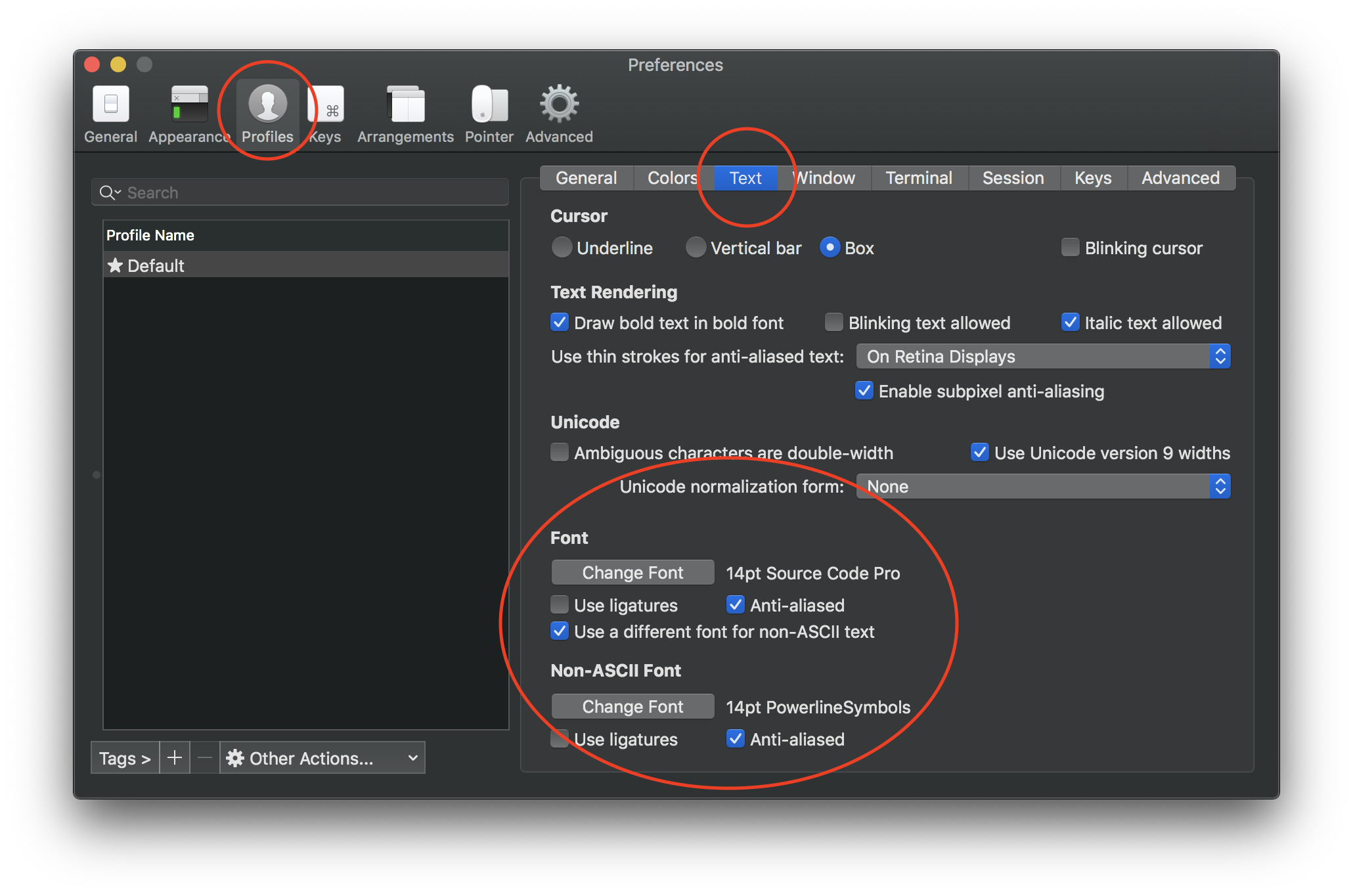
This can also happen on macOS when using iTerm2 and "Use Unicode version 9 character widths" is enabled in Preferences... > Profiles > Text
For that reason, the sample .local customization file stopped using Unicode characters for which width changed in between Unicode 8.0 and 9.0 standards, as well as Emojis.
- **I installed Powerline and/or (patched) fonts but I can't see the Powerline symbols**
🤯 Please realize that you don't need to install [Powerline].
You only need fonts patched with Powerline symbols or the standalone PowerlineSymbols.otf font.
Then make sure your .local customization file copy uses the [Powerline code points] for the tmuxconfthemeleftseparator_main, tmuxconfthemeleftseparator_sub, tmuxconfthemerightseparator_main and tmuxconfthemerightseparator_sub variables.
[Powerline]: https://github.com/Lokaltog/powerline [Powerline code points]: #enabling-the-powerline-look
Features
- C-a acts as secondary prefix, while keeping default C-b prefix - Visual theme inspired by [Powerline][] - [Maximize any pane to a new window with <prefix> +][maximize-pane] - Mouse mode toggle with <prefix> m - Laptop battery status line information - Uptime status line information - Optional highlight of focused pane - Configurable new sessions, windows and panes behavior (to optionally retain the current path) - SSH/Mosh aware username and hostname status line information - SSH/Mosh aware pane splitting (with automatic reconnection to the remote server) - Copy to OS clipboard (needs xsel, xclip, or wl-copy on Linux) - Support for 4-digit hexadecimal Unicode characters - [PathPicker][] integration, if available - [Urlscan][] (preferred) or [Urlview][] integration, if available
[maximize-pane]: http://pempek.net/articles/2013/04/14/maximizing-tmux-pane-new-window/ [PathPicker]: https://facebook.github.io/PathPicker/ [Urlview]: https://packages.debian.org/stable/misc/urlview [Urlscan]: https://github.com/firecat53/urlscan
The "Maximize any pane to a new window with <prefix> +" feature is different from the builtin resize-pane -Z command, as it allows you to further split a maximized pane. It's also more flexible by allowing you to maximize a pane to a new window, then change window, then go back and the pane is still in maximized state in its own window. You can then minimize a pane by using <prefix> + either from the source window or the maximized window.

Mouse mode allows you to set the active window, set the active pane, resize panes and automatically switches to copy-mode to select text.

Bindings
tmux may be controlled from an attached client by using a key combination of a prefix key, followed by a command key. This configuration uses C-a as a secondary prefix while keeping C-b as the default prefix. In the following list of key bindings: - <prefix> means you have to either hit Ctrl + a or Ctrl + b - <prefix> c means you have to hit Ctrl + a or Ctrl + b followed by c - <prefix> C-c means you have to hit Ctrl + a or Ctrl + b followed by Ctrl + c
This configuration uses the following bindings:
- <prefix> e opens the .local customization file copy with the editor defined by the VISUAL or EDITOR environment variable (defaults to vim when empty) - <prefix> r reloads the configuration - C-l clears both the screen and the tmux history
- <prefix> C-c creates a new session - <prefix> C-f lets you switch to another session by name
- <prefix> C-h and <prefix> C-l let you navigate windows (default <prefix> n is unbound and <prefix> p is repurposed) - <prefix> Tab brings you to the last active window
- <prefix> - splits the current pane vertically - <prefix> _ splits the current pane horizontally - <prefix> h, <prefix> j, <prefix> k and <prefix> l let you navigate panes ala Vim - <prefix> H, <prefix> J, <prefix> K, <prefix> L let you resize panes - <prefix> < and <prefix> > let you swap panes - <prefix> + maximizes the current pane to a new window
- <prefix> m toggles mouse mode on or off
- <prefix> U launches Urlscan (preferred) or Urlview, if available - <prefix> F launches Facebook PathPicker, if available
- <prefix> Enter enters copy-mode - <prefix> b lists the paste-buffers - <prefix> p pastes from the top paste-buffer - <prefix> P lets you choose the paste-buffer to paste from
Additionally, copy-mode-vi matches [my own Vim configuration]
[my own Vim configuration]: https://github.com/gpakosz/.vim.git
Bindings for copy-mode-vi:
- v begins selection / visual mode - C-v toggles between blockwise visual mode and visual mode - H jumps to the start of line - L jumps to the end of line - y copies the selection to the top paste-buffer - Escape cancels the current operation
It's also possible to preserve the tmux stock bindings by setting the tmuxconfpreservestockbindings variable to true in your .local customization file copy.
Configuration
While this configuration tries to bring sane default settings, you may want to customize it further to your needs.
🚨 Again, you should never alter the main .tmux.conf or tmux.conf file. If you do, you're on your own.
Please refer to the sample .local customization file to know more about the variables that allow you to alter different behaviors. Upon successful installation, pressing <prefix> e will open your .local customization file copy with the editor defined by the VISUAL or EDITOR environment variable (defaults to vim when empty).
Enabling the Powerline look
Powerline originated as a status-line plugin for Vim. Its popular eye-catching look is based on the use of special symbols:
To make use of these symbols, there are several options:
- Use a font that already bundles those: this is the case of the [Source Code Pro][source code pro] font - Use a [pre-patched font][powerline patched fonts] - Use your preferred font along with the standalone [Powerline font][powerline font] (that only contains the Powerline symbols): [this highly depends on your operating system and your terminal emulator][terminal support], for instance here's a screenshot of iTerm2 configured to use PowerlineSymbols.otf for non ASCII symbols:
[source code pro]: https://github.com/adobe-fonts/source-code-pro/releases/latest [powerline patched fonts]: https://github.com/powerline/fonts [powerline font]: https://github.com/powerline/powerline/raw/develop/font/PowerlineSymbols.otf [terminal support]: http://powerline.readthedocs.io/en/master/usage.html#usage-terminal-emulators
Then edit your .local customization file copy (with <prefix> e) and adjust the following variables:
tmux_c
tmux_c
tmux_c
tmux_c
The [Powerline manual] contains further details on how to install fonts containing the Powerline symbols.
[Powerline manual]: http://powerline.readthedocs.org/en/latest/installation.html#fonts-installation
Configuring the status line
Edit your .local customization file copy (<prefix> e) and adjust the tmuxconfthemestatusleft and tmuxconfthemestatusright variables to your liking.
This configuration supports the following builtin variables:
- #{battery_bar}: horizontal battery charge bar - #{battery_hbar}: 1 character wide, horizontal battery charge bar - #{battery_vbar}: 1 character wide, vertical battery charge bar - #{battery_percentage}: battery percentage - #{battery_status}: is battery charging or discharging? - #{circledsessionname}: circled session number (from ⓪) to ⑳) - #{hostname}: SSH/Mosh aware hostname information - #{hostname_ssh}: SSH/Mosh aware hostname information, blank when not connected to a remote server through SSH/Mosh - #{loadavg}: load average - #{pairing}: is the current session attached to more than one client? - #{prettypanecurrentpath}: prettified #{panecurrent_path} when its length is too long - #{prefix}: is prefix being depressed? - #{root}: is the current user root? - #{synchronized}: are the panes synchronized? - #{uptime_y}: uptime years - #{uptimed}: uptime days, modulo 365 when #{uptimey} is used - #{uptime_h}: uptime hours - #{uptime_m}: uptime minutes - #{uptime_s}: uptime seconds - #{username}: SSH/Mosh aware username information - #{username_ssh}: SSH aware username information, blank when not connected to a remote server through SSH/Mosh
Beside the variables mentioned above, the tmuxconfthemestatusleft and tmuxconfthemestatusright variables support the usual tmux syntax, e.g. using #() to call an external command that inserts weather information provided by [wttr.in]:
tmux_csleep 900 call makes sure the network request is issued at most every 15 minutes whatever the value of status-interval.

[wttr.in]: https://github.com/chubin/wttr.in#one-line-output
💡 You can also define your own custom variables by defining your own POSIX shell functions, see the sample .local customization file for instructions.
Finally, remember that tmuxconfthemestatusleft and tmuxconfthemestatusright end up being given to tmux as status-left and status-right which means they're passed through strftime(). As such, the % character has a special meaning and needs to be escaped by doubling it, e.g.
tmux_cman 3 strftime.
Using TPM plugins
This configuration comes with built-in [TPM] support:
- Use the set -g @plugin ... syntax to enable a plugin - Whenever a plugin introduces a variable to be used in status-left or status-right, you can use it in the tmuxconfthemestatusleft and tmuxconfthemestatusright variables, see instructions above 👆 - ⚠️ Do not add set -g @plugin 'tmux-plugins/tpm' to any configuration file - ⛔️ Do not add run '~/.tmux/plugins/tpm/tpm' to any configuration file
⚠️ The TPM bindings differ slightly from upstream: - Installing plugins: <prefix> + I - Uninstalling plugins: <prefix> + Alt + u - Updating plugins: <prefix> + u
See the sample .local customization file for further instructions.
[TPM]: https://github.com/tmux-plugins/tpm
Using Oh my tmux! on Windows
⚠️ I don't recommend running this configuration with [Cygwin] anymore. Forking under Cygwin is extremely slow and this configuration issues a fair amount run-shell commands under the hood. As such, you will experience high CPU usage.
Instead I recommend [Windows Subsystem for Linux][WSL] along with [Windows Terminal]. As an alternative, you may also consider using [Mintty as a terminal for WSL][wsltty].
[Cygwin]: https://www.cygwin.com [WSL]: https://learn.microsoft.com/en-us/windows/wsl [wsltty]: https://github.com/mintty/wsltty [Windows Terminal]: https://aka.ms/terminal


