
Mortar is a GO framework/library for building gRPC (and REST) web services.
Mortar


|
Mortar is a GO framework/library for building gRPC (and REST) web services. Mortar has out-of-the-box support for configuration, application metrics, logging, tracing, profiling, dependency injection and more. While it comes with predefined defaults, Mortar gives you total control to fully customize it. |
|---|

Demo
Clone this demo repository to better understand some of Mortar capabilities.
When you done, read the documentation.
Service Template
To help you bootstrap your services with Mortar here you can find a template. Read its README first.
Features
- Bundled Grpc-Gateway (REST Reverse-Proxy).
- Dependency Injection using Uber-FX.
- Pimped
*http.Clientwith interceptors support. - Abstract support for Logging, Configuration, Tracing and Monitoring libraries. Use provided wrappers or your own.
- Internal HTTP Handlers
http://.../debug/pprof
- Debug http://.../debug/*
- Configuration http://.../self/config
- Build Information http://.../self/build
- Health http://.../health
- Server/Client Interceptors both for gRPC and HTTP, you can choose which to use and/or add your own.
ctx.Context via gRPC incoming Metadata.
- Automatic monitoring and tracing (if enabled) for every RPC defined by the API.
...and more.
Telemetry (Everything connected)
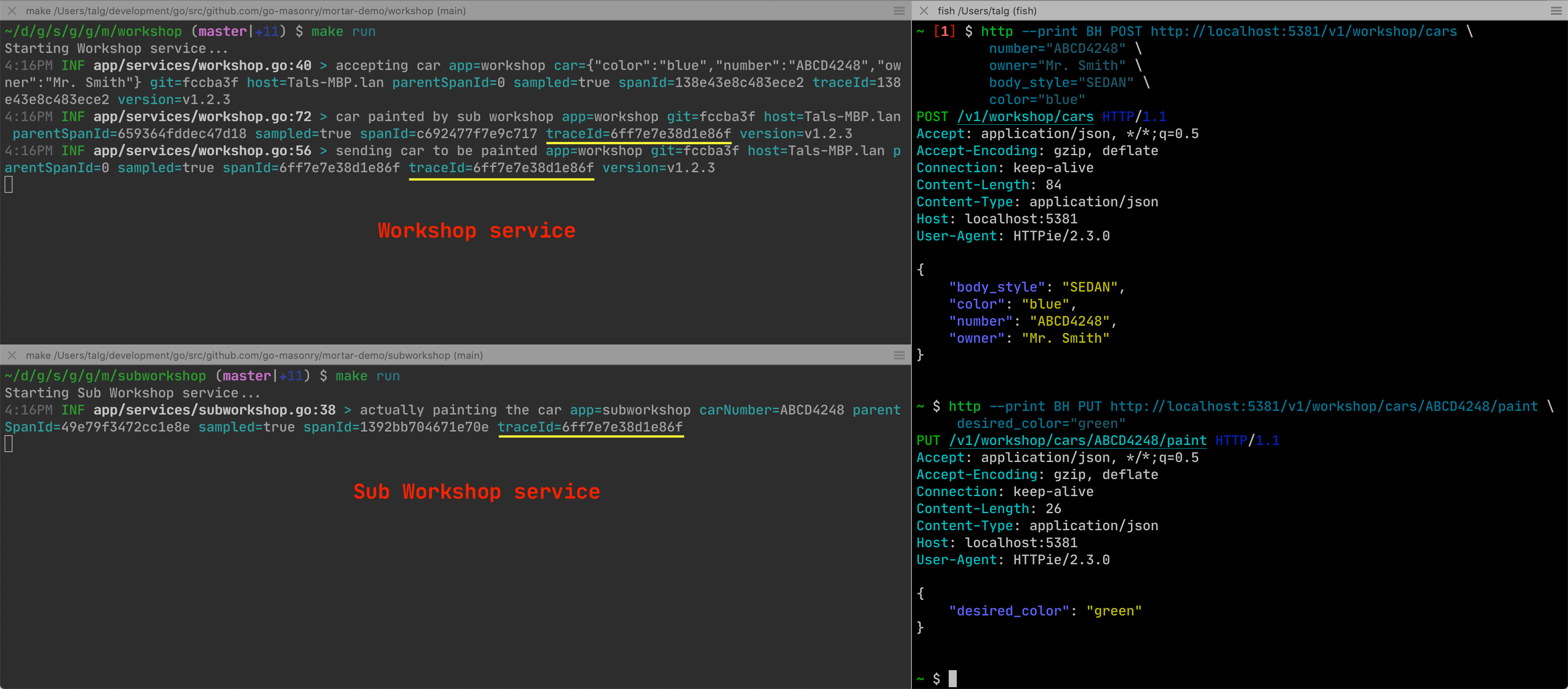
- Logs have Tracing Information
traceId=6ff7e7e38d1e86facross services
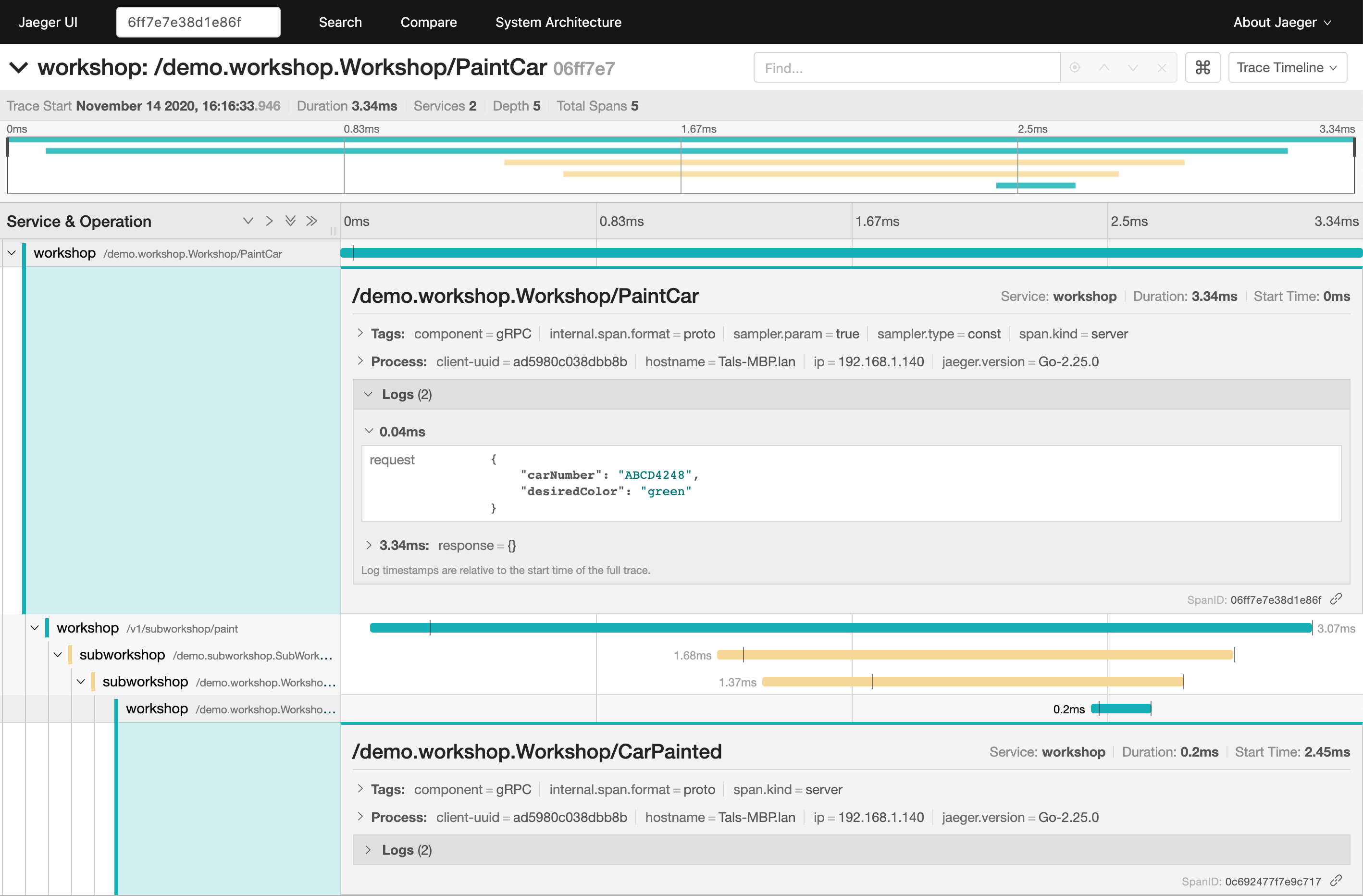
- Also visible in Jaeger
traceId=6ff7e7e38d1e86fif it's sampled.
Support for *http.Client Interceptors, so you can
- Add request and response info to Trace
- Log/Dump requests and/or responses when http request fails.
return func(req http.Request, handler client.HTTPHandler) (resp http.Response, err error) {
        var reqBytes, respBytes []byte
        // If the response is Bad Request, log both Request and Response
        reqBytes, _ = httputil.DumpRequestOut(req, true) // it can be nil and it's ok
        if resp, err = handler(req); err == nil && resp.StatusCode >= http.StatusBadRequest {
            respBytes, _ = httputil.DumpResponse(resp, true) // it can be nil
            logger.WithError(fmt.Errorf("http request failed")).
            WithField("status",resp.StatusCode).
            Warn(req.Context(), "\nRequest:\n%s\n\nResponse:\n%s\n", reqBytes, respBytes)
        }
        return
    }
- Alter requests and/or responses (useful in Tests)
func(http.Request, clientInt.HTTPHandler) (http.Response, error) {
        // special case, don't go anywhere just return the response
        return &http.Response{
            Status:        "200 OK",
            StatusCode:    200,
            Proto:         "HTTP/1.1",
            ProtoMajor:    1,
            ProtoMinor:    1,
            ContentLength: 11,
            Body:          ioutil.NopCloser(strings.NewReader("car painted")),
        }, nil
    }
Monitoring/Metrics support
Export to either Prometheus/Datadog/statsd/etc, it's your choice. Mortar only provides the Interface and also caches the metrics so you don't have to.
counter := w.deps.Metrics.WithTags(monitor.Tags{
 "color":   request.GetDesiredColor(),
 "success": fmt.Sprintf("%t", err == nil),
}).Counter("paintdesiredcolor", "New paint color for car")
counter.Inc()
counter is actually a singleton, uniqueness calculated here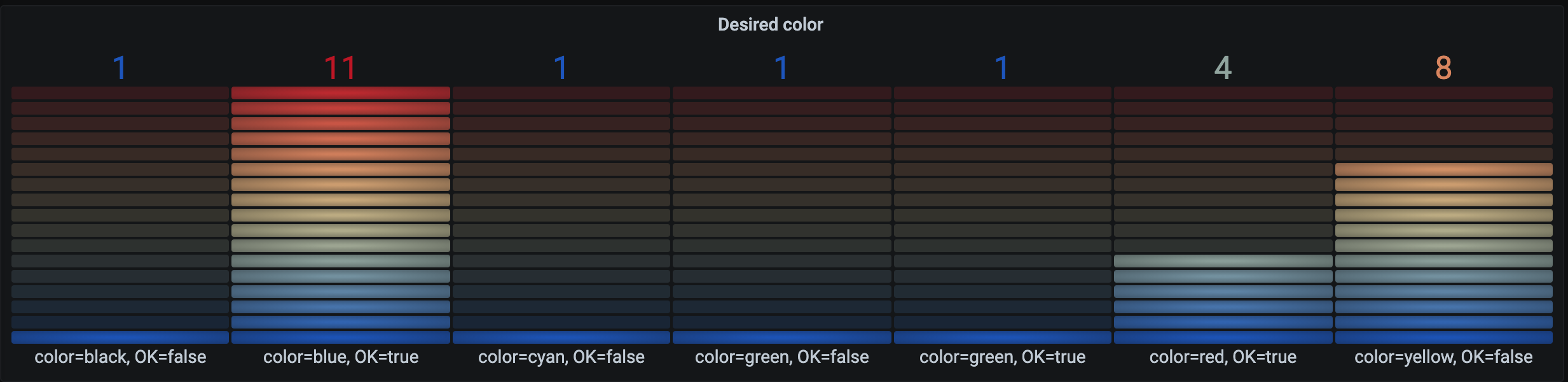
For more information about Mortar Monitoring read here.
Additional Features
/debug/pprofand other useful handlers- Use
configtest.ymlduring tests to override values inconfig.yml, it saves time.
Documentation
Mortar is not a drop-in replacement.
It's important to read its Documentation first.


