
The "breathing k-means" algorithm with datasets and example notebooks
The Breathing K-Means Algorithm (with examples)
The Breathing K-Means is an approximation algorithm for the k-means problem that (on average) is better (higher solution quality) and faster (lower CPU time usage) than k-means++.
Preprint: https://arxiv.org/abs/2006.15666
Upon request comparative experiments with the "Hartigan-Wong" algorithm (the default k-means method in R) were made (post-submission and confirming the choice of k-means++ as point of reference).
Typical results for the "Birch1" data set (100000 points drawn from a mixture of 100 circular Gaussians). k=100 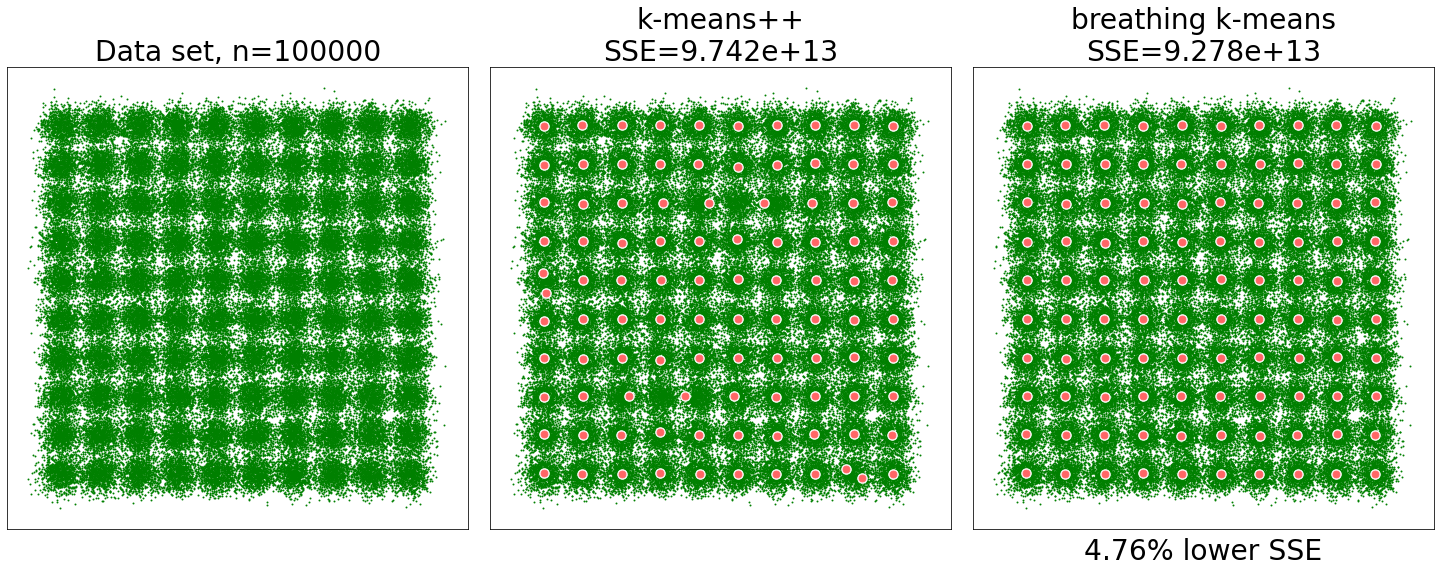
Can you spot the mistakes? :-)
Installation from pypi
pip install bkmeansLocal installation to run the examples
Clone the repositorygit clone https://github.com/gittar/breathing-k-meanscd breathing-k-meansconda env create -n bkm -f environment.ymlconda activate bkmTo run a jupyter notebook with examples, type, e.g.:
jupyter lab notebooks/2D.ipynbContent
The top level folder contains the following subfolders- data/ - data sets used in the notebooks
- notebooks/ - jupyter notebooks with all examples from the preprint
- src/
bkmeans.py - reference implementation of breathing k-means
- misc/
* aux.py - auxiliary functions
* dataset.py - general class to administer and plot data sets
* runfunctions.py` - wrapper functions used in the notebook
API
The included class BKMeans is subclassed from scikit-learn's KMeans class and has, therefore, the same API. It can be used as a plug-in replacement for scikit-learn's KMeans.
There is one new parameters which can be ignored (left at default) for normal usage:
m* (breathing depth), default: 5
The parameter m can also be used, however, to generate faster ( 1 < m < 5) or better (m>5) solutions. For details see the preprint.
Example 1: running on simple random data set
Code:import numpy as np
from bkmeans import BKMeans
generate random data set
X=np.random.rand(1000,2)
create BKMeans instance
bkm = BKMeans(n_clusters=100)
run the algorithm
bkm.fit(X)
print SSE (inertia in scikit-learn terms)
print(bkm.inertia_)1.1775040547902602Example 2: comparison with k-means++ (multiple runs)
Code:import numpy as np
from sklearn.cluster import KMeans
from bkmeans import BKMeans
random 2D data set
X=np.random.rand(1000,2)
number of centroids
k=100
for i in range(5): # kmeans++ km = KMeans(n_clusters=k) km.fit(X)
# breathing k-means bkm = BKMeans(n_clusters=k) bkm.fit(X)
# relative SSE improvement of bkm over km++ imp = 1 - bkm.inertia/km.inertia print(f"SSE improvement over k-means++: {imp:.2%}")
SSE improvement over k-means++: 3.38%
SSE improvement over k-means++: 4.16%
SSE improvement over k-means++: 6.14%
SSE improvement over k-means++: 6.79%
SSE improvement over k-means++: 4.76%


