
Rust re-implementation of OpenFST - library for constructing, combining, optimizing, and searching weighted finite-state transducers (FSTs). A Python binding is also available.
Rustfst


Rust



Python



Rust implementation of Weighted Finite States Transducers.
Rustfst is a library for constructing, combining, optimizing, and searching weighted finite-state transducers (FSTs). Weighted finite-state transducers are automata where each transition has an input label, an output label, and a weight. The more familiar finite-state acceptor is represented as a transducer with each transition's input and output label equal. Finite-state acceptors are used to represent sets of strings (specifically, regular or rational sets); finite-state transducers are used to represent binary relations between pairs of strings (specifically, rational transductions). The weights can be used to represent the cost of taking a particular transition.
FSTs have key applications in speech recognition and synthesis, machine translation, optical character recognition, pattern matching, string processing, machine learning, information extraction and retrieval among others. Often a weighted transducer is used to represent a probabilistic model (e.g., an n-gram model, pronunciation model). FSTs can be optimized by determinization and minimization, models can be applied to hypothesis sets (also represented as automata) or cascaded by finite-state composition, and the best results can be selected by shortest-path algorithms.
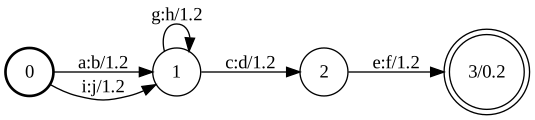
Overview
For a basic example see the section below.
Some simple and commonly encountered types of FSTs can be easily created with the macro [fst] or the functions acceptor and transducer.
For more complex cases you will likely start with the VectorFst type, which will be imported in the [prelude] along with most everything else you need. VectorFst<TropicalWeight> corresponds directly to the OpenFST StdVectorFst, and can be used to load its files using read or readtext.
Because "iteration" over an FST can mean many different things, there are a variety of different iterators. To iterate over state IDs you may use statesiter, while to iterate over transitions out of a state, you may use gettrs. Since it is common to iterate over both, this can be done using fstiter or fstintoiter. It is also very common to iterate over paths accepted by an FST, which can be done with pathsiter, and as a convenience for generating text, stringpathsiter. Alternately, in the case of a linear FST, you may retrieve the only possible path with decodelinear_fst.
Note that iterating over paths is not the same thing as finding the shortest path or paths, which is done with shortest_path (for a single path) or shortestpathwith_config (for N-shortest paths).
For the complete list of algorithms, see the [algorithms] module.
You may now be wondering, especially if you have previously used such linguist-friendly tools as pyfoma, "what if I just want to transduce some text???" The unfriendly answer is that rustfst is a somewhat lower-level library, designed for implementing things like speech recognizers. The somewhat more helpful answer is that you would do this by constructing an acceptor for your input, which you will compose with a transducer, then project the result to itsoutput, and finally iterate over the paths in the resulting FST.
References
Implementation heavily inspired from Mehryar Mohri's, Cyril Allauzen's and Michael Riley's work :
- Weighted automata algorithms
- The design principles of a weighted finite-state transducer library
- OpenFst: A general and efficient weighted finite-state transducer library
- Weighted finite-state transducers in speech recognition
Tr instead of Arc. See Differences fromOpenFST for more information.
Example
use anyhow::Result;
use rustfst::prelude::*;
use rustfst::algorithms::determinize::{DeterminizeType, determinize};
use rustfst::algorithms::rmepsilon::rmepsilon;
fn main() -> Result<()> {     // Creates a empty wFST     let mut fst = VectorFst::<TropicalWeight>::new();
// Add some states     let s0 = fst.add_state();     let s1 = fst.add_state();     let s2 = fst.add_state();
// Set s0 as the start state     fst.set_start(s0)?;
// Add a transition from s0 to s1     fst.add_tr(s0, Tr::new(3, 5, 10.0, s1))?;
// Add a transition from s0 to s2     fst.add_tr(s0, Tr::new(5, 7, 18.0, s2))?;
// Set s1 and s2 as final states     fst.set_final(s1, 31.0)?;     fst.set_final(s2, 45.0)?;
// Iter over all the paths in the wFST     for p in fst.paths_iter() {          println!("{:?}", p);     }
// A lot of operations are available to modify/optimize the FST.     // Here are a few examples :
// - Remove useless states.     connect(&mut fst)?;
// - Optimize the FST by merging states with the same behaviour.     minimize(&mut fst)?;
// - Copy all the input labels in the output.     project(&mut fst, ProjectType::ProjectInput);
// - Remove epsilon transitions.     rm_epsilon(&mut fst)?;
// - Compute an equivalent FST but deterministic.     fst = determinize(&fst)?;
Ok(()) }
Differences from OpenFST
Here is a non-exhaustive list of ways in which Rustfst's API differs from OpenFST:
- The default epsilon symbol is
<eps>and not<epsilon>. - Functions and methods follow Rust naming conventions,
add_state rather than AddState, but are otherwise mostly
equivalent, except that:
- Transitions are called
Trand notArc, becauseArchas a
std::sync::Arc, that is) to reference-count symbol
tables. All associated functions also use tr.
- Final states are not indicated by a final weight of
zero. You
isfinal, and
finalweight returns an [Option]. This
requires some care when converting OpenFST code.
- Transitions can be accessed directly as a slice rather than requiring
- Semiring operations are expressed as plain old methods rather
w1.plus(w2) rather than
Plus(w1, w2), for instance.
- Weights have in-place operations for ⊕
plus_assign) and ⊗
(times_assign).
- Most of the type aliases (which would be trait aliases in Rust) such
StdArc, StdFst, and so forth, are missing, but type inference
allows us to avoid explicit type arguments in most cases, such as
when calling [Tr::new], for instance.
- State IDs are unsigned, with [
NOSTATEID] used for a missing value.
usize] when using them as indices, and vice-versa,
preferably checking for overflows
- Symbol IDs are also unsigned and 32-bits, with [
NO_LABEL] used
- Floating-point weights are not generic, so are always single-precision.
Benchmark with OpenFST
I did a benchmark some time ago on almost every linear fst algorithm and compared the results with OpenFst. You can find the results here :
Rustfst is faster on all those algorithms 😅
Documentation
The documentation of the last released version is available here : https://docs.rs/rustfst
Release process
- Use the script
update_version.shto update the version of every package. - Push
- Push a new tag with the prefix
rustfst-v
./update_version.sh 0.9.1-alpha.6
git commit -am "Release 0.9.1-alpha.6"
git push
git tag -a rustfst-v0.9.1-alpha.6 -m "Release rustfst 0.9.1-alpha.6"
git push --tags
Optionally, if this is a major release, create a GitHub release in the UI.
Projects contained in this repository
This repository contains two main projects:rustfstis the Rust re-implementation.
rustfst-pythonis the python binding ofrustfst.
License
Licensed under either of- Apache License, Version 2.0 (LICENSE-APACHE or http://www.apache.org/licenses/LICENSE-2.0)
- MIT license (LICENSE-MIT) or http://opensource.org/licenses/MIT)
Contribution
Unless you explicitly state otherwise, any contribution intentionally submitted for inclusion in the work by you, as defined in the Apache-2.0 license, shall be dual licensed as above, without any additional terms or conditions.


