
Unified AI Gateway for 30+ LLMs (OpenAI, Anthropic, Bedrock, Azure etc) with Caching, Guardrails, A/B test & cost controls. Go-native Fastest & Scalable AI Gateway LiteLLM & Kong AI Gateway alternative.
 |
Ferro Labs AI Gateway |
| Open-Source, OpenAI-Compatible LLM Gateway |
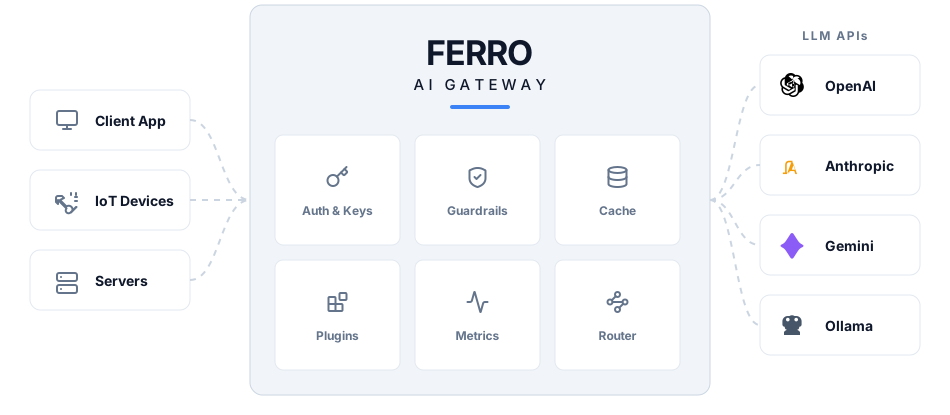
High-performance AI gateway in Go. Route LLM requests across 30 providers via a single OpenAI-compatible API.
Deploy templates











📖 Documentation: docs.ferrolabs.ai
🔀 30 providers, 2,500+ models — one API
⚡ 13,925 RPS at 1,000 concurrent users (v1.0.0 benchmark)
📦 Single static binary, no external services required, 32 MB base memory
Quick Start
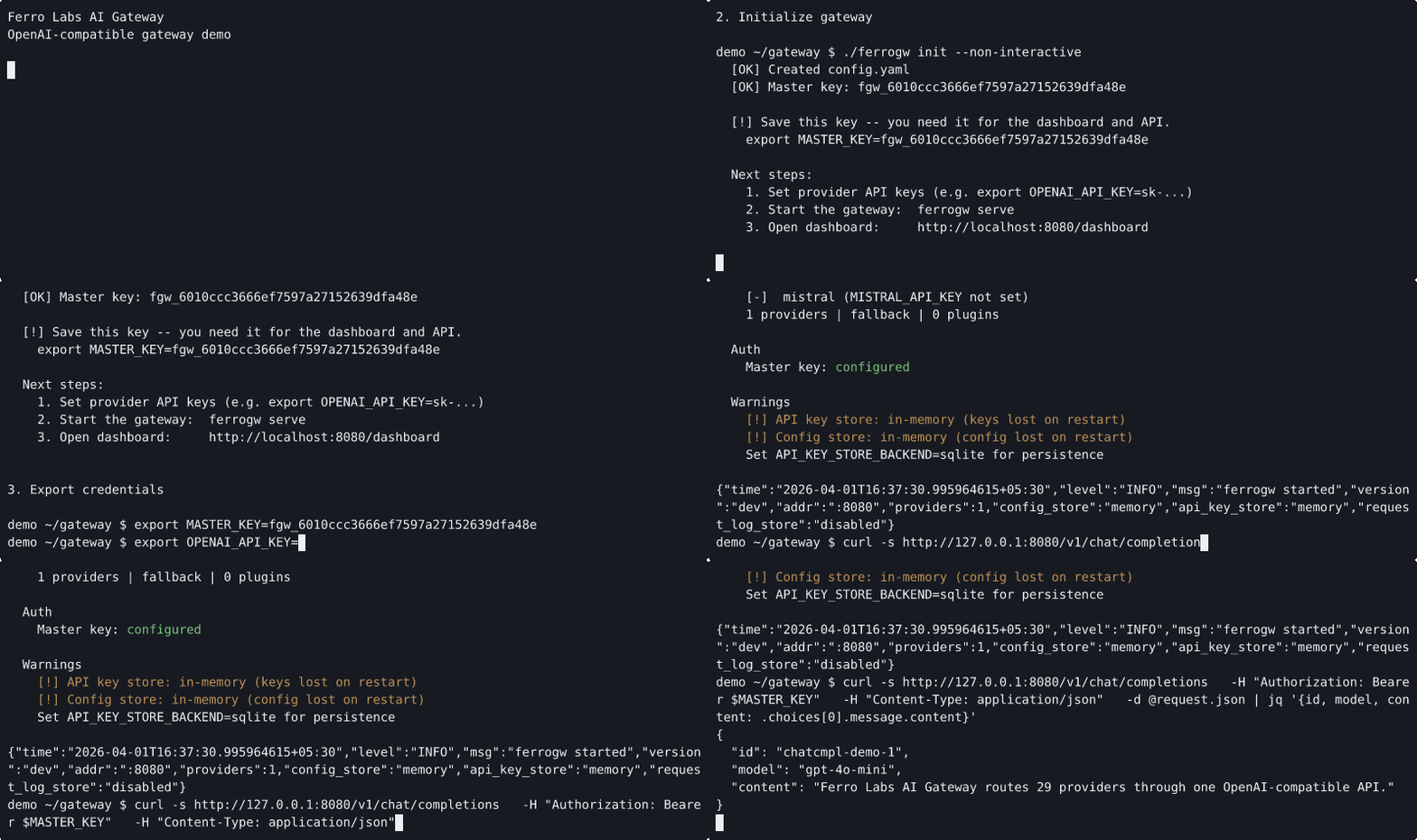
Get from zero to first request in under 2 minutes.
Option A — Binary (fastest)
VER=$(curl -fsSL https://api.github.com/repos/ferro-labs/ai-gateway/releases/latest | grep '"tag_name"' | cut -d'"' -f4)
curl -fsSL "https://github.com/ferro-labs/ai-gateway/releases/download/${VER}/ferrogw${VER#v}linux_amd64.tar.gz" | tar xz
chmod +x ferrogw
./ferrogw init                        # generates config.yaml + MASTER_KEY
export GATEWAY_CONFIG=./config.yaml   # the server reads a config file only when this is set
export OPENAIAPIKEY=sk-your-key     # providers are registered at startup, so export before starting
export MASTERKEY=fgwyour-master-key # the key ferrogw init printed
./ferrogw                             # starts the server
Releases are signed and ship SBOMs — verification steps are in SECURITY.md.
Option B — Docker
docker pull ghcr.io/ferro-labs/ai-gateway:latest
docker run -p 8080:8080 \
  -e OPENAIAPIKEY=sk-your-key \
  -e MASTERKEY=fgwyour-master-key \
  ghcr.io/ferro-labs/ai-gateway:latest
Option C — Go
go install github.com/ferro-labs/ai-gateway/cmd/ferrogw@latest
ferrogw init                          # first-run setup
export GATEWAY_CONFIG=./config.yaml   # the server reads a config file only when this is set
export OPENAIAPIKEY=sk-your-key     # providers are registered at startup, so export before starting
export MASTERKEY=fgwyour-master-key # the key ferrogw init printed
ferrogw                               # start the server
ferrogw init generates the master key and writes a minimal config.yaml. The key is shown once and never written to disk — store it in your .env file or secret manager.
Minimal config
Create config.yaml (or use ferrogw init), then point the gateway at it with export GATEWAY_CONFIG=./config.yaml — a config file is loaded only when that variable names it:
strategy:
  mode: fallback
targets:   - virtual_key: openai     retry:       attempts: 3       onstatuscodes: [429, 502, 503]   - virtual_key: anthropic
aliases:   fast: gpt-4o-mini   smart: claude-3-5-sonnet-20241022
First request
export MASTERKEY=fgwyour-master-key   # the key ferrogw init printed, in whichever shell you curl from
curl http://localhost:8080/v1/chat/completions \   -H "Content-Type: application/json" \   -H "Authorization: Bearer $MASTER_KEY" \   -d '{     "model": "gpt-4o-mini",     "messages": [{"role": "user", "content": "Hello from Ferro Labs AI Gateway"}]   }' | jq
Why Ferro Labs AI Gateway
Most AI gateways are Python proxies that crack under load or JavaScript services that eat memory. Ferro Labs AI Gateway is written in Go from the ground up for real-world throughput — a single binary that routes LLM requests with predictable latency and minimal resource usage.
| Feature | Ferro Labs | LiteLLM | Bifrost | Kong AI | |:-----------------|:------------|:--------|:-----------|:------------| | Language | Go | Python | Go | Go/Lua | | Single binary | ✅ | ❌ | ✅ | ❌ | | Providers | 30 | 100+ | 20+ | 10+ | | MCP support | ✅ | ❌ | ✅ | ❌ | | Response cache | ✅ | ✅ | ✅ | ❌ (paid) | | Guardrails | ✅ | ✅ | ❌ | ❌ (paid) | | OSS license | Apache 2.0 | MIT | Apache 2.0 | Apache 2.0 | | Managed cloud | Coming Soon | ✅ | ✅ | ✅ |
Performance
Every figure in this section comes from one run: **Ferro Labs v1.0.0, measured 2026-03-23**. Benchmarked against Kong OSS, Bifrost, LiteLLM, and Portkey on GCP n2-standard-8 (8 vCPU, 32 GB RAM) using a **60ms fixed-latency mock upstream** — results reflect gateway overhead only. Later releases have not been re-measured; reproduce against the version you intend to run using the commands below.
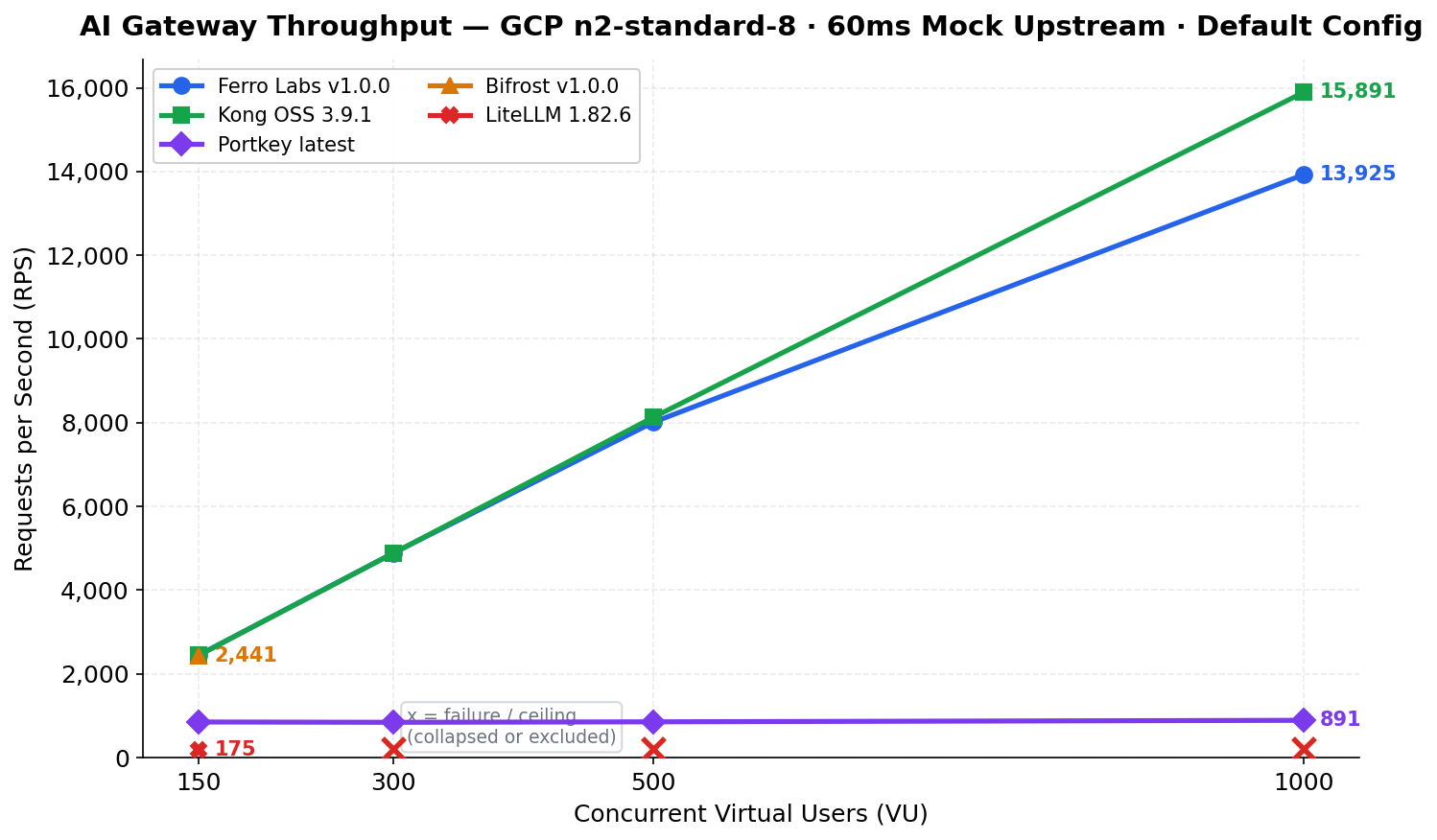
| VU | RPS | p50 | p99 | Memory | |---:|---:|---:|---:|---:| | 50 | 813 | 61.3ms | 64.1ms | 36 MB | | 150 | 2,447 | 61.2ms | 63.4ms | 47 MB | | 300 | 4,890 | 61.2ms | 64.4ms | 72 MB | | 500 | 8,014 | 61.5ms | 72.9ms | 89 MB | | 1,000 | 13,925 | 68.1ms | 111.9ms | 135 MB |
At 1,000 VU: 13,925 RPS, p50 overhead 8.1ms, memory 135 MB. Against the live OpenAI API, the gateway itself adds 25 microseconds p50 in a typical plugin configuration (2µs bare).
Full methodology, raw results, and flamegraph analysis: ferro-labs/ai-gateway-performance-benchmarks (make setup && make bench reproduces it).
Features
🔀 Routing
- 8 routing strategies: single, fallback, load balance, least latency, cost-optimized, content-based, A/B test, conditional — see internal/strategies/README.md
- Provider failover with configurable retry policies and status code filters
- Cost-optimized routing can explicitly fallback, skip, or allow providers with unknown catalog prices
- Per-request model aliases (
fast → gpt-4o-mini,smart → claude-3-5-sonnet)
🔌 Providers (30)
| OpenAI & Compatible | Anthropic & Google | Cloud & Enterprise | Open Source & Inference | |:---|:---|:---|:---| | OpenAI | Anthropic | AWS Bedrock | Ollama, Ollama Cloud | | Azure OpenAI | Google Gemini | Azure Foundry | Hugging Face | | OpenRouter | Vertex AI | Databricks | Replicate | | DeepSeek | | Cloudflare Workers AI | Together AI | | Perplexity | | | Fireworks | | xAI (Grok) | | | DeepInfra | | Mistral | | | NVIDIA NIM | | Groq | | | SambaNova | | Cohere | | | Novita AI | | AI21 | | | Cerebras | | Moonshot / Kimi | | | Qwen / DashScope |
Beyond chat and streaming, providers serve **embeddings, images, rerank, moderations, speech-to-text, text-to-speech, and batch** where the vendor offers them — the full per-provider endpoint matrix is providers/README.md.
🛡️ Guardrails & Plugins
Six plugins ship built-in — word filter, token/message limits, response cache, rate limiting, per-key budgets, and request logging — and the framework is public for writing your own. See plugin/README.md.
🎯 Provider Capabilities
- Capability matrix — one declarative record of which OpenAI parameters each provider forwards, translates, or cannot express
GET /v1/capabilities— compare providers programmatically before you route to them- Strict mode —
compatibility.onunsupportedparam: warn | drop | reject; a parameter the provider cannot honor is no longer silently discarded - Conformance-tested — every provider is built through the same seam the gateway uses and asserted against its real upstream payload shape
🤖 MCP (Model Context Protocol)
The gateway connects to MCP tool servers (stdio and Streamable HTTP), injects their tools into chat completions, and drives the agentic tool_calls loop itself — bounded depth, tool filtering, cross-server dedup. See mcp/README.md.
📊 Observability
- OpenTelemetry tracing — OTLP export, W3C propagation, GenAI semantic conventions plus
ferro.*cost/routing/MCP attributes; a zero-allocation no-op until enabled. See observability/README.md - Prometheus metrics at
/metrics(authenticated) and deep health checks at/health,/livez,/readyz - One trace ID threads logs, spans, and the
X-Request-IDheader; request logs persist to SQLite/PostgreSQL
Dashboard
Every gateway binary serves a built-in operations console at / — same port as the API, compiled in with go:embed, no second image and no second origin. Sign in with your MASTER_KEY or any admin / read-only key and it reads the live gateway: traffic, spend, provider health, routing, plugins, request logs, and the audit trail.
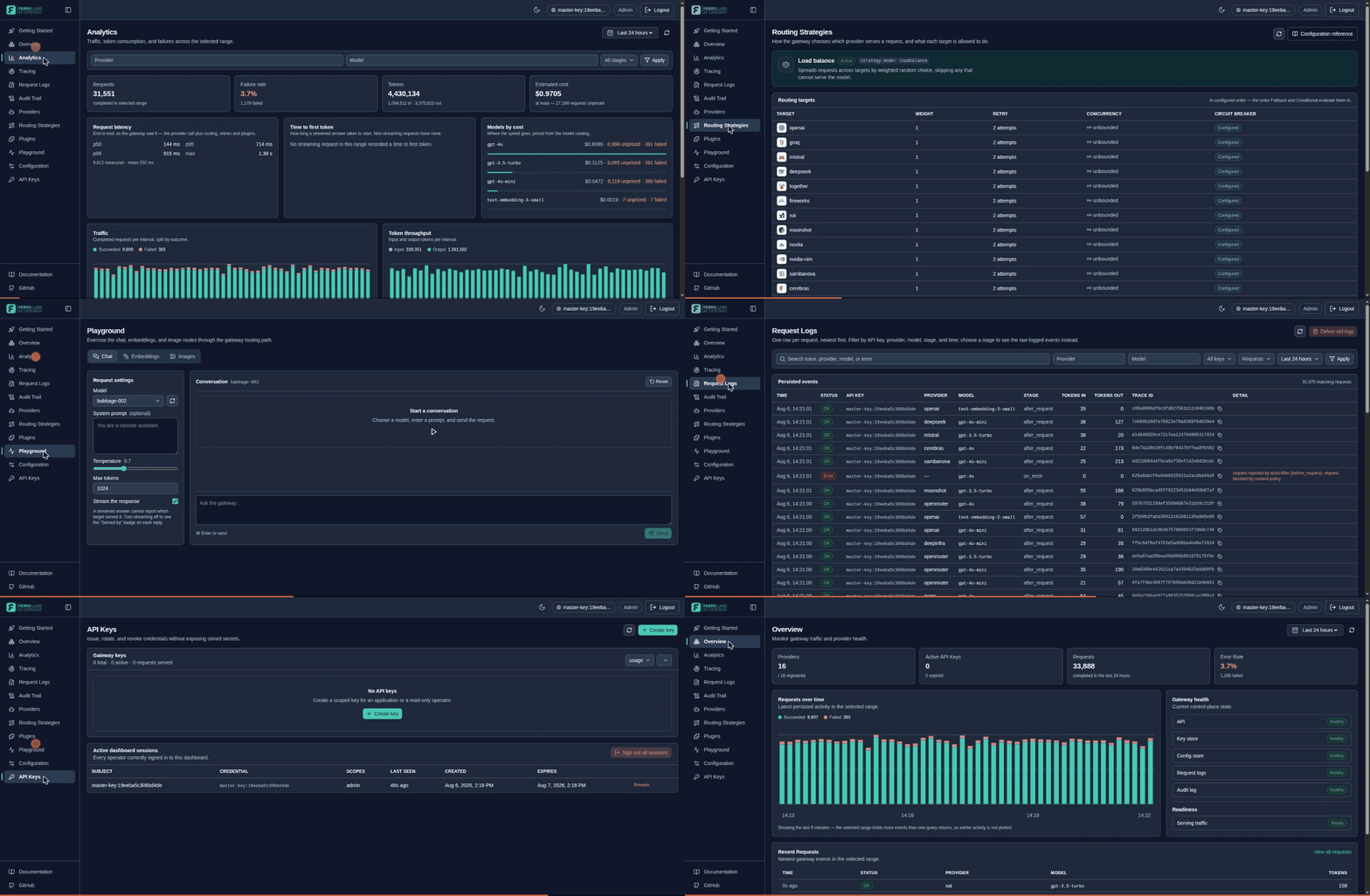
Overview, Analytics (latency/TTFT/cost percentiles), Providers, Routing, Plugins, a Playground over the real routing path, Tracing, Request Logs, the Audit Trail, Configuration with history/rollback, and scoped API key management.
Run the gateway and open
make up-fullstack   # gateway + Postgres + Jaeger + Prometheus + Grafana + mock upstream + load generator
then open http://localhost:8080
Build and development details are in web/README.md.
Documentation
The root README is the overview; each subsystem keeps its own reference beside its code:
| Reference | Covers | |:---|:---| | providers/README.md | The 30 providers, the per-provider endpoint matrix, and every /v1/* surface | | config/README.md | Config loading, validation, ${VAR} secrets, declared models, trusted proxies | | internal/strategies/README.md | All 8 routing strategies and their failure semantics | | plugin/README.md | The plugin framework and the six built-in plugins | | mcp/README.md | MCP tool servers, transports, the subprocess trust boundary, readiness | | observability/README.md | Tracing setup, managed backends, emitted attributes, privacy levels, exporters | | deploy/README.md | Dockerfiles, Compose files, the fullstack demo stack | | web/README.md | Dashboard development and the embed contract | | AGENTS.md | The complete operator/developer reference: architecture, every env var, request flow | | SECURITY.md | Reporting, security posture, release verification | | CONTRIBUTING.md | Branch strategy, commit conventions, provider/plugin checklists |
Examples
Integration examples for common use cases are in ferro-labs/ai-gateway-examples:
| Example | Description | |:--------|:------------| | basic | Single chat completion to the first configured provider | | fallback | Fallback strategy — try providers in order with retries | | loadbalance | Weighted load balancing across targets (70/30 split) | | with-guardrails | Built-in word-filter and max-token guardrail plugins | | with-mcp | Local MCP server with tool-calling integration | | embedded | Embed the gateway as an HTTP handler inside an existing server |
Configuration
One YAML/JSON file, named by GATEWAY_CONFIG, drives routing, guardrails, MCP tools, and observability:
strategy:
  mode: fallback              # 8 modes — see internal/strategies/README.md
targets:   - virtual_key: openai       # an allowlist: only listed providers are routable     retry: { attempts: 3 }    # per target, honoured under every routing mode     concurrency: { maxconcurrency: 32, queuesize: 1000 }   - virtual_key: anthropic
aliases:   fast: gpt-4o-mini
plugins:                      # guardrails first, then cache — see plugin/README.md   - name: word-filter     type: guardrail     stage: before_request     enabled: true     config: { blocked_words: ["password", "secret"] }
mcp_servers:                  # tool servers — see mcp/README.md   - name: search     url: https://mcp.example.com/mcp     headers: { Authorization: "Bearer ${SEARCH_TOKEN}" }
${VAR} references (braced form only) resolve when a component is constructed, never at file load — so secrets are never stored, served by GET /admin/config, or restored by a rollback. A bare $ is data; an undefined variable is an error.
The full annotated reference with every option is config.example.yaml / config.example.json, and the schema guide is config/README.md. ferrogw validate checks a file without starting the server.
Key environment variables
| Variable | Purpose | |----------|---------| | MASTER_KEY | Bootstrap and break-glass admin credential (generated by ferrogw init); give each operator their own key from POST /admin/keys for day-to-day use | | GATEWAY_CONFIG | Path to config YAML/JSON | | GATEWAYENV | Set to production to enable production-mode safety guards: it refuses to start on ALLOWUNAUTHENTICATEDPROXY=true or a * entry in CORSORIGINS, and warns when per-IP rate limiting is off, pprof is mounted, or the API key store is in-memory | | PORT | Server port (default: 8080) | | ALLOWUNAUTHENTICATEDPROXY | Set to true to disable proxy-route auth (dev only; blocked when GATEWAY_ENV=production) | | CORS_ORIGINS | Comma-separated allowed CORS origins; cross-origin is denied when unset. Matched literally — there is no wildcard, so list each origin explicitly | | TRUSTEDPROXIES | CIDRs of trusted reverse proxies; forwarded headers are honored only from these (default: loopback). See config/README.md | | <PROVIDER>BASEURL | Points a provider at a proxy, self-hosted server, or regional endpoint. It is the API root, used verbatim — write it exactly as the vendor documents it, version segment included (https://api.groq.com/openai/v1); a bare host resolves to the provider's own version segment |
See AGENTS.md for the full environment variable reference including provider API keys, store backends, and OTel settings.
Observability
See everything your gateway does — every request, what it cost, how long it took, which provider served it, and which guardrails ran. Ferro Labs AI Gateway ships first-class OpenTelemetry tracing and Prometheus metrics out of the box, and stays at a zero-allocation no-op until you turn it on. Point it at Jaeger, Grafana, New Relic, LangSmith, Datadog, or Honeycomb — anything that speaks OTLP — and every request emits a gateway.request span carrying GenAI semantic conventions (gen_ai.) plus ferro. extensions for cost, routing, MCP tool calls, and stream timings. The same trace ID threads your logs, spans, and the X-Request-ID response header.
📈 Full observability guide → observability/README.md — managed-backend setup, endpoint & transport rules, every emitted attribute, privacy levels, and exporter plugins.
Bring up the gateway wired to a full monitoring stack — Prometheus, Grafana, and Jaeger — driven by generated traffic, in one command:
make up-fullstack # then open Grafana at http://localhost:3000 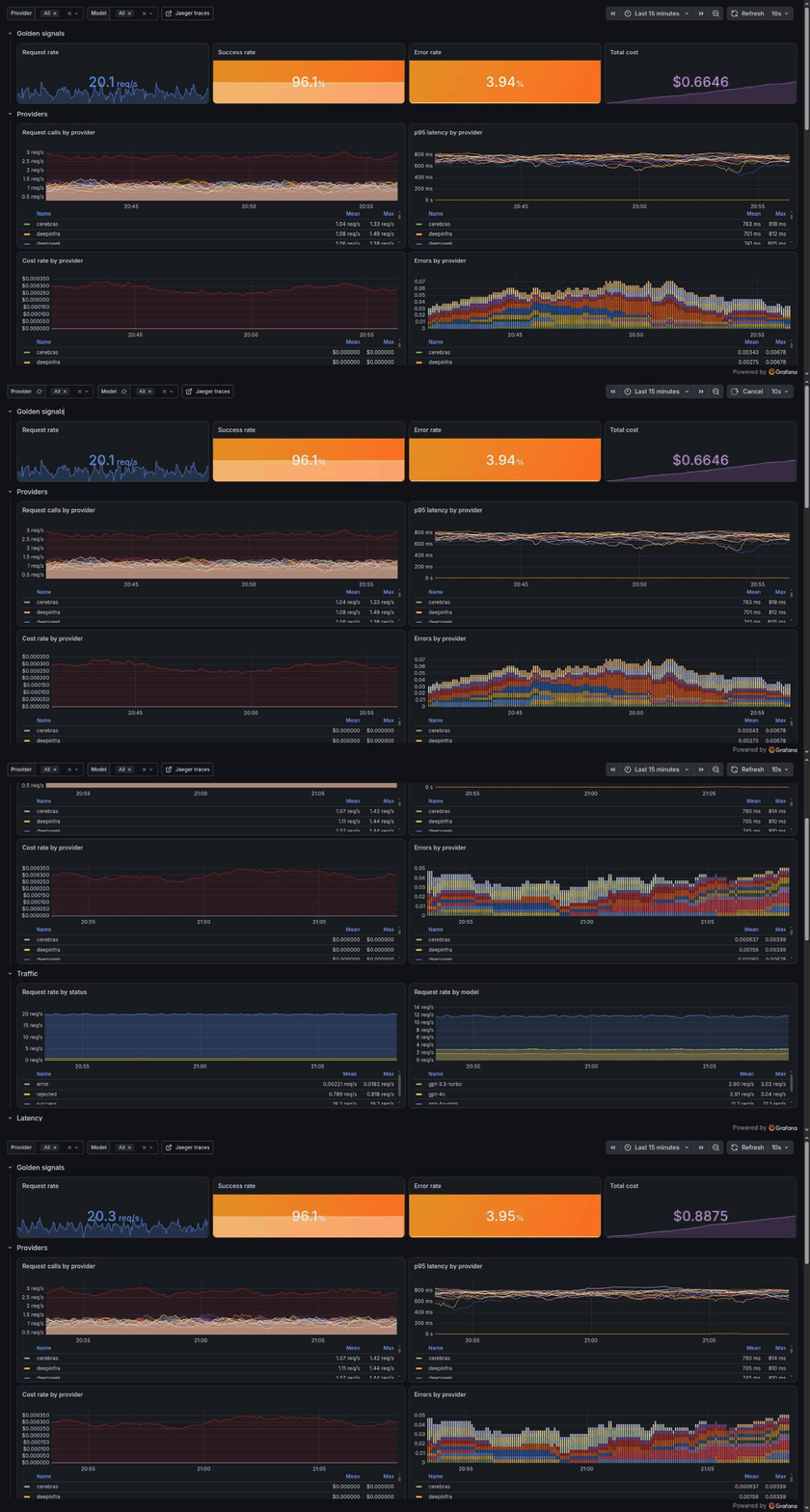
Grafana — request rate, latency percentiles, per-provider breakdown, token cost, and circuit-breaker state, all from the gateway's Prometheus metrics.
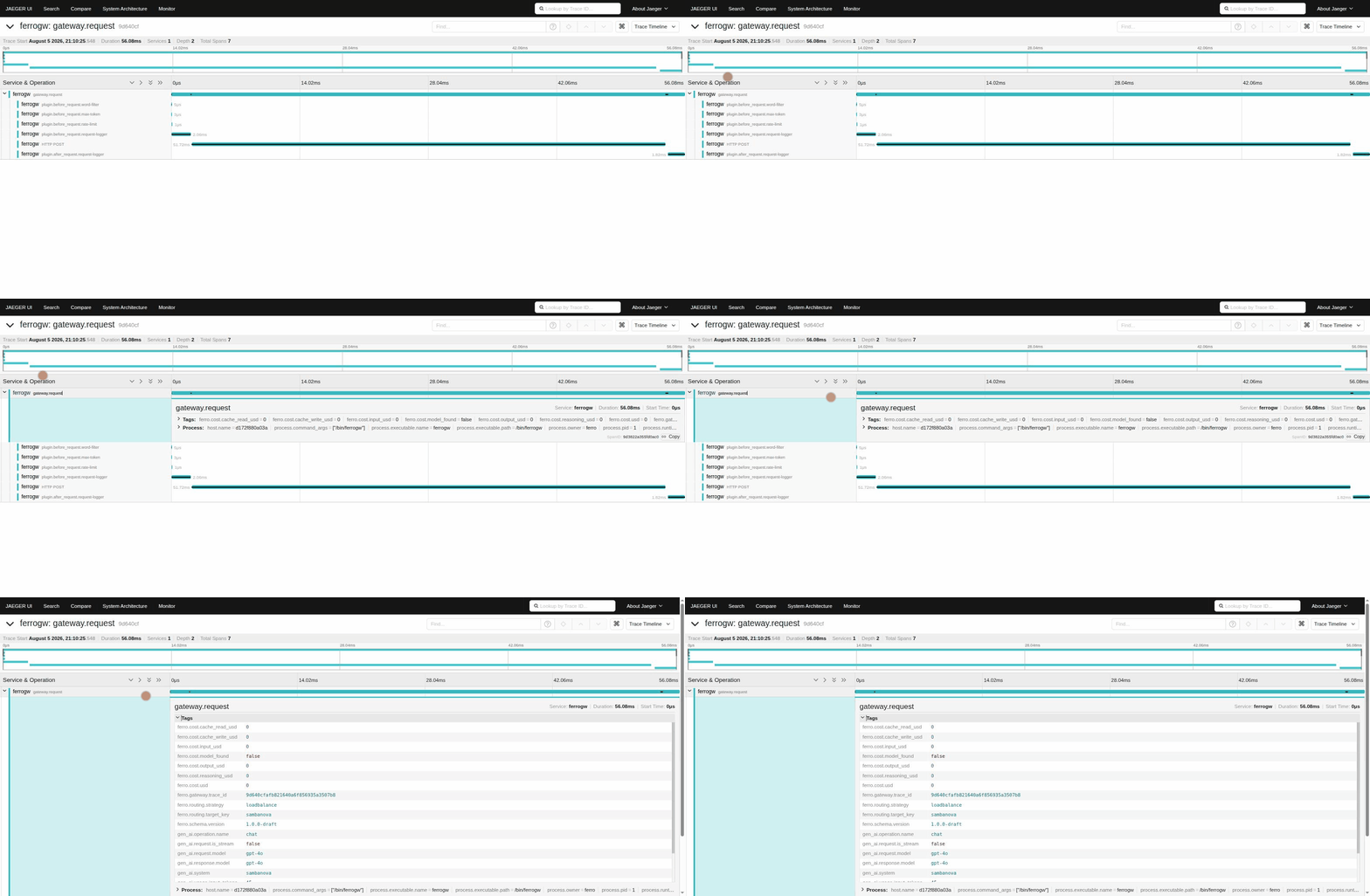
Jaeger — one request's gateway.request span, opened to reveal its gen_ai. and ferro. attributes.
Enable tracing with one variable (or the observability: config block — endpoint, protocol, sampling, privacy, headers are all documented in the guide):
export OTELEXPORTEROTLP_ENDPOINT=localhost:4317
ferrogw serve
CLI
ferrogw is a single binary — no separate CLI tool required.
| Command | Description | |:--------|:------------| | ferrogw | Start the gateway server (default) | | ferrogw serve | Start the gateway server (explicit) | | ferrogw init | First-run setup — generate master key and config | | ferrogw validate | Validate a config file without starting | | ferrogw doctor | Check environment (API keys, config, connectivity) | | ferrogw status | Show gateway health and provider status | | ferrogw version | Print version, commit, and build info | | ferrogw admin keys list | List API keys | | ferrogw admin keys create --name <name> | Create an API key (--scope, --expires-in) | | ferrogw admin logs stats | Show request log statistics | | ferrogw plugins | List registered plugins |
Global flags available on all subcommands: --gateway-url, --api-key, --format (table/json/yaml).
Deployment
Local development
export OPENAIAPIKEY=sk-your-key
export MASTERKEY=fgwyour-master-key
export GATEWAY_CONFIG=./config.yaml
make build && ./bin/ferrogw
Railway & Render
The deploy buttons at the top of this README provision either platform: Railway with SQLite on a volume (set the three *STOREDSN variables to paths under /data) or PostgreSQL, and Render from the repo's render.yaml Blueprint, which generates MASTER_KEY and wires the store DSNs to a managed Postgres automatically.
Docker Compose
Three Compose files in deploy/ follow the standard override pattern — a shared base, a dev override that builds from source, and a prod override with a pinned tag, health check, and resource limits. Run everything from the repository root:
make up             # dev: builds from source
IMAGETAG=v1.4.0 CORSORIGINS=https://your-domain.com make up-prod
make down           # tears down either
One container serves both the API and the dashboard — no second image, no second origin. Provider keys go in a repository-root .env or the environment. deploy/README.md has the full reference, including a self-contained PostgreSQL pairing and the fullstack observability stack.
Kubernetes via Helm
helm repo add ferro-labs https://ferro-labs.github.io/helm-charts
helm repo update
helm install ferro-gw ferro-labs/ai-gateway \
  --set env.OPENAIAPIKEY=sk-your-key
Helm charts: github.com/ferro-labs/helm-charts | ArtifactHub
Migrate to Ferro Labs AI Gateway
The gateway is OpenAI-compatible, so migration from any gateway — or from calling a provider directly — is a base_url change.
From LiteLLM
Before (LiteLLM):
from litellm import completion
response = completion(     model="gpt-4o",     messages=[{"role": "user", "content": "Hello"}] )
After (Ferro Labs AI Gateway):
from openai import OpenAI
client = OpenAI(     base_url="http://localhost:8080/v1",     api_key="your-ferro-api-key", )
response = client.chat.completions.create(     model="gpt-4o",     messages=[{"role": "user", "content": "Hello"}], )
Provider API keys move to environment variables (OPENAIAPIKEY, ANTHROPICAPIKEY, …); the model list becomes targets + aliases in config.yaml.
Why migrate from LiteLLM:
- 14x higher throughput at 150 concurrent users (2,447 vs 175 RPS)
- 23x less memory at peak load (47 MB vs 1,124 MB under streaming)
- Single binary — no Python environment, no pip, no virtualenv
- Predictable latency — p99 stays under 65 ms at 150 VU vs LiteLLM's timeouts at the same concurrency
From Portkey
The code change is the same one line — Ferro Labs uses the standard OpenAI SDK with no custom headers in self-hosted mode.
Why migrate from Portkey:
- Fully open source — no per-request pricing, no log limits
- Self-hosted — your data never leaves your infrastructure
- No vendor lock-in — Apache 2.0 license
- MCP support — Portkey self-hosted lacks native MCP
- FerroCloud (coming soon) for teams that want a managed service
FerroCloud
FerroCloud — the managed version of Ferro Labs AI Gateway with multi-tenancy, analytics, and cost governance — is coming soon.
👉 Join the waitlist at ferrolabs.ai
SDKs
Official client libraries for the Ferro Labs AI Gateway — and the standard OpenAI SDK works unchanged: point base_url at http://your-gateway:8080/v1.
| SDK | Install | Repository | |:----|:--------|:-----------| | Python | pip install ferrolabs | ferro-labs/ferrolabs-python-sdk | | TypeScript | npm install ferrolabs | ferro-labs/ferrolabs-typescript-sdk |
Python
from ferrolabs import FerroClient
client = FerroClient(     base_url="http://localhost:8080/v1",     api_key="your-ferro-api-key", )
response = client.chat.completions.create(     model="gpt-4o",     messages=[{"role": "user", "content": "Hello"}], )
TypeScript
import { FerroClient } from "ferrolabs";
const client = new FerroClient({   baseURL: "http://localhost:8080/v1",   apiKey: "your-ferro-api-key", });
const response = await client.chat.completions.create({   model: "gpt-4o",   messages: [{ role: "user", content: "Hello" }], });
Contributing
We welcome contributions. New providers go in this OSS repo only — never in FerroCloud. See CONTRIBUTING.md for branch strategy, commit conventions, and PR guidelines.
Community
- GitHub Discussions
- Discord
- Built with Ferro Labs AI Gateway? Open a PR to add to our showcase.
License
Apache 2.0 — see LICENSE.


