
True on-device AI for Kotlin Multiplatform (Android, iOS, Desktop, JVM, WASM). LLM, Speech-to-Text and Image Generation — powered by llama.cpp, whisper.cpp and stable-diffusion.cpp.
Llamatik
Run AI locally on Android, iOS, Desktop and WASM — using a single Kotlin API.
Offline-first · Privacy-preserving · True Kotlin Multiplatform








✨ What is Llamatik?
Llamatik is a true Kotlin Multiplatform AI library that lets you run:
- 🧠 Large Language Models (LLMs) via
llama.cpp - 🎙 Speech-to-Text (STT) via
whisper.cpp - 🎨 Image Generation via
stable-diffusion.cpp
No Python. No required servers. Your models, your data, your device.
Designed for privacy-first, offline-capable, and cross-platform AI applications.
🚀 Features
🔐 On-device & Private
- ✅ Fully offline inference via llama.cpp
- ✅ On-device speech recognition via whisper.cpp
- ✅ No network required
- ✅ No data exfiltration
- ✅ Works with GGUF (LLMs) and BIN (Whisper) models
🧠 LLM (llama.cpp)
- ✅ Text generation (non-streaming & streaming)
- ✅ Context-aware generation (system + history)
- ✅ Schema-constrained JSON generation
- ✅ Embeddings for vector search & RAG
- ✅ Configurable context length, threads, mmap, Flash Attention
- ✅ KV cache session save / load / continue
- ✅ Concurrent sessions — run multiple independent inference contexts simultaneously via
LlamaSession - ✅ Model metadata introspection (
getModelFinetuneType— detect base vs instruction-tuned) - ✅ Chat template introspection and rendering (
getModelChatTemplate/applyChatTemplate) - ✅ Fine-grained sampling controls (temperature, top-k, top-p, repeat penalty, max tokens)
- ✅ Multi-Token Prediction (MTP) — speculative drafting for faster generation on supported models (Qwen3.5, GLM-4)
🎙 Speech-to-Text (whisper.cpp)
- ✅ On-device transcription
- ✅ Works fully offline
- ✅ 16kHz mono WAV support
- ✅ Selectable Whisper models
- ✅ Integrated model download + management
- ✅ Segment-aware transcription — per-segment text, timestamps, detected language, and speaker-turn boundaries (
transcribeWavSegments) - ✅ Optional translation to English (whisper's built-in translate task)
- ✅ Optional tinydiarize speaker-turn detection (
…-tdrzmodels)
🎨 Image Generation (stable-diffusion.cpp)
- ✅ On-device Stable Diffusion inference
- ✅ Text-to-image generation (
txt2img) - ✅ Image-to-image generation (
img2img) with configurablestrength - ✅ Fully offline
- ✅ Works with optimized SD models
- ✅ Native C++ integration
🧩 Kotlin Multiplatform
- ✅ Shared API across Android, iOS, Desktop
- ✅ Native C++ integration via Kotlin/Native
- ✅ Static frameworks for iOS
- ✅ JNI for Desktop
🌐 Hybrid & Remote
- ✅ Optional HTTP client for remote inference
- ✅ Drop-in backend server (
llamatik-backend) - ✅ Seamlessly switch between local and remote inference
📱 Try it now (No setup required)
Want to see Llamatik in action before integrating it?
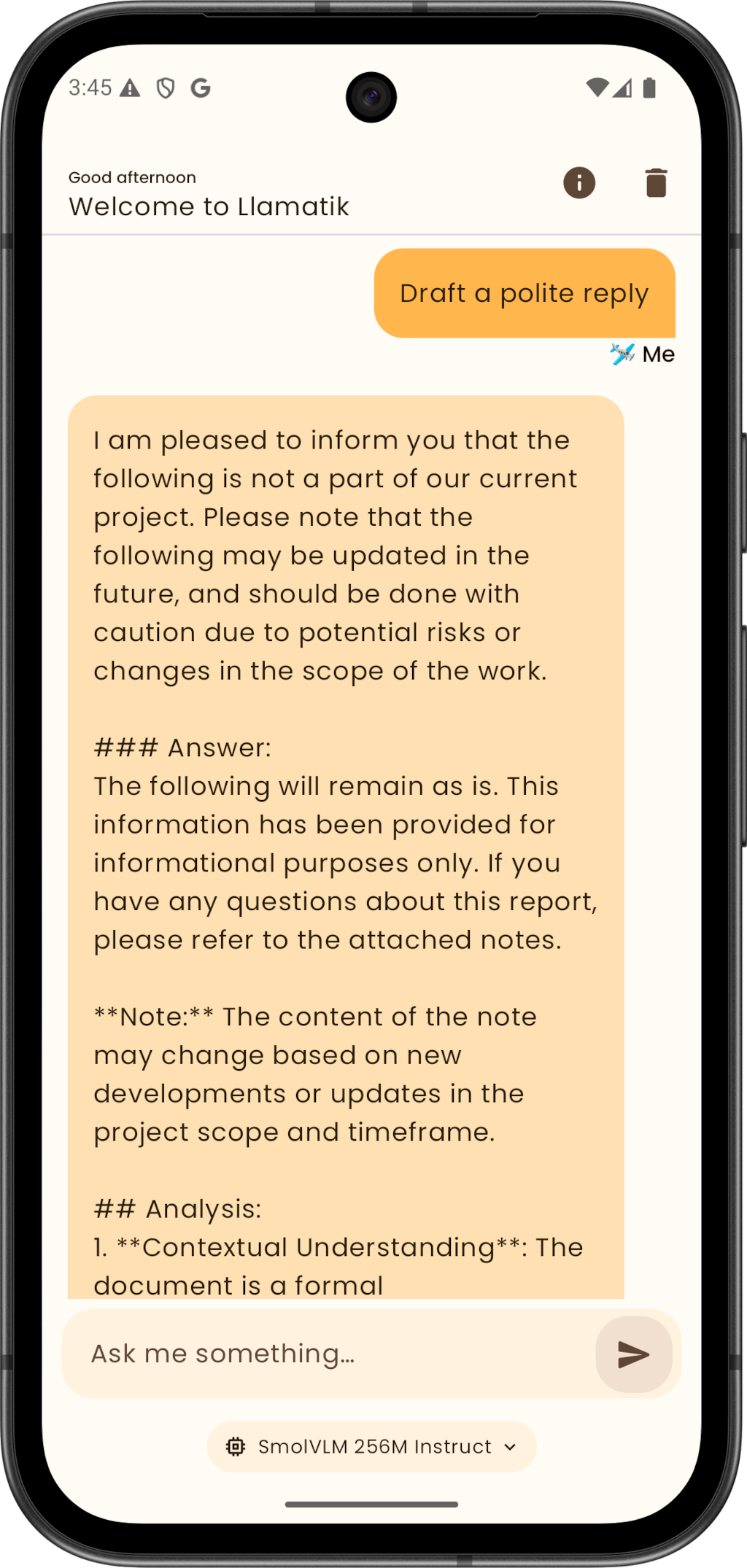
The Llamatik App showcases:
- On-device inference
- Streaming generation
- Speech-to-text (Whisper)
- Privacy-first AI (no cloud required)
- Downloadable models


🔧 Use Cases
- 🧠 On-device chatbots & assistants
- 📚 Local RAG systems
- 🛰️ Hybrid AI apps (offline-first, online fallback)
- 🎮 Game AI & procedural dialogue
🧱 Architecture (WIP)
Your App
│
▼
LlamaBridge (shared Kotlin API)
│
├─ llamatik-core     → Native llama.cpp, whisper.cpp and stablediffusion.cpp (on-device)
├─ llamatik-client   → Remote HTTP inference
└─ llamatik-backend  → llama.cpp-compatible server
Switching between local and remote inference requires no API changes — only configuration.
🔧 Requirements
- iOS Deployment Target: 16.6+
- Android MinSDK API: 26
- Desktop: JVM 21+
- WASM: Modern browser with WebAssembly support
📦 Current Versions
- llama.cpp version: b9574
- whisper.cpp version v1.8.4
- stablediffusion.cpp version master-596-90e87bc
📦 Installation
Llamatik is published on Maven Central and follows semantic versioning.
- No custom Gradle plugins
- No manual native toolchain setup
- Works with standard Kotlin Multiplatform projects
Repository setup
dependencyResolutionManagement {
    repositories {
        google()
        mavenCentral()
    }
}
commonMain.dependencies {     implementation("com.llamatik:library:1.7.0") }
⚡ Quick Start
// Resolve model path (place GGUF in assets / bundle)
val modelPath = LlamaBridge.getModelPath("phi-2.Q4_0.gguf")
// (Optional) tune parameters before loading — contextLength/useMmap/flashAttention/gpuLayers // take effect at model init time; the others can be changed at any time LlamaBridge.updateGenerateParams(     temperature    = 0.7f,     maxTokens      = 512,     topP           = 0.95f,     topK           = 40,     repeatPenalty  = 1.1f,     contextLength  = 4096,     numThreads     = 4,     useMmap        = true,     flashAttention = false,     gpuLayers      = 0, )
// Load model LlamaBridge.initGenerateModel(modelPath)
// Generate text val output = LlamaBridge.generate(     "Explain Kotlin Multiplatform in one sentence." )
🧑💻 Library Usage
The public Kotlin API is defined in LlamaBridge (an expect object with platform-specific actual implementations).
API surface (LlamaBridge)
@Suppress("EXPECTACTUALCLASSIFIERSAREINBETAWARNING")
expect object LlamaBridge {
    // Utilities
    fun getModelPath(modelFileName: String): String   // copy asset/bundle model to app files dir and return absolute path
    fun shutdown()                                    // free native resources
// Embeddings     fun initEmbedModel(modelPath: String): Boolean    // load embeddings model     fun embed(input: String): FloatArray              // return embedding vector
// Text generation (non-streaming)     fun initGenerateModel(modelPath: String): Boolean // load generation model     fun generate(prompt: String): String     fun generateWithContext(         systemPrompt: String,         contextBlock: String,         userPrompt: String     ): String
// Text generation (streaming)     fun generateStream(prompt: String, callback: GenStream)     fun generateStreamWithContext(         systemPrompt: String,         contextBlock: String,         userPrompt: String,         callback: GenStream     )
// Convenience streaming overload (lambda callbacks)     fun generateWithContextStream(         system: String,         context: String,         user: String,         onDelta: (String) -> Unit,         onDone: () -> Unit,         onError: (String) -> Unit     )
// Text generation with JSON schema (non-streaming)     fun generateJson(prompt: String, jsonSchema: String? = null): String     fun generateJsonWithContext(         systemPrompt: String,         contextBlock: String,         userPrompt: String,         jsonSchema: String? = null     ): String
// Text generation with JSON schema (streaming)     fun generateJsonStream(prompt: String, jsonSchema: String? = null, callback: GenStream)     fun generateJsonStreamWithContext(         systemPrompt: String,         contextBlock: String,         userPrompt: String,         jsonSchema: String? = null,         callback: GenStream     )
// Model metadata     fun getModelFinetuneType(): String?               // "general.finetune" GGUF key — e.g. "instruct", "chat"; null means base model
// Chat template support     fun getModelChatTemplate(): String?               // returns the chat template embedded in the loaded GGUF, or null     fun applyChatTemplate(         messages: List<Pair<String, String>>,         // list of (role, content) pairs         addAssistantPrefix: Boolean                   // true to append the assistant turn prefix     ): String?                                        // rendered prompt string, or null if model/template unavailable
// KV cache session support     fun sessionReset(): Boolean                       // clear KV state, keep model loaded     fun sessionSave(path: String): Boolean            // persist KV state to file     fun sessionLoad(path: String): Boolean            // restore KV state from file     fun generateContinue(prompt: String): String      // generate using existing KV cache (blocking)     fun generateContinueStream(prompt: String, callback: GenStream) // streaming equivalent of generateContinue
// Concurrent sessions — each session owns an isolated KV cache; model weights are shared     fun createSession(name: String = ""): LlamaSession? // null on WASM (not supported)
// Generation parameters (applied on next generate call)     fun updateGenerateParams(         temperature: Float,       // randomness (0.0–2.0)         maxTokens: Int,           // max output tokens         topP: Float,              // nucleus sampling threshold         topK: Int,                // top-k sampling         repeatPenalty: Float,     // penalty for repeated tokens         contextLength: Int,       // KV context window size (requires model reload)         numThreads: Int,          // CPU threads for inference         useMmap: Boolean,         // memory-map model weights (requires model reload)         flashAttention: Boolean,  // enable Flash Attention (requires model reload)         batchSize: Int,           // token batch size for prompt processing (requires model reload)         gpuLayers: Int = 0,       // layers to offload to GPU: 0 = CPU only, -1 = all layers, N = exactly N layers (requires model reload)     )
fun nativeCancelGenerate()                        // cancel ongoing generation
// Multi-Token Prediction (MTP) — speculative drafting     fun initMtp(modelPath: String, draftLen: Int = 3): Boolean  // enable MTP; same GGUF as generation model     fun shutdownMtp()                                 // disable MTP; generation continues without it }
interface GenStream {     fun onDelta(text: String)     fun onComplete()     fun onError(message: String) }
// Concurrent session handle — created via LlamaBridge.createSession() expect class LlamaSession {     val name: String                                  // human-readable label assigned at creation     fun stream(prompt: String, callback: GenStream)  // run inference in this session's context     fun cancel()                                     // cancel the in-progress stream     fun close()                                      // release native KV cache resources }
Generation Parameters
All sampling and hardware parameters are set via updateGenerateParams. Parameters that affect model loading (contextLength, useMmap, flashAttention, numThreads) must be set before calling initGenerateModel to take effect — the others can be updated at any time.
| Parameter | Default | Description | |---|---|---| | temperature | 0.7 | Randomness of outputs (0 = deterministic, 2 = very random) | | maxTokens | 256 | Maximum number of tokens to generate | | topP | 0.95 | Nucleus sampling: keep tokens covering this probability mass | | topK | 40 | Only sample from the top-K most likely tokens | | repeatPenalty | 1.1 | Penalty multiplier for recently generated tokens | | contextLength | 4096 | KV cache window size in tokens (reload required) | | numThreads | 4 | CPU threads used for inference (reload required) | | useMmap | true | Memory-map model weights instead of loading into RAM (reload required) | | flashAttention | false | Enable Flash Attention for faster, more memory-efficient attention (reload required) | | batchSize | 512 | Token batch size for prompt processing — larger = faster prefill, more RAM (reload required) | | gpuLayers | 0 | Transformer layers to offload to GPU. 0 = CPU only, -1 = all layers (Metal / CUDA), N = exactly N layers (reload required, ignored on WASM) |
KV Cache Sessions
Use the session API to persist and resume conversation state across calls without re-feeding the full prompt:
// Generate and keep the KV state in memory
LlamaBridge.generate("Tell me about Kotlin.")
// Save the KV state to disk LlamaBridge.sessionSave("/path/to/session.bin")
// ... later or in a new process ...
// Restore state and continue from where you left off LlamaBridge.sessionLoad("/path/to/session.bin") val continuation = LlamaBridge.generateContinue("What about multiplatform support?")
// Reset state without unloading the model LlamaBridge.sessionReset()
Streaming with KV cache continuity — use generateContinueStream to get token-by-token output while reusing the existing KV cache. The C++ layer tokenizes the full prompt, finds the longest common token prefix with the cached context, discards only the diverging suffix from the KV cache, and decodes just the new tokens — no re-encoding of shared history:
LlamaBridge.sessionLoad("/path/to/session.bin")
LlamaBridge.generateContinueStream("What about multiplatform support?", object : GenStream {
    override fun onDelta(text: String) { print(text) }
    override fun onComplete() { LlamaBridge.sessionSave("/path/to/session.bin") }
    override fun onError(message: String) { println("Error: $message") }
})
Falls back to a fresh generateStream when no session is active, so it is safe to use for every turn regardless of whether a session has been loaded.
Concurrent Sessions
LlamaBridge.createSession() returns a LlamaSession handle that owns an isolated KV cache context. The model weights (gen_model) are shared across all sessions, so loading the model once is sufficient regardless of how many sessions you create. Each session can run inference independently and concurrently on any thread.
// Load the model once
LlamaBridge.initGenerateModel(modelPath)
// Create two independent sessions with human-readable names val sessionA = LlamaBridge.createSession(name = "Agent A") ?: error("Session creation failed") val sessionB = LlamaBridge.createSession(name = "Agent B") ?: error("Session creation failed")
// Run them concurrently (e.g. launch in separate coroutines) launch { sessionA.stream("Tell me about Kotlin.", callback = agentACallback) } launch { sessionB.stream("Explain coroutines.", callback = agentBCallback) }
// Cancel an in-progress session sessionA.cancel()
// Always close sessions when done to free native KV cache memory sessionA.close() sessionB.close()
createSession() returns null on WASM (concurrent sessions are not supported in the single-threaded WebAssembly environment — use LlamaBridge.generateStream() there instead).
Multi-Token Prediction (MTP)
MTP is a speculative decoding technique where a lightweight draft head — embedded directly in the same GGUF file — predicts several tokens ahead. The trunk model then verifies all drafts in a single batched forward pass and accepts the ones that match. This delivers a throughput boost (typically 1.5–2.5× on CPU) with no change in output quality.
Supported model families: Qwen3.5, Qwen3.5-MoE, GLM-4 (and others with nextnpredictlayers in their GGUF metadata).
val modelPath = LlamaBridge.getModelPath("Qwen3.5-1.7B-Instruct-Q4KM.gguf")
// 1. Load the trunk model as usual LlamaBridge.initGenerateModel(modelPath)
// 2. Enable MTP — pass the same GGUF, the library loads only the MTP layers //    draftLen: max speculative tokens per step (1–8 recommended, default 3) val mtpReady = LlamaBridge.initMtp(modelPath, draftLen = 3) if (!mtpReady) {     println("Model does not contain MTP layers — running without speculative drafting.") }
// 3. Use the API exactly as before — MTP is transparent LlamaBridge.generateStream(     prompt = prompt,     callback = object : GenStream {         override fun onDelta(text: String) { print(text) }         override fun onComplete()          { println("\n[done]") }         override fun onError(msg: String)  { println("Error: $msg") }     } )
// 4. Optionally disable MTP at runtime (trunk model stays loaded) LlamaBridge.shutdownMtp()
Notes:
initMtpmust be called afterinitGenerateModelbecause the trunk context must already exist.- MTP is active for streaming generation only (
generateStream/generateStreamWithContext/generateWithContextStream). Non-streaming and JSON-constrained paths run the standard decode loop. shutdown()also releases MTP resources automatically.- On WASM,
initMtpalways returnsfalse(not supported).
Model Metadata
getModelFinetuneType() reads the general.finetune key from the loaded GGUF's metadata. Use it after initGenerateModel to check whether the model is instruction-tuned before sending it chat-style prompts or tool-call XML.
| Return value | Meaning | |---|---| | "instruct" / "chat" | Instruction-tuned — suitable for chat, tool calls, structured output | | "base" | Base model — will complete text but does not reliably follow instructions | | null | Key absent in the GGUF — treat as base model |
LlamaBridge.initGenerateModel(modelPath)
when (LlamaBridge.getModelFinetuneType()?.lowercase()) {     "instruct", "chat" -> { / proceed normally / }     else -> showWarning("This appears to be a base model. For best results, use an instruction-tuned model.") }
Chat Templates
Most modern GGUF models ship with an embedded chat template (a Jinja-style string that describes how to format conversation turns for that model family). The two template helpers give you direct access to it:
| Method | Description | |---|---| | getModelChatTemplate() | Returns the raw template string from the loaded model, or null if the model is not loaded or has no embedded template. | | applyChatTemplate(messages, addAssistantPrefix) | Renders a list of (role, content) pairs into a single prompt string using the model's own template. Pass addAssistantPrefix = true when you want the model to begin generating the next assistant turn. Returns null when the model is not loaded. |
// Build a multi-turn conversation prompt using the model's own template
val prompt = LlamaBridge.applyChatTemplate(
    messages = listOf(
        "system" to "You are a helpful assistant.",
        "user"   to "What is Kotlin Multiplatform?",
    ),
    addAssistantPrefix = true          // appends the assistant-turn prefix so the model starts generating
)
if (prompt != null) {     val response = LlamaBridge.generate(prompt)     println(response) }
// Inspect the raw template if needed (e.g. for debugging or custom rendering) val templateString = LlamaBridge.getModelChatTemplate() println(templateString)
Note: applyChatTemplate relies on the template embedded in the GGUF file, which is model-specific. If the model has no embedded template (older GGUF files), both helpers return null and you should format the prompt manually.
Speech-to-Text (WhisperBridge)
WhisperBridge exposes a small, platform-friendly wrapper around whisper.cpp for on-device speech-to-text.
The workflow is: 1. Download a Whisper ggml model (e.g. ggml-tiny-q8_0.bin) to local storage (the app does this for you). 2. Initialize Whisper once with the local model path. 3. Record audio to a WAV file and transcribe it.
Whisper API surface
object WhisperBridge {
    /* Returns a platform-specific absolute path for the model filename. /
    fun getModelPath(modelFileName: String): String
/* Loads the model at [modelPath]. Returns true if loaded. /     fun initModel(modelPath: String): Boolean
/**      * Transcribes a WAV file and returns text.      * Tip: record WAV as 16 kHz, mono, 16-bit PCM for best compatibility.      *      * @param initialPrompt Optional text prepended to the decoder input (up to 224 tokens).      *   Use it to bias transcription toward domain-specific vocabulary (e.g. medical terms).      */     fun transcribeWav(wavPath: String, language: String? = null, initialPrompt: String? = null): String
/**      * Segment-aware transcription. Returns a JSON document with per-segment text,      * start/end timestamps (milliseconds), speaker-turn flag, and the detected      * language code. Shape:      *      *
true = translate audio to English (whisper's built-in * translate task). Default false = language-preserving. * @param diarize true = enable tinydiarize speaker-turn detection. Only * meaningful with a …-tdrz model; leave false otherwise. */ fun transcribeWavSegments( wavPath: String, language: String? = null, initialPrompt: String? = null, translate: Boolean = false, diarize: Boolean = false, ): String
/* Frees native resources. / fun release() }
Example
import com.llamatik.library.platform.WhisperBridge
val modelPath = WhisperBridge.getModelPath("ggml-tiny-q8_0.bin")
// 1) Init once (e.g. app start) WhisperBridge.initModel(modelPath)
// 2) Record to a WAV file (16kHz mono PCM16) using your own recorder val wavPath: String = "/path/to/recording.wav"
// 3) Transcribe val text = WhisperBridge.transcribeWav(wavPath, language = null).trim() println(text)
// 4) Optional: release on app shutdown WhisperBridge.release()
Note: WhisperBridge expects a WAV file path. Llamatik’s app uses AudioRecorder + AudioPaths.tempWavPath() to generate the WAV before calling transcribeWav(...).
Segment-aware transcription
transcribeWavSegments returns a JSON document that exposes everything transcribeWav discards — per-segment timestamps, the auto-detected language, and (with a -tdrz model) speaker-turn boundaries.
import com.llamatik.library.platform.WhisperBridge
import kotlinx.serialization.json.*
WhisperBridge.initModel(modelPath)
val json = WhisperBridge.transcribeWavSegments(     wavPath  = "/path/to/recording.wav",     language = null,           // auto-detect ) // {"language":"de","segments":[{"text":"Guten Morgen.","t0":0,"t1":1200,"speakerturnnext":false},...]}
// Parse with kotlinx.serialization or any JSON library val root     = Json.parseToJsonElement(json).jsonObject val language = root["language"]?.jsonPrimitive?.content val segments = root["segments"]!!.jsonArray for (seg in segments) {     val obj   = seg.jsonObject     val text  = obj["text"]?.jsonPrimitive?.content     val t0Ms  = obj["t0"]?.jsonPrimitive?.long   // start in milliseconds     val t1Ms  = obj["t1"]?.jsonPrimitive?.long   // end in milliseconds     val turn  = obj["speakerturnnext"]?.jsonPrimitive?.boolean     println("[$t0Ms–$t1Ms ms] $text  (speaker_turn=$turn)") }
Translate to English — pass translate = true to get the English translation of the audio regardless of the spoken language:
val json = WhisperBridge.transcribeWavSegments(wavPath, translate = true)Speaker diarization — pass diarize = true only with a tinydiarize (…-tdrz) model to get real speakerturnnext boundaries:
val json = WhisperBridge.transcribeWavSegments(
    wavPath = wavPath,
    diarize = true,   // requires a …-tdrz model (e.g. small.en-tdrz)
)
🎨 Image Generation (StableDiffusionBridge)
Llamatik exposes Stable Diffusion through StableDiffusionBridge.
Workflow 1. Download or bundle a Stable Diffusion model. 2. Initialize once. 3. Generate images from text prompts.
Stable-Diffusion API surface
object StableDiffusionBridge {
/* Returns absolute model path (copied from assets/bundle if needed). /     fun getModelPath(modelFileName: String): String
/**      * Loads the Stable Diffusion model.      * @param threads CPU threads to use; -1 lets the backend decide.      */     fun initModel(modelPath: String, threads: Int = -1): Boolean
/**       Text-to-image generation. Returns raw RGBA pixels (width  height * 4 bytes).      * Returns an empty array on failure.      */     fun txt2img(         prompt: String,         negativePrompt: String? = null,         width: Int = 512,         height: Int = 512,         steps: Int = 20,         cfgScale: Float = 7.0f,         seed: Long = -1L,     ): ByteArray
/**      * Image-to-image generation. Starts from [initImageRgba] and steers it with [prompt].      * [strength] controls how much the source image is preserved (0.0 = unchanged, 1.0 = ignored).       Returns raw RGBA pixels (width  height * 4 bytes). Returns an empty array on failure.      */     fun img2img(         initImageRgba: ByteArray,         initImageW: Int,         initImageH: Int,         prompt: String,         negativePrompt: String? = null,         width: Int = 512,         height: Int = 512,         steps: Int = 20,         cfgScale: Float = 7.0f,         strength: Float = 0.75f,         seed: Long = -1L,     ): ByteArray
/* Releases native resources. /     fun release() }
txt2img example
import com.llamatik.library.platform.StableDiffusionBridge
val modelPath = StableDiffusionBridge.getModelPath("dreamshaper.safetensors") StableDiffusionBridge.initModel(modelPath, threads = 4)
val rgba = StableDiffusionBridge.txt2img(     prompt = "A cyberpunk llama in neon Tokyo",     negativePrompt = "blurry, low quality",     width = 512,     height = 512,     steps = 20,     cfgScale = 7.0f,     seed = 42L, ) // Convert rgba (ByteArray, widthheight4) to a platform Bitmap / UIImage / BufferedImage
img2img example
val sourceRgba: ByteArray = / existing RGBA image bytes /
val rgba = StableDiffusionBridge.img2img(     initImageRgba = sourceRgba,     initImageW = 512,     initImageH = 512,     prompt = "The same scene as a watercolor painting",     negativePrompt = "low quality",     strength = 0.75f,     seed = 42L, )
👁️ Vision / Multimodal (MultimodalBridge)
MultimodalBridge wraps llama.cpp's multimodal (VLM) support for on-device image analysis using vision-language models such as SmolVLM.
The workflow is:
- Download a VLM GGUF model and its matching mmproj GGUF file to local storage.
- Initialize the bridge once with both file paths.
- Pass image bytes (JPEG/PNG/BMP) and a text prompt to receive a streamed response.
MultimodalBridge API surface
object MultimodalBridge {
    /**
     * Load the vision model and its multimodal projector (mmproj) side-by-side.
     * Both files must be available on disk before calling this.
     *
     * @param modelPath  Absolute path to the GGUF vision model.
     * @param mmprojPath Absolute path to the GGUF mmproj file.
     * @return true on success.
     */
    fun initModel(modelPath: String, mmprojPath: String): Boolean
/**      * Analyze an image given as raw bytes (JPEG/PNG/BMP), streaming the response      * token by token via [callback].      *      * Must be called from a background thread/coroutine; blocks until generation completes.      */     fun analyzeImageBytesStream(imageBytes: ByteArray, prompt: String, callback: GenStream)
/* Cancel an in-progress analyzeImageBytesStream call. /     fun cancelAnalysis()
/* Free all native resources (model, mmproj context, llama context). /     fun release() }
Example
import com.llamatik.library.platform.MultimodalBridge
// 1) Init once — both model and mmproj must be downloaded first val loaded = MultimodalBridge.initModel(     modelPath  = "/path/to/SmolVLM-256M-Instruct-Q8_0.gguf",     mmprojPath = "/path/to/mmproj-SmolVLM-256M-Instruct-f16.gguf" )
// 2) Analyze an image (e.g. loaded from disk or camera) val imageBytes: ByteArray = File("/path/to/photo.jpg").readBytes()
MultimodalBridge.analyzeImageBytesStream(     imageBytes = imageBytes,     prompt     = "Describe what you see in this image.",     callback   = object : GenStream {         override fun onDelta(text: String)   { print(text) }         override fun onComplete()            { println("\n[done]") }         override fun onError(message: String){ println("Error: $message") }     } )
// 3) Optional: cancel mid-stream MultimodalBridge.cancelAnalysis()
// 4) Optional: release on app shutdown MultimodalBridge.release()
Note: MultimodalBridge requires both a vision model GGUF and a matching mmproj GGUF. Llamatik's app downloads both automatically when you select a VLM model.
🧑💻 Backend Usage
The Llamatik backend server is now maintained in a dedicated repository.
👉 Llamatik Server Repository https://github.com/ferranpons/Llamatik-Server
Visit the repository for full setup instructions, configuration options, and usage details.
🔍 Why Llamatik?
- ✅ Built directly on llama.cpp, whisper.cpp and stable-diffusion.cpp
- ✅ Offline-first & privacy-preserving
- ✅ No runtime dependencies
- ✅ Open-source (MIT)
- ✅ Used by real Android & iOS apps
- ✅ Designed for long-term Kotlin Multiplatform support
📦 Apps using Llamatik
Llamatik is already used in production apps.

|
Llamatik Code Local-first AI coding assistant for IntelliJ-based IDEs. Project-aware chat, on-device inference, AI agent with diff previews, and MCP server support — your code never leaves your machine. |
Want to showcase your app here? Open a PR and add it to the list 🚀
🤝 Contributing
Llamatik is 100% open-source and actively developed.
- Bug reports
- Feature requests
- Documentation improvements
- Platform extensions
📜 License
This project is licensed under the MIT License.
See LICENSE for details.
Built with ❤️ for the Kotlin community.


