
Selfhosted alternative to 12ft.io. and 1ft.io. Proxy to remove CORS headers and modify HTML

Ladder






Ladder is a http web proxy.
Ladder is a developer tool for testing and analyzing paywall implementations and content delivery behavior on modern websites.
It allows developers, researchers, and publishers to simulate different client environments (such as browsers and crawlers) and observe how content is served under varying conditions. This makes it useful for debugging paywall configurations, verifying access controls, http headers, and ensuring consistent behavior across different user agents.
Ladder is intended for legitimate testing, research, and quality assurance purposes only. It should only be used in compliance with applicable laws and the terms of service of the target website.
How it works
sequenceDiagram
    client->>+ladder: GET
    ladder-->>ladder: apply RequestModifications
    ladder->>+website: GET
    website->>-ladder: 200 OK
    ladder-->>ladder: apply ResultModifications
    ladder->>-client: 200 OK
Features
- [x] Remove/modify CORS headers from responses, assets, and images ...
- [x] Remove/modify other headers (e.g. Content-Security-Policy)
- [x] Remove/inject custom code (HTML, CSS, JavaScript) into the page
- [x] Apply domain based ruleset/code to modify response / requested URL
- [x] Keep site browsable
- [x] API
- [x] Fetch RAW HTML
- [x] Custom User Agent
- [x] Custom X-Forwarded-For IP
- [x] Docker container (amd64, arm64)
- [x] Linux binary
- [x] Mac OS binary
- [x] Windows binary (untested)
- [x] Basic Auth
- [x] Access logs
- [x] Might break tracking, adds and other 3rd party content
- [x] Limit the proxy to a list of domains
- [x] Expose Ruleset to other ladders
- [ ] Robots.txt testing
- [ ] Optional TOR proxy
- [ ] A key to share a proxied URL
Limitations
Some websites deliver different content (Cloaking) depending on the type of client accessing them (for example, search engine crawlers versus standard web browsers). Ladder can be configured to emulate different client types in order to retrieve publicly accessible content for testing, automation, or research purposes.However, many websites implement advanced mechanisms to restrict automated access, such as fingerprinting, rate limiting, or behavioral analysis. Ladder does not circumvent such protections and may not function correctly on services that actively restrict or control access.
Third-party tools such as FlareSolverr exist and may be used independently to render web pages in a headless browser environment. These tools are not part of Ladder, and their use may be subject to legal and contractual restrictions. Users are solely responsible for ensuring that their usage complies with all applicable regulations.
Installation
Warning: If your instance will be publicly accessible, make sure to enable Basic Auth. This will prevent unauthorized users from using your proxy. If you do not enable Basic Auth, anyone can use your proxy to browse nasty/illegal stuff. And you will be made responsible for it.
Binary
1) Download binary here 2) Unpack and run the binary./ladder -r https://raw.githubusercontent.com/everywall/ladder-rules/main/ruleset.yaml
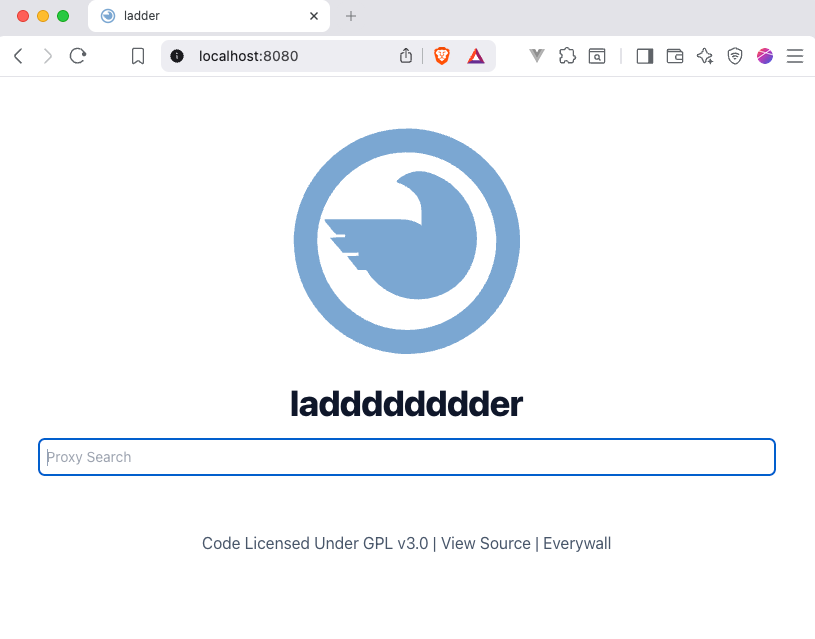
3) Open Browser (Default: http://localhost:8080)
Docker
docker run -p 8080:8080 -d --env RULESET=https://raw.githubusercontent.com/everywall/ladder-rules/main/ruleset.yaml --name ladder ghcr.io/everywall/ladder:latestDocker Compose
curl https://raw.githubusercontent.com/everywall/ladder/main/docker-compose.yaml --output docker-compose.yaml
docker-compose up -d
Helm
See README.md in helm-chart sub-directory for more information.Usage
Browser
1) Open Browser (Default: http://localhost:8080) 2) Enter URL 3) Press EnterOr direct by appending the URL to the end of the proxy URL: http://localhost:8080/https://www.example.com
Or create a bookmark with the following URL:
window.location.href="http://localhost:8080/"+location.hrefAPI
curl -X GET "http://localhost:8080/api/https://www.example.com"RAW
http://localhost:8080/raw/https://www.example.comRunning Ruleset
http://localhost:8080/rulesetConfiguration
Environment Variables
| Variable | Description | Value | | --- | --- | --- | | PORT | Port to listen on | 8080 | | PREFORK | Spawn multiple server instances | false | | USER_AGENT | User agent to emulate | Mozilla/5.0 (compatible; Googlebot/2.1; +http://www.google.com/bot.html) | | XFORWARDEDFOR | IP forwarder address | 66.249.66.1 | | USERPASS | Enables Basic Auth, format admin:123456 | ` | | LOG_URLS | Log fetched URL's | true | | DISABLE_FORM | Disables URL Form Frontpage | false | | FORM_PATH | Path to custom Form HTML | | | RULESET | Path or URL to a ruleset file, accepts local directories | https://raw.githubusercontent.com/everywall/ladder-rules/main/ruleset.yaml or /path/to/my/rules.yaml or /path/to/my/rules/ | | EXPOSE_RULESET | Make your Ruleset available to other ladders | true | | ALLOWED_DOMAINS | Comma separated list of allowed domains. Empty = no limitations | | | ALLOWEDDOMAINSRULESET | Allow Domains from Ruleset. false = no limitations | false | | FLARESOLVERR_HOST | URL for the FlareSolverr service for Cloudflare bypass (optional) | http://localhost:8191 |
ALLOWEDDOMAINS and ALLOWEDDOMAINS_RULESET are joined together. If both are empty, no limitations are applied. | BASE_PATH | Base path for the proxy, useful if you want to run the proxy on a subpath (e.g. http://localhost:8080/proxy/) | |
Ruleset
It is possible to apply custom rules to modify the response or the requested URL. This can be used to remove unwanted or modify elements from the page. The ruleset is a YAML file, a directory with YAML Files, or an URL to a YAML file that contains a list of rules for each domain. These rules are loaded on startup.
There is a basic ruleset available in a separate repository ruleset.yaml. Feel free to add your own rules and create a pull request.
<pre><code class="lang-yaml">- domain: example.com # Includes all subdomains domains: # Additional domains to apply the rule - www.example.de - www.beispiel.de headers: x-forwarded-for: none # override X-Forwarded-For header or delete with none referer: none # override Referer header or delete with none user-agent: Mozilla/5.0 (Macintosh; Intel Mac OS X 10157) AppleWebKit/537.36 (KHTML, like Gecko) Chrome/119.0.0.0 Safari/537.36 content-security-policy: script-src 'self'; # override response header cookie: privacy=1 regexRules: - match:
- domain: www.anotherdomain.com # Domain where the rule applies
- domain: demo.com
FlareSolverr Integration
Ladder now supports integration with FlareSolverr to bypass Cloudflare protection and other anti-bot challenges. This is particularly useful for sites that employ sophisticated bot detection mechanisms.
Setting up FlareSolverr
- Using Docker Compose (Recommended):
- Running FlareSolverr separately:
Then start Ladder with the FlareSolverr URL: <pre><code class="lang-bash">FLARESOLVERR_HOST=http://localhost:8191 ./ladder</code></pre>
Configuring Rules for FlareSolverr
To use FlareSolverr for specific domains, add the useFlareSolverr: true flag in your ruleset:
<pre><code class="lang-yaml"># Example ruleset with FlareSolverr
- domain: cloudflare-protected-site.com
Regular site without FlareSolverr
- domain: regular-site.com
Use Cases
FlareSolverr integration is particularly useful for:
- Cloudflare-protected sites: Sites using Cloudflare's anti-bot challenges
- Sites with JavaScript challenges: Pages that require JavaScript execution to access content
- Dynamic content loading: Sites that load content dynamically through JavaScript
- Advanced bot detection: Sites using sophisticated fingerprinting and bot detection techniques
Important Notes
- FlareSolverr adds additional latency to requests as it needs to solve challenges
- Only enable useFlareSolverr
for domains that actually need it to maintain performance - FlareSolverr requires more resources as it runs a headless browser
- Make sure FlareSolverr is running and accessible before enabling it in your ruleset
Development
To run a development server at http://localhost:8080:
<pre><code class="lang-bash">echo "dev" > handlers/VERSION RULESET="./ruleset.yaml" go run cmd/main.go</code></pre>
Optional: Live reloading development server with cosmtrek/air
Install air according to the installation instructions.
Run a development server at http://localhost:8080:
<pre><code class="lang-bash">air # or the path to air if you haven't added a path alias to your .bashrc or .zshrc</code></pre>
This project uses pnpm to build a stylesheet with the Tailwind CSS classes. For local development, if you modify styles in form.html, run pnpm build` to generate a new stylesheet.


