
Benchmarks of approximate nearest neighbor libraries in Python
Status of ANN-Benchmarks ========================
At this point, ann-benchmarks is no longer actively maintained. Please consider submitting your work to different benchmarks, such as VIBE.
Benchmarking nearest neighbors ==============================
Doing fast searching of nearest neighbors in high dimensional spaces is an increasingly important problem with notably few empirical attempts at comparing approaches in an objective way, despite a clear need for such to drive optimization forward.
This project contains tools to benchmark various implementations of approximate nearest neighbor (ANN) search for selected metrics. We have pre-generated datasets (in HDF5 format) and prepared Docker containers for each algorithm, as well as a test suite to verify function integrity.
Evaluated =========
- Annoy
- FLANN
- scikit-learn: LSHForest, KDTree, BallTree
- Weaviate
- PANNS
- NearPy
- KGraph
- NMSLIB (Non-Metric Space Library)
: SWGraph, HNSW, BallTree, MPLSH
- hnswlib (a part of nmslib project)
- RPForest
- FAISS
- DolphinnPy
- Datasketch
- nndescent
- PyNNDescent
- MRPT
- NGT
: ONNG, PANNG, QG
- SPTAG
- PUFFINN
- N2
- ScaNN
- Vearch
- Elasticsearch
: HNSW
- Elastiknn
- ExpANN
- OpenSearch KNN
- DiskANN
: Vamana, Vamana-PQ
- Vespa
- scipy: cKDTree
- vald
- Qdrant
- HUAWEI(qsgngt)
- Milvus
: Knowhere
- Zilliz(Glass)
- pgvector
- pgvecto.rs
- RediSearch


 Data sets
=========
Data sets
=========
We have a number of precomputed data sets in HDF5 format. All data sets have been pre-split into train/test and include ground truth data for the top-100 nearest neighbors.
| Dataset | Dimensions | Train size | Test size | Neighbors | Distance | Download | | ----------------------------------------------------------------- | ---------: | ---------: | --------: | --------: | --------- | -------------------------------------------------------------------------- | | DEEP1B | 96 | 9,990,000 | 10,000 | 100 | Angular | HDF5 (3.6GB) | Fashion-MNIST | 784 | 60,000 | 10,000 | 100 | Euclidean | HDF5 (217MB) | | GIST | 960 | 1,000,000 | 1,000 | 100 | Euclidean | HDF5 (3.6GB) | | GloVe | 25 | 1,183,514 | 10,000 | 100 | Angular | HDF5 (121MB) | | GloVe | 50 | 1,183,514 | 10,000 | 100 | Angular | HDF5 (235MB) | | GloVe | 100 | 1,183,514 | 10,000 | 100 | Angular | HDF5 (463MB) | | GloVe | 200 | 1,183,514 | 10,000 | 100 | Angular | HDF5 (918MB) | | Kosarak | 27,983 | 74,962 | 500 | 100 | Jaccard | HDF5 (33MB) | | MNIST | 784 | 60,000 | 10,000 | 100 | Euclidean | HDF5 (217MB) | | MovieLens-10M | 65,134 | 69,363 | 500 | 100 | Jaccard | HDF5 (63MB) | | NYTimes | 256 | 290,000 | 10,000 | 100 | Angular | HDF5 (301MB) | | SIFT | 128 | 1,000,000 | 10,000 | 100 | Euclidean | HDF5 (501MB) | | Last.fm | 65 | 292,385 | 50,000 | 100 | Angular | HDF5 (135MB) | | COCO-I2I | 512 | 113,287 | 10,000 | 100 | Angular | HDF5 (136MB) | | COCO-T2I | 512 | 113,287 | 10,000 | 100 | Angular | HDF5 (136MB) |
Results =======
These are all as of April 2025, running all benchmarks on a r6i.16xlarge machine on AWS with --parallelism 31 and hyperthreading disabled. All benchmarks are single-CPU.
glove-100-angular

sift-128-euclidean

fashion-mnist-784-euclidean

nytimes-256-angular

gist-960-euclidean
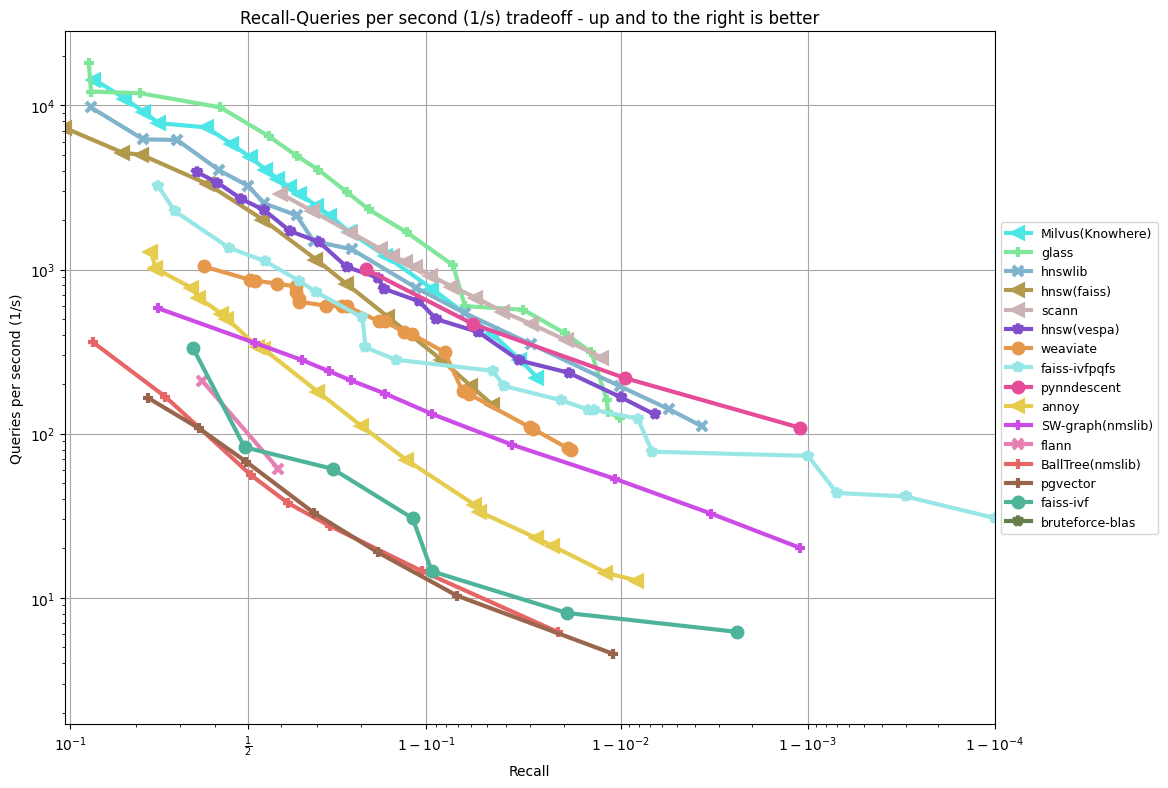
glove-25-angular

TODO: update plots on
Install =======
The only prerequisite is Python (tested with 3.10.6) and Docker.
- Clone the repo.
- Run
pip install -r requirements.txt. - Run
python install.pyto build all the libraries inside Docker containers (this can take a while, like 10-30 minutes).
- Run
python run.py(this can take an extremely long time, potentially days). - Run
python plot.py --x-scale logit --y-scale logto plot results. - Run
python create_website.pyto create a website with lots of plots.
- Check that
annbenchmarks/algorithms/{YOURIMPLEMENTATION}/config.ymlcontains the parameter settings that you want to test - To run experiments on SIFT, invoke
python run.py --dataset glove-100-angular. Seepython run.py --helpfor more information on possible settings. Note that experiments can take a long time. - To process the results, either use
python plot.py --dataset glove-100-angularorpython createwebsite.py. An example call:python createwebsite.py --plottype recall/time --latex --scatter --outputdir website/.
Add your algorithm in the folder annbenchmarks/algorithms/{YOURIMPLEMENTATION}/ by providing
- [ ] A small Python wrapper in
module.py - [ ] A Dockerfile named
Dockerfile - [ ] A set of hyper-parameters in
config.yml - [ ] A CI test run by adding your implementation to
.github/workflows/benchmarks.yml
Principles ==========
- Everyone is welcome to submit pull requests with tweaks and changes to how each library is being used.
- In particular: if you are the author of any of these libraries, and you think the benchmark can be improved, consider making the improvement and submitting a pull request.
- This is meant to be an ongoing project and represent the current state.
- Make everything easy to replicate, including installing and preparing the datasets.
- Try many different values of parameters for each library and ignore the points that are not on the precision-performance frontier.
- High-dimensional datasets with approximately 100-1000 dimensions. This is challenging but also realistic. Not more than 1000 dimensions because those problems should probably be solved by doing dimensionality reduction separately.
- Single queries are used by default. ANN-Benchmarks enforces that only one CPU is saturated during experimentation, i.e., no multi-threading. A batch mode is available that provides all queries to the implementations at once. Add the flag
--batchtorun.pyandplot.pyto enable batch mode. - Avoid extremely costly index building (more than several hours).
- Focus on datasets that fit in RAM. For billion-scale benchmarks, see the related big-ann-benchmarks project.
- We mainly support CPU-based ANN algorithms. GPU support exists for FAISS, but it has to be compiled with GPU support locally and experiments must be run using the flags
--local --batch. - Do proper train/test set of index data and query points.
- Note that we consider that set similarity datasets are sparse and thus we pass a sorted array of integers to algorithms to represent the set of each user.
Authors =======
Built by Erik Bernhardsson with significant contributions from Martin Aumüller and Alexander Faithfull.
Related Publication ==================
Design principles behind the benchmarking framework are described in the following publications:
- M. Aumüller, E. Bernhardsson, A. Faithfull:
- M. Aumüller, E. Bernhardsson, A. Faithfull: Reproducibility protocol for ANN-Benchmarks: A benchmarking tool for approximate nearest neighbor search algorithms, Artifacts.
- big-ann-benchmarks is a benchmarking effort for billion-scale approximate nearest neighbor search as part of the NeurIPS'21 Competition track.
- VIBE, same functionality as ann-benchmarks but with modern datasets and better tooling.


