
A high performance memory-bound Go cache
Ristretto




Ristretto is a fast, concurrent cache library built with a focus on performance and correctness.
The motivation to build Ristretto comes from the need for a contention-free cache in [Dgraph][].
[Dgraph]: https://github.com/dgraph-io/dgraph
Features
- High Hit Ratios - with our unique admission/eviction policy pairing, Ristretto's performance
- Fast Throughput - we use a variety of techniques for managing contention and the result is
- Cost-Based Eviction - any large new item deemed valuable can evict multiple smaller items
- Fully Concurrent - you can use as many goroutines as you want with little throughput
- Metrics - optional performance metrics for throughput, hit ratios, and other stats.
- Simple API - just figure out your ideal
Configvalues and you're off and running.
Status
Ristretto is production-ready. See Projects using Ristretto.
Getting Started
Installing
To start using Ristretto, install Go 1.21 or above. Ristretto needs go modules. From your project, run the following command
go get github.com/dgraph-io/ristretto/v2This will retrieve the library.
Choosing a version
Following these rules:
- v1.x.x is the first version used in most programs with Ristretto dependencies.
- v2.x.x is the new version with support for generics, for which it has a slightly different
Usage
package main
import (   "fmt"
"github.com/dgraph-io/ristretto/v2" )
func main() {   cache, err := ristretto.NewCache(&ristretto.Config[string, string]{     NumCounters: 1e7,     // number of keys to track frequency of (10M).     MaxCost:     1 << 30, // maximum cost of cache (1GB).     BufferItems: 64,      // number of keys per Get buffer.   })   if err != nil {     panic(err)   }   defer cache.Close()
// set a value with a cost of 1   cache.Set("key", "value", 1)
// wait for value to pass through buffers   cache.Wait()
// get value from cache   value, found := cache.Get("key")   if !found {     panic("missing value")   }   fmt.Println(value)
// del value from cache   cache.Del("key") }
Benchmarks
The benchmarks can be found in https://github.com/dgraph-io/dgraph-benchmarks/tree/main/cachebench/ristretto.
Hit Ratios for Search
This trace is described as "disk read accesses initiated by a large commercial search engine in response to various web search requests."
.svg)
Hit Ratio for Database
This trace is described as "a database server running at a commercial site running an ERP application on top of a commercial database."
.svg)
Hit Ratio for Looping
This trace demonstrates a looping access pattern.
.svg)
Hit Ratio for CODASYL
This trace is described as "references to a CODASYL database for a one hour period."
.svg)
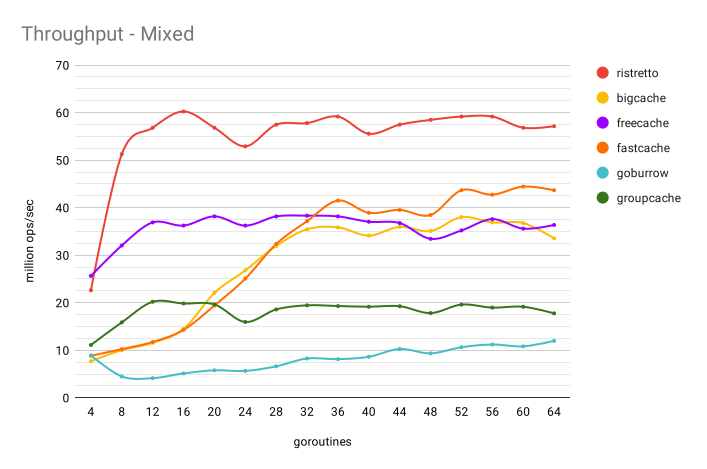
Throughput for Mixed Workload
Throughput for Read Workload
.svg)
Through for Write Workload
.svg)
Projects Using Ristretto
Below is a list of known projects that use Ristretto:
database with a graph backendFAQ
How are you achieving this performance? What shortcuts are you taking?
We go into detail in the Ristretto blog post, but in short: our throughput performance can be attributed to a mix of batching and eventual consistency. Our hit ratio performance is mostly due to an excellent admission policy and SampledLFU eviction policy.
As for "shortcuts," the only thing Ristretto does that could be construed as one is dropping some Set calls. That means a Set call for a new item (updates are guaranteed) isn't guaranteed to make it into the cache. The new item could be dropped at two points: when passing through the Set buffer or when passing through the admission policy. However, this doesn't affect hit ratios much at all as we expect the most popular items to be Set multiple times and eventually make it in the cache.
Is Ristretto distributed?
No, it's just like any other Go library that you can import into your project and use in a single process.


