
🤫 Easily manage configs and secrets in your Python projects (with CLI support)

Installation
pip install confidentialHow does it work?
Confidential manages secrets for your project, using AWS Secrets Manager and SSM Parameter Store.
First, store a secret in AWS Secrets Manager. Then, create a secrets file, say my_secrets.json. A value will be decrypted if the word secret precedes it, like the database value below:
{
  "database": "secret:database_details",
  "environment": "production",
  "debug_mode": false
}
Similarly, SSM Parameters can be referenced by providing a parameter key, e.g.: "ssm:somessmparameter_key". You can decrypt this file either in Python, or directly using the CLI. Ensure AWS CLI is set up, then run:
confidential my_secrets.jsonwhich outputs the file with decrypted values
{ "database": { "url": "https://example.com", "username": "admin", "password": "p@55w0rd", "port": 5678 }, "environment": "production", "debug_mode": false }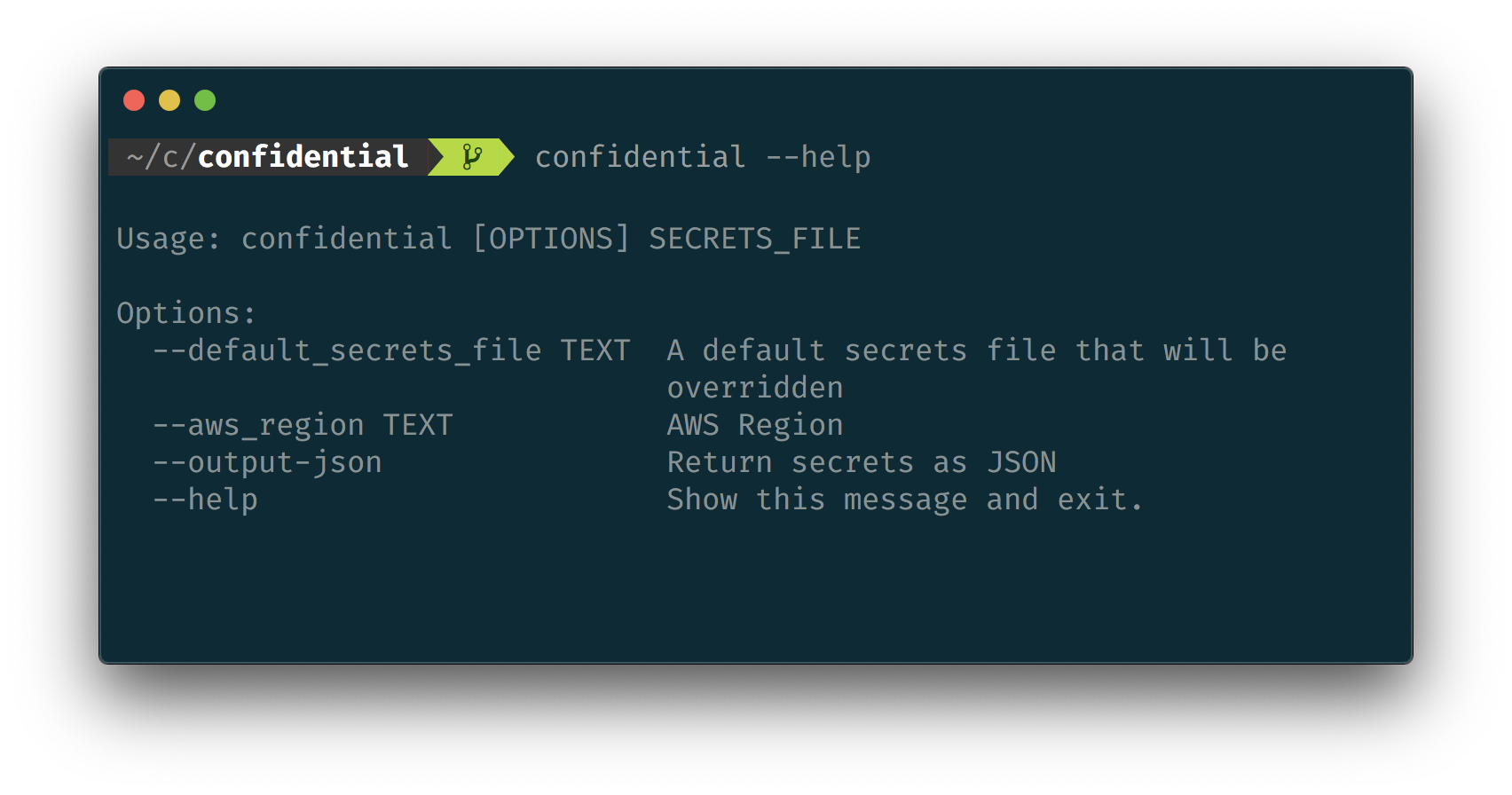
Can I use it in my Python projects?
Yes, simply import and instantiate SecretsManager, like so:
settings.py
from confidential import SecretsManager
secrets = SecretManager(     secrets_file=".secrets/production.json",     secretsfiledefault=".secrets/defaults.json",  # Overridable defaults you can use in common environments     regi, )
DATABASES = {     'default': secrets["database"] }
If exportenvvariables is set to True, each secret will also be exported as an environment variable, with the uppercase key as the variable name, e.g.:
from confidential import SecretsManager
import os
secrets = SecretManager(     secrets_file=".secrets/production.json",     secretsfiledefault=".secrets/defaults.json",  # Overridable defaults you can use in common environments     regi,     exportenvvariables=True,  # Optionally, export secrets as environment variables. Default is False. )
If the key of a secret is api_key, then the following is true:
assert secrets["apikey"] == os.environ.get("APIKEY")
Trying to access an inexisting key returns None. On previous versions, it would throw an exception.
Testing
First, install all dependencies:
poetry installThen run the tests
poetry run pytest


