
Bedrock Knowledge Base and Agents for Retrieval Augmented Generation (RAG)
Retrieval Augmented Generation using Amazon Bedrock
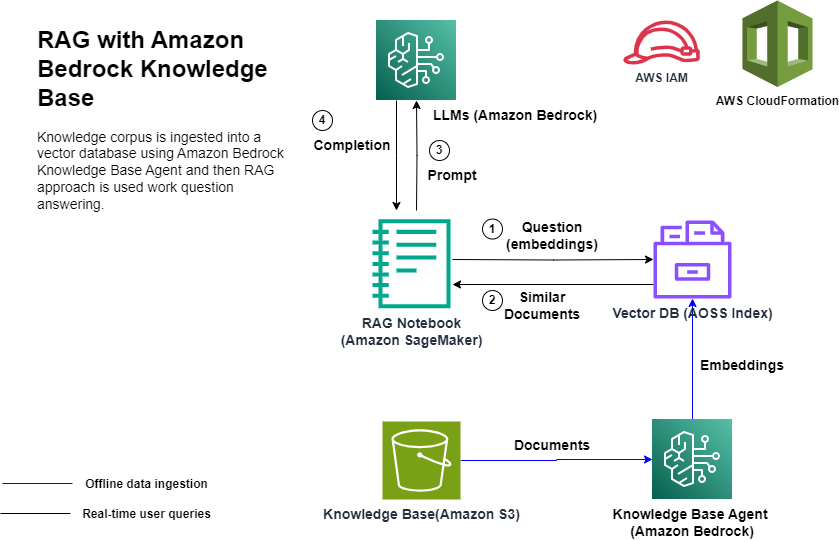
This repository provides sample code for implementing a question answering application using the Retrieval Augmented Generation (RAG) technique with Amazon Bedrock. A RAG implementation consists of two parts:
- A data pipeline that ingests that from documents (typically stored in Amazon S3) into a knowledge base i.e. a vector database such as Amazon OpenSearch Service Serverless (AOSS) so that it is available for lookup when a question is received.
- An application that receives a question from the user, looks up the knowledge base for relevant pieces of information (context) and then creates a prompt that includes the question and the context and provides it to an LLM for generating a response.
Once the data is available in the Bedrock Knowledge Base then a question answering application can be built using the following architectural pattern.
Installation
Follow the steps listed below to create and run the RAG solution. The blog_post.md describes this solution in detail.
- Launch the AWS CloudFormation template included in this repository using one of the buttons from the table below. The CloudFormation template creates the following resources within your AWS account: Amazon OpenSearch Service Serverless (AOSS) Collection, Amazon S3 bucket, IAM roles for Amazon Bedrock Knowledge Base Agent and Notebook and a Amazon SageMaker Notebook with this repository cloned to run the next steps.
|AWS Region | Link | |:------------------------:|:-----------:| |us-east-1 (N. Virginia) |  | |us-west-2 (Oregon) | |
- Follow instructions in Build a RAG based question answer solution using Amazon Bedrock Knowledge Base and Amazon OpenSearch Service Serverless
Managed Knowledge Bases (New)
This workshop was originally built with a vector knowledge base using Amazon OpenSearch Serverless. Amazon Bedrock now also supports Managed Knowledge Bases, which simplify the setup by eliminating the need for a separate vector store.
With Managed Knowledge Bases:
- Bedrock handles embedding, storage, and retrieval automatically
- No OpenSearch Serverless collection required (no minimum OCU costs)
- Supports agentic retrieval with intelligent query decomposition and managed reranking
template_managed.yml as an alternative to the vector-based template.yml.
To use managed retrieval in your application code:
import boto3
client = boto3.client('bedrock-agent-runtime')
response = client.retrieve(     knowledgeBaseId='YOURKBID',     retrievalQuery={'text': 'your question'},     retrievalConfiguration={         'managedSearchConfiguration': {             'numberOfResults': 5         }     } )
SDK requirements: boto3 >= 1.43 for managed search and agentic retrieval.
Reranking Options
Managed KBs use a service-managed reranker by default. You can customize this in the managedSearchConfiguration:
"rerankingModelType": "MANAGED"(default) — automatic reranking, no config needed"rerankingModelType": "NONE"— disable reranking"rerankingModelType": "CUSTOM"— use your own Bedrock reranking model (e.g., Cohere Rerank v3.5)
Resources
- Build a Managed Knowledge Base
- Create a Managed Knowledge Base
- Query a Knowledge Base (Retrieve API)
- Connect a Data Source (Web Crawler)
- Agentic Retrieval
Security
See CONTRIBUTING for more information.
License
This library is licensed under the MIT-0 License. See the LICENSE file.


