
Runs Trivy as GitHub action to scan your Docker container image for vulnerabilities
Trivy Action
GitHub Action for Trivy
[![GitHub Release][release-img]][release] [![GitHub Marketplace][marketplace-img]][marketplace] [![License][license-img]][license]
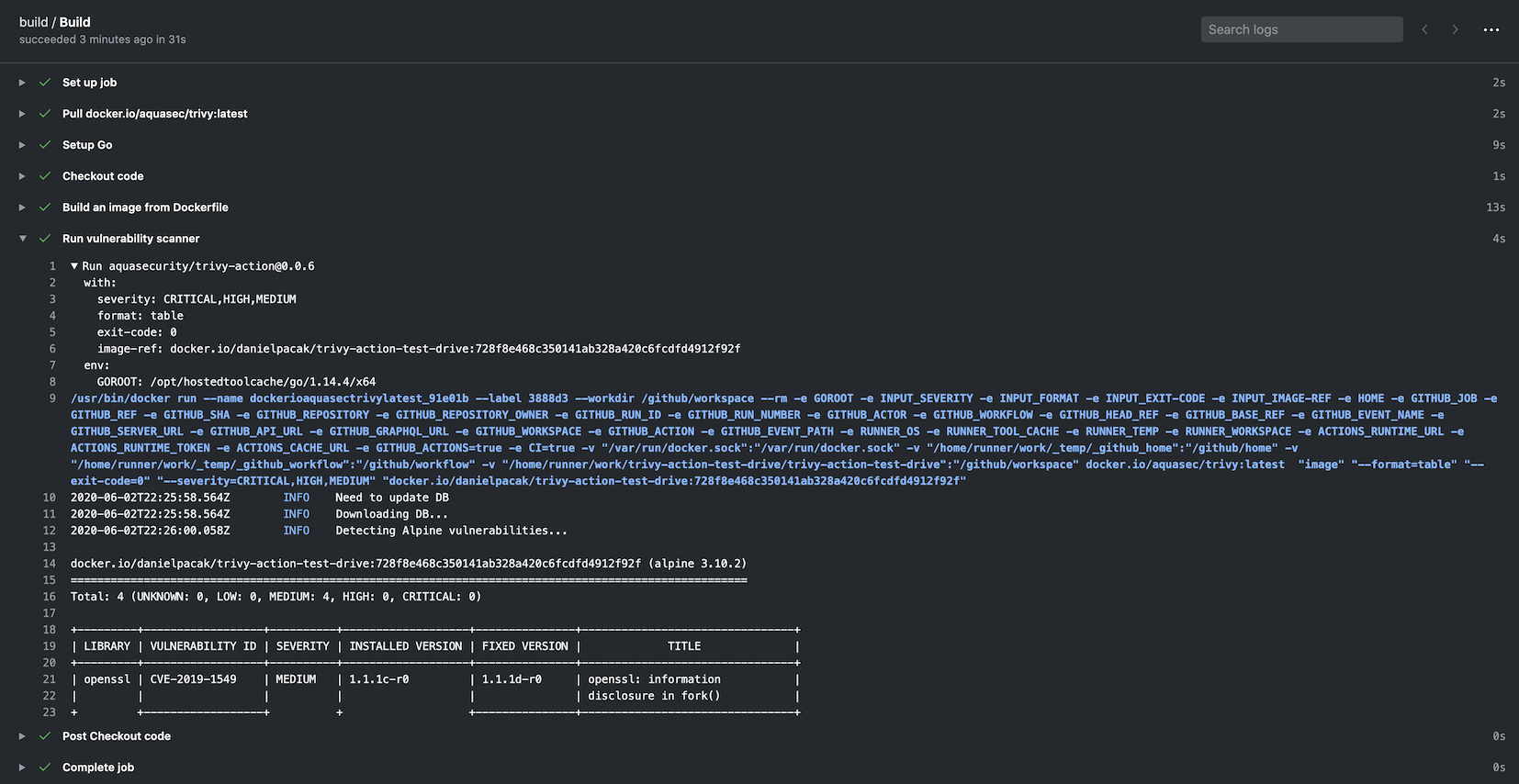
Table of Contents
* Scan CI Pipeline * Scan CI Pipeline (w/ Trivy Config) * Cache * Trivy Setup * Scanning a Tarball * Using Trivy with templates * Using Trivy with GitHub Code Scanning * Using Trivy to scan your Git repo * Using Trivy to scan your rootfs directories * Using Trivy to scan Infrastructure as Code * Using Trivy to generate SBOM * Using Trivy to scan your private registry * Using Trivy if you don't have code scanning enabled * inputs * Environment variables * Trivy config fileUsage
Scan CI Pipeline
name: build
on:
  push:
    branches:
      - main
  pull_request:
jobs:
  build:
    name: Build
    runs-on: ubuntu-24.04
    steps:
      - name: Checkout code
        uses: actions/checkout@v4
      - name: Build an image from Dockerfile
        run: docker build -t docker.io/my-organization/my-app:${{ github.sha }} .
      - name: Run Trivy vulnerability scanner
        uses: aquasecurity/trivy-action@v0.36.0
        with:
          image-ref: 'docker.io/my-organization/my-app:${{ github.sha }}'
          format: 'table'
          exit-code: '1'
          ignore-unfixed: true
          vuln-type: 'os,library'
          severity: 'CRITICAL,HIGH'
Scan CI Pipeline (w/ Trivy Config)
name: build
on:
  push:
    branches:
    - main
  pull_request:
jobs:
  build:
    name: Build
    runs-on: ubuntu-24.04
    steps:
    - name: Checkout code
      uses: actions/checkout@v4
- name: Run Trivy vulnerability scanner in fs mode       uses: aquasecurity/trivy-action@v0.36.0       with:         scan-type: 'fs'         scan-ref: '.'         trivy-config: trivy.yaml
In this case trivy.yaml is a YAML configuration that is checked in as part of the repo. Detailed information is available on the Trivy website but an example is as follows:
format: json exit-code: 1 severity: CRITICAL secret: config: config/trivy/secret.yamlIt is possible to define all options in the trivy.yaml file. Specifying individual options via the action are left for backward compatibility purposes. Defining the following is required as they cannot be defined with the config file:
scan-ref: If usingfs, reposcans.image-ref: If usingimagescan.scan-type: To define the scan type, e.g.image,fs,repo, etc.
Order of preference for options
Trivy uses Viper which has a defined precedence order for options. The order is as follows:- GitHub Action flag
- Environment variable
- Config file
- Default
Cache
The action has a built-in functionality for caching and restoring the vulnerability DB, the Java DB and the checks bundle if they are downloaded during the scan. The cache is stored in the$GITHUB_WORKSPACE/.cache/trivy directory by default. The cache is restored before the scan starts and saved after the scan finishes.
It uses actions/cache under the hood but requires less configuration settings. The cache input is optional, and caching is turned on by default.
Disabling caching
If you want to disable caching, set thecache input to false, but we recommend keeping it enabled to avoid rate limiting issues.
- name: Run Trivy scanner without cache
      uses: aquasecurity/trivy-action@v0.36.0
      with:
        scan-type: 'fs'
        scan-ref: '.'
        cache: 'false'
Updating caches in the default branch
Please note that there are restrictions on cache access between branches in GitHub Actions. By default, a workflow can access and restore a cache created in either the current branch or the default branch (usuallymain or master).
If you need to share caches across branches, you may need to create a cache in the default branch and restore it in the current branch.
To optimize your workflow, you can set up a cron job to regularly update the cache in the default branch. This allows subsequent scans to use the cached DB without downloading it again.
# Note: This workflow only updates the cache. You should create a separate workflow for your actual Trivy scans.
In your scan workflow, set TRIVYSKIPDBUPDATE=true and TRIVYSKIPJAVADB_UPDATE=true.
name: Update Trivy Cache
on:   schedule:     - cron: '0 0   *'  # Run daily at midnight UTC   workflow_dispatch:  # Allow manual triggering
jobs:   update-trivy-db:     runs-on: ubuntu-latest     steps:       - name: Setup oras         uses: oras-project/setup-oras@v1
- name: Get current date         id: date         run: echo "date=$(date +'%Y-%m-%d')" >> $GITHUB_OUTPUT
- name: Download and extract the vulnerability DB         run: |           mkdir -p $GITHUB_WORKSPACE/.cache/trivy/db           oras pull ghcr.io/aquasecurity/trivy-db:2           tar -xzf db.tar.gz -C $GITHUB_WORKSPACE/.cache/trivy/db           rm db.tar.gz
- name: Download and extract the Java DB         run: |           mkdir -p $GITHUB_WORKSPACE/.cache/trivy/java-db           oras pull ghcr.io/aquasecurity/trivy-java-db:1           tar -xzf javadb.tar.gz -C $GITHUB_WORKSPACE/.cache/trivy/java-db           rm javadb.tar.gz
- name: Cache DBs         uses: actions/cache/save@v4         with:           path: ${{ github.workspace }}/.cache/trivy           key: cache-trivy-${{ steps.date.outputs.date }}
When running a scan, set the environment variables TRIVYSKIPDBUPDATE and TRIVYSKIPJAVADB_UPDATE to skip the download process.
- name: Run Trivy scanner without downloading DBs
      uses: aquasecurity/trivy-action@v0.36.0
      with:
        scan-type: 'image'
        scan-ref: 'myimage'
      env:
        TRIVYSKIPDB_UPDATE: true
        TRIVYSKIPJAVADBUPDATE: true
Trivy Setup
By default the action callsaquasecurity/setup-trivy as the first step
which installs the trivy version specified by the version input. If you have already installed trivy by other
means, e.g. calling aquasecurity/setup-trivy directly, or are invoking this action multiple times then you can use the
skip-setup-trivy input to disable this step.
Setting up Trivy Manually
name: build
on:
  push:
    branches:
    - main
  pull_request:
jobs:
  build:
    name: Build
    runs-on: ubuntu-24.04
    steps:
    - name: Checkout code
      uses: actions/checkout@v4
- name: Manual Trivy Setup       uses: aquasecurity/setup-trivy@v0.2.0       with:         cache: true         version: v0.72.0
- name: Run Trivy vulnerability scanner in repo mode       uses: aquasecurity/trivy-action@v0.36.0       with:         scan-type: 'fs'         ignore-unfixed: true         format: 'sarif'         output: 'trivy-results.sarif'         severity: 'CRITICAL'         skip-setup-trivy: true
Skipping Setup when Calling Trivy Action multiple times
Another common use case is when a build calls this action multiple times, in this case we can setskip-setup-trivy to
true on subsequent invocations e.g.
name: build
on:   push:     branches:       - main   pull_request:
jobs:   test:     runs-on: ubuntu-latest     permissions:       contents: read     steps:       - name: Check out Git repository         uses: actions/checkout@v4
# The first call to the action will invoke setup-trivy and install trivy       - name: Generate Trivy Vulnerability Report         uses: aquasecurity/trivy-action@v0.36.0         with:           scan-type: "fs"           output: trivy-report.json           format: json           scan-ref: .           exit-code: 0
- name: Upload Vulnerability Scan Results         uses: actions/upload-artifact@v4         with:           name: trivy-report           path: trivy-report.json           retention-days: 30
- name: Fail build on High/Criticial Vulnerabilities         uses: aquasecurity/trivy-action@v0.36.0         with:           scan-type: "fs"           format: table           scan-ref: .           severity: HIGH,CRITICAL           ignore-unfixed: true           exit-code: 1           # On a subsequent call to the action we know trivy is already installed so can skip this           skip-setup-trivy: true
Use non-default token to install Trivy
GitHub Enterprise Server (GHES) uses an invalidgithub.token for https://github.com server.
Therefore, you can't install Trivy using the setup-trivy action.
To fix this problem, you need to overwrite the token for setup-trivy using token-setup-trivy input:
- name: Run Trivy scanner without cache uses: aquasecurity/trivy-action@v0.36.0 with: scan-type: 'fs' scan-ref: '.' token-setup-trivy: ${{ secrets.GITHUB_PAT }}GitHub even has create-github-app-token for similar cases.
Scanning a Tarball
name: build
on:
  push:
    branches:
    - main
  pull_request:
jobs:
  build:
    name: Build
    runs-on: ubuntu-24.04
    steps:
    - name: Checkout code
      uses: actions/checkout@v4
- name: Generate tarball from image       run: |         docker pull <your-docker-image>         docker save -o vuln-image.tar <your-docker-image>
- name: Run Trivy vulnerability scanner in tarball mode       uses: aquasecurity/trivy-action@v0.36.0       with:         input: /github/workspace/vuln-image.tar         severity: 'CRITICAL,HIGH'
Using Trivy with templates
The action supports [Trivy templates][trivy-templates].Use template input to specify path (remember to prefix the path with @) to template file.
name: build
on:
  push:
    branches:
      - main
  pull_request:
jobs:
  build:
    name: Build
    runs-on: ubuntu-24.04
    steps:
      - name: Checkout code
        uses: actions/checkout@v4
- name: Run Trivy vulnerability scanner         uses: aquasecurity/trivy-action@v0.36.0         with:           scan-type: "fs"           scan-ref: .           format: 'template'           template: "@path/to/my_template.tpl"
Default templates
Trivy has [default templates][trivy-default-templates].By default, setup-trivy installs them into the $HOME/.local/bin/trivy-bin/contrib directory.
name: build
on:
  push:
    branches:
      - main
  pull_request:
jobs:
  build:
    name: Build
    runs-on: ubuntu-24.04
    steps:
      - name: Checkout code
        uses: actions/checkout@v4
- name: Run Trivy vulnerability scanner         uses: aquasecurity/trivy-action@v0.36.0         with:           scan-type: "fs"           scan-ref: .           format: 'template'           template: "@$HOME/.local/bin/trivy-bin/contrib/html.tpl"
Using Trivy with GitHub Code Scanning
If you have GitHub code scanning available you can use Trivy as a scanning tool as follows:name: build
on:
push:
branches:
- main
pull_request:
jobs:
build:
name: Build
runs-on: ubuntu-24.04
permissions:
contents: read # Required to checkout and read repo files
security-events: write # Required to upload SARIF files to Security tab
steps:
- name: Checkout code
uses: actions/checkout@v4
- name: Build an image from Dockerfile run: | docker build -t docker.io/my-organization/my-app:${{ github.sha }} .
- name: Run Trivy vulnerability scanner uses: aquasecurity/trivy-action@v0.36.0 with: image-ref: 'docker.io/my-organization/my-app:${{ github.sha }}' format: 'sarif' output: 'trivy-results.sarif'
- name: Upload Trivy scan results to GitHub Security tab uses: github/codeql-action/upload-sarif@v4 with: sarif_file: 'trivy-results.sarif'
You can find a more in-depth example here: https://github.com/aquasecurity/trivy-sarif-demo/blob/master/.github/workflows/scan.yml
If you would like to upload SARIF results to GitHub Code scanning even upon a non zero exit code from Trivy Scan, you can add the following to your upload step:
name: build on:   push:     branches:       - main   pull_request: jobs:   build:     name: Build     runs-on: ubuntu-24.04     permissions:       contents: read          # Required to checkout and read repo files       security-events: write  # Required to upload SARIF files to Security tab     steps:       - name: Checkout code         uses: actions/checkout@v4
- name: Build an image from Dockerfile         run: |           docker build -t docker.io/my-organization/my-app:${{ github.sha }} .
- name: Run Trivy vulnerability scanner         uses: aquasecurity/trivy-action@v0.36.0         with:           image-ref: 'docker.io/my-organization/my-app:${{ github.sha }}'           format: 'sarif'           output: 'trivy-results.sarif'
- name: Upload Trivy scan results to GitHub Security tab         uses: github/codeql-action/upload-sarif@v4         if: always()         with:           sarif_file: 'trivy-results.sarif'
See this for more details: https://docs.github.com/en/actions/learn-github-actions/expressions#always
Using Trivy to scan your Git repo
It's also possible to scan your git repos with Trivy's built-in repo scan. This can be handy if you want to run Trivy as a build time check on each PR that gets opened in your repo. This helps you identify potential vulnerabilities that might get introduced with each PR.If you have GitHub code scanning available you can use Trivy as a scanning tool as follows:
name: build on:   push:     branches:       - main   pull_request: jobs:   build:     name: Build     runs-on: ubuntu-24.04     permissions:       contents: read          # Required to checkout and read repo files       security-events: write  # Required to upload SARIF files to Security tab     steps:       - name: Checkout code         uses: actions/checkout@v4
- name: Run Trivy vulnerability scanner in repo mode         uses: aquasecurity/trivy-action@v0.36.0         with:           scan-type: 'fs'           ignore-unfixed: true           format: 'sarif'           output: 'trivy-results.sarif'           severity: 'CRITICAL'
- name: Upload Trivy scan results to GitHub Security tab         uses: github/codeql-action/upload-sarif@v4         with:           sarif_file: 'trivy-results.sarif'
Using Trivy to scan your rootfs directories
It's also possible to scan your rootfs directories with Trivy's built-in rootfs scan. This can be handy if you want to run Trivy as a build time check on each PR that gets opened in your repo. This helps you identify potential vulnerabilities that might get introduced with each PR.If you have GitHub code scanning available you can use Trivy as a scanning tool as follows:
name: build on:   push:     branches:       - main   pull_request: jobs:   build:     name: Build     runs-on: ubuntu-24.04     permissions:       contents: read          # Required to checkout and read repo files       security-events: write  # Required to upload SARIF files to Security tab     steps:       - name: Checkout code         uses: actions/checkout@v4
- name: Run Trivy vulnerability scanner with rootfs command         uses: aquasecurity/trivy-action@v0.36.0         with:           scan-type: 'rootfs'           scan-ref: 'rootfs-example-binary'           ignore-unfixed: true           format: 'sarif'           output: 'trivy-results.sarif'           severity: 'CRITICAL'
- name: Upload Trivy scan results to GitHub Security tab         uses: github/codeql-action/upload-sarif@v4         with:           sarif_file: 'trivy-results.sarif'
Using Trivy to scan Infrastructure as Code
It's also possible to scan your IaC repos with Trivy's built-in repo scan. This can be handy if you want to run Trivy as a build time check on each PR that gets opened in your repo. This helps you identify potential vulnerabilities that might get introduced with each PR.If you have GitHub code scanning available you can use Trivy as a scanning tool as follows:
name: build on:   push:     branches:       - main   pull_request: jobs:   build:     name: Build     runs-on: ubuntu-24.04     permissions:       contents: read          # Required to checkout and read repo files       security-events: write  # Required to upload SARIF files to Security tab     steps:       - name: Checkout code         uses: actions/checkout@v4
- name: Run Trivy vulnerability scanner in IaC mode         uses: aquasecurity/trivy-action@v0.36.0         with:           scan-type: 'config'           hide-progress: true           format: 'sarif'           output: 'trivy-results.sarif'           exit-code: '1'           severity: 'CRITICAL,HIGH'
- name: Upload Trivy scan results to GitHub Security tab         if: always()         uses: github/codeql-action/upload-sarif@v4         with:           sarif_file: 'trivy-results.sarif'
Note: If your Terraform configuration contains private modules, configure Git to authenticate with the repository hosting them. This can be done by adding a step in your CI workflow that sets up access, for example using a Personal Access Token (PAT) or SSH keys:
- name: Configure Git for private modules
  run: |
    git config --global url."https://$GITHUBUSER:$PRIVATEREPO_TOKEN@github.com/".insteadOf "https://github.com/"
  env:
    GITHUB_USER: ${{ github.actor }}
PRIVATEREPOTOKEN: ${{ secrets.PRIVATEREPOTOKEN }}Using Trivy to generate SBOM
It's possible for Trivy to generate an SBOM of your dependencies and submit them to a consumer like GitHub Dependency Graph.The sending of an SBOM to GitHub feature is only available if you currently have GitHub Dependency Graph enabled in your repo.
In order to send results to GitHub Dependency Graph, you will need to create a GitHub PAT or use the GitHub installation access token (also known as GITHUB_TOKEN):
---
name: Generate SBOM
on:
  push:
    branches:
    - main
GITHUB_TOKEN authentication, add only if you're not going to use a PAT
permissions:
  contents: write
jobs:   generate-sbom:     runs-on: ubuntu-latest     steps:       - name: Checkout code         uses: actions/checkout@v4
- name: Run Trivy in GitHub SBOM mode and submit results to Dependency Graph         uses: aquasecurity/trivy-action@v0.36.0         with:           scan-type: 'fs'           format: 'github'           output: 'dependency-results.sbom.json'           scan-ref: '.'           github-pat: ${{ secrets.GITHUBTOKEN }} # or ${{ secrets.githubpat_name }} if you're using a PAT
When scanning images you may want to parse the actual output JSON as Github Dependency doesn't show all details like the file path of each dependency for instance.
You can upload the report as an artifact and download it, for instance using the upload-artifact action:
---
name: Generate SBOM
on:
  push:
    branches:
    - main
GITHUB_TOKEN authentication, add only if you're not going to use a PAT
permissions:
  contents: write
jobs:   generate-sbom:     runs-on: ubuntu-latest     steps:       - name: Scan image in a private registry         uses: aquasecurity/trivy-action@v0.36.0         with:           image-ref: "privateimageregistry/imagename:imagetag"           scan-type: image           format: 'github'           output: 'dependency-results.sbom.json'           github-pat: ${{ secrets.GITHUBTOKEN }} # or ${{ secrets.githubpat_name }} if you're using a PAT           severity: "MEDIUM,HIGH,CRITICAL"           scanners: "vuln"         env:           TRIVYUSERNAME: "imageregistryadminusername"           TRIVYPASSWORD: "imageregistryadminpassword"
- name: Upload trivy report as a Github artifact         uses: actions/upload-artifact@v4         with:           name: trivy-sbom-report           path: '${{ github.workspace }}/dependency-results.sbom.json'           retention-days: 20 # 90 is the default
Using Trivy to scan your private registry
It's also possible to scan your private registry with Trivy's built-in image scan. All you have to do is set ENV vars.Docker Hub registry
Docker Hub needsTRIVYUSERNAME and TRIVYPASSWORD.
You don't need to set ENV vars when downloading from a public repository.
name: build
on:
  push:
    branches:
      - main
  pull_request:
jobs:
  build:
    name: Build
    runs-on: ubuntu-24.04
    permissions:
      contents: read          # Required to checkout and read repo files
      security-events: write  # Required to upload SARIF results to the GitHub Security tab
    steps:
      - name: Checkout code
        uses: actions/checkout@v4
- name: Run Trivy vulnerability scanner         uses: aquasecurity/trivy-action@v0.36.0         with:           image-ref: 'docker.io/my-organization/my-app:${{ github.sha }}'           format: 'sarif'           output: 'trivy-results.sarif'         env:           TRIVY_USERNAME: Username           TRIVY_PASSWORD: Password
- name: Upload Trivy scan results to GitHub Security tab         uses: github/codeql-action/upload-sarif@v4         with:           sarif_file: 'trivy-results.sarif'
AWS ECR (Elastic Container Registry)
Trivy uses AWS SDK. You don't need to installaws CLI tool.
You can use [AWS CLI's ENV Vars][env-var].
[env-var]: https://docs.aws.amazon.com/cli/latest/userguide/cli-configure-envvars.html
name: build on:   push:     branches:       - main   pull_request: jobs:   build:     name: Build     runs-on: ubuntu-24.04     permissions:       contents: read          # Required to checkout and read repo files       security-events: write  # Required to upload SARIF files to Security tab     steps:       - name: Checkout code         uses: actions/checkout@v4
- name: Run Trivy vulnerability scanner         uses: aquasecurity/trivy-action@v0.36.0         with:           image-ref: 'awsaccountid.dkr.ecr.region.amazonaws.com/imageName:${{ github.sha }}'           format: 'sarif'           output: 'trivy-results.sarif'         env:           AWSACCESSKEYID: keyid           AWSSECRETACCESSKEY: accesskey           AWSDEFAULTREGION: us-west-2
- name: Upload Trivy scan results to GitHub Security tab         uses: github/codeql-action/upload-sarif@v4         with:           sarif_file: 'trivy-results.sarif'
GCR (Google Container Registry)
Trivy uses Google Cloud SDK. You don't need to installgcloud command.
If you want to use target project's repository, you can set it via GOOGLEAPPLICATIONCREDENTIALS.
name: build on:   push:     branches:       - main   pull_request: jobs:   build:     name: Build     runs-on: ubuntu-24.04     permissions:       contents: read          # Required to checkout and read repo files       security-events: write  # Required to upload SARIF files to Security tab     steps:       - name: Checkout code         uses: actions/checkout@v4
- name: Run Trivy vulnerability scanner         uses: aquasecurity/trivy-action@v0.36.0         with:           image-ref: 'docker.io/my-organization/my-app:${{ github.sha }}'           format: 'sarif'           output: 'trivy-results.sarif'         env:           GOOGLEAPPLICATIONCREDENTIALS: /path/to/credential.json
- name: Upload Trivy scan results to GitHub Security tab         uses: github/codeql-action/upload-sarif@v4         with:           sarif_file: 'trivy-results.sarif'
Self-Hosted
BasicAuth server needsTRIVYUSERNAME and TRIVYPASSWORD.
if you want to use 80 port, use NonSSL TRIVYNONSSL=true
name: build
on:
  push:
    branches:
      - main
  pull_request:
jobs:
  build:
    name: Build
    runs-on: ubuntu-24.04
    permissions:
      contents: read          # Required to checkout and read repo files
      security-events: write  # Required to upload SARIF files to Security tab
    steps:
      - name: Checkout code
        uses: actions/checkout@v4
- name: Run Trivy vulnerability scanner         uses: aquasecurity/trivy-action@v0.36.0         with:           image-ref: 'docker.io/my-organization/my-app:${{ github.sha }}'           format: 'sarif'           output: 'trivy-results.sarif'         env:           TRIVY_USERNAME: Username           TRIVY_PASSWORD: Password
- name: Upload Trivy scan results to GitHub Security tab         uses: github/codeql-action/upload-sarif@v4         with:           sarif_file: 'trivy-results.sarif'
Using Trivy if you don't have code scanning enabled
It's also possible to browse a scan result in a workflow summary.
This step is especially useful for private repositories without GitHub Advanced Security license.
- name: Run Trivy scanner
uses: aquasecurity/trivy-action@v0.36.0
with:
scan-type: config
hide-progress: true
output: trivy.txt
- name: Publish Trivy Output to Summary
run: |
if [[ -s trivy.txt ]]; then
{
echo "### Security Output"
echo "<details><summary>Click to expand</summary>"
echo ""
echo ''
echo "</details>"
} >> $GITHUBSTEPSUMMARY
fiCustomizing
Configuration priority:
- Inputs
- Environment variables
- Trivy config file
- Default values
inputs
Following inputs can be used as step.with keys:
| Name | Type | Default | Description | |------------------------------|---------|------------------------------------|------------------------------------------------------------------------------------------------------------------------------------------------------------------| | scan-type | String | image | Scan type, e.g. image or fs | | input | String | | Tar reference, e.g. alpine-latest.tar | | image-ref | String | | Image reference, e.g. alpine:3.10.2 | | scan-ref | String | /github/workspace/ | Scan reference, e.g. /github/workspace/ or . | | format | String | table | Output format (table, json, template, sarif, cyclonedx, spdx, spdx-json, github, cosign-vuln) | | template | String | | Output template (@$HOME/.local/bin/trivy-bin/contrib/gitlab.tpl, @$HOME/.local/bin/trivy-bin/contrib/junit.tpl) | | tf-vars | String | | path to Terraform variables file | | output | String | | Save results to a file | | exit-code | String | 0 | Exit code when specified vulnerabilities are found | | ignore-unfixed | Boolean | false | Ignore unpatched/unfixed vulnerabilities | | vuln-type | String | os,library | Vulnerability types (os,library) | | severity | String | UNKNOWN,LOW,MEDIUM,HIGH,CRITICAL | Severities of vulnerabilities to scanned for and displayed | | skip-dirs | String | | Comma separated list of directories where traversal is skipped | | skip-files | String | | Comma separated list of files where traversal is skipped | | cache-dir | String | $GITHUB_WORKSPACE/.cache/trivy | Cache directory. NOTE: This value cannot be configured by trivy.yaml. | | timeout | String | 5m0s | Scan timeout duration | | ignore-policy | String | | Filter vulnerabilities with OPA rego language | | hide-progress | String | false | Suppress progress bar and log output | | list-all-pkgs | String | | Output all packages regardless of vulnerability | | scanners | String | vuln,secret | comma-separated list of what security issues to detect (vuln,secret,misconfig,license) | | trivyignores | String | | comma-separated list of relative paths within the repository to one or more .trivyignore files, or a single .trivyignore.yaml file. | | trivy-config | String | | Path to trivy.yaml config | | github-pat | String | | Authentication token to enable sending SBOM scan results to GitHub Dependency Graph. Can be either a GitHub Personal Access Token (PAT) or GITHUB_TOKEN | | limit-severities-for-sarif | Boolean | false | By default SARIF format enforces output of all vulnerabilities regardless of configured severities. To override this behavior set this parameter to true | | docker-host | String | | By default it is set to unix://var/run/docker.sock, but can be updated to help with containerized infrastructure values (unix:/ or other prefix is required) | | version | String | v0.72.0 | Trivy version to use, e.g. latest or v0.72.0 | | skip-setup-trivy | Boolean | false | Skip calling the setup-trivy action to install trivy | | token-setup-trivy | Boolean | | Overwrite github.token used by setup-trivy to checkout the trivy repository |
Environment variables
You can use [Trivy environment variables][trivy-env] to set the necessary options (including flags that are not supported by Inputs, such as--secret-config).
NB In some older versions of the Action there was a bug that caused inputs from one call to the Action to leak over to subsequent calls to the Action. This could cause workflows that call the Action multiple times e.g. to run multiple scans, or the same scans with different output formats, to not produce the desired output. You can see if this is the case by looking at the GitHub Actions step information, if the env section shown in your Actions output contains TRIVY_* environment variables you did not explicitly set then you may be affected by this bug and should upgrade to the latest Action version.
Trivy config file
When using thetrivy-config Input, you can set options using the [Trivy config file][trivy-config] (including flags that are not supported by Inputs, such as --secret-config).
[release]: https://github.com/aquasecurity/trivy-action/releases/latest [release-img]: https://img.shields.io/github/release/aquasecurity/trivy-action.svg?logo=github [marketplace]: https://github.com/marketplace/actions/aqua-security-trivy [marketplace-img]: https://img.shields.io/badge/marketplace-trivy--action-blue?logo=github [license]: https://github.com/aquasecurity/trivy-action/blob/master/LICENSE [license-img]: https://img.shields.io/github/license/aquasecurity/trivy-action [trivy-env]: https://aquasecurity.github.io/trivy/latest/docs/configuration/#environment-variables [trivy-config]: https://aquasecurity.github.io/trivy/latest/docs/references/configuration/config-file/ [trivy-templates]: https://aquasecurity.github.io/trivy/latest/docs/configuration/reporting/#template [trivy-default-templates]: https://aquasecurity.github.io/trivy/latest/docs/configuration/reporting/#default-templates


