
A scalable, declarative, low-code framework for real-time and batch feature calculation/management (quant finance, anomaly/fraud detection, etc.), predictive ML training/inference and simulation. Built on top of Ray
What is SVOE?
SVOE is a low-code declarative framework providing scalable and highly configurable pipelines for streaming and batch feature engineering, predictive model training, real-time inference and backtesting. Built on top of Ray, the framework allows to build and scale your custom pipelines from multi-core laptop to a cluster of 1000s of nodes.
SVOE was originally built to accommodate a typical financial data research workflow (i.e. for Quant Researchers) with specific data models in mind (trades, quotes, order book updates, etc., hence some examples are provided in this domain), however the framework itself is domain-agnostic and it's components can easily be generalised and used in other fields which rely on real-time time-series based data processing and simulation(anomaly detection, sales forecasting etc.)
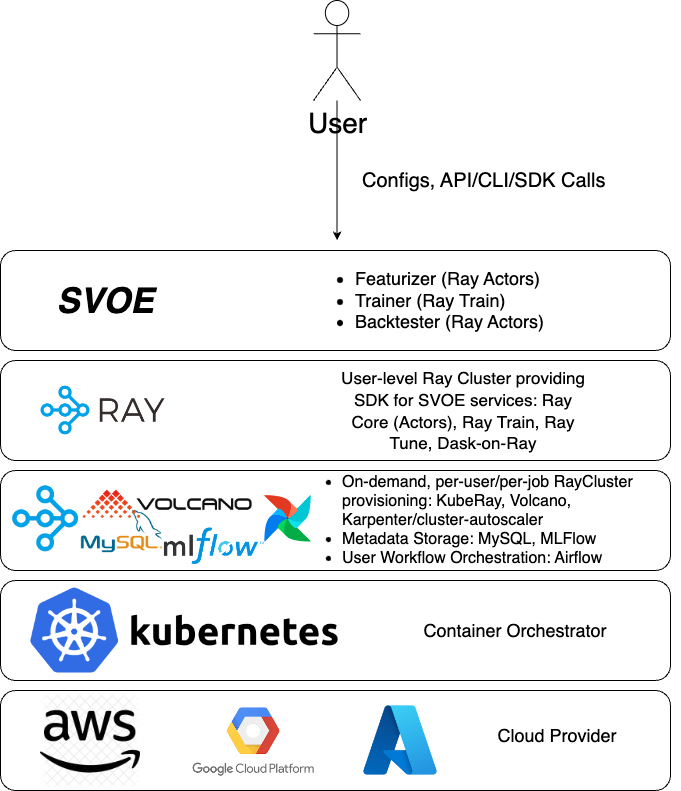
How does it work?
SVOE consists of three main components, each providing a set of tools for a typical Quant/ML engineer workflow
- Featurizer helps defining, calculating and storing real-time/offline (batch) features.
- Trainer allows training predictive models in distributed setting using popular
- Backtester is used to validate and test predictive models along with
You can read more in docs
Why use SVOE?
- Easy to use standardized and flexible data and computation models - seamlessly switch between real-time and
- Low code, modularity and configurability - define reusable components such as
- Avoid train-predict inconsistency - Featurizer uses same feature definition for real-time inference and batch training
- No need for external data infra/DWH - Featurizer Storage allows to store and catalog computed features in any object storage while keeping index
- Ray integration - SVOE runs wherever Ray runs (everywhere!)
- MLFlow integration - store, retrieve and analyze your ML models with MLFlow API
- Cloud / Kubernetes ready - use KubeRay or native Ray on AWS to scale out your workloads in a cloud
- Easily integrates with orchestrators (Airflow, Luigi, Prefect) - SVOE provides basic Airflow Operators
- Real-time inference without MLOps burden - no need to maintain model containerization pipelines, FastAPI services and model registries. Deploy with simple Python API or yaml using InferenceLoop
- Designed for high volume low granularity data - as an example, when used in financial domain, unlike existing financial ML frameworks which use only OHLCV
- Minimized number of external dependencies - SVOE is built using Ray Core primitives and has no heavyweight external dependencies
Installation
Install from PyPi. Be aware that Svoe requires Python 3.10+.
pip install svoeFor local environment launch standalone setup on your laptop. This will start local Ray cluster, create and populate SQLite database, spin up MLFlow tracking server and load sample data from remote store (S3). Make sure you have all necessary dependencies present
svoe standaloneFor distributed setting, please refer to Running on remote clusters
Quick Start
For this example, we will consider a scenario which often occurs in financial markets simulation, however please note that the framework is not limited to financial data and can be used with whatever scenario user provides. As an example, here is a simple 3 step tutorial to build a simple mid-price prediction model based on past price and volatility.
- Run Featurizer to construct mid-price and volatility features from partial order book updates, 5 second lookahead label as prediction target, using 1 second granularity data
featurizer-config.yaml
start_date: '2023-02-01 10:00:00'
    end_date: '2023-02-01 11:00:00'
    labelfeatureindex: 0
    label_lookahead: '5s'
    featurestostore: [0, 1]
    feature_configs:
      - featuredefinition: price.midprice_fd.MidPriceFD
        name: mid_price
        params:
          data_source: &id001
            - exchange: BINANCE
              instrument_type: spot
              symbol: BTC-USDT
          feature:
            sampling: 1s
      - featuredefinition: volatility.volatilitystddev_fd.VolatilityStddevFD
        params
          data_source: *id001
          feature:
sampling: 1ssvoe featurizer run <pathtoconfig> --ray-address <addr> --parallelism <num-workers>
- Python API: Featurizer.run(path=<pathtoconfig>, rayaddress=<addr>, parallelism=<numworkers>)
- Once calculation is finished, load sampled svoe featurizer get-data --every-n <everynthrow>
- Python API: Featurizer.getmaterializeddata(pickeverynthrow=<everynth_row>)
timestamp  receipttimestamp  labelmidprice-midprice  midprice-midprice  featureVolatilityStddevFD62271b09-volatility
    0     1.675234e+09       1.675234e+09                  23084.800            23084.435                                        0.000547
    1     1.675234e+09       1.675234e+09                  23083.760            23084.355                                        0.040003
    2     1.675234e+09       1.675234e+09                  23083.505            23084.635                                        0.117757
    3     1.675234e+09       1.675234e+09                  23084.610            23085.020                                        0.257091
    4     1.675234e+09       1.675234e+09                  23084.725            23084.800                                        0.242034
... ... ... ... ... ...svoe featurizer plot --every-n <everynthrow>
- Once we have our
calculated and loaded in cluster memory, let's use Trainer to train XGBoost model to predict mid-price 5 seconds ahead, validate the model, tune hyperparams and pick best model
xgboost:
      params:
        tree_method: 'approx'
        objective: 'reg:linear'
        eval_metric: [ 'logloss', 'error' ]
      numboostrounds: 10
      trainvalidtest_split: [0.5, 0.3]
    num_workers: 3
    tuner_config:
      param_space:
        params:
          max_depth:
            randint:
              lower: 2
              upper: 8
          minchildweight:
            randint:
              lower: 1
              upper: 10
      num_samples: 8
      metric: 'train-logloss'
      mode: 'min'
maxconcurrenttrials: 3svoe trainer run --config-path <config-path> --ray-address <addr>
- Python API:
config = TrainerConfig.loadconfig(configpath)
      trainermanager = TrainerManager(config=config, rayaddress=ray_address)
trainermanager.run(trainerrun_id='sample-run-id', tags={})svoe trainer predictions --model-uri <model-uri>
- Select best model
- CLI: svoe trainer best-model --metric-name valid-logloss --mode min
- Python API:
mlflow_client = SvoeMLFlowClient()
best-model-uri = mlflowclient.getbestcheckpointuri(metricname=metricname, experimentname=experimentname, mode=mode)- In this example, we use Backtester in the context of financial markets, hence our user-defined logic is based on a notion of trading strategy. This can be extended to any other scenario which user wants to emulate. Once we have our best model, we can plug it in our
derived class and run backtester to simulate our scenario
featurizerconfigpath: featurizer-config.yaml
     inference_config:
       model_uri: <your-best-model-uri>
       predictorclassname: 'XGBoostPredictor'
       num_replicas: <number-of-predictor-replicas>
     simulationclassname: 'backtester.strategy.ml_strategy.MLStrategy'
     simulation_params:
       buy_delta: 0
       sell_delta: 0
     userdefinedparams:
       portfolioconfig: <portfolioconfig>
       tradableinstrumentsparams:
         - exchange: 'BINANCE'
           instrument_type: 'spot'
symbol: 'BTC-USDT'svoe backtester run --config-path <config-path> --ray-address <addr> --num-workers <num-workers>
- Python API:
config = BacktesterConfig.loadconfig(configpath)
        backtester = Backtester.from_config(config)
backtester.runremotely(rayaddress=rayaddress, numworkers=num_workers)backtester.get_stats()
Documentation
We try to maintain as fresh and detailed docs as possible. Please leave your feedback if you have any questions.
Contributions
SVOE is an open-source first project and we would love to get feedback and contributions from the community! The project is in a very early stage and is still a work in progress, so any help would be greatly appreciated! Please feel free to open GitHub issues with questions/bugs or PRs with contributions!


