
XQRiskCore is a governance-grade risk control engine for trading — with unified trade approval, structured audit logging, role-based access control, and multi-layer enforcement.
XQRiskCore: A Governance-Grade Risk Control Engine for Trading
Built to Govern — Not Just Execute
Unified trade approval. Structured audit logging. Role-based access. Multi-layer enforcement.
⚠️ Talk is cheap. Try the governance.
No install. No guessing. No hiding.
If it doesn't run — it's not XQRiskCore.
🚀 Jump in as an admin, trader, risker or auditor — no setup required. 🎯 Live Demo → https://xqriskcore-production.up.railway.app/
📑 Table of Contents
🧭 Foundations
✅ Core Capabilities- Unified Trade Flow
- Dual-Path Risk Control Architecture
- Role-Based Governance (RBAC)
- Structured Behavioral Logging
- Emergency Guard Layer
🧭 System Origins & Design Philosophy
Most risk systems weren’t built for today’s rules. Permissions tangled. Logs missing. Controls patched on outdated cores. When failures happen, it’s already too late.
XQRiskCore responds to structural fatigue — not to predict alpha, but to enforce discipline before trades happen.
Governance isn’t a wrapper. It’s the foundation.
🔍 What Went Wrong — and What I Built to Fix It
I studied 10 major failures — not for drama, but to see what broke:
| 💥 Failure Type | Example(s) | What Went Wrong | XQRiskCore Response | |------------------------|-----------------------------|----------------------------------------------------------|--------------------------------------------------| | 🔐 Role confusion | Barings, SocGen, FTX | No separation — same user could approve + execute | RBAC enforces scoped roles | | 🧾 No audit trail | Enron, Wirecard, Macquarie | Logs missing, falsified, or unverifiable | AuditLogger, AuditViewer, immutable .jsonl | | 🛑 No auto-block | Macquarie, Lehman, MF Global | Signals existed — no structural trigger or lockdown | SilentTriggerEngine, KillSwitchManager | | 🧟 Legacy code risk | Knight Capital | Old logic reactivated, no sandbox or fallback | Intent → Approval → Execution lifecycle | | 📉 Model overtrust | LTCM, FTX | Smart models, zero enforceable guardrails | RiskSignalSet, override tracking |
🧱 Built Bottom-Up — By Principle, Not Convention
Every trade follows the same lifecycle: Intent → Signals → Approval → Execution → Audit → Monitoring
Priority is hardcoded into the system:
| Layer | Priority | Goal | Stability | Build First | |-----------------------------|----------|-------------------------|-----------|-------------| | ✅ Compliance / Audit | First | Trust, accountability | ✅ High | ✅ Yes | | ✅ Risk Engine (Rules + Score) | Second | Block risky behavior | ⚠️ Medium | ✅ Yes | | 🧑💼 Execution / Strategy | Third | Trigger actions | ❌ Low | ❌ No |
Enforced by:
- 🔐 Role-based access (RBAC)
- 🔍 Structured logging
- 🛡️ Multi-stage kill switches
- 🧠 Unified approval flow
📚 Institutional Inspirations
XQRiskCore borrows lessons from world-class systems — but flips the build order.
✅ Inspired & embedded in v1.0:
- BlackRock Aladdin — Unified trade flow; scoped permissions; audit attribution
- J.P. Morgan Vega / RaaS — Pre- and post-trade enforcement
- Goldman Sachs Marquee — Structured logging and behavior traceability
- Beacon / Vega — Rule hot-swapping, versioned policy control
- Bridgewater / Two Sigma — Adaptive scoring, live feedback loops
You don’t need to be big to enforce discipline.
You just need to build like you mean it.
🎧 Theme Track: The Core Structured. Watchful. Unyielding.
✅ Core Capabilities
🔁 Unified Trade Flow — One Pipe for All Trades
Unlike most systems that separate manual, strategy, and rebalance trades, XQRiskCore unifies them into a single pipeline — one that enforces the same approval logic, risk checks, and audit trace.
No trade escapes the flow. Every source — whether it’s a button click, a strategy trigger, or a scheduled rebalance — must go through:
→ Intent → Risk Signal → Approval → Execution → Audit → Post-Trade Monitoring
📊 Figure 1: XQRiskCore Risk-Controlled Trade Lifecycle
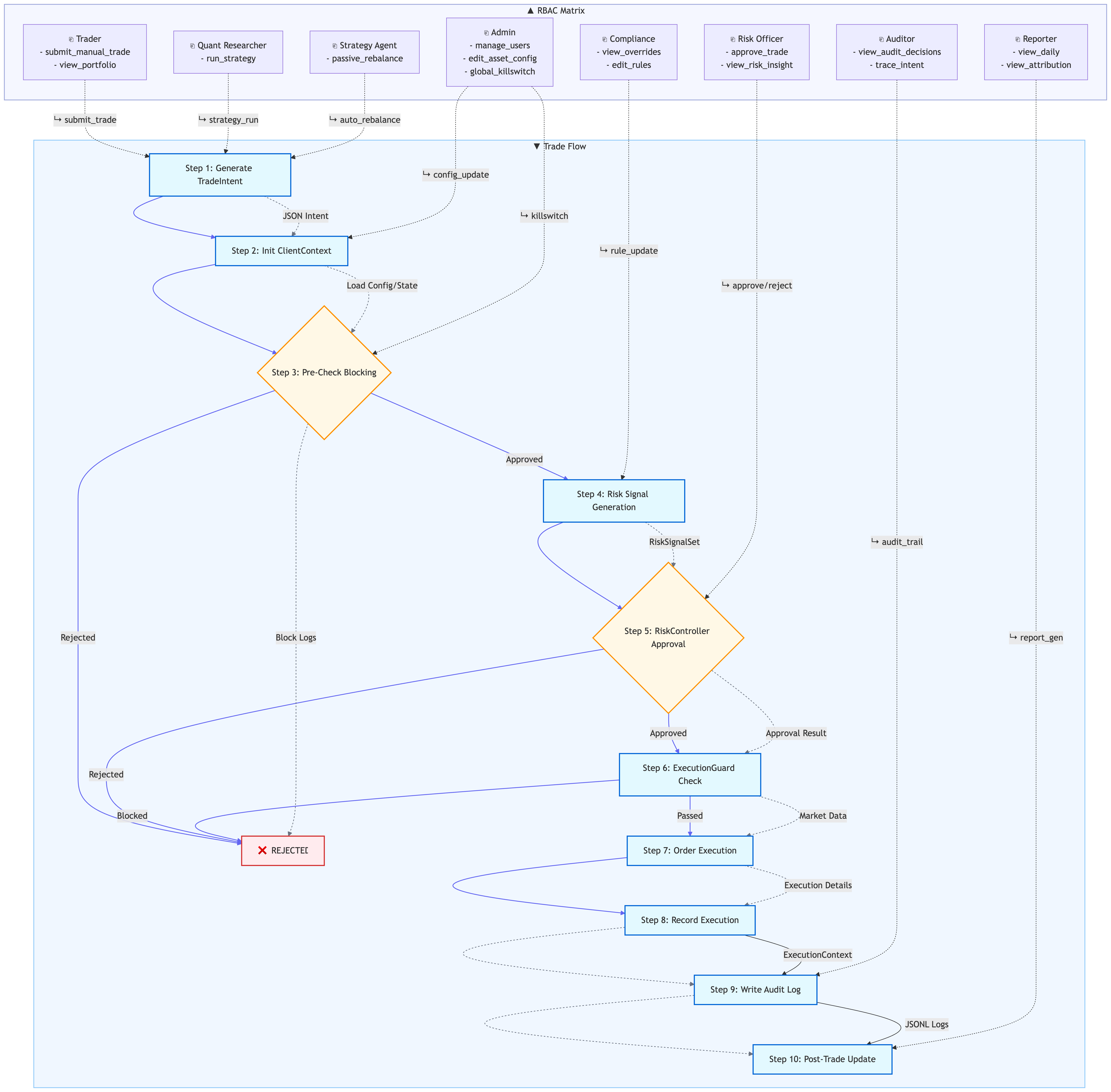
🧩 Want to understand how this unified trade pipeline actually works under the hood?
Included:
- 🎯 The philosophy behind
TradeIntent— “a trade is a trade, regardless of source” - 📦 Side-by-side examples of manual vs strategy-generated intents
- 🔒 How pre-block mechanisms (Kill Switch, Silent Mode) intercept trades before execution
- ✅ How the Risk Approval Engine evaluates score, volatility, and VaR
- 📊 Full trade lifecycle from intent → approval → execution → audit
- 🧠 How this structure ensures policy consistency, traceability, and enforceable compliance
🧠 Dual-Path Risk Control Architecture
Approve what deserves to go through.
Monitor everything that actually did.
XQRiskCore turns logging into automated containment — high-risk behavior is not just observed, but structurally blocked.
XQRiskCore enforces risk through two layers:
- Pre-Trade Approval — blocks high-risk trades before execution
- Post-Trade Monitoring — detects exposures and auto-locks after execution
1️⃣ Pre-Trade Approval
Every trade — manual, strategy, or rebalance — passes a unified approval flow before execution. This is the core of XQRiskCore’s institutional-grade risk governance.
🔁 Approval Flow Diagram
┌──────────────────┐
          │ TradeIntent      │
          └────────┬─────────┘
                   ▼
        ┌────────────────────────────┐
        │ Is this a SELL action?     │
        └───────┬─────────────▲──────┘
                ▼             │
      ┌────────────────┐      │
      │ Check holdings │      │
      └─────┬──────────┘      │
            ▼                 │
   ┌──────────────┐     ┌──────────────┐
   │ Enough shares│     │ Not enough   │
   │ → Approve    │     │ → Reject     │
   └──────────────┘     └──────────────┘
▼ (If BUY)        ┌────────────────────────────┐        │ Fetch price + estimate cost│        └───────┬────────────────────┘                ▼        ┌────────────────────────────┐        │ Enough cash?               │        └───────┬───────────────┬────┘                ▼               ▼           Fetch signals     Reject trade
▼          Evaluate:          - score          - volatility          - VaR
▼           Decision:           APPROVE / LIMIT / REJECT
▼        Generate approval response
Try it:
→ Go toTrader: Manual Trade Submit  → Select a client and submit a trade form to trigger the full risk approval flow. → Activate a strategy and observe how it routes through the same unified trade lifecycle.
→ Go to
→ Select a client and submit a trade form to trigger the full risk approval flow. → Activate a strategy and observe how it routes through the same unified trade lifecycle.
→ Go to Audit: Decision Records
→ Review detailed decision records, including approvals, rejections, risk scores, and override flags.

🧯 2️⃣ Post-Trade Monitoring — Risk Trigger System
After execution, XQRiskCore continuously monitors positions using:
- ⚡
IntradayTriggerEngine— real-time risk detection - 🌙
SilentTriggerEngine— end-of-day lockout review
- Silent Mode — temporary cooldown
- Kill Switch — full lockout
🧮 Account-Level Triggers
| Condition | Metric | Action | Module | |-----------------------------------|------------------|---------------------|-------------------------| | Intraday drawdown ≤ -5% | drawdown | Silent Mode (2d) | Intraday | | Daily return ≤ -5% | daily_return | Silent Mode (2d) | Silent | | Monthly return ≤ -10% | monthly_return | Silent Mode (EOM) | Silent | | ≥ 3 consecutive losing days | consecutive_losses | Silent Mode (1d) | Silent |
💡 These act as portfolio-level brakes when losses accumulate or behavior destabilizes.
📦 Asset-Level Triggers
| Condition | Metric | Threshold | Lock | Module(s) | |----------------------------------|-------------------------|-----------|---------|-------------------------| | Position drawdown ≤ -7% | pos_drawdown | -7% | 3 days | Intraday | | 3-day drawdown ≤ -10% | drawdown_3d | -10% | 7 days | Silent | | Live drawdown ≤ -15% | drawdown_pct | -15% | 7 days | Silent | | ≥ 3 down days | consecutivedowndays | 3 | 7 days | Intraday + Silent | | One-day move ≥ ±8% | (cur - prev) / prev | ±8% | 7 days | Intraday + Silent | | Slippage ≥ 0.5% | lastslippagepct | 0.5% | 7 days | Intraday + Silent |
📌 Asset-level blocks prevent repeat exposure to stressed instruments and slippage-heavy trades.
📄 See 02intray&&daily_trigger.md Covers:
- 🛰️ Real-time vs EOD trigger engine design
- ⚡ Key thresholds: drawdown, volatility, slippage
- 🔁 Audit integration and override traceability
- 🔍 Per-client monitoring logic
🧠 Future Enhancements
- Black Swan KillSwitch — e.g. S&P500 drops > 5% triggers lockdown
- Slow Burn Lockdown — 5 small losses without major drop triggers cooling phase
🧱 Role-Based Governance (RBAC)
Every role in XQRiskCore is scoped by permission, linked to identity, and logged for accountability.
| Functional Area | Role | Status | |----------------------------------------|--------------------|----------------| | Config & Access Control | admin | ✅ Implemented | | Manual Trade Execution | trader | ✅ Implemented | | Risk Approval & Rule Enforcement | risker | ✅ Implemented | | Audit & Log Review | auditor | ✅ Implemented | | Strategy Research | quant_researcher | ✅ Implemented | | Report Generation | reporter | 🔧 Coming Soon | | Compliance Oversight | compliance_officer | 🔧 Coming Soon | | Strategy Signal Execution | strategy_agent | 🔧 Coming Soon |
🔐 Governance Design Principles
- What you see = info scope
- What you can do = last line of control
- What you trigger = traceable decision path
- What gets logged = structured compliance proof
🧑💼 Admin Console
→Admin → User & Role Manager → Manage clients, assign roles, activate users.
⬇️ UI Preview 
- 👉 Still as
admin
Admin → Role Permission Matrix → Configure per-role access.
⬇️ Matrix Preview 
📄 See 03_rbac.md Covers:
- 🧩 Per-client segmentation
- 🔄 Hot-swappable permission changes
- 🧾 Immutable audit logging
- 🔍 Real-time permission checks
- 🛡️ Wall-Street-grade access control principles
🧾 Structured Behavioral Logging
XQRiskCore logs every user and system action as structured metadata — enabling traceability, compliance, and post-trade forensics.
🧩 Action Types
| Type | Description | Example | |----------|----------------------------------|----------------------------------------| | view | Passive interactions | Opened a dashboard | | action | User-initiated operations | Submitted a trade | | system | Automated system behavior | Triggered Silent Mode |
🗂️ File Format & Storage
Logs are saved in newline-delimited JSON (.jsonl), partitioned by role, user, and date:
audit/useractionlogs/{role}/{user_id}/{YYYY-MM-DD}/events.jsonlEach file captures timestamped, structured records.
🔍 Admin Log Viewer
- 👉 Login as
admin1→Admin → User Action Logs
⬇️ UI Preview 
🧠 Why It Matters
Risk officers don’t log for vanity — they log for moments that matter:
- 🕵️ Regulatory investigations
- 🧾 Internal audits
- ⚖️ Disputes & legal defense
- 💼 Board accountability
📌 Logged Fields
Each action includes:
user_id– who did ittimestamp– whenmodule– whereaction– whatstatus,override_flag– approved, rejected, bypassedtrace_path– who was involved
- 🔍 Anomaly detection
- 📊 Risk reporting
- 🧠 Strategy attribution
- 🧾 Compliance tracebacks
🧯 Emergency Guard Layer
XQRiskCore’s final line of defense — enforcing stability, audit integrity, and strategy discipline, even under failure or attack.
It’s designed to fail safe, not fail silently.
✅ Active Safeguards
| Module | Function | Status | |-----------------------|------------------------------------------------------------------|-----------| | SystemGuard | Blocks execution if core services (API/data) go down | ✅ Active | | StrategyThrottler | Suspends overly frequent or failing strategies | ✅ Active | | TradeAuditFailSafe | Cancels trades if audit logs cannot persist | ✅ Active | | KillSwitchManager | Locks accounts/assets on risk breach | ✅ Active | | runtime_controls.py | UI trigger for emergency lockdowns | ✅ Active |
These guards keep the system governable, observable, and survivable — even when strategies break or infrastructure degrades.
📄 See 04emergencyguard_layer.md Covers:
- 🛡️ Failure containment: audit loss, system outages, runaway logic
- ⚙️ Modules:
SystemGuard,KillSwitchManager,AuditFailSafe - 🔁 Lifecycle hooks: pre-trade, post-trade, override-stage
- 🔍 Full-traceability across manual, strategy, and auto execution
- 🔒 Planned: circuit breakers, alerting, privileged override audits
🧩 System Architecture
XQRiskCore follows a four-layer architecture:
| Layer | Function | Modules & Files | |-------|-----------------------------------------------|----------------------------------------------------------------------------------| | 1️⃣ Data & Signal | Market data ingestion, risk signal gen | marketdata/, utils/, riskengine/signals/, portfolio_state.json | | 2️⃣ Risk & Approval | Risk scoring, rule checks, trade blocking | riskengine/, assetconfig.yaml | | 3️⃣ Strategy Module | Strategy execution, trade intent creation | strategy/, rebalancescheduler.py, tradeform.py | | 4️⃣ Execution & Audit | Trade execution, audit logging, lifecycle trace | trade_flow.py, core/execution/, audit/, roles/auditor/ |
🧠 Core Context Containers
| Context | Scope | Role | Created When | Represents | |-----------------|----------------------------|----------------------------------------|--------------------------------|------------------------------------| | ClientContext | Risk state & metrics | Tracks portfolio, drawdown, triggers | On trade intent submit | 📊 Account risk snapshot | | ExecutionContext | Full trade lifecycle | Tracks approval, execution, audit log | Inside trade_flow.py | 🔁 Trade-level audit container | | RequestContext | User + permissions | Governs access, logs interactions | On user login (session_state) | 🔐 UI access & role scope |
🔄 Core Architecture Overview
┌────────────────────────────┐ │ RequestContext │ │────────────────────────────│ │ user_id │ │ role → RBAC permissions │ │ session_token │ └────────────▲───────────────┘ │ Login │ ▼ ┌──────────────────┐ │ TradeIntent │ ← Manual / Strategy / Auto-Rebalancer └───────┬───────────┘ ▼ ┌────────────────────────────────────┐ │ ClientContext │ ← Per-client container │────────────────────────────────────│ │ portfolio_state │ │ risk_profile (from config) │ │ intraday risk metrics & triggers │ └───────────────┬────────────────────┘ ▼ ┌────────────────────────────────────┐ │ ExecutionContext │ ← Full trade lifecycle container │────────────────────────────────────│ │ trade_intent │ │ risksignals + approvalscore │ │ execution_result │ │ audit_log (for structured tracking)│ └────────────────────────────────────┘
🧩 Service Interface Abstraction
To demonstrate modular engineering capability and support SDK-like integration, core services in XQRiskCore have been refactored into interface classes. These interfaces decouple logic from orchestration, enabling independent testing, service injection, and future API exposure.
✅ Implemented Service Interfaces
| Interface Class | Role Description | |----------------------------|----------------------------------------------------| | TradeFlowService | Unified trade lifecycle execution interface | | RiskEvaluatorService | Risk signal generation and approval logic | | StrategySignalService | Strategy-based trade intent generation | | MarketDataService | Market price and history access abstraction |
These classes can be imported and invoked independently, allowing for flexible integration and precise control over each layer:
svc = TradeFlowService(ctx)
result = svc.submit(intent)
risk = RiskEvaluatorService(ctx) signals = risk.evaluate(intent)
market = MarketDataService() price = market.getlatestprice("AAPL")
🧮 Functional Overview
XQRiskCore unifies trade routing, approval, control, and audit into a single, enforceable lifecycle. Every trade — regardless of origin — must pass through the same discipline.
🔒 Integrated Risk Coverage
Controls span all three major financial risk classes:
- Market Risk — volatility, VaR breaches, drawdowns
- Operational Risk — execution errors, unauthorized behavior, audit gaps
- Governance Risk — role overreach, invisible actions, policy bypass
⚙️ Core System Capabilities
- ✅ Unified trade flow — All sources pass through one approval pipeline
- ✅ Built-in risk control — VaR limits, KillSwitches, and Silent Mode
- ✅ Structured audit logs — Action metadata:
user_id,timestamp,action,status, trace path - ✅ Client-specific config — Per-client assets, strategies, and risk rules
- ✅ Role-based governance — RBAC with behavioral logging and scope control
📌 Use Cases — Built to Prevent What Actually Happens
XQRiskCore wasn’t built for hypotheticals. It responds directly to the structural causes behind real-world trading failures:
🔒 Governance Risk — When Roles Blur, Discipline Fails
| 💥 Failure | 📉 Structural Cause | 🛡️ XQRiskCore Response | |--------------------|----------------------------------------------------|------------------------------------------------------------------| | Barings, FTX | Same user could approve and execute trades | RBAC enforces strict role separation: submit ≠ approve ≠ execute | | SocGen | Rogue trader bypassed formal approvals | TradeIntent required for every action; approvals scoped via RBAC | | FTX (again) | No tracking of overrides or decision authority | All overrides logged with who, when, why — shown in AuditViewer | | Wirecard (again) | Auditors couldn’t reconstruct decision history | TradeLifecycleState records full trade flow, timestamped and traceable |
🔁 Operational Risk — When Systems Drift, Failures Multiply
| 💥 Failure | 📉 Structural Cause | 🛡️ XQRiskCore Response | |-------------------------|------------------------------------------------------|------------------------------------------------------------------| | Enron, Wirecard | Logs were missing, falsified, or unverifiable | AuditLogger creates immutable .jsonl logs; AuditViewer replays them | | Knight Capital | Legacy code reactivated during production run | All trades follow Intent → Approval → Execution lifecycle; sandboxable | | Credit Suisse (Archegos) | No per-asset risk view → silent concentration | AssetPosition + scoring detect exposure buildup early per asset |
📉 Market Risk — When Signals Exist, But No One Acts
| 💥 Failure | 📉 Structural Cause | 🛡️ XQRiskCore Response | |----------------------|----------------------------------------------------------|----------------------------------------------------------------------| | Macquarie, MF Global | Risk signals existed, but no auto-action | SilentTriggerEngine scans daily logs and auto-locks risky assets/accounts | | LTCM, Archegos, FTX | Smart models, no structural brakes or trigger layers | RiskSignalSet computes VaR, CVaR, regime risk; blocks if breached | | Lehman | Run-up to collapse wasn’t intercepted | KillSwitchManager monitors post-trade exposure and locks accounts |
⚠️ These weren’t bugs. They were missing structures.
XQRiskCore builds those structures — before, during, and after every trade.
✅ Built for Teams That Need Answers
- Multi-strategy desks — unify discretionary and algorithmic trades under a single approval flow
- Risk managers — monitor every asset, account, and override in real time
- Auditors — export full decision chains with timestamps, reasons, and actor IDs
- Quant teams — test approval scores and failure modes before live deployment
- Fund leaders — enforce policy before things break — not just observe after
🚧 Roadmap & Evolution Overview
XQRiskCore is live with full trade lifecycle coverage, risk gating, and audit logging. Next: production-grade scalability, microservice refactor, and institutional readiness.
| Area | Current | Next | |-----------------------|--------------------------------------------|------------------------------------------------------------| | Governance Logic | YAML rules, modular signal engine | Runtime hot-swap, version control | | Risk Scoring | HMM, GARCH, VaR, CVaR | Plug-in engines, feedback loop | | Access Control | RBAC roles + UI/module scoping | Token auth, permission templates | | Execution Layer | Broker-agnostic API (Alpaca) | Upgrade to FIX-ready architecture | | Data Layer | YAML + JSONL audit logs | PostgreSQL or MongoDB | | Services | Interface-based logic (e.g., TradeFlow) | Flask/FastAPI microservices | | Scheduling | Sync lifecycle engine | Celery / Airflow orchestration | | Deployment | Cloud via Railway | EC2 / GCP + scalable infra | | Long-Term Refactor | Python (modular, fast dev) | Rebuild in Java/C++ for low-latency trading |
🌱 Evolution by Design
Every module is built for upgrades — not hard rewrites.
- New rules? Add via YAML.
- New scores? Extend plug-ins.
- New roles? RBAC handles it.
- New audits? Log and trace.
🤝 Collaboration & Opportunities
If you're building something serious — or looking for someone who does — feel free to reach out:
📄 License
Selected modules of XQRiskCore are released under the MIT License. See LICESNSE for details on what is open and what remains proprietary.


