
Uniformly Scaling Flows
CJD-Flows: Constant-Jacobian-Determinant Flows
CJD-Flows is a Python library for building and evaluating flow-based density estimators with a guaranteed constant Jacobian determinant. In this repository, we use US flows (uniformly scaling flows) as the term for the broader model class, and CJD-Flows as the library name.
The library is designed for applications that benefit from stable training, exact likelihoods, and predictable latent level-set geometry.
Used libraries




Citation
If you use this library, please cite the VeriFlow paper:
Zaid, F. A., Neider, D., and Yalciner, M. (2026). VeriFlow: Modeling Distributions for Neural Network Verification. Proceedings of the AAAI Conference on Artificial Intelligence, 40(33), 28050-28058. https://doi.org/10.1609/aaai.v40i33.40030
GitHub citation support and downloadable formats:
CITATION.cff(for GitHub's "Cite this repository" widget)CITATION.bib(downloadable BibTeX)
BibTeX
@article{ZaidNeiderYalciner_2026,
  title   = {VeriFlow: Modeling Distributions for Neural Network Verification},
  author  = {Zaid, Faried Abu and Neider, Daniel and Yal{\c{c}}iner, Mustafa},
  journal = {Proceedings of the AAAI Conference on Artificial Intelligence},
  volume  = {40},
  number  = {33},
  pages   = {28050--28058},
  year    = {2026},
  month   = mar,
  doi     = {10.1609/aaai.v40i33.40030},
  url     = {https://ojs.aaai.org/index.php/AAAI/article/view/40030}
}
Core features
- Exact and efficient
log_probevaluation and sampling. - Uniformly scaling architectures with constant Jacobian determinant.
- Piecewise-affine behavior for additive-coupling architectures with (leaky-)ReLU conditioners.
- UDL-preserving structure, enabling interpretable level-set mappings between latent and data spaces.
- Scalable conditioner networks, from piecewise-affine CNNs/MLPs to a Jet-style vision transformer with a global receptive field.
- ONNX export support for inference graphs (
log_proband sampling).
Latent-space alignment
Uniformly scaling flows preserve upper density level sets: data-space density level sets map onto latent norm level sets. The 2D GMM example below shows latent representations colored by the data density. For the US flow (left), the density decreases monotonically with the latent norm and aligns with the concentric level sets of the base distribution. For a non-US flow (right), high-density regions are skewed against the latent level-set geometry, so latent norms carry no reliable density information.


This alignment is what makes latent upper density level sets (UDLs) meaningful proxies for data-space density level sets — the basis for the verification and anomaly-detection applications below.
Architecture overview
CJD-Flows provides a modular implementation of US-flow components:
- Flow models and building blocks in
src/cjd_flows/flows.py. - Affine and coupling transforms in
src/cjd_flows/transforms.py. - Conditioner networks in
src/cjd_flows/networks.py. - Flexible base distributions in
src/cjd_flows/distributions.py, including radial distributions forL1,L2, andLinfgeometries.
Conditioners
Additive couplings have unit Jacobian determinant regardless of the conditioner, so arbitrary modeling capacity can be spent on the conditioner network without losing the constant-Jacobian-determinant property. The library provides:
| Conditioner | Input topology | Piecewise affine | |---|---|---| | ConvNet / CondConvNet | vector, 1–3D spatial | with (leaky-)ReLU nonlinearity | | JetConditioner | vector, 1–3D spatial, sequences | no |
JetConditioner is a scalable ViT-style transformer conditioner following the Jet architecture (Kolesnikov et al., 2024): patchified tokens, pre-LN attention blocks with QK-normalization, and a zero-initialized output head so every coupling layer starts as the identity. All linear maps act independently per token; self-attention is the only cross-token operation and provides a global receptive field in a single coupling layer. Context variables (e.g. the soft-training noise scale) are injected via adaLN-zero modulation. The trunk is domain-agnostic: sequence data is supported through in_dims=[C, L] with optional causal attention and padding masks (sequence length is fixed at construction).
Note on piecewise affinity: with (leaky-)ReLU nonlinearities, the CNN/MLP conditioners keep the whole flow piecewise affine, which enables exact, SMT/MILP-based verification. The transformer conditioner is smooth rather than piecewise affine (softmax attention, GELU, LayerNorm), so it is out of reach for exact SMT encodings; abstract-interpretation-based verifiers such as alpha-beta-CROWN, however, handle transformer architectures via bound propagation, so verification workflows remain possible. It is also the natural choice for density estimation and anomaly detection, where no verifier is involved.
Evaluation suite
The evaluation module in src/cjd_flows/explib/eval.py is tailored to radial-base US flows and includes:
- norm-distribution diagnostics (KS, Wasserstein, PP/QQ/KDE),
- radiality diagnostics (sign symmetry and simplex-uniformity tests),
- calibration-oriented latent-space analysis,
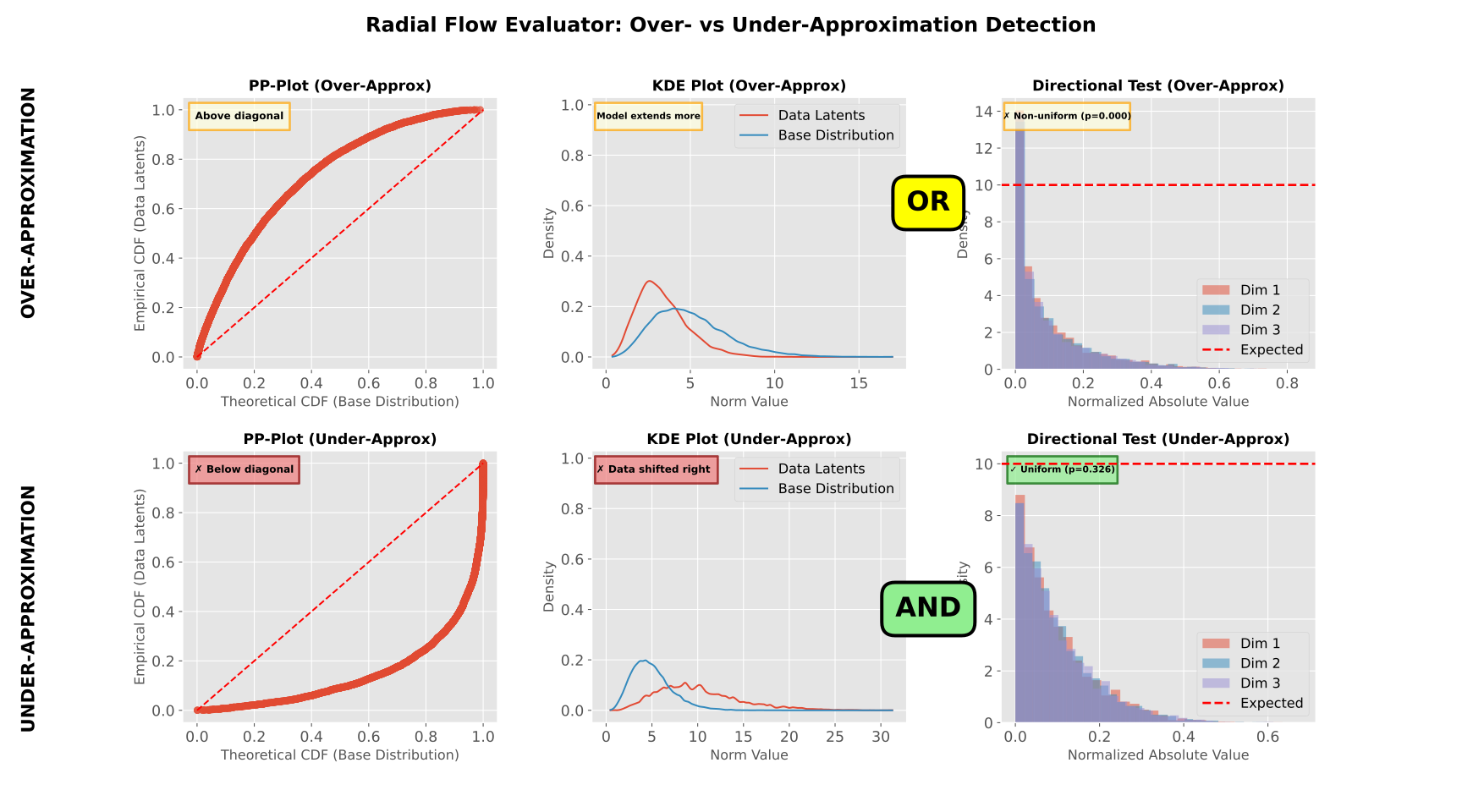
- fine-grained mismatch diagnostics that help distinguish over- vs. under-approximation of density level sets.
Installation
Assuming the package is published on PyPI:
pip install cjd-flowsApplications
CJD-Flows is intended as a general-purpose density-modeling library. We are currently expanding application examples and will add more soon.
Example: Neural network verification
One current use case is verification with distribution-aware input restrictions:
- train a US flow as a proxy density model of valid inputs,
- define latent upper density level sets (UDLs),
- map these sets through the flow to input-space constraints,
- verify properties (e.g., robustness/fairness) over likely inputs.
This turns flow density estimates into practically usable constraints for symbolic and abstract verification pipelines.
Example: Anomaly detection
Because the Jacobian determinant is constant, latent norms are monotone in the data density: a sample is anomalous exactly when its latent representation falls outside a chosen norm level set. This gives calibrated, threshold-based anomaly scores directly from the latent space — no likelihood-ratio tricks required. High-capacity conditioners such as JetConditioner can be used freely here, since piecewise affinity is not needed for this use case.
Experiments
The repository includes a lightweight YAML-based experiment framework.
python scripts/run-experiment.py --config <config file> --report_dir <log dir>Acknowledgment

The Bavarian AI Act Accelerator is a two-year project funded by the Bavarian State Ministry of Digital Affairs to support SMEs, start-ups, and the public sector in Bavaria in complying with the EU AI Act. Under the leadership of the appliedAI Institute for Europe and in collaboration with Ludwig Maximilian University, the Technical University of Munich, and the Technical University of Nuremberg, training, resources, and events are being offered. The project objectives include reducing compliance costs, shortening the time to compliance, and strengthening AI innovation. To achieve these objectives, the project is divided into five work packages: project management, research, education, tools and infrastructure, and community.


