
[EMNLP 25] An effective and interpretable weight-editing method for mitigating overly short reasoning in LLMs, and a mechanistic study uncovering how reasoning length is encoded in the model’s representation space.
ThinkEdit
This is the official repository for the paper: ThinkEdit: Interpretable Weight Editing to Mitigate Overly Short Thinking in Reasoning Models. Here is our 5 min read project website.
🆕 Updates
- 2025/08/20 — 🎉 Our paper has been accepted to EMNLP 2025 main conference!
- 2025/06/06 — 🚀 Released improved ThinkEdit models with 4% short reasoning heads edited and introduced the larger ThinkEdit-deepseek-qwen-32b model. Please see our updated paper.
Overview
Set Up
pip install -r requirements.txtIf you want to skip all the steps and directly access the resulting output files, you can download them through:
gdown https://drive.google.com/uc?id=135ttUxdNc4gQkmbZlpr3ecbhA3_392PEunzip ThinkEdit.zipSteer along Reasoning Length Direction
Step 1: Generate responses for probing from GSM8k
First, collect the responses from the reasoning models and store them in responses/ for extracting hidden states later:
python generate response_gsm8k.pySpecify the --model argument: deepseek-qwen-1.5b, deepseek-llama3-8b, deepseek-qwen-14b, deepseek-qwen-32b.
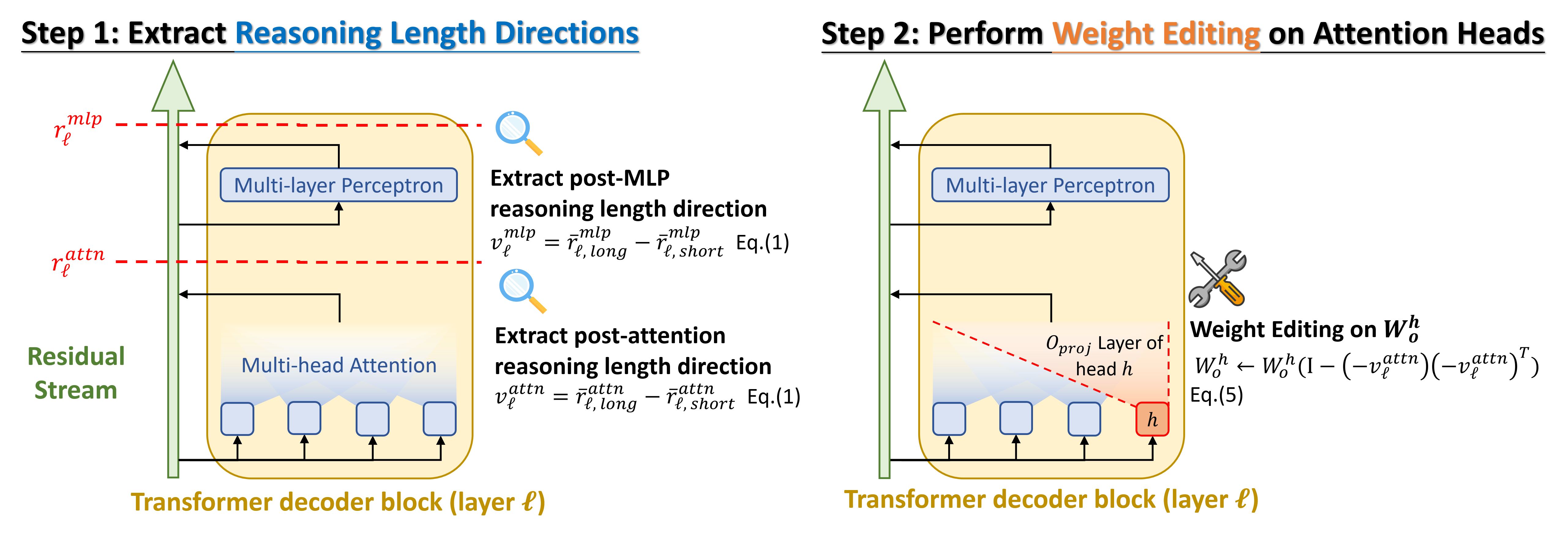
Step 2: Extract the Reasoning Length Direction
Next, extract the layerwise directions from Self-Attn or MLP and store them in directions/:
python extractthinkinglengthdirectiongsm8kattn.py
python extractthinkinglengthdirectiongsm8kmlp.py
Specify the --model argument: deepseek-qwen-1.5b, deepseek-llama3-8b, deepseek-qwen-14b, deepseek-qwen-32b.
Step 3: Steer the reasoning length of the models
Finally, steer the models with the directions and observe changes in accuracy and reasoning length. To evaluate on 200 test examples from gsm8k and store the results in gsm8kalllayerthinkinglengthsteeringresults/:
python thinkinglengthsteering_gsm8k.pySpecify the --model argument: deepseek-qwen-1.5b, deepseek-llama3-8b, deepseek-qwen-14b, deepseek-qwen-32b.
--control argument options: thinkinglengthattn, thinkinglengthmlp.
The steering strength alpha (--direction_weight): we use -0.08 -0.07 ... 0.07 0.08 in our paper.
Similarly, to evaluate 140 Level-5 examples from MATH and store the results in mathlevel5alllayerthinkinglengthsteering_results/:
python thinkinglengthsteeringmathlevel6.pySpecify arguments accordingly.
To steer only one layer each time and store the results in gsm8klayerwisethinkinglengthsteering_results/:
python thinkinglengthlayerwisesteeringgsm8k.pySpecify arguments accordingly. Use --layer to specify the layer and set --directionweight to -1 or 1 (as in our paper). Running the layerwise analysis can take considerable time. We suggest using automatelayerwisesteeringjobs.sh to handle the jobs; please modify the script based on your hardware.
ThinkEdit models: Weight editing short reasoning heads
Step 1: Find the short reasoning heads
First, identify the short reasoning heads by calculating their per-head contribution to the short reasoning direction:
python findshortthinkingattnheads.pySpecify the --model argument: deepseek-qwen-1.5b, deepseek-llama3-8b, deepseek-qwen-14b, deepseek-qwen-32b.
This will output a list of short reasoning heads and a heatmap figure of every head's contribution.
Step 2: Perform Weight Editing
Next, perform weight editing to the oproj layer of the short reasoning heads and store the model under ThinkEditmodels/:
python getThinkEditmodels.pySpecify the --model argument: deepseek-qwen-1.5b, deepseek-llama3-8b, deepseek-qwen-14b, deepseek-qwen-32b.
We have provided ThinkEdit models on the Huggingface repo:
- cesun/ThinkEdit-deepseek-qwen-32b
- cesun/ThinkEdit-deepseek-qwen-14b
- cesun/ThinkEdit-deepseek-llama3-8b
- cesun/ThinkEdit-deepseek-qwen-1.5b
Step 3: Evaluate the performance of the ThinkEdit models
Finally, evaluate the performance of the original and ThinkEdit models and store the results under ThinkEditmodelevaluation_results/. We use vllm to speed up evaluation:
CUDAVISIBLEDEVICES={your available gpus} python evaluateThinkEditmodels.pySpecify the --model argument: deepseek-qwen-32b, deepseek-qwen-14b, deepseek-llama3-8b, deepseek-qwen-1.5b, ThinkEdit-deepseek-qwen-32b, ThinkEdit-deepseek-qwen-14b, ThinkEdit-deepseek-llama3-8b, ThinkEdit-deepseek-qwen-1.5b.
--dataset argument: gsm8k, mmluelementarymath, MATH-500, MATH-level1, MATH-level5.
--n_samples argument: we set this to 10 in our paper, meaning each question is evaluated 10 times.
--tensorparallelsize argument: set this according to your number of GPUs; it should be a factor of the number of attention heads in each model. We recommend setting it to 4.
After you have all the results, run:
python analyzeThinkEditperformance.pyto generate the plots and tables presented in our paper. You can expect output similar to the results shown below.
Results
1. Overall Accuracy
| Model | GSM8K | MMLU Elem. | MATH-Lv1 | MATH-Lv5 | MATH500 | |---------------------------------|---------------------|----------------------|---------------------|---------------------|---------------------| | ds-qwen-32b | 92.97 ± 0.39 | 95.93 ± 0.83 | 96.41 ± 0.45 | 91.27 ± 0.53 | 91.62 ± 0.58 | | ThinkEdit-ds-qwen-32b | 95.25 ± 0.25 | 98.02 ± 0.31 | 96.02 ± 0.42 | 91.31 ± 0.50 | 91.60 ± 0.65 | | ds-qwen-14b | 90.80 ± 0.36 | 95.08 ± 0.65 | 96.32 ± 0.35 | 90.25 ± 0.72 | 91.48 ± 0.55 | | ThinkEdit-ds-qwen-14b | 93.78 ± 0.50 | 96.56 ± 0.84 | 96.38 ± 0.52 | 91.03 ± 0.44 | 91.92 ± 0.63 | | ds-llama3-8b | 82.26 ± 0.91 | 96.01 ± 0.62 | 93.46 ± 0.84 | 85.49 ± 0.83 | 87.26 ± 1.16 | | ThinkEdit-ds-llama3-8b| 89.44 ± 0.55 | 96.19 ± 0.73 | 94.44 ± 0.31 | 86.49 ± 0.54 | 88.06 ± 1.09 | | ds-qwen-1.5b | 79.15 ± 1.08 | 68.52 ± 1.56 | 93.00 ± 0.33 | 75.48 ± 0.90 | 82.22 ± 1.29 | | ThinkEdit-ds-qwen-1.5b| 84.56 ± 0.79 | 90.66 ± 0.97 | 93.66 ± 0.62 | 75.05 ± 0.82 | 82.24 ± 0.89 |
2. Accuracy on Short Reasoning Cases (Top 5% / 10% / 20%)
| Model | GSM8K | MMLU Elem. | MATH-Lv1 | MATH-Lv5 | MATH500 | |---------------------------------|---------------------------------|----------------------------------|----------------------------------|----------------------------------|----------------------------------| | ds-qwen-32b | 98.31 / 97.18 / 96.20 | 97.78 / 97.03 / 95.87 | 100.00 / 100.00 / 98.97 | 93.03 / 96.36 / 97.35 | 86.40 / 92.00 / 94.00 | | ThinkEdit-ds-qwen-32b | 98.92 / 97.71 / 97.83 | 97.78 / 97.57 / 97.20 | 100.00 / 100.00 / 98.74 | 98.03 / 98.64 / 97.99 | 92.00 / 94.40 / 95.80 | | ds-qwen-14b | 96.31 / 95.65 / 92.93 | 93.89 / 96.22 / 95.60 | 99.52 / 99.30 / 97.70 | 89.39 / 94.32 / 96.25 | 86.40 / 91.40 / 93.50 | | ThinkEdit-ds-qwen-14b | 96.31 / 96.18 / 96.77 | 97.78 / 95.14 / 96.53 | 99.53 / 98.62 / 98.67 | 96.67 / 97.88 / 98.11 | 91.20 / 93.20 / 95.00 | | ds-llama3-8b | 88.92 / 87.18 / 85.82 | 97.22 / 96.49 / 96.80 | 97.14 / 94.88 / 94.83 | 78.64 / 88.79 / 93.41 | 82.00 / 81.40 / 88.30 | | ThinkEdit-ds-llama3-8b| 97.08 / 95.27 / 93.95 | 97.78 / 98.65 / 97.87 | 100.00 / 99.30 / 98.62 | 95.61 / 96.89 / 97.12 | 92.80 / 93.60 / 94.40 | | ds-qwen-1.5b | 88.46 / 87.48 / 85.02 | 62.78 / 62.16 / 60.53 | 97.62 / 95.12 / 93.91 | 91.52 / 95.00 / 95.72 | 82.40 / 89.80 / 93.40 | | ThinkEdit-ds-qwen-1.5b| 92.62 / 92.90 / 92.32 | 87.78 / 88.11 / 88.67 | 95.71 / 95.58 / 96.44 | 95.15 / 96.59 / 97.27 | 90.80 / 92.00 / 94.20 |
Cite this work
Chung-En Sun, Ge Yan, Tsui-Wei Weng, "ThinkEdit: Interpretable Weight Editing to Mitigate Overly Short Thinking in Reasoning Models", EMNLP 2025
@article{ThinkEdit,
   title={ThinkEdit: Interpretable Weight Editing to Mitigate Overly Short Thinking in Reasoning Models},
   author={Sun, Chung-En and Yan, Ge and Weng, Tsui-Wei},
   journal={EMNLP},
   year={2025}
}


