
Source code of paper "RLCSD: Reinforcement Learning with Contrastive On-Policy Self-Distillation"
RLCSD: Reinforcement Learning with Contrastive On-Policy Self-Distillation


On-policy self-distillation (OPSD) gives reasoning models dense, token-level supervision by aligning a model's own distribution with the distribution it produces under a privileged context (typically a verified solution). We show that this distributional gap is dominated by style tokens rather than task-bearing tokens — a pathology we call privilege-induced style drift, which destabilizes training and collapses response length.
RLCSD removes this drift by **contrasting the teacher–student gap under a correct hint against the gap under a wrong hint** produced under an identical prompt template. The shared stylistic component cancels in the subtraction, leaving a token-level signal that is more concentrated on task-bearing tokens. We then integrate this signal into GRPO as a verifier-anchored modulation of the outcome advantage, instead of a replacement for it. On Qwen3 (1.7B / 4B / 8B) and Olmo-3-7B-Think, across DeepMath (AMC23 / AIME24 / AIME25) and Knights & Knaves, RLCSD **consistently outperforms GRPO and every prior OPSD baseline we tested**, while keeping training dynamics stable where existing methods either explode or collapse.

Method overview
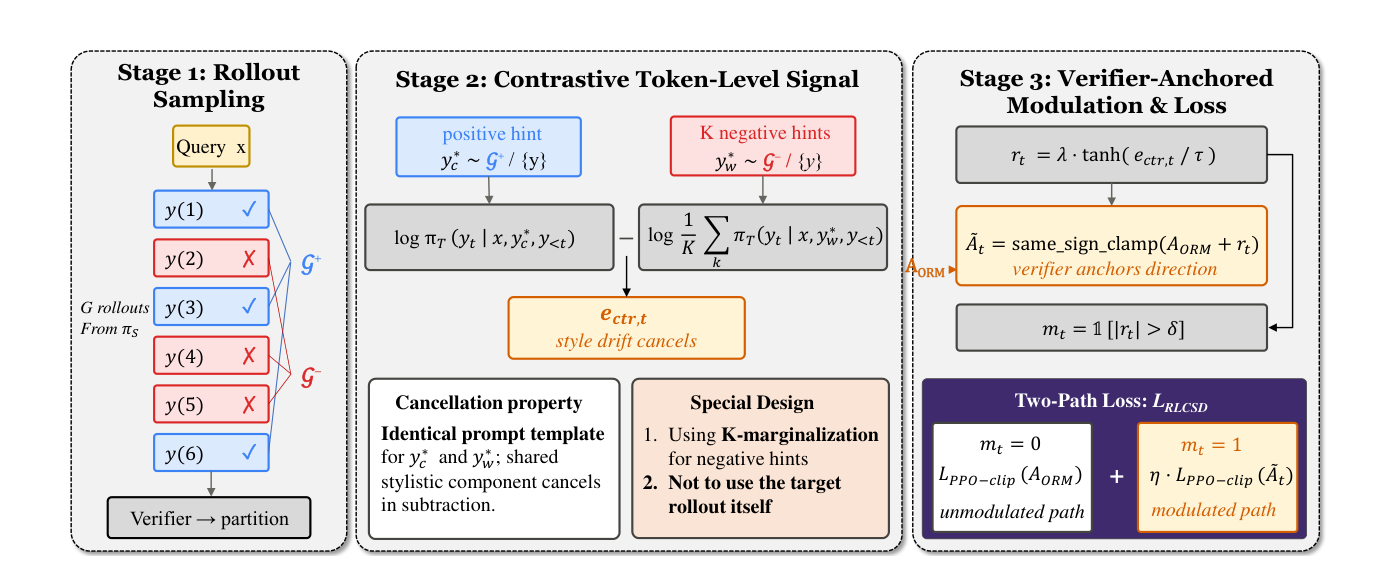
For each query we run three stages:
- Rollout sampling and partitioning. Sample G rollouts from the student
- Contrastive token-level signal. Draw a positive hint y\*c from
ectr,t = log πT(yt | x, yc, y<t) − log (1/K) Σk πT(yt | x, y{w,k}, y<t)Two refinements matter: (i) K-marginalize the negative branch to stay robust against error-type mismatch between the target rollout and the sampled negative, and (ii) **exclude the target rollout from the hint pool** to avoid self-conditioning over-confidence.
- Verifier-anchored modulation & two-path loss. Convert ectr,t
See the paper for derivations of (1)–(3) and ablations on each design choice.
Methods supported in this repo
Each YAML config selects a method via the method: key. Implementations live in thirdparty/verl/verl/trainer/ppo/corealgos.py (loss) and src/selfdistillmain.py (RLCSD/ECTR rollout-side data path).
| Key | Method | Reference | |--------------|------------------------------------------------------------------------------------------|----------------------------------------------------------------------------| | grpo | Group Relative Policy Optimization — verifier-only RLVR baseline. | Shao et al., 2024 — arXiv:2402.03300 | | opsd | On-policy self-distillation with dense forward-KL distillation and per-token KL clipping. | Zhao et al., 2026 — arXiv:2601.18734 | | sdpo | Dense distillation using Jensen–Shannon divergence (mode-balancing variant of OPSD). | Hübotter et al., 2026 — arXiv:2601.20802 | | srpo | Sample-level routing: GRPO on correct rollouts, SDPO-style distillation on failed ones. | Li et al., 2026 — arXiv:2604.02288 | | rlsd | Per-token sampled-token distillation gap used to modulate AORM. | Yang et al., 2026 — arXiv:2604.03128 | | rlcsd | This work — contrastive cancellation across symmetric positive/negative hints, then K-marginalized and integrated as a verifier-anchored AORM modulation. | this repo | | opsd_ectr | OPSD + the contrastive construction grafted onto its dense distillation target (plug-in study, §4.3 of the paper). | this repo | | rlsd_ectr | RLSD + the contrastive construction grafted onto its scalar modulation (plug-in study, §4.3 of the paper). | this repo |
The two _ectr variants are not new training methods on their own; they exist to show that the contrastive principle behind RLCSD is general — see Contrastive hints as a plug-in component below.
Repo layout
src/
  selfdistillmain.py     RLCSD / OPSD / SDPO / RLSD / SRPO trainer entry
  verl_main.py             Legacy non-verl trainer (kept for reference)
  losses.py                generalizedjsdloss / sdpoloss / rlsdloss
  verl_reward.py           Custom reward function used by verl
  opsd_format.py           Prompt template + privileged-context wrapping
  data_utils.py / prompts.py / models.py
configs/
  mathdeepmath/           {model}{algo}.yaml  (4 models × 6 algos + 4B-only ectr)
  logic_kk/                same layout
scripts/
  runverl.sh             Launcher: reads a YAML and runs the right entry
  mathdeepmath/run*.sh   Per-config shims
  logickk/run*.sh
  download_data.py         Pull train/eval parquets from HuggingFace
third_party/verl/          Vendored verl with the RLCSD policy losses registered
assets/                    Figures from the paper used in this README
requirements.txt
Install
# Recommended: a fresh Python 3.10–3.12 env
pip install -r requirements.txt
A few practical notes:
requirements.txtpinstorch>=2.5.0,<2.10to keep a CUDA 12 toolchain.
pip install "torch>=2.5.0,<2.10" --index-url https://download.pytorch.org/whl/cu126flash-attnbuilds against the installed torch — use
pip install flash-attn --no-build-isolation if pip's build env can't find torch.
thirdparty/verl/is added toPYTHONPATHautomatically byrun_verl.sh.
Data
Training and eval parquets live at Leyiii/RLCSD. Pull everything in one shot:
python scripts/download_data.py --allThis writes to data/verl/<dataset>/{train,val}.parquet. The launcher resolves paths under that root.
| Dataset | Used by | |--------------------------------------|------------------------------------| | deepmathfilteredlevel5_7 | Qwen3-1.7B (math train) | | deepmathfilteredlevel6_8 | Qwen3-4B (math train) | | deepmathfilteredlevel7_10 | Qwen3-8B + Olmo3-7B (math train) | | amc23+aime24+aime25 | math eval | | kk_4to8 | logic train (Knights & Knaves 4–8) | | kk4to8test+kk9+kk10+kk_11 | logic eval (ID 4–8 + OOD 9–11) |
Training data subsets come from filtering DeepMath-103K (He et al., 2025) by difficulty band. The Knights & Knaves generator follows Logic-RL (Xie et al., 2025).
Run
# RLCSD on Qwen3-4B, math reasoning
bash scripts/mathdeepmath/runqwen34brlcsd.sh
SDPO baseline on Olmo3-7B-Think, logic puzzles
bash scripts/logickk/runolmo37bthink_sdpo.sh
Each shim is a one-liner that forwards a config to scripts/runverl.sh. To override individual hyperparameters, append Hydra-style overrides:
bash scripts/mathdeepmath/runqwen34brlcsd.sh learningrate=2e-6 groupsize=16Common environment overrides:
SWANLABAPIKEY— for swanlab logging (setuse_swanlab: truein configs)HF_ENDPOINT— e.g.https://hf-mirror.comfor a HuggingFace mirrorCUDA_HOME— defaults to/usr/local/cuda-12.6
Results
Main results across model scales
RLCSD attains the strongest average performance in every model block and wins most individual benchmarks across Qwen3 scales and Olmo-3-7B. The gains over the Base model average +4.3 (math) and +10.9 (logic) at 1.7B; +2.5 / +6.8 at 4B; +2.7 / +14.4 at 8B; and +1.8 / +9.9 on Olmo-3-7B. The advantage is especially pronounced on the OOD Knights & Knaves splits (+21.0 on 11-role at 8B; +13.0 on 11-role with Olmo-3-7B), suggesting the cleaned token-level signal improves generalization rather than just fitting the training task difficulty.
| Model | Method | AMC23 | AIME24 | AIME25 | Math Avg. | KK 4–8 | KK 9 | KK 10 | KK 11 | Logic Avg. | |-------------|-----------------|------:|-------:|-------:|----------------:|-------:|-----:|------:|------:|----------------:| | Qwen3-1.7B | Base | 74.1 | 48.3 | 33.3 | 51.9 | 63.2 | 53.0 | 43.0 | 31.0 | 47.6 | | | GRPO | 76.6 | 51.6 | 37.2 | 55.1 | 67.4 | 59.0 | 52.0 | 34.0 | 53.1 | | | OPSD | 76.3 | 50.8 | 37.7 | 54.9 | 64.4 | 55.0 | 52.0 | 32.0 | 50.9 | | | SDPO | 72.9 | 42.2 | 33.6 | 49.6 | 67.4 | 61.0 | 54.0 | 30.0 | 53.1 | | | SRPO | 73.2 | 43.6 | 34.4 | 50.4 | 64.4 | 58.0 | 47.0 | 33.0 | 50.6 | | | RLSD | 73.9 | 46.1 | 36.9 | 52.3 | 66.8 | 59.0 | 50.0 | 35.0 | 52.7 | | | RLCSD (ours)| 77.2 | 53.1 | 38.3 | 56.2 (+4.3) | 70.0 | 63.0 | 63.0 | 38.0 | 58.5 (+10.9) | | Qwen3-4B | Base | 88.6 | 72.5 | 65.3 | 75.5 | 73.2 | 67.0 | 58.0 | 42.0 | 60.1 | | | GRPO | 89.1 | 75.8 | 66.1 | 77.0 | 75.4 | 71.0 | 61.0 | 45.0 | 63.1 | | | OPSD | 89.4 | 74.2 | 67.5 | 77.0 | 73.4 | 71.0 | 62.0 | 42.0 | 62.1 | | | SDPO | 88.3 | 68.3 | 64.4 | 73.7 | 74.4 | 72.0 | 62.0 | 45.0 | 63.4 | | | SRPO | 87.9 | 71.4 | 64.7 | 74.7 | 75.0 | 71.0 | 61.0 | 45.0 | 63.0 | | | RLSD | 86.9 | 71.2 | 66.9 | 75.0 | 76.8 | 72.0 | 63.0 | 48.0 | 65.0 | | | RLCSD (ours)| 90.1 | 74.4 | 69.4 | 78.0 (+2.5) | 78.6 | 73.0 | 66.0 | 50.0 | 66.9 (+6.8) | | Qwen3-8B | Base | 88.8 | 74.2 | 66.9 | 76.6 | 72.4 | 67.0 | 55.0 | 44.0 | 59.6 | | | GRPO | 90.1 | 76.1 | 69.7 | 78.6 | 76.8 | 75.0 | 63.0 | 49.0 | 66.0 | | | OPSD | 90.4 | 76.9 | 68.7 | 78.7 | 75.2 | 74.0 | 61.0 | 49.0 | 64.8 | | | SDPO | 88.8 | 76.1 | 65.6 | 76.8 | 72.4 | 72.0 | 56.0 | 46.0 | 61.6 | | | SRPO | 88.3 | 75.3 | 65.6 | 76.4 | 74.8 | 72.0 | 60.0 | 49.0 | 64.0 | | | RLSD | 88.7 | 75.5 | 67.2 | 77.1 | 76.6 | 77.0 | 64.0 | 52.0 | 67.4 | | | RLCSD (ours)| 90.8 | 77.5 | 69.7 | 79.3 (+2.7) | 81.8 | 79.0 | 70.0 | 65.0 | 74.0 (+14.4) | | Olmo-3-7B | Base | 91.2 | 73.9 | 66.9 | 77.3 | 70.6 | 64.0 | 55.0 | 35.0 | 56.2 | | | GRPO | 92.4 | 75.8 | 68.9 | 79.0 | 73.8 | 69.0 | 63.0 | 39.0 | 61.2 | | | OPSD | 92.2 | 75.6 | 66.9 | 78.2 | 72.4 | 69.0 | 62.0 | 38.0 | 60.4 | | | SDPO | 91.6 | 74.2 | 67.4 | 77.7 | 73.2 | 67.0 | 59.0 | 46.0 | 61.3 | | | SRPO | 92.1 | 75.0 | 65.3 | 77.5 | 73.2 | 68.0 | 61.0 | 40.0 | 60.6 | | | RLSD | 92.6 | 74.7 | 66.9 | 78.1 | 73.8 | 65.0 | 61.0 | 38.0 | 59.4 | | | RLCSD (ours)| 92.7 | 76.1 | 68.6 | 79.1 (+1.8) | 75.4 | 76.0 | 65.0 | 48.0 | 66.1 (+9.9) |
Math is reported as mean@12; Knights & Knaves as pass@1. KK 4–8 is the in-distribution test set; 9 / 10 / 11 are out-of-distribution role counts.
Training stability
Existing OPSD methods exhibit two characteristic failure modes:
- Entropy explosion → training collapse. OPSD, SDPO, and SRPO produce
- Premature length shrinkage. RLSD steadily decreases response length on
RLCSD keeps both entropy and response length stable throughout training while achieving stronger final validation performance:

Contrastive hints as a plug-in component
The contrastive construction is not specific to RLCSD. Applying it on top of two representative methods from different families — OPSD (dense distillation) and RLSD (advantage modulation) — improves every method on nearly every metric.
Concretely, for each method we vary only the source of the privileged signal and hold everything else fixed:
- Dataset CoT — privileged context is the ground-truth solution from the
- Own correct rollout — privileged context is a correct rollout sampled
- Own rollout + contrast — the contrastive construction (correct rollout
*_ectr and rlcsd use.
Settings (1) and (2) perform essentially the same across all three methods — switching the source of the one-sided hint barely matters. Setting (3) is the one that wins. Δ below is the **gain of (3) over the better of (1) and (2)**, averaged across benchmarks (Math = AMC23 + AIME24 + AIME25 mean@12, KK = 4–8 + 9 + 10 + 11 pass@1, Qwen3-4B):
| Method | Δ (Math avg) | Δ (KK avg) | |---------|-------------:|-----------:| | OPSD | +0.2 | +2.3 | | RLSD | +2.2 | +1.0 | | RLCSD | +3.0 | +5.4 |
opsd_ectr — OPSD + contrastive token-level signal. Without contrast, OPSD's actor entropy explodes in the late stage (the failure mode above); adding the contrastive hint keeps entropy bounded and yields a stable training reward.

rlsd_ectr — RLSD + contrastive evidence ratio. The contrastive signal mitigates the length collapse seen in vanilla RLSD on math (left panel below). The right panel is an RLCSD ablation: removing the contrast from RLCSD reproduces the same length-collapse pathology, confirming that the contrastive construction is what keeps RLCSD's reasoning traces from shrinking.

These plug-in results are reported only on Qwen3-4B in the paper, and only those configs ship here (configs/{mathdeepmath,logickk}/qwen34bopsd_ectr.yaml and qwen34brlsd_ectr.yaml).
Built on verl
The vendored fork under third_party/verl/ is based on verl (Sheng et al., 2024). RLCSD-specific extensions live in:
thirdparty/verl/verl/trainer/ppo/corealgos.py— new policy losses
@registerpolicyloss("rlcsd" | "opsdectr" | "rlsdectr")
third_party/verl/verl/workers/{actor,utils}/— minor plumbing for the
Citation
If you use this code or the released RLCSD method, please cite:
@article{pan2026rlcsd,
  title={RLCSD: Reinforcement Learning with Contrastive On-Policy Self-Distillation},
  author={Pan, Leyi and Tao, Shuchang and Zhai, Yunpeng and Zhang, Lingzhe and Liu, Zhaoyang and Ding, Bolin and Liu, Aiwei and Wen, Lijie},
  journal={arXiv preprint arXiv:2606.11709},
  year={2026}
}


