
Volume spike detector for Solana. Finds tokens with unusual DEX volume and uses Claude to classify organic vs manipulation.
Surge
Breakout-pressure engine for Solana tokens.
Find the Solana breakouts that still look tradable after the first sweep.
bun run dev
- watches buyer breadth, liquidity migration, refill quality, and venue concentration
- ignores one-wallet spikes and thin one-venue squeezes
- promotes setups that still have exitable depth after the initial burst


Live Breakout Pressure Board • Operating Surfaces • Why Surge Exists • Signal Ladder • Technical Spec • Quick Start
At a Glance
Use case: short-horizon breakout filtering for Solana tokensPrimary input: buyer breadth, liquidity migration, refill behaviorPrimary failure mode: optical spikes that become untradeable after the first sweepBest for: operators who need to know whether a move can still be exited cleanly
Live Breakout Pressure Board
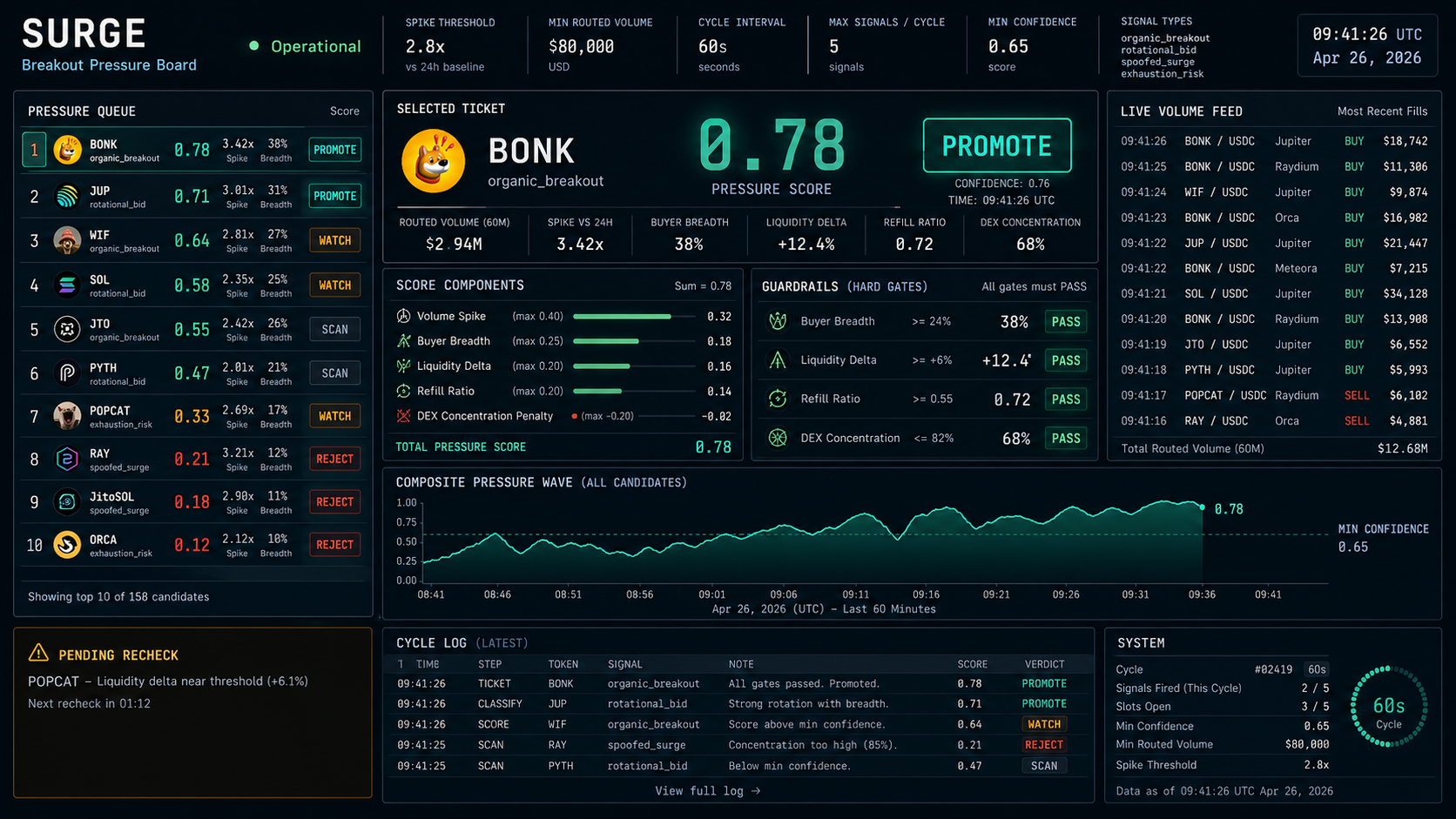
Live operating view for Surge: ranked candidate queue, Jupiter routed-volume feed, selected ticket with score components and four gates, composite pressure wave, and the agent's current PROMOTE, WATCH, SCAN, or REJECT decision.
Operating Surfaces
Breakout Board: ranks candidates by pressure quality instead of raw volumeFlow Components: exposes the inputs driving the breakout scoreCycle Log: shows why a name stayed eligible, moved to watch, or fell outTerminal Ticket: prints the exact setup the operator sees in the scan
What Surge Is Actually Trying To Solve
The average breakout scanner is too easy to fool. One wallet can force a candle, one venue can print a dramatic move, and social traders will still treat it as a "signal" because the chart looks urgent.
Surge is intentionally stricter than that. It assumes a move is fake until breadth, refill behavior, and exitable depth say otherwise. The point is not to catch every spike. The point is to keep attention on the spikes that still look tradeable after the first round of chasing is over.
Why Surge Exists
Most meme scanners fire on raw volume. That is the easy part. The useful distinction is whether the spike is broad enough and liquid enough to keep moving after the first burst.
Surge ranks each candidate with a continuation model:
breakoutScore = 0.34 spike + 0.24 breadth + 0.22 liquidity + 0.20 refill - 0.18 * concentrationPenalty
Signals are rejected when any of these fail:
buyerBreadthPct < MINBUYERBREADTH_PCTliquidityDeltaPct < MINLIQUIDITYDELTA_PCTrefillRatio < MINREFILLRATIOdexDominancePct > MAXDEXDOMINANCE_PCT
What Surge Looks For
The strongest Surge setup does not just print volume. It broadens. You want fresh takers, a book that keeps refilling, and enough depth growth that the move still looks tradeable after the first chase candle.
That is why Surge cares about participation quality more than dramatic candles. A break that only lives on one venue or one wallet cluster is usually too fragile to promote.
Signal Ladder
Surge pushes names through four practical states:
scan: the name is active, but the move still needs confirmationwatch: the move is real enough to track, but one component is still weakpromote: breadth, refill, and depth all support continuationreject: the move is too concentrated, too thin, or too late
How It Works
Surge follows a narrow sequence on every cycle:
- collect fresh routed volume from the monitored Solana pairs
- compare current flow against the rolling baseline
- test whether the move is broadening across buyers instead of concentrating
- check whether top-of-book depth and refill quality still support continuation
- rank the survivors and print the names worth watching
How A Real Scan Cycle Reads
A good Surge cycle usually feels boring before it feels exciting.
- Volume expansion starts to appear on one or two Solana venues.
- Surge checks whether that flow is broadening across more buyers instead of concentrating.
- The board looks for depth growth and refill behavior after the first sweep.
- Only after those pieces line up does the candidate move from scan to watch or promote.
What Generic Spike Scanners Miss
- they overvalue raw notional without checking who is actually buying
- they promote thin books where exiting becomes the real problem
- they fail to distinguish rotational flow from broad breakout participation
- they reward dramatic candles even when one venue is doing all the work
Example Output
SURGE // BREAKOUT PRESSURE TICKET
[PROMOTE] BONK pressure score     0.84 buyer breadth      34% liq delta          +10% refill ratio       0.71 dex concentration  60%
operator note: breadth is broad enough and refill held after the first sweep
Technical Spec
Inputs
spikeRatio: current routed volume divided by the rolling baselinebuyerBreadthPct: share of buying flow coming from many small and medium takers instead of one pocketliquidityDeltaPct: change in exitable top-of-book depth during the moverefillRatio: how much of the consumed book refills after each sweepdexDominancePct: how concentrated the move is on a single venue
Design Rationale
- High
spikeRatiowithout breadth is usually a one-pocket move. - Positive
liquidityDeltaPctmeans the market is still willing to make the pair. - Strong
refillRatioreduces late-entry fragility. - High
dexDominancePctincreases manipulation risk and lowers continuation odds.
Signal Types
organic_breakout: broad demand with healthy refill and growing depthrotational_bid: real inflow, but more sector rotation than full breakout participationspoofed_surge: concentrated or thin move that looks optically largeexhaustion_risk: strong move, but refill quality is fading into the push
Practical Interpretation Guide
When Surge Is Strong
- the top candidate still looks liquid after the first rush
- buyer participation keeps broadening instead of narrowing
- refill quality remains healthy while the move is underway
When Surge Stays Quiet
- there is size, but no buyer breadth
- the move only lives on one venue
- depth is being consumed faster than it can recover
Risk Controls
breadth gate: rejects moves with narrow buyer participationdepth gate: rejects moves that are growing price without growing exitable depthrefill gate: rejects names where the book does not recover after each sweepvenue gate: rejects single-venue dominance that makes the move too easy to manipulate
Quick Start
git clone https://github.com/SurgeDetect/Surge
cd Surge
npm install
cp .env.example .env
npm run dev
Configuration
ANTHROPICAPIKEY=sk-ant-...
SPIKE_THRESHOLD=2.8
MINVOLUMEUSD=80000
MINBUYERBREADTH_PCT=24
MINLIQUIDITYDELTA_PCT=6
MINREFILLRATIO=0.55
MAXDEXDOMINANCE_PCT=82
SCANINTERVALMS=60000
Why Traders Keep It Open
Surge is meant to be glanced at during noisy conditions. The board gives one clean question: if this move extends, will there still be enough market left to exit?
That framing matters more than raw breakout excitement. A lot of meme flow looks explosive for one minute and untradeable the next. Surge exists to cut that out.
Local Audit Docs
Support Docs
License
MIT


