
A communication toolkit for Go services.
kun
kun is a communication toolkit for Go services. It concentrates on handling the communications between Go services, to free developers to focus on the business logic.
Ultimately, kun may support the following communication types:
- In-process function call
- RPC (e.g., HTTP and gRPC)
- Asynchronous messaging
- Cron Jobs
The Zen of kun
- Focus on the most valuable things
Furthermore, it should be effortless to change the communication types.
- Write code in Go whenever possible
- Maintainability counts
Features
- Code Generation Tool
- Useful Packages
How it works
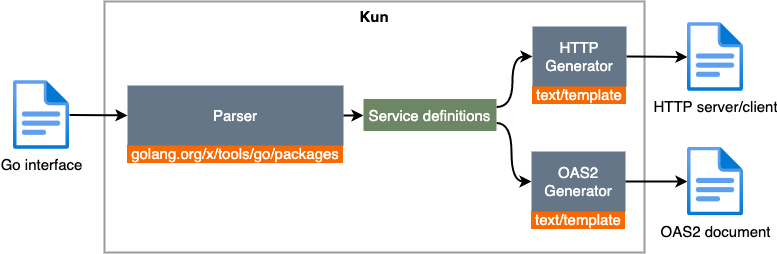
HTTP Generation
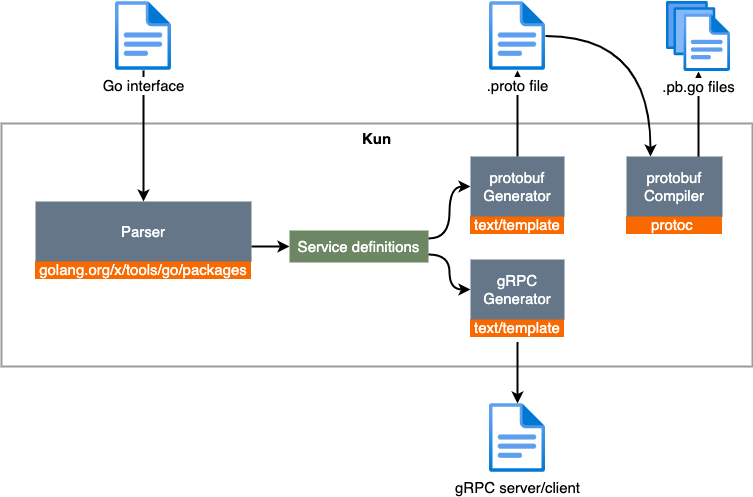
gRPC Generation
Installation
$ go install github.com/RussellLuo/kun/cmd/kungen@latest Usage
$ kungen -h
kungen [flags] source-file interface-name
  -flat
    	whether to use flat layout (default true)
  -fmt
    	whether to make code formatted (default true)
  -force
    	whether to remove previously generated files before generating new ones
  -out string
    	output directory (default ".")
  -snake
    	whether to use snake-case for default names (default true)
  -trace
    	whether to enable tracing
Quick Start
HTTP
NOTE: The following code is located in helloworld.
- Define the interface
type Service interface {
        SayHello(ctx context.Context, name string) (message string, err error)
}- Implement the service
type Greeter struct{}
func (g *Greeter) SayHello(ctx context.Context, name string) (string, error) {         return "Hello " + name, nil     }
- Add HTTP annotations
type Service interface {
        //kun:op POST /messages
        SayHello(ctx context.Context, name string) (message string, err error)
}- Generate the HTTP code
$ cd examples/helloworld
$ kungen ./service.go Service- Consume the service
$ go run cmd/main.go
    2020/09/15 18:06:22 transport=HTTP addr=:8080
Consume by HTTPie:
$ http POST :8080/messages name=Tracey
    HTTP/1.1 200 OK
    Content-Length: 27
    Content-Type: application/json; charset=utf-8
    Date: Tue, 15 Sep 2020 10:06:34 GMT
{         "message": "Hello Tracey"     }
- See the OAS documentation
(Click to expand)
$ http GET :8080/api
    HTTP/1.1 200 OK
    Content-Length: 848
    Content-Type: text/plain; charset=utf-8
    Date: Tue, 15 Sep 2020 10:08:24 GMT
swagger: "2.0"     info:       title: "No Title"       version: "0.0.0"       description: "Service is used for saying hello."       license:         name: "MIT"     host: "example.com"     basePath: "/"     schemes:       - "https"     consumes:       - "application/json"     produces:       - "application/json"
paths:       /messages:         post:           description: "SayHello says hello to the given name."           operationId: "SayHello"           parameters:             - name: body               in: body               schema:                 $ref: "#/definitions/SayHelloRequestBody"
produces:             - application/json; charset=utf-8           responses:             200:               description: ""               schema:                 $ref: "#/definitions/SayHelloResponse"
definitions:       SayHelloRequestBody:         type: object         properties:           name:             type: string       SayHelloResponse:         type: object         properties:           message:             type: string
gRPC
NOTE: The following code is located in helloworldgrpc.
- Define the interface
type Service interface {
        SayHello(ctx context.Context, name string) (message string, err error)
}- Implement the service
type Greeter struct{}
func (g *Greeter) SayHello(ctx context.Context, name string) (string, error) {         return "Hello " + name, nil     }
- Add gRPC annotations
type Service interface {
        //kun:grpc
        SayHello(ctx context.Context, name string) (message string, err error)
}- Generate the gRPC code
$ cd examples/helloworldgrpc
$ kungen ./service.go Service- Consume the service
$ go run cmd/main.go
    2020/09/15 18:06:22 transport=HTTP addr=:8080
Consume by grpcurl:
$ grpcurl -plaintext -d '{"name": "Tracey"}' :8080 pb.Service/SayHello
    {
      "message": "Hello Tracey"
    }
See more examples here.
HTTP
Annotations
Define the HTTP request operation
Directive //kun:op
Syntax
//kun:op <method> <pattern>If a Go method needs to correspond to more than one URI (or HTTP method), you can specify multiple //kun:op directives, which will produce multiple HTTP request operations.
Note that there are only three possible differences among these HTTP request operations:
- HTTP method
- URI
- Path parameters (defined in URI)
Arguments
- method: The request method.
- pattern: The request URI.
//kun:param.
Examples
- Single operation:
type Service interface {
        //kun:op DELETE /users/{id}
        DeleteUser(ctx context.Context, id int) (err error)
    }
// HTTP request:     // $ http DELETE /users/101
- Multiple operations:
type Service interface {
        //kun:op GET /messages/{messageID}
        //kun:op GET /users/{userID}/messages/{messageID}
        GetMessage(ctx context.Context, userID string, messageID string) (text string, err error)
    }
// See a runnable example in examples/messaging.
// HTTP request:     // $ http GET /messages/123456     // $ http GET /users/me/messages/123456
Define the HTTP request parameters
Directive //kun:param
Syntax
//kun:param <argName> [<parameter> [, <parameter2> [, ...]]]If multiple method arguments are involved, you may need to apply multiple bindings. This can be done by adding a new //kun:param directive, or by appending the binding to the end of the last //kun:param directive in a semicolon-separated list.
Arguments
- argName: The name of the method argument.
<parameter>s in a comma-separated list, multiple request parameters (each one is of basic type or repeated basic type) can be aggregated into one method argument (of any type).
+ Blank identifier: By specifying the argName with a double underscore prefix _, the corresponding request parameter(s) will not be mapped to any method argument. See here for more details.
- parameter: The definition of a single request parameter, to which the method argument will be mapped.
in=<in> name=<name> required=<required> type=<type> descr=<descr>
+ Options:
- in:
+ path: The request parameter is a path parameter.
- Optional: All variables in pattern will automatically be bound to their corresponding method arguments (match by names in lower camel case), as path parameters.
+ query: The request parameter is a query parameter.
- To receive values from a multi-valued query parameter, the method argument can be defined as a slice of basic type.
+ header: The request parameter is a header parameter.
- To receive values from a multi-valued header parameter, the method argument can be defined as a slice of basic type.
+ cookie: The request parameter is a cookie parameter.
- Not supported yet.
+ request: The request parameter is a property of Go's http.Request.
- This is a special case, and only one property RemoteAddr is available now.
- Note that parameters located in request have no relationship with OAS.
- name: The name of the request parameter.
+ Optional: Defaults to argName (snake-case, or lower-camel-case if -snake=false) if not specified.
- required: Determines whether this parameter is mandatory.
+ Optional: Defaults to false, if not specified.
+ If the parameter location is path, this property will be set to true internally, whether it's specified or not.
- type: The OAS type of the request parameter.
+ Optional: Defaults to the type of the method argument, if not specified.
- descr: The OAS description of the request parameter.
+ Optional: Defaults to "", if not specified.
Examples
- Bind request parameters to simple arguments:
type Service interface {
        //kun:op PUT /users/{id}
        //kun:param name in=header name=X-User-Name
        UpdateUser(ctx context.Context, id int, name string) (err error)
    }
// HTTP request:     // $ http PUT /users/101 X-User-Name:tracey
- Bind multiple request parameters to a struct according to tags:
type User struct {
        ID   int    kun:"in=path"  // name defaults to snake case id
        Name string kun:"in=query" // name defaults to snake case name
        Age  int    kun:"in=header name=X-User-Age"
    }
type Service interface {         //kun:op PUT /users/{id}         //kun:param user         UpdateUser(ctx context.Context, user User) (err error)     }
// HTTP request:     // $ http PUT /users/101?name=tracey X-User-Age:1
- Bind multiple query parameters to a struct with no tags:
type User struct {
        Name    string   // equivalent to kun:"in=query name=name"
        Age     int      // equivalent to kun:"in=query name=age"
        Hobbies []string // equivalent to kun:"in=query name=hobbies"
    }
type Service interface {         //kun:op POST /users         //kun:param user         CreateUser(ctx context.Context, user User) (err error)     }
// HTTP request:     // $ http POST /users?name=tracey&age=1&hobbies=music&hobbies=sport
- Argument aggregation:
type Service interface {
        //kun:op POST /logs
        //kun:param ip in=header name=X-Forwarded-For, in=request name=RemoteAddr
        Log(ctx context.Context, ip net.IP) (err error)
    }
// The equivalent annotations =>     // (using backslash-continued annotations)     type Service interface {         //kun:op POST /logs         //kun:param ip in=header name=X-Forwarded-For, \         //             in=request name=RemoteAddr         Log(ctx context.Context, ip net.IP) (err error)     }
// You must customize the decoding of ip later (conventionally in another file named codec.go).     // See a runnable example in examples/usersvc.
// HTTP request:     // $ http POST /logs
- Multiple bindings in a single
//kun:param:
type Service interface {
        //kun:op POST /users
        //kun:param name; age; ip in=header name=X-Forwarded-For, in=request name=RemoteAddr
        CreateUser(ctx context.Context, name string, age int, ip net.IP) (err error)
    }
// The equivalent annotations =>     // (using backslash-continued annotations)
type Service interface {         //kun:op POST /users         //kun:param name; \         //          age; \         //          ip in=header name=X-Forwarded-For, in=request name=RemoteAddr         CreateUser(ctx context.Context, name string, age int, ip net.IP) (err error)     }
// HTTP request:     // $ http POST /users?name=tracey&age=1
Define the HTTP request body
Directive //kun:body
Syntax
//kun:body <field>or
//kun:body <manipulation> [; <manipulation2> [; ...]]Arguments
- field: The name of the method argument whose value is mapped to the HTTP request body.
- can be used, to define that there is no HTTP request body. As a result, every argument, which is not located in path/query/header, will automatically be mapped to one or more query parameters.
- manipulation:
<argName> name=<name> type=<type> descr=<descr> required=<required>
+ Options:
- argName: The name of the method argument to be manipulated.
- name: The name of the request parameter.
+ Optional: Defaults to argName (snake-case, or lower-camel-case if -snake=false) if not specified.
- type: The OAS type of the request parameter.
+ Optional: Defaults to the type of the method argument, if not specified.
- descr: The OAS description of the request parameter.
+ Optional: Defaults to "", if not specified.
- required: Determines whether this parameter is mandatory.
+ Optional: Defaults to false, if not specified.
Examples
- Omitted:
type Service interface {
        //kun:op POST /users
        CreateUser(ctx context.Context, name string, age int) (err error)
    }
// HTTP request:     // $ http POST /users name=tracey age=1
- Specified as a normal argument:
type User struct {
        Name string json:"name"
        Age  int    json:"age"
    }
type Service interface {         //kun:op POST /users         //kun:body user         CreateUser(ctx context.Context, user User) (err error)     }
// HTTP request:     // $ http POST /users name=tracey age=1
- Specified as
-:
type User struct {
        Name    string
        Age     int
        Hobbies []string kun:"name=hobby"
    }
type Service interface {         //kun:op POST /users         //kun:body -         CreateUser(ctx context.Context, user User) (err error)     }
// HTTP request:     // $ http POST /users?name=tracey&age=1&hobby=music&hobby=sport
- Manipulation:
type Service interface {
        //kun:op POST /users
        //kun:body age name=user_age type=string descr='The user age'
        CreateUser(ctx context.Context, name string, age int) (err error)
    }
// HTTP request:     // $ http POST /users name=tracey user_age=1
Define the success HTTP response
Directive //kun:success
Syntax
//kun:success statusCode=<statusCode> body=<body> manip=<manipulation> [; <manipulation2> [; ...]]Arguments
- statusCode: The status code of the success HTTP response.
200, if not specified.
- body: The name of the response field whose value is mapped to the HTTP response body.
- manipulation:
<argName> name=<name> type=<type> descr=<descr>
+ Not supported yet.
Examples
type User struct {
    Name string json:"name"
    Age  int    json:"age"
}
type Service interface {     //kun:op POST /users     //kun:success statusCode=201 body=user     CreateUser(ctx context.Context) (user User, err error) }
Define the OAS metadata
Directive //kun:oas
Syntax
//kun:oas <property>=<value>Arguments
- property: The property to set. Supported properties:
"/api" if not specified.
+ title: The title field of Info Object, see Basic Structure.
- Optional: Defaults to "No Title" if not specified.
+ version: The version field of Info Object, see Basic Structure.
- Optional: Defaults to "0.0.0" if not specified.
+ description: The description field of Info Object, see Basic Structure.
- Unavailable: Automatically extracted from the Go documentation of the interface definition.
+ basePath: The basePath property, see API Host and Base URL.
+ tags: A list of tags (comma-separated), see Grouping Operations With Tags.
- value: The value of the property.
Examples
// This is the API documentation of User.
//kun:oas docsPath=/api-docs
//kun:oas title=User-API
//kun:oas version=1.0.0
//kun:oas basePath=/v1
//kun:oas tags=user
type Service interface {
    //kun:op POST /users
    CreateUser(ctx context.Context, name string, age int) (err error)
}
Define the annotation alias
Directive //kun:alias
Syntax
//kun:alias <name>=<value>Arguments
- name: The name of the alias.
- value: The string value that the alias represents.
Examples
type Service interface {
    //kun:op POST /users
    //kun:param operatorID in=header name=Authorization required=true
    CreateUser(ctx context.Context, operatorID int) (err error)
//kun:op DELETE /users/{id}     //kun:param operatorID in=header name=Authorization required=true     DeleteUser(ctx context.Context, id, operatorID int) (err error) }
// The equivalent annotations =>
//kun:alias opID=operatorID in=header name=Authorization required=true type Service interface {     //kun:op POST /users     //kun:param $opID     CreateUser(ctx context.Context, operatorID int) (err error)
//kun:op DELETE /users/{id}     //kun:param $opID     DeleteUser(ctx context.Context, id, operatorID int) (err error) }
Encoding and decoding
See the HTTP Codec interface.
Also see here for examples.
OAS Schema
See the OAS Schema interface.
gRPC
Annotations
Directive //kun:grpc
Syntax
//kun:grpc request=<request> response=<response>Arguments
- request: The name of the method argument, whose value will be mapped to the gRPC request.
- response: The name of the method result, whose value will be mapped to the gRPC response.
Examples
- Omitted:
type Service interface {
        //kun:grpc
        CreateUser(ctx context.Context, name string, age int) (err error)
    }
// gRPC request:     // $ grpcurl -d '{"name": "tracey", "age": 1}' ... pb.Service/CreateUser
- Specified:
type User struct {
        Name string json:"name"
        Age  int    json:"age"
    }
type Service interface {         //kun:grpc request=user         CreateUser(ctx context.Context, user User) (err error)     }
// gRPC request:     // $ grpcurl -d '{"name": "tracey", "age": 1}' ... pb.Service/CreateUser
Event
Annotations
Directive //kun:event
Syntax
//kun:event type=<type> data=<data>Arguments
- type: The type of the event.
-snake=false) if not specified.
- data: The name of the method argument whose value is mapped to the event data.
Examples
- Omitted:
type Service interface {
        //kun:event
        EventCreated(ctx context.Context, id int) (err error)
    }
// event: {"type": "event_created", "data": {"id": 1}}
- Specified:
type Data struct {
        ID int json:"id"
    }
type Service interface {         //kun:event type=created data=data         EventCreated(ctx context.Context, data Data) (err error)     }
// event: {"type": "created", "data": {"id": 1}}
Cron
Annotations
Directive //kun:cron
Syntax
//kun:cron name=<name> expr=<expr>Arguments
- name: The job name.
-snake=false) if not specified.
- expr: The cron expression.
Examples
- Name omitted:
type Service interface {
        //kun:cron expr='@every 5s'
        SendEmail(ctx context.Context) error
    }
// job: {"name": "send_email", "expr": "@every 5s"}
- Name specified:
type Service interface {
        //kun:cron name=send expr='@every 5s'
        SendEmail(ctx context.Context) error
    }
// job: {"name": "send", "expr": "@every 5s"}
Documentation
Checkout the [Godoc][5].
License
[1]: https://blog.cleancoder.com/uncle-bob/2012/08/13/the-clean-architecture.html [2]: https://swagger.io/specification/v2/ [3]: https://github.com/RussellLuo/appx [4]: https://pkg.go.dev/golang.org/x/net/trace [5]: https://pkg.go.dev/github.com/RussellLuo/kun


