
DEPRECATED, wifipumpkin3 -> https://github.com/P0cL4bs/wifipumpkin3
This repository is ⛔️ DEPRECATED, wifipumpkin3 is Released, checkout!



WiFi-Pumpkin - Framework for Rogue Wi-Fi Access Point Attack
Description
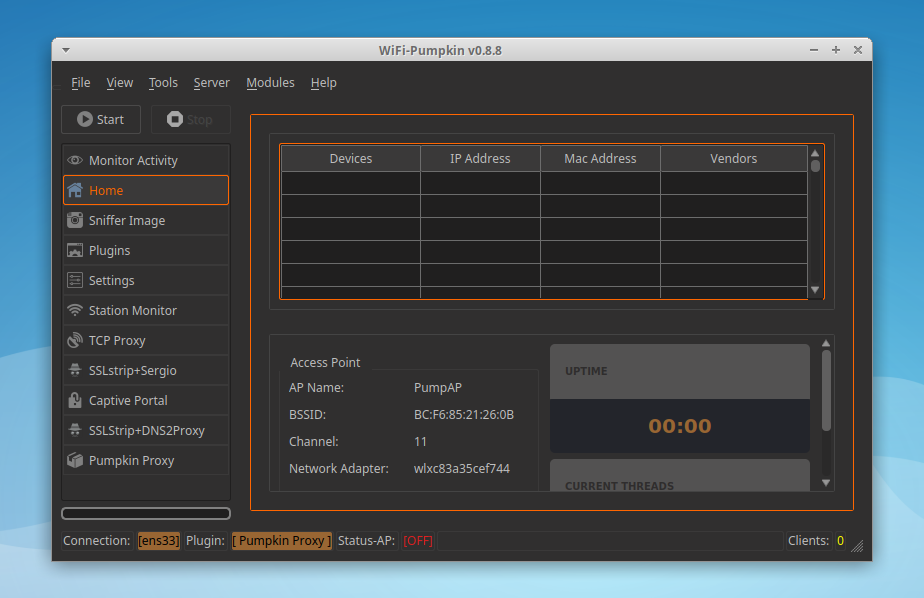
The WiFi-Pumpkin is a rogue AP framework to easily create these fake networks, all while forwarding legitimate traffic to and from the unsuspecting target. It comes stuffed with features, including rogue Wi-Fi access points, deauth attacks on client APs, a probe request and credentials monitor, transparent proxy, Windows update attack, phishing manager, ARP Poisoning, DNS Spoofing, Pumpkin-Proxy, and image capture on the fly. moreover, the WiFi-Pumpkin is a very complete framework for auditing Wi-Fi security check the list of features is quite broad.
Installation
- Python 2.7
git clone https://github.com/P0cL4bs/WiFi-Pumpkin.git
 cd WiFi-Pumpkin
 ./installer.sh --install
or download .deb file to install
sudo dpkg -i wifi-pumpkin-0.8.8-all.deb
sudo apt-get -f install # force install dependencies if not install normally
refer to the wiki for Installation
Features
- Rogue Wi-Fi Access Point
- Deauth Attack Clients AP
- Probe Request Monitor
- DHCP Starvation Attack
- Credentials Monitor
- Transparent Proxy
- Windows Update Attack
- Phishing Manager
- Partial Bypass HSTS protocol
- Support beef hook
- ARP Poison
- DNS Spoof
- Patch Binaries via MITM (BDF-Proxy)
- LLMNR, NBT-NS and MDNS poisoner (Responder)
- Pumpkin-Proxy (ProxyServer (mitmproxy API))
- Capture images on the fly
- TCP-Proxy (with scapy)
- Moduled plugins and proxys
- Wireless Mode support hostapd-mana/hostapd-karma attacks
- Capitve-portals [new]
Donation
paypal:

Via BTC:
1HBXz6XX3LcHqUnaca5HRqq6rPUmA3pf6f
Plugins
| Plugin | Description | | :----------------------------------------------------------- | :---------------------------------------------------------------------------------------------------------------------------------------------- | | Dns2proxy | This tools offer a different features for post-explotation once you change the DNS server to a Victim. | | Sstrip2 | Sslstrip is a MITM tool that implements Moxie Marlinspike's SSL stripping attacks based version fork @LeonardoNve/@xtr4nge. | | Sergioproxy | Sergio Proxy (a Super Effective Recorder of Gathered Inputs and Outputs) is an HTTP proxy that was written in Python for the Twisted framework. | | BDFProxy | Patch Binaries via MITM: BackdoorFactory + mitmProxy, bdfproxy-ng is a fork and review of the original BDFProxy @secretsquirrel. | | Responder | Responder an LLMNR, NBT-NS and MDNS poisoner. Author: Laurent Gaffie | | [PumpkinProxy]() | Intercepting HTTP data, this proxy server that allows to intercept requests and response on the fly | [CaptivePortals]() | Captive-Portal allow the Attacker block Internet access for users until they open the page login page where a password is required before being allowed to browse the web. |
Transparent Proxy
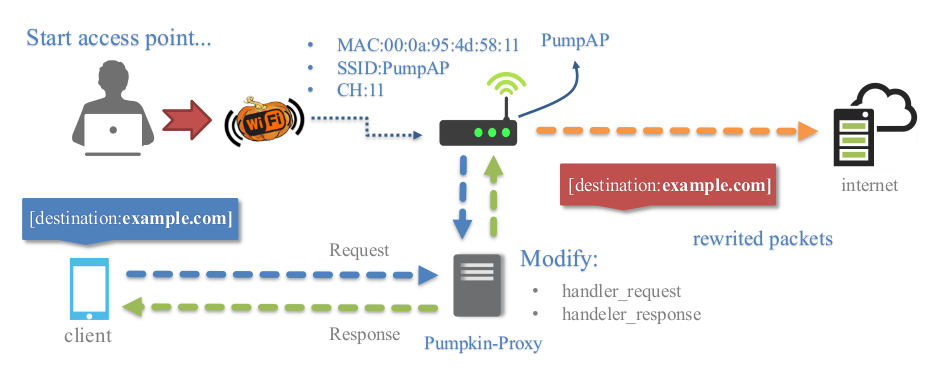
Transparent proxies(mitmproxy) that you can use to intercept and manipulate HTTP traffic modifying requests and responses, that allow to inject javascripts into the targets visited. You can easily implement a module to inject data into pages creating a python file in directory "plugins/extension/" automatically will be listed on Pumpkin-Proxy tab.
Plugins Example Dev
from mitmproxy.models import decoded # for decode content html
from plugins.extension.plugin import PluginTemplate
class Nameplugin(PluginTemplate):    meta = {        'Name'      : 'Nameplugin',        'Version'   : '1.0',        'Description' : 'Brief description of the new plugin',        'Author'    : 'by dev'    }    def init(self):        for key,value in self.meta.items():            self.dict[key] = value        # if you want set arguments check refer wiki more info.        self.ConfigParser = False # No require arguments
def request(self, flow):        print flow.dict        print flow.request.dict        print flow.request.headers.dict # request headers        host = flow.request.pretty_host # get domain on the fly requests        versionH = flow.request.http_version # get http version
# get redirect domains example        # pretty_host takes the "Host" header of the request into account,        if flow.request.pretty_host == "example.org":            flow.request.host = "mitmproxy.org"
# get all request Header example        self.send_output.emit("\n[{}][HTTP REQUEST HEADERS]".format(self.Name))        for name, valur in flow.request.headers.iteritems():            self.send_output.emit('{}: {}'.format(name,valur))
print flow.request.method # show method request        # the model printer data        self.send_output.emit('[NamePlugin]:: this is model for save data logging')
def response(self, flow):        print flow.dict        print flow.response.dict        print flow.response.headers.dict #convert headers for python dict        print flow.response.headers['Content-Type'] # get content type
#every HTTP response before it is returned to the client        with decoded(flow.response):            print flow.response.content # content html            flow.response.content.replace('</body>','<h1>injected</h1></body>') # replace content tag
del flow.response.headers["X-XSS-Protection"] # remove protection Header
flow.response.headers["newheader"] = "foo" # adds a new header        #and the new header will be added to all responses passing through the proxy
About plugins
plugins on the wiki
TCP-Proxy Server
A proxy that you can place between in a TCP stream. It filters the request and response streams with (scapy module) and actively modify packets of a TCP protocol that gets intercepted by WiFi-Pumpkin. this plugin uses modules to view or modify the intercepted data that possibly easiest implementation of a module, just add your custom module on "plugins/analyzers/" automatically will be listed on TCP-Proxy tab.
from scapy.all import *
from scapy_http import http # for layer HTTP
from default import PSniffer # base plugin class
class ExamplePlugin(PSniffer):     _activated     = False     _instance      = None     meta = {         'Name'      : 'Example',         'Version'   : '1.0',         'Description' : 'Brief description of the new plugin',         'Author'    : 'your name',     }     def init(self):         for key,value in self.meta.items():             self.dict[key] = value
@staticmethod     def getInstance():         if ExamplePlugin._instance is None:             ExamplePlugin._instance = ExamplePlugin()         return ExamplePlugin._instance
def filterPackets(self,pkt): # (pkt) object in order to modify the data on the fly         if pkt.haslayer(http.HTTPRequest): # filter only http request
http_layer = pkt.getlayer(http.HTTPRequest) # get http fields as dict type             ip_layer = pkt.getlayer(IP)# get ip headers fields as dict type
print http_layer.fields['Method'] # show method http request             # show all item in Header request http             for item in http_layer.fields['Headers']:                 print('{} : {}'.format(item,http_layer.fields['Headers'][item]))
print ip_layer.fields['src'] # show source ip address             print ip_layer.fields['dst'] # show destiny ip address
print http_layer # show item type dict             print ip_layer # show item type dict
return self.output.emit({'name_module':'send output to tab TCP-Proxy'})
About TCP-Proxy
TCP-Proxy on the wiki
About Captive Portals
the plugin Captive-Portal allow the Attacker mount a wireless access point which is used in conjuction with a web server and iptables traffic capturing rules to create the phishing portal. Users can freely connect to these networks without a password and will often be directed to a login page where a password is required before being allowed to browse the web.
Captive-portals on the wiki
Screenshots
Screenshot on the wiki
FAQ
FAQ on the wiki
Contact Us
Whether you want to report a bug, send a patch or give some suggestions on this project, drop us or open pull requests


