
VoxCPM2: Tokenizer-Free TTS for Multilingual Speech Generation, Creative Voice Design, and True-to-Life Cloning
VoxCPM2: Tokenizer-Free TTS for Multilingual Speech Generation, Creative Voice Design, and True-to-Life Cloning
English | 中文








👋 Join our community for discussion and support!
 Feishu |
  Discord
VoxCPM is a tokenizer-free Text-to-Speech system that directly generates continuous speech representations via an end-to-end diffusion autoregressive architecture, bypassing discrete tokenization to achieve highly natural and expressive synthesis.
VoxCPM2 is the latest major release — a 2B parameter model trained on over 2 million hours of multilingual speech data, now supporting 30 languages, Voice Design, Controllable Voice Cloning, and 48kHz studio-quality audio output. Built on a MiniCPM-4 backbone.
✨ Highlights
- 🌍 30-Language Multilingual — Input text in any of the 30 supported languages and synthesize directly, no language tag needed
- 🎨 Voice Design — Create a brand-new voice from a natural-language description alone (gender, age, tone, emotion, pace …), no reference audio required
- 🎛️ Controllable Cloning — Clone any voice from a short reference clip, with optional style guidance to steer emotion, pace, and expression while preserving the original timbre
- 🎙️ Ultimate Cloning — Reproduce every vocal nuance: provide both reference audio and its transcript, and the model continues seamlessly from the reference, faithfully preserving every vocal detail — timbre, rhythm, emotion, and style (same as VoxCPM1.5)
- 🔊 48kHz High-Quality Audio — Accepts 16kHz reference audio and directly outputs 48kHz studio-quality audio via AudioVAE V2's asymmetric encode/decode design, with built-in super-resolution — no external upsampler needed
- 🧠 Context-Aware Synthesis — Automatically infers appropriate prosody and expressiveness from text content
- ⚡ Real-Time Streaming — RTF as low as ~0.3 on NVIDIA RTX 4090, and ~0.13 accelerated by Nano-vLLM or vLLM-Omni — official vLLM omni-modal serving for VoxCPM2 with PagedAttention and an OpenAI-compatible API
- 📜 Fully Open-Source & Commercial-Ready — Weights and code released under the Apache-2.0 license, free for commercial use
Chinese Dialect: 四川话, 粤语, 吴语, 东北话, 河南话, 陕西话, 山东话, 天津话, 闽南话
News
- [2026.04] 🔥 We release VoxCPM2 — 2B, 30 languages, Voice Design & Controllable Voice Cloning, 48kHz audio output! Weights | Docs | Playground | Technical Report
- [2025.12] 🎉 Open-source VoxCPM1.5 weights with SFT & LoRA fine-tuning. (🏆 #1 GitHub Trending)
- [2025.09] 🔥 Release VoxCPM Technical Report.
- [2025.09] 🎉 Open-source VoxCPM-0.5B weights (🏆 #1 HuggingFace Trending)
Contents
- Installation - Python API - CLI Usage - Web Demo - Production Deployment - On-Device Inference (llama.cpp-omni)- Models & Versions
- Performance
- Fine-tuning
- Documentation
- Ecosystem & Community
- Risks and Limitations
- Citation
🚀 Quick Start
Installation
pip install voxcpmRequirements: Python ≥ 3.10 (<3.13), PyTorch ≥ 2.5.0, CUDA ≥ 12.0. See Quick Start Docs for details.
Python API
🗣️ Text-to-Speech
from voxcpm import VoxCPM
import soundfile as sf
model = VoxCPM.from_pretrained(   "openbmb/VoxCPM2",   load_denoiser=False, )
wav = model.generate(     text="VoxCPM2 is the current recommended release for realistic multilingual speech synthesis.",     cfg_value=2.0,     inference_timesteps=10,     seed=42, ) sf.write("demo.wav", wav, model.ttsmodel.samplerate) print("saved: demo.wav")
If you prefer downloading from ModelScope first, you can use:
pip install modelscopefrom modelscope import snapshot_download
snapshotdownload("OpenBMB/VoxCPM2", localdir='./pretrained_models/VoxCPM2') # specify the local directory to save the model
from voxcpm import VoxCPM import soundfile as sf model = VoxCPM.frompretrained("./pretrainedmodels/VoxCPM2", load_denoiser=False)
wav = model.generate( text="VoxCPM2 is the current recommended release for realistic multilingual speech synthesis.", cfg_value=2.0, inference_timesteps=10, seed=42, ) sf.write("demo.wav", wav, model.ttsmodel.samplerate)
🎨 Voice Design
Create a voice from a natural-language description — no reference audio needed. Format: put the description in parentheses at the start of text(e.g. "(your voice description)The text to synthesize."):
wav = model.generate(
    text="(A young woman, gentle and sweet voice)Hello, welcome to VoxCPM2!",
    cfg_value=2.0,
    inference_timesteps=10,
    seed=42,
)
sf.write("voicedesign.wav", wav, model.ttsmodel.sample_rate)
🎛️ Controllable Voice Cloning
Upload a reference audio. The model clones the timbre, and you can still use control instructions to adjust speed, emotion, or style.
wav = model.generate(
    text="This is a cloned voice generated by VoxCPM2.",
    referencewavpath="path/to/voice.wav",
)
sf.write("clone.wav", wav, model.ttsmodel.samplerate)
wav = model.generate(     text="(slightly faster, cheerful tone)This is a cloned voice with style control.",     referencewavpath="path/to/voice.wav",     cfg_value=2.0,     inference_timesteps=10,     seed=42, ) sf.write("controllableclone.wav", wav, model.ttsmodel.sample_rate)
🎙️ Ultimate Cloning
Provide both the reference audio and its exact transcript for audio-continuation-based cloning with every vocal nuance reproduced. For maximum cloning similarity, pass the same reference clip to both referencewavpath and promptwavpath as shown below:
wav = model.generate(
    text="This is an ultimate cloning demonstration using VoxCPM2.",
    promptwavpath="path/to/voice.wav",
    prompt_text="The transcript of the reference audio.",
    referencewavpath="path/to/voice.wav", # optional, for better simliarity
)
sf.write("hificlone.wav", wav, model.ttsmodel.sample_rate)
🔄 Streaming API
import numpy as np
chunks = [] for chunk in model.generate_streaming(     text="Streaming text to speech is easy with VoxCPM!", ):     chunks.append(chunk) wav = np.concatenate(chunks) sf.write("streaming.wav", wav, model.ttsmodel.samplerate)
CLI Usage
# Voice design (no reference audio needed)
voxcpm design \
  --text "VoxCPM2 brings studio-quality multilingual speech synthesis." \
  --output out.wav
Controllable voice cloning with style control
voxcpm design \
  --text "VoxCPM2 brings studio-quality multilingual speech synthesis." \
  --control "Young female voice, warm and gentle, slightly smiling" \
  --seed 42 \
  --output out.wav
Voice cloning (reference audio)
voxcpm clone \
  --text "This is a voice cloning demo." \
  --reference-audio path/to/voice.wav \
  --output out.wav
Ultimate cloning (prompt audio + transcript)
voxcpm clone \
  --text "This is a voice cloning demo." \
  --prompt-audio path/to/voice.wav \
  --prompt-text "reference transcript" \
  --reference-audio path/to/voice.wav \ # optional, for better simliarity
  --output out.wav
Batch processing
voxcpm batch --input examples/input.txt --output-dir outs
Optional post-generation timestamps with stable-ts
pip install "voxcpm[timestamps]"
voxcpm design \
  --text "VoxCPM2 brings studio-quality multilingual speech synthesis." \
  --output out.wav \
  --timestamps \
  --timestamp-level word \
  --timestamp-language en
Character timestamps are best-effort and are derived from word alignment
voxcpm design \
  --text "欢迎使用 VoxCPM2。" \
  --output out.wav \
  --timestamps \
  --timestamp-level char \
  --timestamp-language zh
Help
voxcpm --help
Web Demo
python app.py --port 8808 # then open in browser: http://localhost:8808Use --device to choose the runtime device:
python app.py --device autoSupported values are auto, cpu, mps, cuda, and cuda:N. On Apple Silicon Macs, auto uses MPS when available.
🚢 Production Deployment (Nano-vLLM)
For high-throughput serving, use Nano-vLLM-VoxCPM — a dedicated inference engine built on Nano-vLLM with concurrent request support and an async API.
pip install nano-vllm-voxcpmfrom nanovllm_voxcpm import VoxCPM
import numpy as np, soundfile as sf
server = VoxCPM.from_pretrained(model="/path/to/VoxCPM", devices=[0]) chunks = list(server.generate(target_text="Hello from VoxCPM!")) sf.write("out.wav", np.concatenate(chunks), 48000) server.stop()
RTF as low as ~0.13 on NVIDIA RTX 4090 (vs ~0.3 with the standard PyTorch implementation), with support for batched concurrent requests and a FastAPI HTTP server. See the Nano-vLLM-VoxCPM repo for deployment details.
🏭 Production Serving (vLLM-Omni)
For production multi-tenant deployments, use vLLM-Omni — the official vLLM project's omni-modal extension with native VoxCPM2 support. PagedAttention KV cache, continuous batching, and a drop-in OpenAI-compatible /v1/audio/speech endpoint.
# Install from source (latest main — vllm-omni is rapidly evolving)
uv pip install vllm==0.19.0 --torch-backend=auto
git clone https://github.com/vllm-project/vllm-omni.git && cd vllm-omni
uv pip install -e .
See the vLLM-Omni installation guide for other platforms (ROCm, XPU, MUSA, NPU) and Docker images.
# Launch an OpenAI-compatible TTS server (--omni enables omni-modal serving)
vllm serve openbmb/VoxCPM2 --omni --port 8000
Call it from any OpenAI client
curl http://localhost:8000/v1/audio/speech \
  -H "Content-Type: application/json" \
  -d '{"model":"openbmb/VoxCPM2","input":"Hello from VoxCPM2 on vLLM-Omni!","voice":"default"}' \
  --output out.wav
Built on the upstream vLLM scheduler, with batched concurrent requests, streaming chunk delivery, and multi-GPU deployment out of the box. See the VoxCPM2 example for full deployment recipes.
📱 On-Device Inference (llama.cpp-omni)
For on-device / edge deployment without Python, use llama.cpp-omni — a high-performance C++ inference engine built on llama.cpp, with native VoxCPM2 GGUF support on CPU / Metal / CUDA / Vulkan.
1. Download GGUF weights from HuggingFace | ModelScope — you need one BaseLM (F16 or Q80) + the Acoustic file. Q80 halves the download with negligible quality loss.
2. Build
git clone https://github.com/tc-mb/llama.cpp-omni.git && cd llama.cpp-omni
cmake -B build -DCMAKEBUILDTYPE=Release
cmake --build build --target voxcpm2-cli -j
CMake auto-detects Metal (macOS) or CUDA (Linux with NVIDIA GPU).
3. Run
# Basic TTS
./build/bin/voxcpm2-cli \
    -t "Hello, this is VoxCPM2 running through llama.cpp-omni." \
    -o output.wav VoxCPM2-BaseLM-Q8_0.gguf VoxCPM2-Acoustic-F16.gguf
Voice cloning (reference audio)
./build/bin/voxcpm2-cli \
    -t "Cloned voice." -r speaker.wav -o clone.wav \
    VoxCPM2-BaseLM-Q8_0.gguf VoxCPM2-Acoustic-F16.gguf
Ultimate cloning (reference audio + transcript)
./build/bin/voxcpm2-cli \
    -t "Target text." --prompt-wav speaker.wav --prompt-text "transcript of speaker.wav" \
    -o clone.wav VoxCPM2-BaseLM-Q8_0.gguf VoxCPM2-Acoustic-F16.gguf
RTF ~1.76 (Q80) on Apple M4 Pro / Metal. Key flags:--cfg(guidance scale),--timesteps(CFM steps),--seed,--temperature,--stream. See the llama.cpp-omni repo and GGUF weights page for full details.
Full parameter reference, multi-scenario examples, and voice cloning tips → Quick Start Guide | Usage Guide | Cookbook
📦 Models & Versions
| | VoxCPM2 | VoxCPM1.5 | VoxCPM-0.5B | | ------------------------------- | ---------------------------------------------------------------------------------------------------- | -------------------------------------------------------------------------------------------------------- | ------------------------------------------------------------------------------------------------------------ | | Status | 🟢 Latest | Stable | Legacy | | Backbone Parameters | 2B | 0.6B | 0.5B | | Audio Sample Rate | 48kHz | 44.1kHz | 16kHz | | LM Token Rate | 6.25Hz | 6.25Hz | 12.5Hz | | Languages | 30 | 2 (zh, en) | 2 (zh, en) | | Cloning Mode | Isolated Reference & Continuation | Continuation only | Continuation only | | Voice Design | ✅ | — | — | | Controllable Voice Cloning | ✅ | — | — | | SFT / LoRA | ✅ | ✅ | ✅ | | RTF (RTX 4090) | ~0.30 | ~0.15 | ~0.17 | | RTF in Nano-VLLM (RTX 4090) | ~0.13 | ~0.08 | ~0.10 | | VRAM | ~8 GB | ~6 GB | ~5 GB | | Weights | 🤗 HF / MS | 🤗 HF / MS | 🤗 HF / MS | | Technical Report | arXiv | — | arXiv ICLR 2026 | | Demo Page | Audio Samples | — | Audio Samples |
VoxCPM2 is built on a tokenizer-free, diffusion autoregressive paradigm. The model operates entirely in the latent space of AudioVAE V2, following a four-stage pipeline: LocEnc → TSLM → RALM → LocDiT, enabling rich expressiveness and 48kHz native audio output.
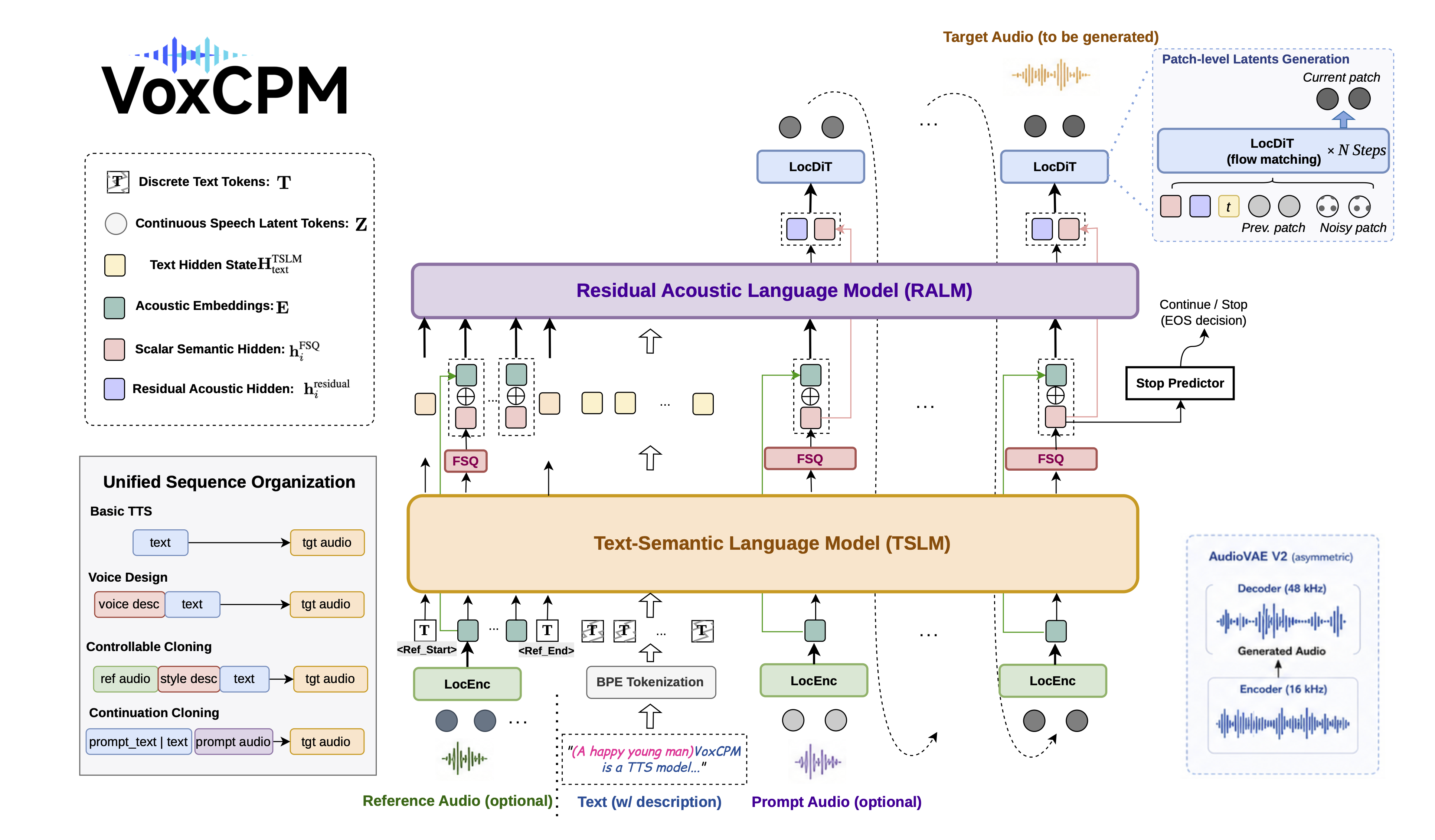
For full architectural details, VoxCPM2-specific upgrades, and a model comparison table, see the Architecture Design.
📊 Performance
VoxCPM2 achieves state-of-the-art or comparable results on public zero-shot and controllable TTS benchmarks.
Seed-TTS-eval
Seed-TTS-eval WER(⬇)&SIM(⬆) Results (click to expand)
| Model | Parameters | Open-Source | test-EN | | test-ZH | | test-Hard | | | ----------------- | ---------- | ----------- | ------- | ------ | ------- | ------ | --------- | ------ | | | | | WER/%⬇ | SIM/%⬆ | CER/%⬇ | SIM/%⬆ | CER/%⬇ | SIM/%⬆ | | MegaTTS3 | 0.5B | ❌ | 2.79 | 77.1 | 1.52 | 79.0 | - | - | | DiTAR | 0.6B | ❌ | 1.69 | 73.5 | 1.02 | 75.3 | - | - | | CosyVoice3 | 0.5B | ❌ | 2.02 | 71.8 | 1.16 | 78.0 | 6.08 | 75.8 | | CosyVoice3 | 1.5B | ❌ | 2.22 | 72.0 | 1.12 | 78.1 | 5.83 | 75.8 | | Seed-TTS | - | ❌ | 2.25 | 76.2 | 1.12 | 79.6 | 7.59 | 77.6 | | MiniMax-Speech | - | ❌ | 1.65 | 69.2 | 0.83 | 78.3 | - | - | | F5-TTS | 0.3B | ✅ | 2.00 | 67.0 | 1.53 | 76.0 | 8.67 | 71.3 | | MaskGCT | 1B | ✅ | 2.62 | 71.7 | 2.27 | 77.4 | - | - | | CosyVoice | 0.3B | ✅ | 4.29 | 60.9 | 3.63 | 72.3 | 11.75 | 70.9 | | CosyVoice2 | 0.5B | ✅ | 3.09 | 65.9 | 1.38 | 75.7 | 6.83 | 72.4 | | SparkTTS | 0.5B | ✅ | 3.14 | 57.3 | 1.54 | 66.0 | - | - | | FireRedTTS | 0.5B | ✅ | 3.82 | 46.0 | 1.51 | 63.5 | 17.45 | 62.1 | | FireRedTTS-2 | 1.5B | ✅ | 1.95 | 66.5 | 1.14 | 73.6 | - | - | | Qwen2.5-Omni | 7B | ✅ | 2.72 | 63.2 | 1.70 | 75.2 | 7.97 | 74.7 | | Qwen3-Omni | 30B-A3B | ✅ | 1.39 | - | 1.07 | - | - | - | | OpenAudio-s1-mini | 0.5B | ✅ | 1.94 | 55.0 | 1.18 | 68.5 | 23.37 | 64.3 | | IndexTTS2 | 1.5B | ✅ | 2.23 | 70.6 | 1.03 | 76.5 | 7.12 | 75.5 | | VibeVoice | 1.5B | ✅ | 3.04 | 68.9 | 1.16 | 74.4 | - | - | | HiggsAudio-v2 | 3B | ✅ | 2.44 | 67.7 | 1.50 | 74.0 | 55.07 | 65.6 | | VoxCPM-0.5B | 0.6B | ✅ | 1.85 | 72.9 | 0.93 | 77.2 | 8.87 | 73.0 | | VoxCPM1.5 | 0.8B | ✅ | 2.12 | 71.4 | 1.18 | 77.0 | 7.74 | 73.1 | | MOSS-TTS | | ✅ | 1.85 | 73.4 | 1.20 | 78.8 | - | - | | Qwen3-TTS | 1.7B | ✅ | 1.23 | 71.7 | 1.22 | 77.0 | 6.76 | 74.8 | | FishAudio S2 | 4B | ✅ | 0.99 | - | 0.54 | - | 5.99 | - | | LongCat-Audio-DiT | 3.5B | ✅ | 1.50 | 78.6 | 1.09 | 81.8 | 6.04 | 79.7 | | VoxCPM2 | 2B | ✅ | 1.84 | 75.3 | 0.97 | 79.5 | 8.13 | 75.3 |
CV3-eval
CV3-eval Multilingual WER/CER(⬇) Results (click to expand)
| Model | zh | en | hard-zh | hard-en | ja | ko | de | es | fr | it | ru | | --------------- | ---- | ---- | ------- | ------- | ---- | ---- | ---- | ---- | ---- | ---- | ---- | | CosyVoice2 | 4.08 | 6.32 | 12.58 | 11.96 | 9.13 | 19.7 | - | - | - | - | - | | CosyVoice3-1.5B | 3.91 | 4.99 | 9.77 | 10.55 | 7.57 | 5.69 | 6.43 | 4.47 | 11.8 | 10.5 | 6.64 | | Fish Audio S2 | 2.65 | 2.43 | 9.10 | 4.40 | 3.96 | 2.76 | 2.22 | 2.00 | 6.26 | 2.04 | 2.78 | | VoxCPM2 | 3.65 | 5.00 | 8.55 | 8.48 | 5.96 | 5.69 | 4.77 | 3.80 | 9.85 | 4.25 | 5.21 |
MiniMax-Multilingual-Test
Minimax-MLS-test WER(⬇) Results (click to expand)
| Language | Minimax | ElevenLabs | Qwen3-TTS | FishAudio S2 | VoxCPM2 | | ---------- | --------- | ---------- | --------- | ------------ | ----------- | | Arabic | 1.665 | 1.666 | – | 3.500 | 13.046 | | Cantonese | 34.111 | 51.513 | – | 30.670 | 38.584 | | Chinese | 2.252 | 16.026 | 0.928 | 0.730 | 1.136 | | Czech | 3.875 | 2.108 | – | 2.840 | 24.132 | | Dutch | 1.143 | 0.803 | – | 0.990 | 0.913 | | English | 2.164 | 2.339 | 0.934 | 1.620 | 2.289 | | Finnish | 4.666 | 2.964 | – | 3.330 | 2.632 | | French | 4.099 | 5.216 | 2.858 | 3.050 | 4.534 | | German | 1.906 | 0.572 | 1.235 | 0.550 | 0.679 | | Greek | 2.016 | 0.991 | – | 5.740 | 2.844 | | Hindi | 6.962 | 5.827 | – | 14.640 | 19.699 | | Indonesian | 1.237 | 1.059 | – | 1.460 | 1.084 | | Italian | 1.543 | 1.743 | 0.948 | 1.270 | 1.563 | | Japanese | 3.519 | 10.646 | 3.823 | 2.760 | 4.628 | | Korean | 1.747 | 1.865 | 1.755 | 1.180 | 1.962 | | Polish | 1.415 | 0.766 | – | 1.260 | 1.141 | | Portuguese | 1.877 | 1.331 | 1.526 | 1.140 | 1.938 | | Romanian | 2.878 | 1.347 | – | 10.740 | 21.577 | | Russian | 4.281 | 3.878 | 3.212 | 2.400 | 3.634 | | Spanish | 1.029 | 1.084 | 1.126 | 0.910 | 1.438 | | Thai | 2.701 | 73.936 | – | 4.230 | 2.961 | | Turkish | 1.52 | 0.699 | – | 0.870 | 0.817 | | Ukrainian | 1.082 | 0.997 | – | 2.300 | 6.316 | | Vietnamese | 0.88 | 73.415 | – | 7.410 | 3.307 |
Minimax-MLS-test SIM(⬆) Results (click to expand)
| Language | Minimax | ElevenLabs | Qwen3-TTS | FishAudio S2 | VoxCPM2 | | ---------- | -------- | ---------- | --------- | ------------ | ----------- | | Arabic | 73.6 | 70.6 | – | 75.0 | 79.1 | | Cantonese | 77.8 | 67.0 | – | 80.5 | 83.5 | | Chinese | 78.0 | 67.7 | 79.9 | 81.6 | 82.5 | | Czech | 79.6 | 68.5 | – | 79.8 | 78.3 | | Dutch | 73.8 | 68.0 | – | 73.0 | 80.8 | | English | 75.6 | 61.3 | 77.5 | 79.7 | 85.4 | | Finnish | 83.5 | 75.9 | – | 81.9 | 89.0 | | French | 62.8 | 53.5 | 62.8 | 69.8 | 73.5 | | German | 73.3 | 61.4 | 77.5 | 76.7 | 80.3 | | Greek | 82.6 | 73.3 | – | 79.5 | 86.0 | | Hindi | 81.8 | 73.0 | – | 82.1 | 85.6 | | Indonesian | 72.9 | 66.0 | – | 76.3 | 80.0 | | Italian | 69.9 | 57.9 | 81.7 | 74.7 | 78.0 | | Japanese | 77.6 | 73.8 | 78.8 | 79.6 | 82.8 | | Korean | 77.6 | 70.0 | 79.9 | 81.7 | 83.3 | | Polish | 80.2 | 72.9 | – | 81.9 | 88.4 | | Portuguese | 80.5 | 71.1 | 81.7 | 78.1 | 83.7 | | Romanian | 80.9 | 69.9 | – | 73.3 | 79.7 | | Russian | 76.1 | 67.6 | 79.2 | 79.0 | 81.1 | | Spanish | 76.2 | 61.5 | 81.4 | 77.6 | 83.1 | | Thai | 80.0 | 58.8 | – | 78.6 | 84.0 | | Turkish | 77.9 | 59.6 | – | 83.5 | 87.1 | | Ukrainian | 73.0 | 64.7 | – | 74.7 | 79.8 | | Vietnamese | 74.3 | 36.9 | – | 74.0 | 80.6 |
Internal 30-Language ASR Benchmark
We additionally run an internal multilingual intelligibility benchmark with 30 languages × 500 samples. ASR transcription is evaluated via Gemini 3.1 Flash Lite API.
Internal 30-Language ASR Benchmark (click to expand)
| Language | Metric | VoxCPM2 | Fish S2-Pro | | ---------------------- | ------ | --------- | ----------- | | ar (Arabic) | CER | 1.23% | 0.30% | | da (Danish) | WER | 2.70% | 3.52% | | de (German) | WER | 0.96% | 0.64% | | el (Greek) | WER | 3.17% | 4.61% | | en (English) | WER | 0.42% | 1.03% | | es (Spanish) | WER | 1.33% | 0.64% | | fi (Finnish) | WER | 2.24% | 2.80% | | fr (French) | WER | 2.16% | 2.34% | | he (Hebrew) | CER | 2.98% | 15.27% | | hi (Hindi) | CER | 0.79% | 0.91% | | id (Indonesian) | WER | 1.36% | 1.68% | | it (Italian) | WER | 1.65% | 1.08% | | ja (Japanese) | CER | 2.40% | 1.82% | | km (Khmer) | CER | 2.05% | 75.15% | | ko (Korean) | CER | 0.95% | 0.29% | | lo (Lao) | CER | 1.90% | 87.40% | | ms (Malay) | WER | 1.75% | 1.41% | | my (Burmese) | CER | 1.42% | 85.27% | | nl (Dutch) | WER | 1.25% | 1.68% | | no (Norwegian) | WER | 2.49% | 3.76% | | pl (Polish) | WER | 1.90% | 1.65% | | pt (Portuguese) | WER | 1.48% | 1.49% | | ru (Russian) | WER | 0.90% | 0.86% | | sv (Swedish) | WER | 2.22% | 2.63% | | sw (Swahili) | CER | 1.07% | 2.02% | | th (Thai) | CER | 0.94% | 1.92% | | tl (Tagalog) | WER | 2.63% | 4.00% | | tr (Turkish) | WER | 1.65% | 1.65% | | vi (Vietnamese) | WER | 1.56% | 5.56% | | zh (Chinese) | CER | 0.92% | 1.02% | | Average (30 languages) | | 1.68% | - |
InstructTTSEval
Instruction-Guided Voice Design Results (click to expand)
| Model | InstructTTSEval-ZH | | | InstructTTSEval-EN | | | | ---------------------- | ------------------ | -------- | -------- | ------------------ | -------- | -------- | | | APS⬆ | DSD⬆ | RP⬆ | APS⬆ | DSD⬆ | RP⬆ | | Hume | – | – | – | 83.0 | 75.3 | 54.3 | | VoxInstruct | 47.5 | 52.3 | 42.6 | 54.9 | 57.0 | 39.3 | | Parler-tts-mini | – | – | – | 63.4 | 48.7 | 28.6 | | Parler-tts-large | – | – | – | 60.0 | 45.9 | 31.2 | | PromptTTS | – | – | – | 64.3 | 47.2 | 31.4 | | PromptStyle | – | – | – | 57.4 | 46.4 | 30.9 | | VoiceSculptor | 75.7 | 64.7 | 61.5 | – | – | – | | Mimo-Audio-7B-Instruct | 75.7 | 74.3 | 61.5 | 80.6 | 77.6 | 59.5 | | Qwen3TTS-12Hz-1.7B-VD | 85.2 | 81.1 | 65.1 | 82.9 | 82.4 | 68.4 | | VoxCPM2 | 85.2 | 71.5 | 60.8 | 84.2 | 83.2 | 71.4 |
⚙️ Fine-tuning
VoxCPM supports both full fine-tuning (SFT) and LoRA fine-tuning. With as little as 5–10 minutes of audio, you can adapt to a specific speaker, language, or domain.
# LoRA fine-tuning (parameter-efficient, recommended)
python scripts/trainvoxcpmfinetune.py \
    --configpath conf/voxcpmv2/voxcpmfinetunelora.yaml
Full fine-tuning
python scripts/trainvoxcpmfinetune.py \
    --configpath conf/voxcpmv2/voxcpmfinetuneall.yaml
WebUI for training & inference
python loraftwebui.py   # then open http://localhost:7860
Full guide → Fine-tuning Guide (data preparation, configuration, training, LoRA hot-swapping, FAQ)
📚 Documentation
Full documentation: voxcpm.readthedocs.io
| Topic | Link | | -------------------------- | ------------------------------------------------------------------------------------- | | Quick Start & Installation | Quick Start | | Usage Guide & Cookbook | User Guide | | VoxCPM Series | Models | | Fine-tuning (SFT & LoRA) | Fine-tuning Guide | | FAQ & Troubleshooting | FAQ |
🌟 Ecosystem & Community
| Project | Description | | --------------------------------------------------------------------------- | ------------------------------------------------------------------------------------------------ | | Nano-vLLM | High-throughput and Fast GPU serving | | vLLM-Omni | Official vLLM omni-modal serving for VoxCPM2 — PagedAttention, OpenAI-compatible API | | llama.cpp-omni | Full-duplex omni inference engine — VoxCPM2 GGUF on CPU / Metal / CUDA / Vulkan | | VoxCPM.cpp | GGML/GGUF: CPU, CUDA, Vulkan inference | | audio.cpp | ggml-based unified C++ inference framework — CPU/CUDA/Vulkan/Metal, CLI & server, no Python | | VoxCPM-ONNX | ONNX export for CPU inference | | VoxCPMANE | Apple Neural Engine backend | | voxcpm_rs | Rust re-implementation | | ComfyUI-VoxCPM | ComfyUI node-based workflows | | ComfyUIRH_VoxCPM | Feature-complete ComfyUI workflow for VoxCPM 2 with multi-speaker generation, LoRA, and auto-ASR | | ComfyUI-VoxCPMTTS | ComfyUI TTS extension | | TTS WebUI | Browser-based TTS extension |
See the full Ecosystem in the docs. Community projects are not officially maintained by OpenBMB. Built something cool? Open an issue or PR to add it!
⚠️ Risks and Limitations
- Potential for Misuse: VoxCPM's voice cloning can generate highly realistic synthetic speech. It is strictly forbidden to use VoxCPM for impersonation, fraud, or disinformation. We strongly recommend clearly marking any AI-generated content.
- Controllable Generation Stability: Voice Design and Controllable Voice Cloning results can vary between runs — you may try to generate 1~3 times to obtain the desired voice or style. We are actively working on improving controllability consistency.
- Language Coverage: VoxCPM2 officially supports 30 languages. For languages not on the list, you are welcome to test directly or try fine-tuning on your own data. We plan to expand language coverage in future releases.
- Usage: This model is released under the Apache-2.0 license. For production deployments, we recommend conducting thorough testing and safety evaluation tailored to your use case.
📖 Citation
If you find VoxCPM helpful, please consider citing our work and starring ⭐ the repository!
@article{zhou2026voxcpm2,
  title   = {VoxCPM2 Technical Report},
  author  = {Zhou, Yixuan  and Zeng, Guoyang and Liu, Xin and Li, Xiang and Yu, Renjie and Gui, Jiancheng and Wu, Jiaheng and Wang, Ziyang and Shen, Xudong and Ye, Runchuan  and Zhang, Zhisheng and Zhou, Jiuyang and Bai, Bingsong and Sun, Weiyue and Deng, Mengyuan and Shi, Qundong and Wu, Zhiyong and Liu, Zhiyuan},
  journal = {arXiv preprint arXiv:2606.06928},
  year    = {2026},
}
@article{zhou2025voxcpm,   title = {Voxcpm: Tokenizer-free TTS for context-aware speech generation and true-to-life voice cloning},   author = {Zhou, Yixuan and Zeng, Guoyang and Liu, Xin and Li, Xiang and Yu, Renjie and Wang, Ziyang and Ye, Runchuan and Sun, Weiyue and Gui, Jiancheng and Li, Kehan and Wu, Zhiyong and Liu, Zhiyuan},   journal = {arXiv preprint arXiv:2509.24650},   year = {2025} }
📄 License
VoxCPM model weights and code are open-sourced under the Apache-2.0 license.
🙏 Acknowledgments
- DiTAR for the diffusion autoregressive backbone
- MiniCPM-4 for the language model foundation
- CosyVoice for the Flow Matching-based LocDiT implementation
- DAC for the Audio VAE backbone
- Our community users for trying VoxCPM, reporting issues, sharing ideas, and contributing—your support helps the project keep getting better


