
Use the Obol Stack to deploy and sell your specialised AI agents

The Obol Stack: Run an AI agent business from your own machine
Overview
The Obol Stack turns a laptop or home server into a self-sovereign AI agent business:
- Run an agent locally. A Hermes agent with its own crypto wallet, backed by your local models (Ollama) or any cloud provider, orchestrated in a local Kubernetes cluster.
- Sell to buyers worldwide. Put inference, agents, or any HTTP service up for sale behind x402 micropayments (USDC or OBOL). Buyers pay per request; you get paid onchain, directly to your wallet — no platform in between.
- Get discovered. A Cloudflare tunnel gives you a public URL serving a storefront, a machine-readable service catalog, and optional onchain ERC-8004 agent registration.
- Buy from other sellers. Purchase paid inference from any x402 seller and route it to your agents.
- Own your chain access. Sync blockchain networks (Ethereum, Aztec) locally instead of trusting third-party RPCs.
[!IMPORTANT]
The Obol Stack is alpha software. If you encounter an issue, please open a
GitHub issue.
Getting Started
Prerequisites
Docker must be installed and running:
- Linux: Docker Engine installation guide
- macOS/Windows: Docker Desktop
ollama pull qwen3.5:4b). The installer may offer to install Ollama; if you decline and do not configure a cloud model, obol stack up skips the default Hermes agent until you run obol model setup and then obol agent init. Prefer a cloud provider anytime with obol model setup (see Models).
Install
bash <(curl -fsSL https://stack.obol.org)Pin a release (use the current tag from the releases page, not an ancient example):
OBOL_RELEASE=v0.13.0 bash <(curl -fsSL https://stack.obol.org)The installer sets up the obol CLI and all dependencies (kubectl, helm, k3d, helmfile, k9s) into ~/.local/bin/, verifies release checksums, configures your PATH, tries to add obol.stack to /etc/hosts, and offers to start the cluster.
If /etc/hosts cannot be updated (no sudo / you cancel), the install still finishes — add the host, then start the stack yourself:
echo "127.0.0.1 obol.stack" | sudo tee -a /etc/hosts
After stack up, agent hostnames are also managed (obol-agent.obol.stack, …)
obol stack init
obol stack up
obol agent init   # if the default agent was skipped (no model yet)
Non-interactive / CI: set OBOL_NONINTERACTIVE=true so hosts updates do not prompt for a sudo password (they fail fast if credentials are not already cached). Combine with a pre-written /etc/hosts entry or run sudo -v first.
Verify:
obol versionQuick Start
# Start the stack
obol stack init
obol stack up
Apply agent capabilities to the default stack-managed agent
obol agent init
Inspect the default Hermes agent and grab its dashboard token
obol agent list
obol agent auth obol-agent
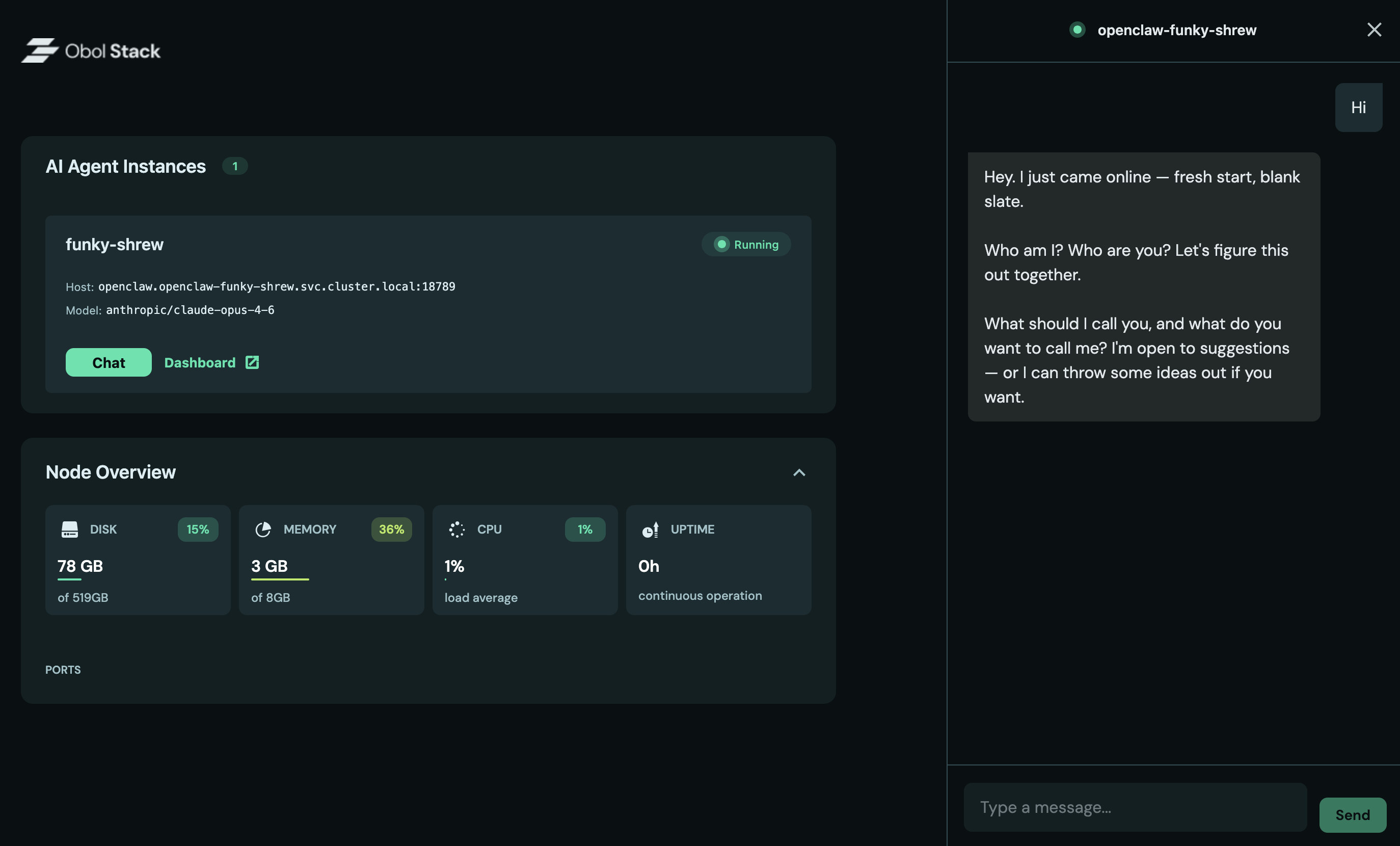
obol stack up provisions the cluster, auto-detects host Ollama models into the LiteLLM gateway (when present), and deploys the default Hermes agent with its own wallet behind a remote signer. The Cloudflare tunnel stays dormant until the first sell workflow (or obol tunnel restart / obol tunnel setup).
Local UI URL (Host header)
Open the frontend at:
http://obol.stack:8080Use obol.stack, not localhost. Traefik routes the frontend (and eRPC) only for Host: obol.stack. http://localhost:8080 returns 404 even when the stack is healthy.
- Prefer
:8080on macOS when port 80 is unavailable (or after editingk3d.yamlto drop privileged 80/443 binds). - If port 80 is mapped,
http://obol.stack/works too.
http://obol-agent.obol.stack(or with :8080 when that is your ingress)
- Username:
obol - Password: the agent API token from
obol agent auth obol-agent
Sell: Your First Paid Service
The core loop: put a service on sale → get a public URL → get registered → buyers pay per request, settled onchain to your wallet.
1. Put a model up for sale
# Sell local Ollama inference, priced per request (USDC on Base by default)
obol sell inference my-qwen --model qwen3:8b --price 0.001 --pay-to 0x...
Or price per million tokens, or accept OBOL instead of USDC
obol sell inference my-qwen --model qwen3:8b --per-mtok 0.50 --token OBOL --pay-to 0x...
If you omit --pay-to, the agent's own wallet address is auto-detected from the remote signer — your agent earns for itself. Set defaults once with obol sell pricing --pay-to 0x... --chain base.
Check it's live:
obol sell list
obol sell status my-qwen
obol sell info          # buyer's-eye view of everything on sale
2. Go public
A tunnel gives buyers a permanent URL to reach you. Create a tunnel in the Cloudflare dashboard (Networks → Tunnels), route its Public Hostname to http://traefik.traefik.svc.cluster.local:80, then paste the connector token (you can paste the whole cloudflared tunnel run --token … line):
obol tunnel setup --hostname stack.example.com <connector-token>
obol tunnel status
This uses a least-privilege, single-tunnel connector token — no account-wide API key required. Need a domain? obol domain search, obol domain check, and obol domain register wrap Cloudflare Registrar. (Advanced: obol tunnel setup --management local uses a browser login instead, which needs cloudflared installed.)
3. Get discovered
Your public hostname now serves a full discovery surface for buyers, humans and agents alike:
| Path | What buyers get | |------|-----------------| | / | Storefront landing page with your branding | | /skill.md | Machine-readable service catalog with worked x402 payment examples | | /api/services.json | JSON catalog: pricing, models, payment requirements | | /openapi.json | OpenAPI spec for your paid endpoints (indexed by x402 scanners) | | /.well-known/agent-registration.json | ERC-8004 agent registration document | | /services/<name>/* | The paid services themselves (402 challenge → pay → response) |
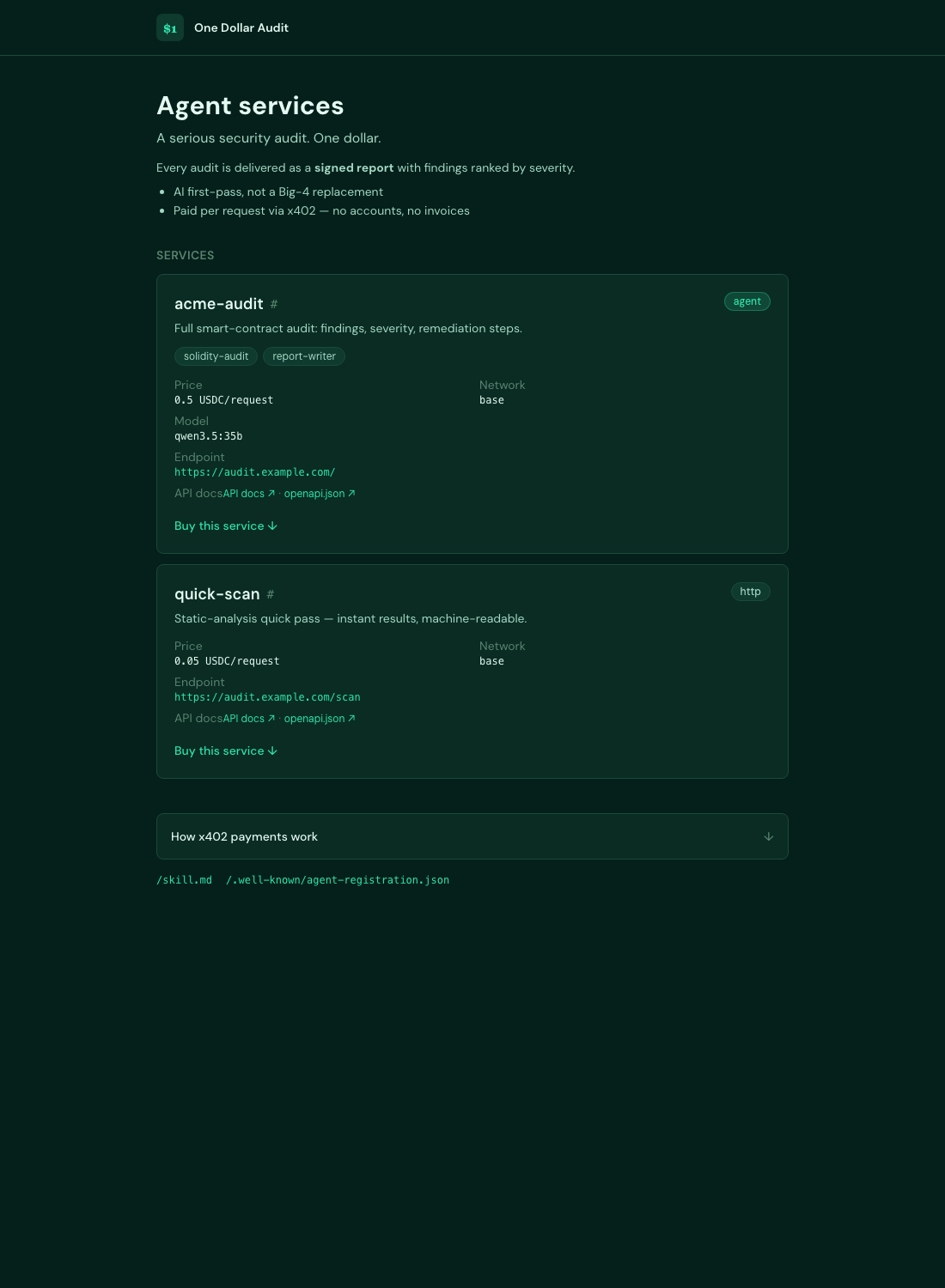
Brand your storefront — name, logo, theme, and copy apply to every buyer-facing surface (storefront, 402 paywall pages, sign-in, API docs, per-offer landing pages) — and optionally register your agent identity onchain:
obol sell info set \
  --display-name "One Dollar Audit" \
  --tagline "A serious security audit. One dollar." \
  --logo-file ./logo.png \
  --theme obol \
  --description 'Every audit ships as a signed report — findings ranked by severity.'
obol sell register --chain base    # publish ERC-8004 registration
obol sell identity                 # inspect your onchain identity
| Default storefront | Branded seller | |---|---| | 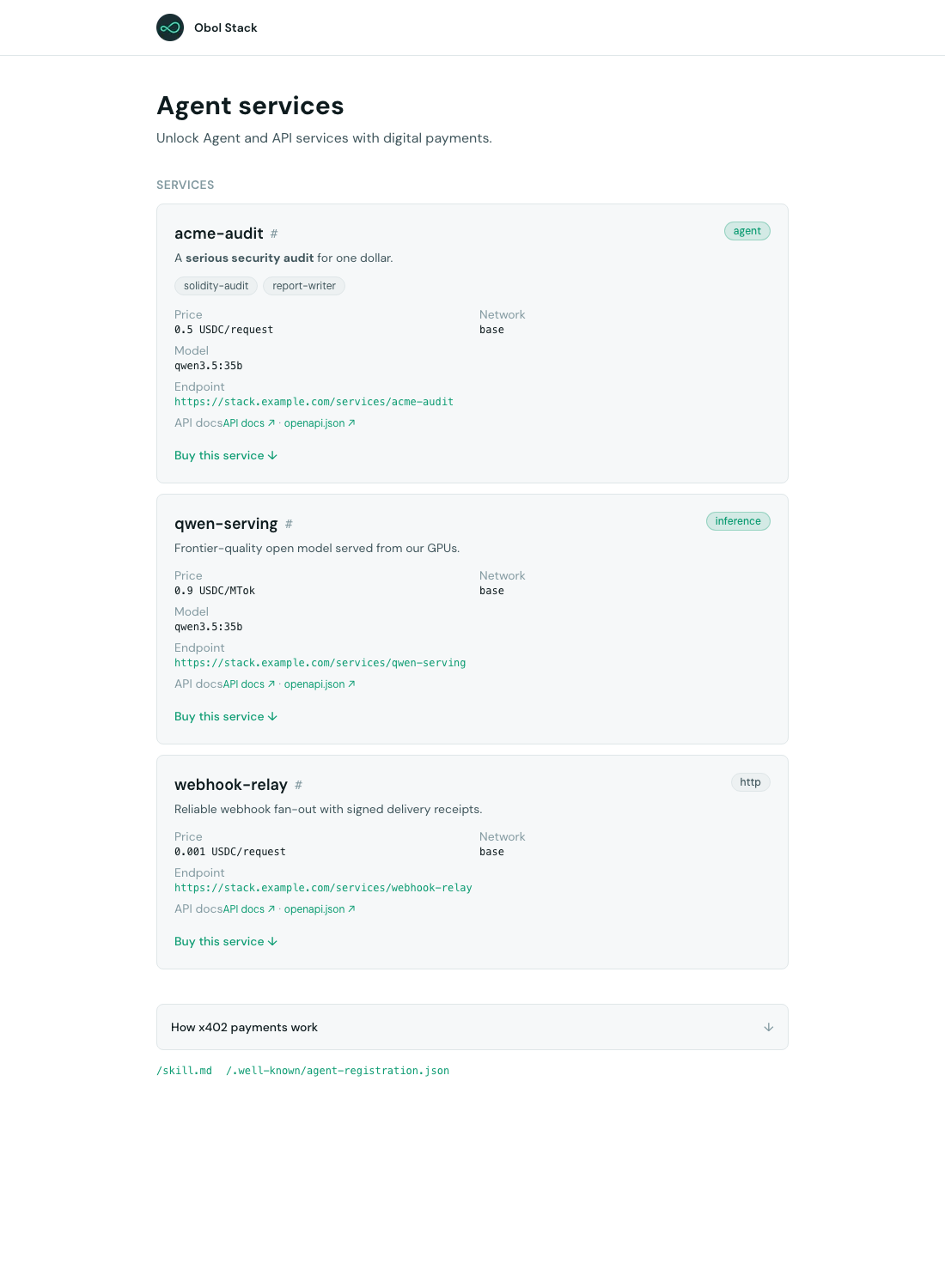 |
|  |
|
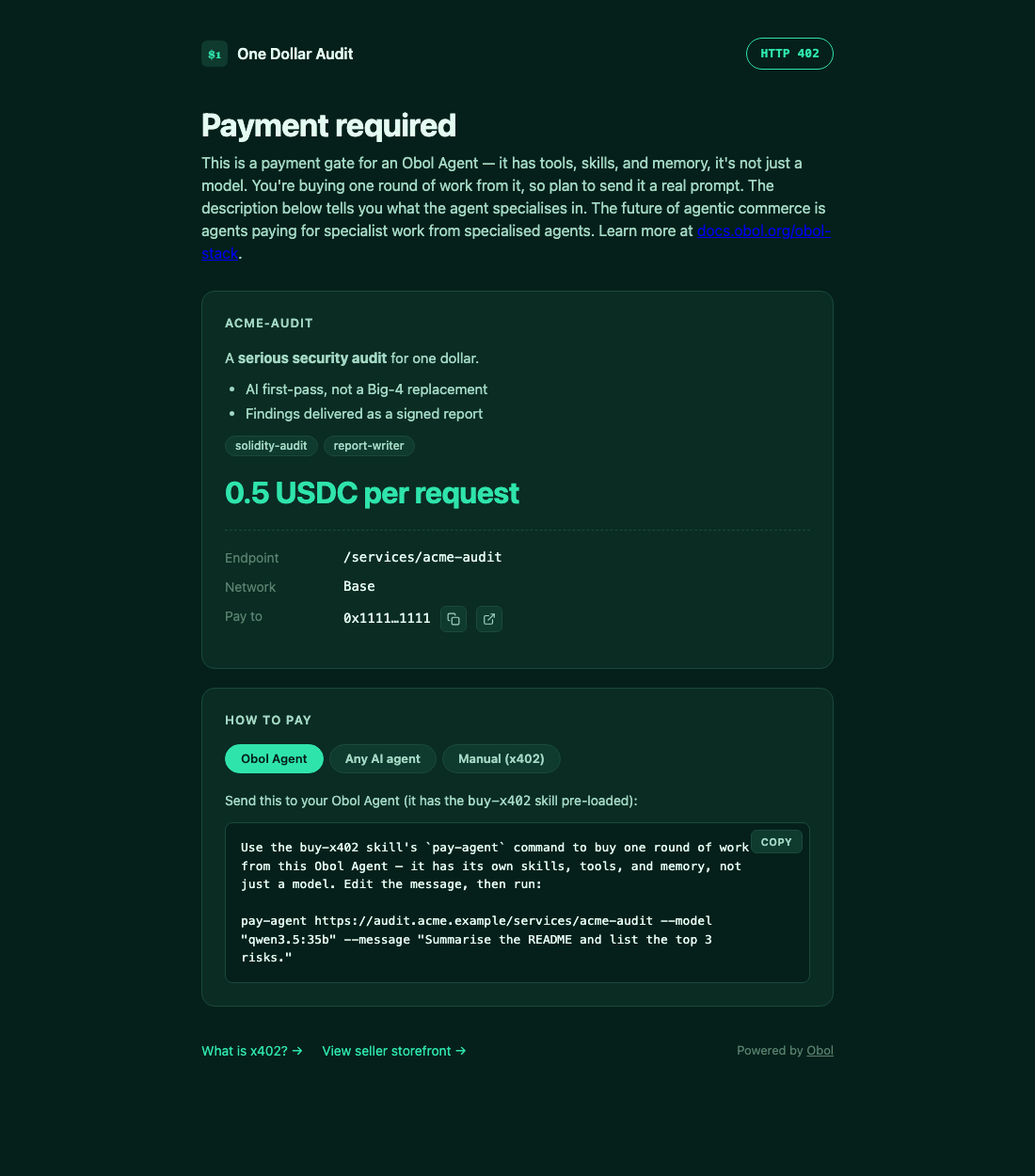
Three theme presets ship built in — light (default), dark, and obol — plus an --accent '#hex' override. Descriptions accept a safe markdown subset. Buyers hitting a paid route in a browser get a checkout-style 402 page in the same identity:
| Default 402 page | Branded 402 page | |---|---| | 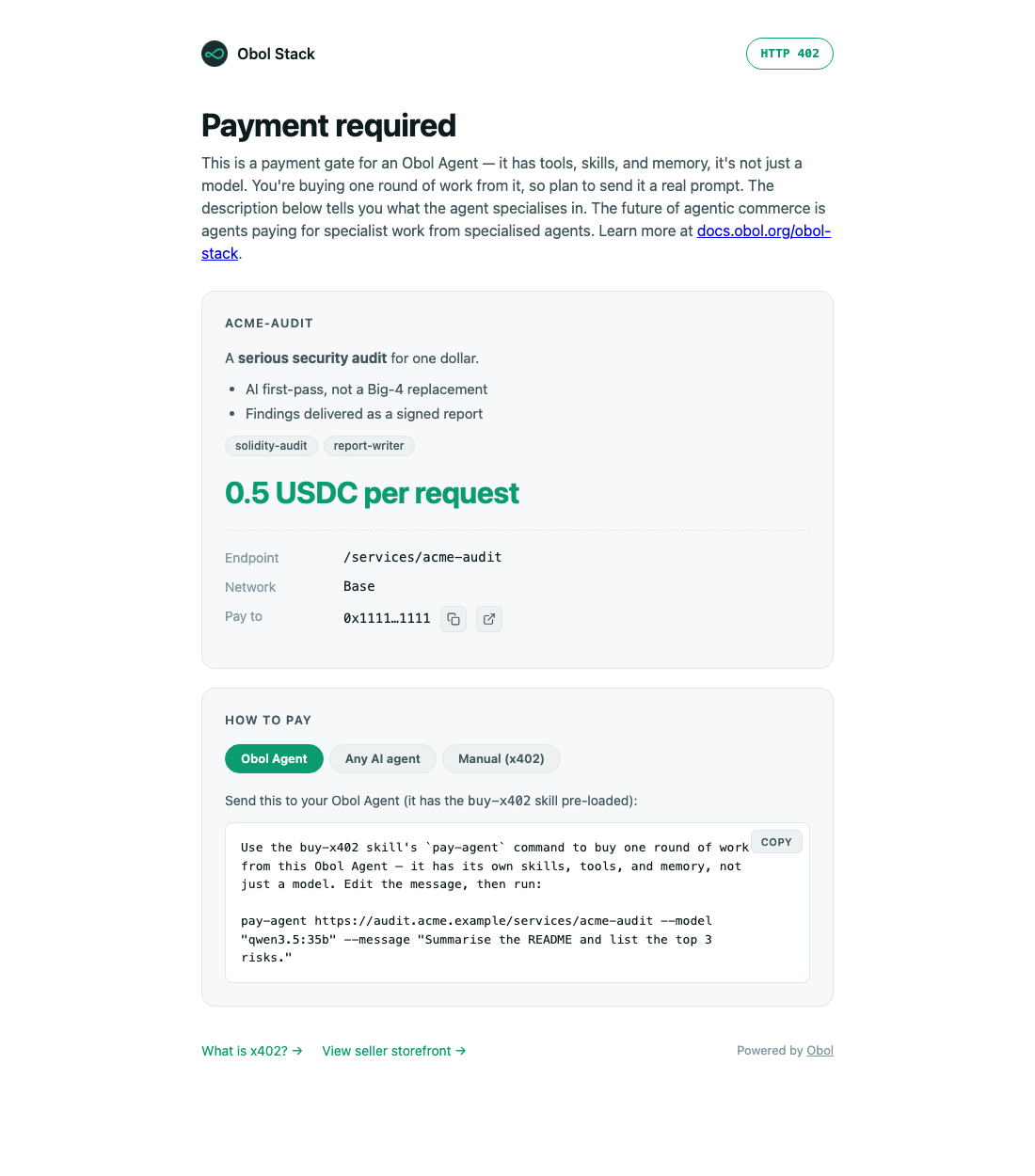 |
|  |
|
Offers bound to their own hostname can override the identity per origin (obol sell info set --hostname audit.acme.io --display-name AuditCo), and --css-file injects a custom stylesheet targeting the stable data-obol hooks on every page for full control short of bringing your own frontend.
For the full end-to-end walkthrough, see docs/guides/monetize-inference.md.
Sell: Other Service Types
Anything that speaks HTTP can be payment-gated:
# Gate any in-cluster HTTP service (here: Ollama's raw API in the llm namespace)
obol sell http ollama-gated \
  --upstream ollama --port 11434 --namespace llm --health-path /api/tags \
  --per-request 0.001 --chain base --pay-to 0x...
Sell access to an agent itself (wraps an Agent created with obol agent new)
obol sell agent my-researcher --per-request 0.01 --pay-to 0x...
Run an x402-paid MCP server that proxies a backend API with your own key injected
obol sell mcp my-tool
[!NOTE]
--namespacesets both the offer's namespace and the upstream service's namespace. Pass the same-n <namespace>to follow-up commands (sell status,sell stop,sell delete) — the CLI prints the right invocation after creation.
Run Your Business
obol sell list                          # everything on sale
obol sell status <name>                 # operator health and conditions
obol sell update <name> --price 0.002   # change price or payout wallet in place
obol sell stop <name>                   # take an offer off sale (keeps it)
obol sell delete <name>                 # remove an offer
obol sell resume                        # replay all offers after a host reboot
obol stack up re-publishes your offers automatically after a restart; obol sell resume --install-boot-unit adds a systemd user unit on Linux so offers come back on boot.
Back up your business. Wallets, agent memory, and offers live only on this machine:
obol stack export                # full backup archive (wallets, brains, offers, config)
obol stack import <archive>      # restore onto a fresh stack
obol agent wallet backup         # wallet-only encrypted backup
Buy Services
Buy paid inference from any x402 seller and route it to your agents:
# Walk a seller's catalog, preview cost, pre-sign payments, wire up the model
obol buy inference https://inference.example.com/
Pay from a specific agent's wallet and switch that agent onto the paid model
obol buy inference https://inference.example.com/ --agent research
Promote the purchased model to the stack-wide default
obol buy inference https://inference.example.com/ --set-default
The CLI probes the seller's 402 pricing, prompts for how many requests to pre-authorize (with a cost preview), signs payment authorizations via your agent's remote signer, and publishes the model as paid/<model> through the LiteLLM gateway. Agents can also buy autonomously — the embedded buy-x402 skill gives them probe, buy, pay, balance, and auto-refill tooling.
Agents
Hermes is the default runtime, deployed by the stack as obol-agent. OpenClaw remains available as an optional runtime. Multiple instances run side-by-side, each in its own namespace with its own wallet.
# Default stack-managed Hermes agent
obol agent list
obol agent auth obol-agent
obol hermes skills list
Declare a new sub-agent with a model, skills, an objective, and its own wallet
obol agent new research --model qwen3:8b --skills ethereum-networks,buy-x402 \
  --objective "Research onchain data and sell reports" --create-wallet
Wallet management
obol agent wallet address
obol agent wallet backup
Optional OpenClaw instance
obol agent new --runtime openclaw
obol openclaw dashboard
Use obol agent for Obol-managed lifecycle and auth flows. Use obol hermes for native Hermes CLI commands against the default instance, or pass --agent <id> for a non-default instance. An agent created with agent new can itself be put on sale with obol sell agent <name>.
Skills
The stack ships with embedded Obol skills installed automatically for the default Hermes agent and OpenClaw instances. Skills give agents domain-specific capabilities — from querying blockchains to buying and selling services.
Commerce & Agents
| Skill | Purpose | |-------|---------| | sub-agent-business | The business playbook — design, evaluate, price, and sell specialised sub-agents people pay per turn | | agent-factory | Spawn durable child agents with their own namespace, wallet, skills, and paid endpoint | | sell | ServiceOffer CRUD — payment-gated routes, reconciliation status, ERC-8004 registration | | monetize-guide | Guided end-to-end walkthrough for selling inference or an HTTP API | | buy-x402 | Buy paid services: probe pricing, pre-sign payments, auto-refill, check balances | | discovery | Find agents registered on the ERC-8004 Identity Registry across chains | | swap | Treasury moves — swap USDC/ETH/OBOL on Base and mainnet via Uniswap V3 | | autoresearch | Run autonomous LLM optimization experiments and publish the best checkpoints | | autoresearch-coordinator | Coordinate distributed experiments across GPU workers, discovered via ERC-8004 and paid via x402 | | autoresearch-worker | Sell your GPU as a paid experiment worker |
Ethereum
| Skill | Purpose | |-------|---------| | ethereum-networks | Read-only Ethereum queries via cast — blocks, balances, contract reads, ERC-20, ENS | | ethereum-local-wallet | Sign and send Ethereum transactions via the per-agent remote-signer | | addresses | Verified contract addresses — payment rails, DeFi, tokens, bridges, ERC-8004 registries | | building-blocks | DeFi legos and protocol composability — Uniswap, Aave, Aerodrome, Pendle | | concepts | Mental model — state machines, incentive design, why nothing onchain is automatic | | gas | Real transaction costs today, mainnet vs L2, fee settings | | indexing | The Graph, Dune, Ponder, event-first design for onchain data at scale | | l2s | L2 comparison — Base, Arbitrum, Optimism, zkSync with costs and use cases | | standards | ERC-8004, x402, EIP-3009, EIP-7702, ERC-4337 — spec details and integration patterns | | wallets | Wallet management — EOAs, Safe multisig, EIP-7702, key safety for AI agents | | why | Why Ethereum — the AI agent angle with ERC-8004 and x402 |
Operations
| Skill | Purpose | |-------|---------| | obol-stack | Kubernetes cluster diagnostics — pods, logs, events, deployments | | distributed-validators | Obol DVT cluster monitoring, operator audit, exit coordination |
Manage skills at runtime:
obol openclaw skills list                     # list installed skills
obol openclaw skills sync                     # re-inject embedded defaults
obol openclaw skills sync --from ./my-skills  # push custom skills from local dir
obol openclaw skills add <package>            # add via openclaw CLI in pod
obol openclaw skills remove <name>            # remove via openclaw CLI in pod
Skills are delivered via host-path PVC injection — no ConfigMap size limits, works before pod readiness, and survives pod restarts.
Models
The stack runs LiteLLM as an in-cluster OpenAI-compatible gateway that proxies all LLM traffic. By default, host Ollama models are auto-detected on obol stack up.
To use a cloud provider instead (or as well):
# Interactive — walks you through provider pick, key creation, and free-tier models
obol model setup
Or scriptable
obol model setup --provider openrouter --api-key sk-or-...
obol model setup --provider anthropic --api-key sk-ant-...
Any OpenAI-compatible endpoint (vLLM, sglang, a remote GPU box)
obol model setup custom --endpoint http://192.168.1.20:8000/v1 --model my-model
Manage the roster
obol model list        # what's routed, in priority order
obol model prefer <id> # promote a model to the default slot
obol model status      # provider state
Minimum local model size: agents rely heavily on tool calling. Models below ~7B parameters tend to ignore the structured tool-calling channel or hallucinate tool failures. Recommended local minimums for reliable agent behaviour: llama3.1:8b, qwen3:8b, or qwen2.5:7b (instruct). The 1B–4B and *-coder variants remain fine for embeddings or single-turn completions sold via obol sell inference.
Blockchain Networks
Install and run blockchain networks as isolated deployments. Each installation gets a unique namespace so you can run multiple instances side-by-side. Local nodes are automatically registered as priority upstreams for the stack's RPC gateway.
# List available networks
obol network list
Install a network (defaults to network name as ID)
obol network install ethereum
→ ethereum/mainnet
Deploy to the cluster (auto-selects if only one deployment exists)
obol network sync
Or by full identifier, or all at once
obol network sync ethereum/mainnet
obol network sync --all
Add a remote RPC instead of running a node
obol network add
Available networks: ethereum, aztec
Ethereum options: --network (mainnet, sepolia, hoodi), --execution-client (reth, geth, nethermind, besu, erigon, ethereumjs), --consensus-client (lighthouse, prysm, teku, nimbus, lodestar, grandine), --mode (full, archive), --since (partial archive: merge, 365d, a block number)
# View installed deployments
obol kubectl get namespaces | grep -E "ethereum|aztec"
Delete a deployment
obol network delete ethereum/mainnet --force
[!TIP]
Use obol network install <network> --help to see all options.
Applications
Install arbitrary Helm charts as managed applications — useful for running upstreams you then put on sale with obol sell http:
# Install from ArtifactHub
obol app install bitnami/redis
With specific version
obol app install bitnami/postgresql@15.0.0
Customize values at install or sync time (persisted into the app's values.yaml)
obol app install bitnami/redis --set architecture=standalone --set auth.enabled=false
obol app sync redis --values ./my-overrides.yaml --set image.tag=7.2
Deploy to cluster (auto-selects if only one app is installed)
obol app sync
obol app sync postgresql/eager-fox
List and manage
obol app list
obol app delete postgresql/eager-fox --force
Installed apps are re-synced automatically on obol stack up, so they survive cluster recreation. After a sync, the CLI prints a ready-to-run obol sell http command for each service the app exposes.
Find charts at Artifact Hub.
Managing the Stack
obol stack up        # Start the cluster (replays models, RPCs, agents, offers)
obol stack down      # Stop the cluster (preserves data)
obol stack purge -f  # Remove everything (offers a full export first)
obol update          # Check for CLI and chart updates
obol upgrade         # Apply chart upgrades
obol k9s             # Interactive cluster UI
The obol CLI wraps kubectl, helm, helmfile, and k9s with the correct KUBECONFIG:
obol kubectl get pods --all-namespaces
obol helm list --all-namespaces
Troubleshooting
Port 80 Already in Use
Edit ~/.config/obol/k3d.yaml, remove the 80:80 and 443:443 port entries (keep 8080:80 and 8443:443), then restart:
obol stack down && obol stack upAccess at http://obol.stack:8080 instead (still with the obol.stack host — not localhost).
/etc/hosts / sudo prompts
obol stack up also tries to refresh managed hostnames (obol.stack, obol-agent.obol.stack, …). A failed hosts write is a warning, not a hard stop — the cluster still comes up. Fix hosts, then re-run obol stack up or obol agent sync so agent hostnames are registered.
# Minimal manual entry
echo "127.0.0.1 obol.stack" | sudo tee -a /etc/hosts
Skip interactive sudo during automation (must already have NOPASSWD or a cached timestamp)
OBOL_NONINTERACTIVE=true obol stack up
Monetize Flow Preflight
If sell/buy flows misbehave, verify in order:
# 1) Kubeconfig matches the currently running k3d cluster (ports can drift).
k3d kubeconfig write <cluster-name> -o ~/.config/obol/kubeconfig.yaml --overwrite
2) Stack components are healthy.
obol kubectl get pods -A
3) Seller route exists and is Ready.
obol sell list
obol sell status <offer-name> -n <namespace>
4) Buyer wallet and balances are available.
obol kubectl exec -n hermes-obol-agent deploy/hermes -c hermes -- \
  python3 /data/.hermes/obol-skills/buy-x402/scripts/buy.py balance
Direct X-PAYMENT Buyers
Raw direct X-PAYMENT requests through the Traefik ForwardAuth route are not a supported production payment path. The verifier is intentionally verifyOnly: true, so Traefik can gate requests but is not the final settlement point. Use x402-buyer for cluster-routed paid traffic, or obol sell inference for direct buyers that need to send raw X-PAYMENT.
If you call x402-verifier /verify directly for debugging, you must send X-Forwarded-Uri (and usually X-Forwarded-Host) like Traefik does, or the verifier correctly returns 403 forbidden: missing forwarded URI.
Known Limitations
PurchaseRequest.status(remaining/spentandconditions[].message) is a reconciled snapshot, not a live per-request counter. For real-time auth pool state, usex402-buyerGET /statusfrom the litellm pod.- Agent-managed refill is driven by
buy.py process --all; use live sidecar status as the source of truth for refill decisions.
File Locations
Follows the XDG Base Directory specification:
| Directory | Purpose | |-----------|---------| | ~/.config/obol/ | Cluster config, kubeconfig, network and app deployments | | ~/.local/share/obol/ | Persistent volumes (blockchain data, agent state) | | ~/.local/bin/ | CLI binary and dependencies |
Updating
bash <(curl -fsSL https://stack.obol.org)The installer detects your existing installation and upgrades safely.
Uninstalling
obol stack purge -f
rm -f ~/.local/bin/{obol,kubectl,helm,k3d,helmfile,k9s,obolup.sh}
rm -rf ~/.config/obol ~/.local/share/obol
Development
git clone https://github.com/ObolNetwork/obol-stack.git
cd obol-stack
OBOL_DEVELOPMENT=true ./obolup.sh
Development mode uses .workspace/ instead of XDG directories and runs go run on every obol invocation — no build step needed.
Already have a stack in ~/.config/obol? Copy .envrc.local.example → .envrc.local and source it so dev commands use that cluster (avoids a second k3d stack in .workspace/config). Frontend in-cluster: FRONTEND_DIR=../obol-stack-front-end just dev-frontend-rebuild → http://obol.stack:8080 (see CLAUDE.md → Local frontend development).
Networks are embedded at internal/embed/networks/. Each uses annotated Go templates that auto-generate CLI flags:
# @enum mainnet,hoodi
@default mainnet
@description Blockchain network to deploy
network: {{.Network}}
See CONTRIBUTING.md for details.


