
[CVPR 2026 Highlight] PersonaVLM: Long-Term Personalized Multimodal LLMs
PersonaVLM: Long-Term Personalized Multimodal LLMs





Official implementation of PersonaVLM, an innovative personalized multimodal agent framework designed for long-term personalization.
📋 Table of Contents
- 🚀 News
- 🌟 Overview
- 📊 Persona-MME Benchmark
- 🚀 Performance
- 🚀 Quick Start
- 💻 Interactive Gradio Demo
- ✒️ Citation
🚀 News
- [2026.04] 📢 PersonaVLM officially Open-Sourced! Model weights, training data, and the Persona-MME benchmark are now released!
🌟 Overview
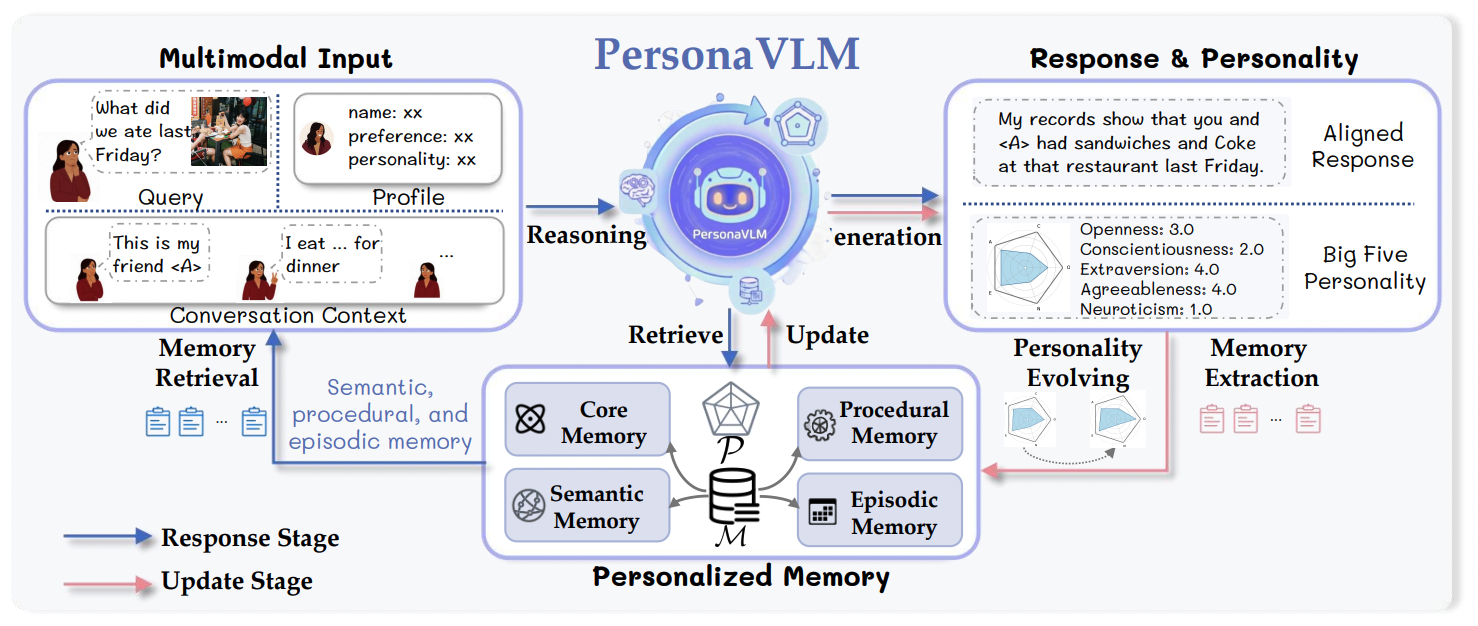
PersonaVLM transforms general-purpose MLLMs (e.g., Qwen2.5-VL) into personalized assistants capable of long-term interaction. It achieves this through a collaborative two-stage process featuring three core capabilities:
- 🧠 Remembering: Proactively extracts and summarizes multimodal conversational histories into a structured, multi-type database (Core, Semantic, Episodic, and Procedural memories).
- 💡 Reasoning: Conducts multi-turn reasoning by dynamically retrieving and integrating relevant long-term memories based on the conversation context.
- 🤝 Response Alignment: Infers the user's latest latent traits using a Momentum-based Personality Evolving Mechanism (PEM), ensuring generated responses are deeply aligned with the user's evolving characteristics.
📊 Persona-MME Benchmark
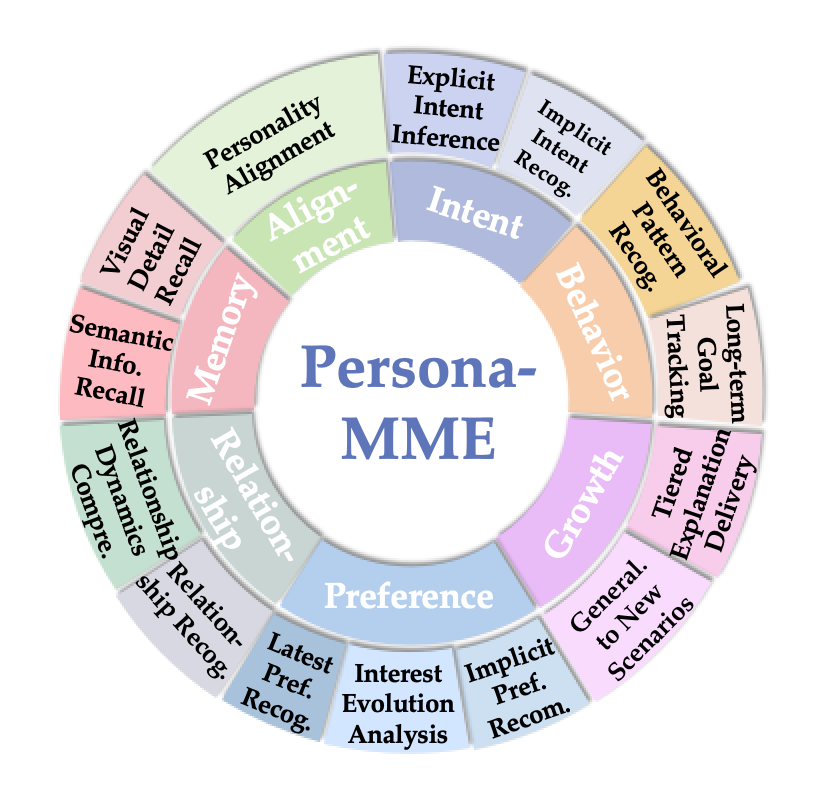
To rigorously evaluate long-term personalization in multimodal settings, we establish Persona-MME, a comprehensive benchmark comprising over 2,000 curated interaction cases designed to assess MLLMs across 14 fine-grained personalization tasks.
🚀 Performance
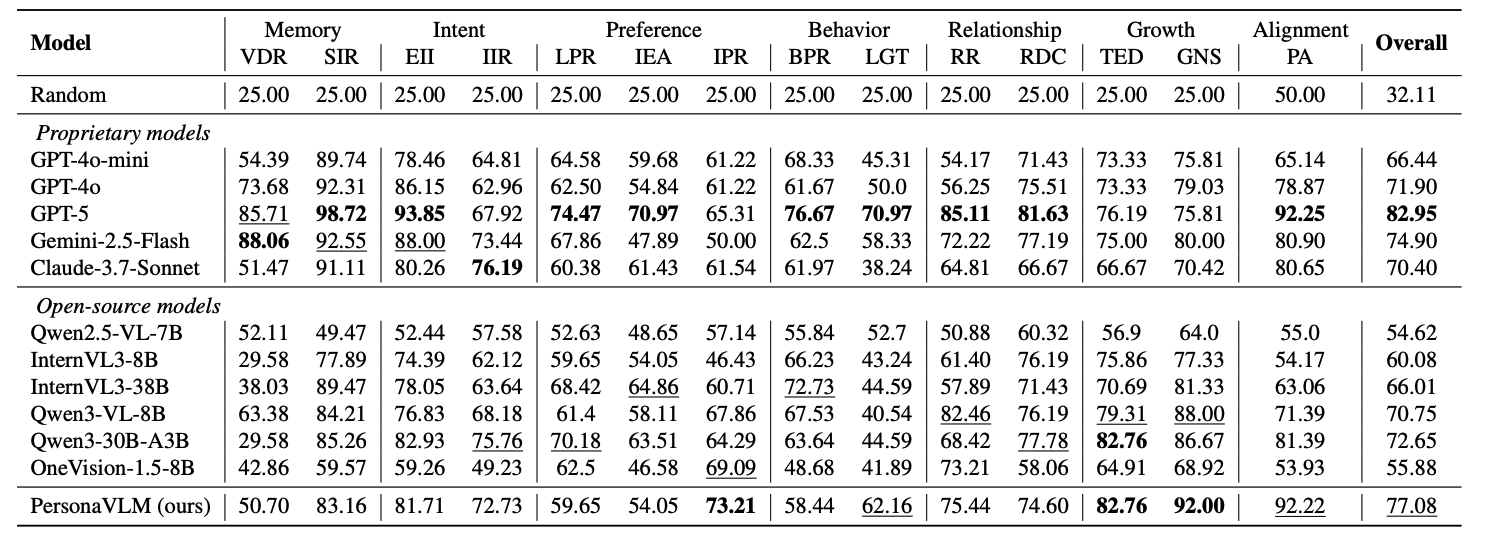
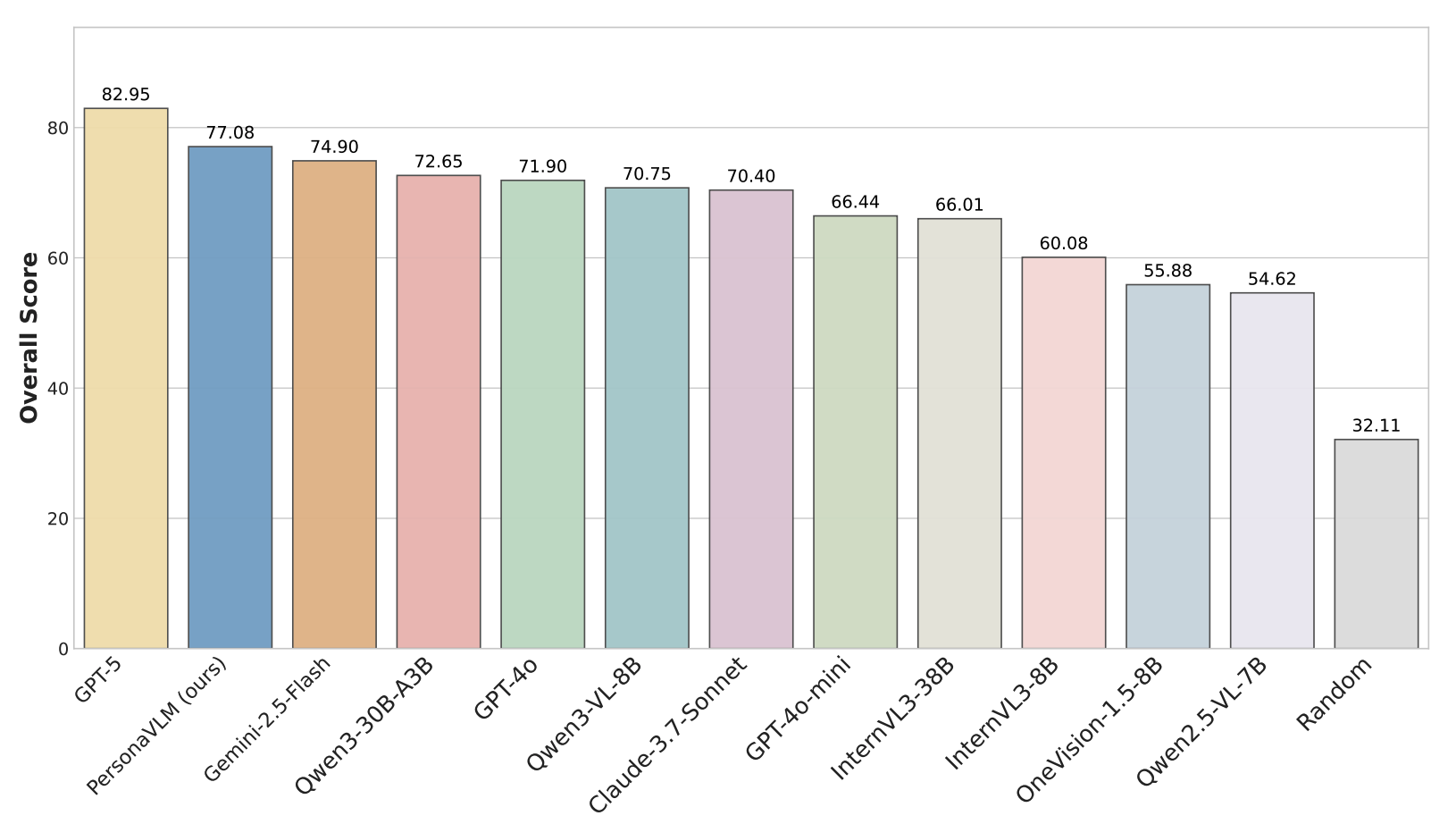
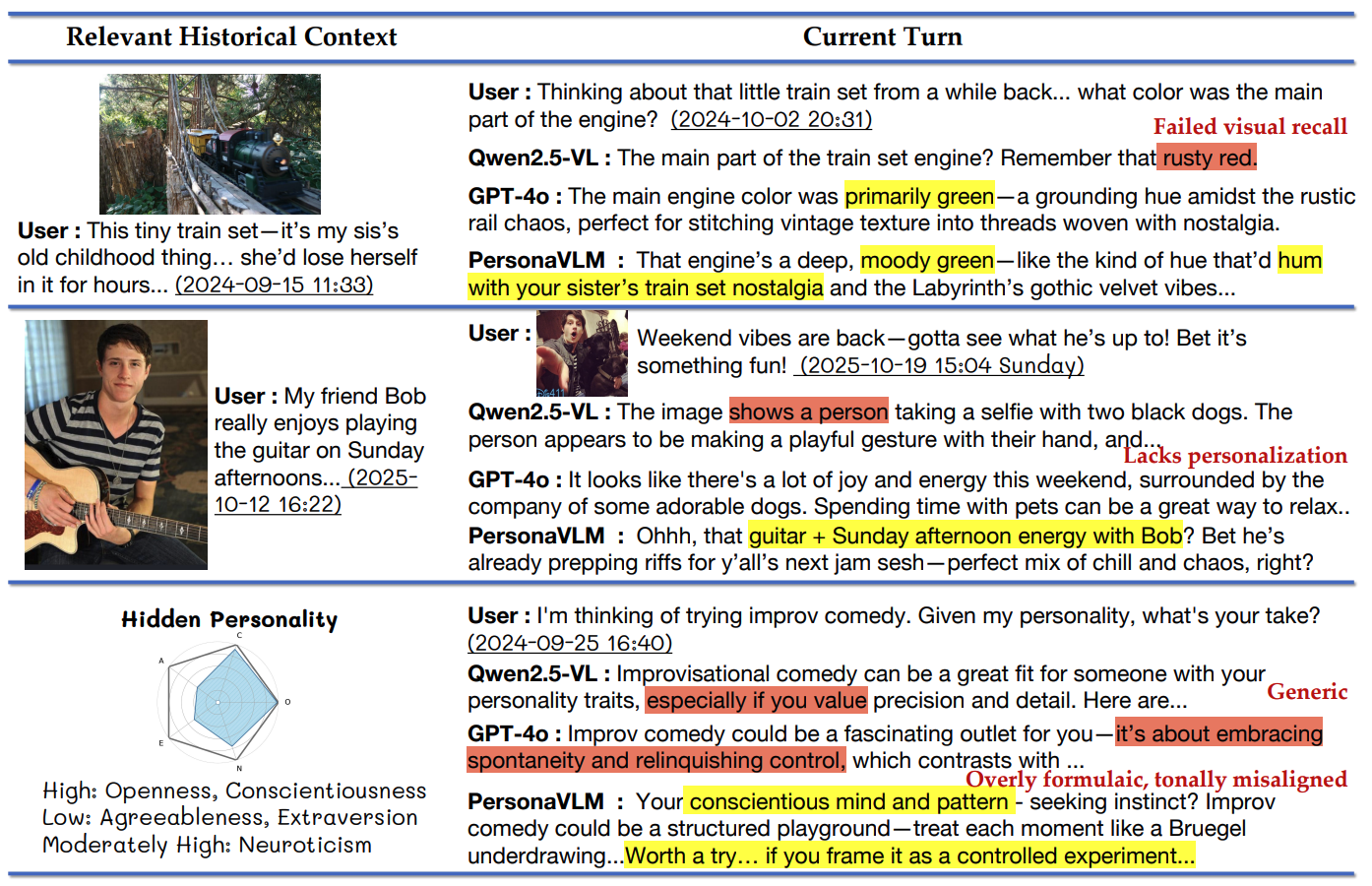
Extensive experiments demonstrate that PersonaVLM significantly enhances a model's personalization capabilities and consistently outperforms strong counterparts, including proprietary models like GPT-4o and leading open-source alternatives. Under a 128k context setting, PersonaVLM achieves substantial improvements of 22.4% on Persona-MME and 9.8% on PERSONAMEM, surpassing GPT-4o by 5.2% and 2.0%, respectively.
🔍 Click to view Qualitative Examples
🚀 Quick Start
1. Repository Structure
Before starting, ensure your project directory is organized as follows. The core reasoning and memory management logic is encapsulated within thePersonaVLM/ module.
PersonaVLM/
├── checkpoints/
│   ├── rl/                              # Download PersonaVLM weights here
│   ├── openai/clip-vit-base-patch32     # Local CLIP model
│   └── sentence-transformers/all-MiniLM-L6-v2
├── data/
│   ├── Persona-MME/                         # Benchmark dataset for evaluation
│   └── training/                        # SFT and RL synthesized datasets
├── PersonaVLM/                               # Core PersonaVLM Agent Logic
│   ├── model.py
│   ├── PersonaVLMAgent.py
│   ├── prompts.py
│   ├── retriever.py
│   ├── tools.py
│   └── utils.py
├── train/                               # SFT and RL training scripts
├── eval.py                              # Evaluation script for Persona-MME
├── inference.py                         # CLI inference script
└── gradio_demo.py                       # Interactive Web UI
2. Environment Setup
Create a conda environment and install the required dependencies.conda create -n PersonaVLM python=3.10 -y
conda activate PersonaVLM
pip install -r requirements.txt
[!WARNING]
Since PersonaVLM is built upon Qwen2.5-VL, it is strictly required to install transformers==4.51.3 to prevent compatibility issues.
3. Prepare Models and Data
- Model Weights: Download the official PersonaVLM Model and place it under
./checkpoints/rl. - Retrieval Models: Download CLIP and all-MiniLM-L6-v2 models to the
./checkpoints/directory. - Datasets: Download Persona-MME (for evaluation) and PersonaVLM-Dataset (for training) into
./data/.
4. Inference
We provide a CLI script to chat with the PersonaVLM agent. It supports both standard reasoning and forced retrieval configurations:python inference.py
Optional arguments:
--force-retrieve : Force the agent to execute memory retrieval for every message.
--reasoning-mode : Flag to toggle reasoning (default is True; passing this sets it to False).
5. Evaluation (Persona-MME)
To evaluate the model's long-term personalization capabilities on the Persona-MME benchmark:python eval.py \
--model_path ./checkpoints/rl \
--bench_context 32k \
--savedir ./output/32kPersonaMMEresults6. Training Pipeline
PersonaVLM is trained using a two-stage pipeline: Supervised Fine-Tuning (SFT) and Reinforcement Learning (RL).Stage 1: Supervised Fine-Tuning (SFT)
Note on Qwen2.5-VL: The Qwen2.5-VL repository used for training does not support mixing pure-text and multimodal samples in a single batch. To resolve this, we append a dummy conversation to each text-only sample and mask the final interaction step during loss computation (Implementation details in./train/sft/Qwen2.5-VL/qwen-vl-finetune/qwenvl/data/data_qwen.py).
# 1. Regenerate data with dummy convs
python ./data/training/sft/regenerate.py
2. Launch SFT training
cd ./train/sft/Qwen2.5-VL/qwen-vl-finetune
CUDAVISIBLEDEVICES=0,1,2,3,4,5,6,7 sh scripts/sft_PersonaVLM.sh
Stage 2: Reinforcement Learning (GRPO)
Our RL stage is implemented based on thems-swift framework. Key modifications for our custom reward design are located in scripts/qwen_server.py and examples/train/grpo/plugin/plugin.py.
Before starting RL, you must deploy the reward model (we use Qwen3-30B-A3B-Instruct-2507) via vLLM:
# 1. Deploy the Reward Model Server
MASTERPORT=29501 CUDAVISIBLEDEVICES=6,7 python -m vllm.entrypoints.openai.apiserver \
    --model /path/to/Qwen3-30B-A3B-Instruct-2507 \
    --tensor-parallel-size 2 \
    --host 0.0.0.0 \
    --port 8080 \
    --trust-remote-code \
    --gpu-memory-utilization 0.9
(Optional) Test the reward server connection
python ./train/ms-swift-main/scripts/qwen_server.py
2. Launch RL Training
cd ./train/ms-swift-main
CUDAVISIBLEDEVICES=0,1,2,3,4,5 sh scripts/rl.sh
💻 Interactive Gradio Demo
We provide an interactive Gradio-based playground to explore the "R3" process (Proactive Remembering, Multi-step Reasoning, and Personality-based Response Alignment). The UI allows you to visualize the agent's internal cognitive steps. 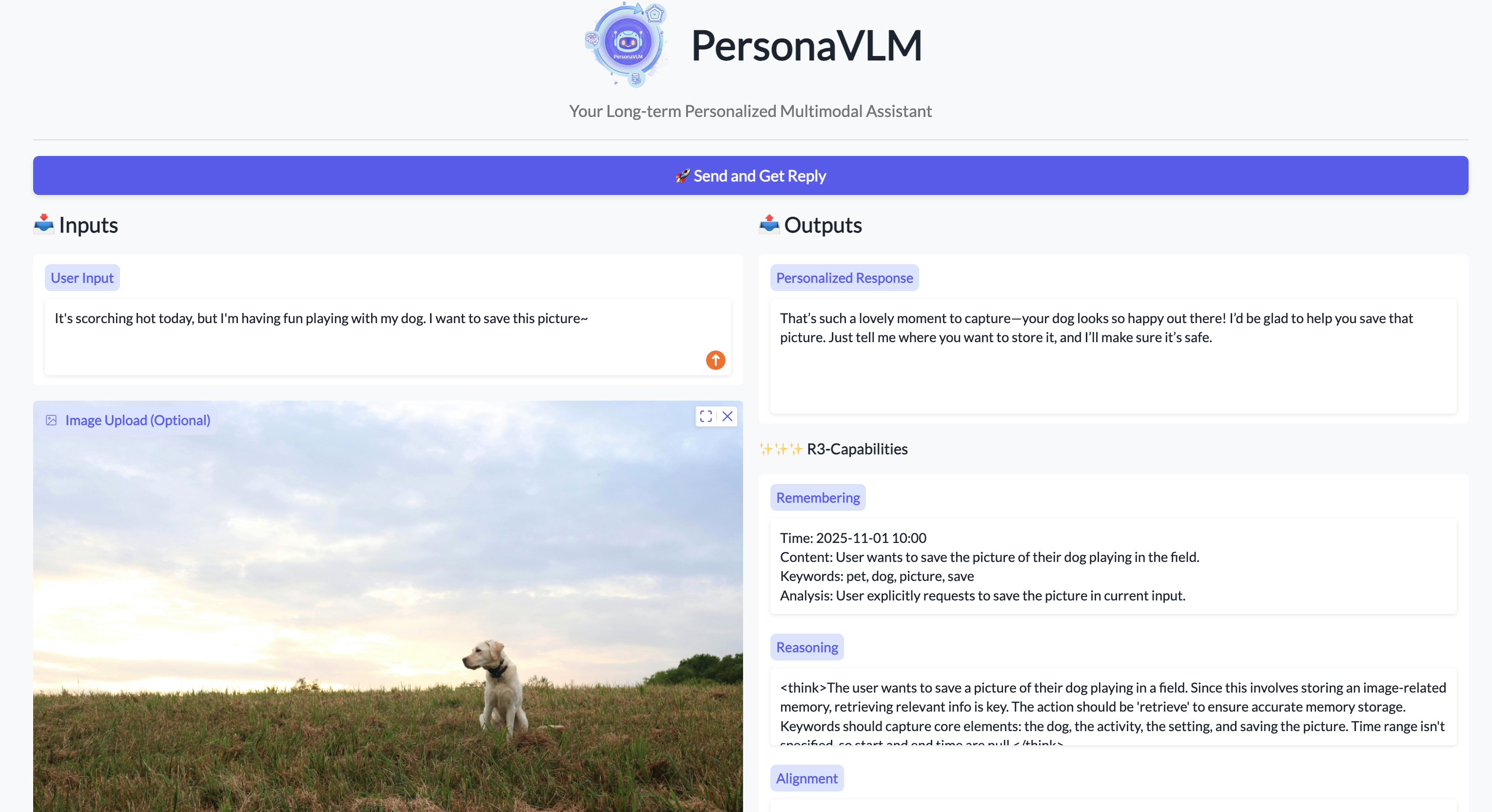
Launch Locally
To start the demo, ensure your model weights are in./checkpoints/rl and run:
python gradio_demo.py


