
[NeurIPS 2025] Official implementation for our paper "Scaling Diffusion Transformers Efficiently via μP".
Scaling Diffusion Transformers Efficiently via μP
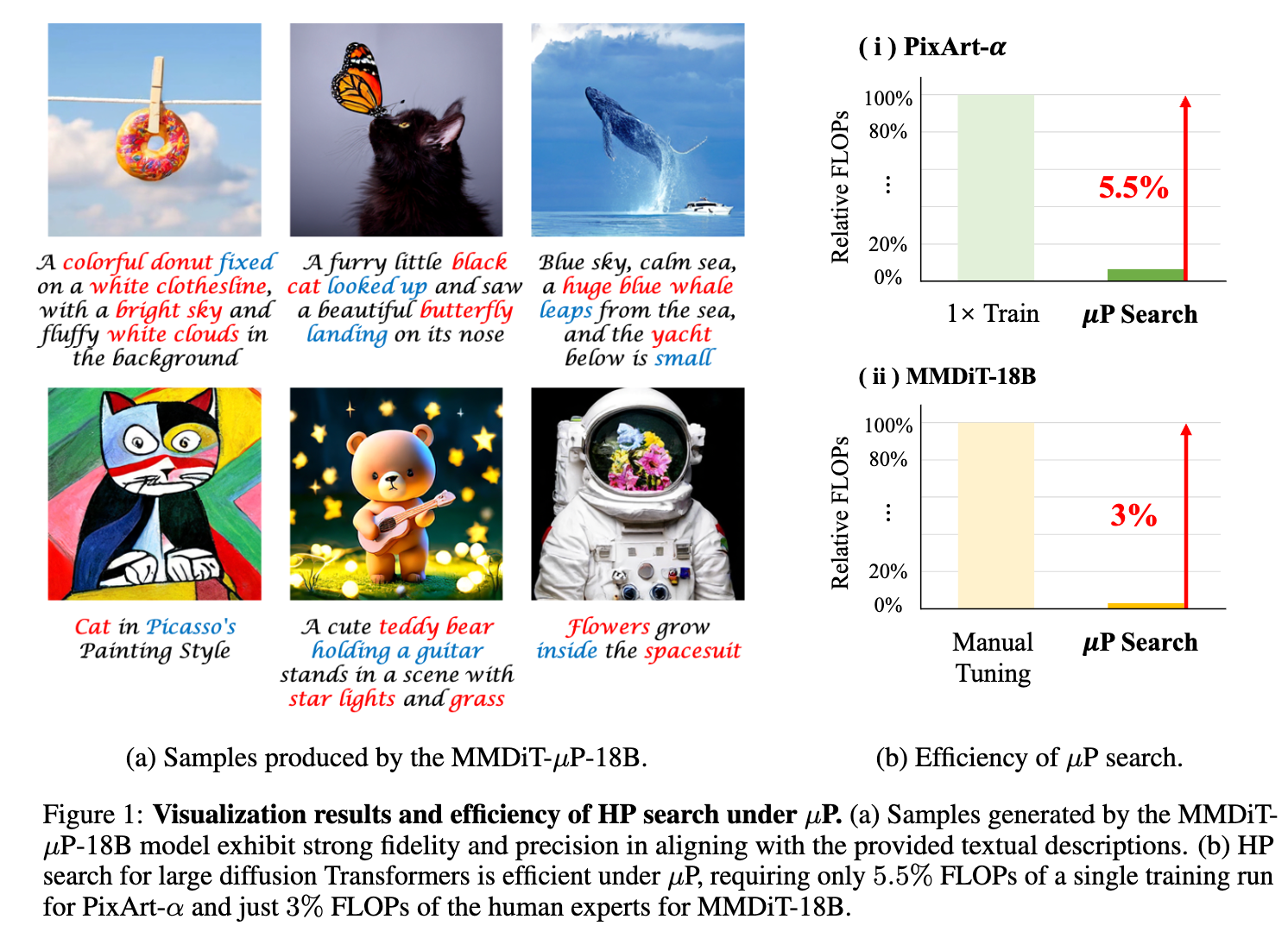
This is the official implementation for our NeurIPS 2025 paper "Scaling Diffusion Transformers Efficiently via μP". We verify that μP enables stable hyperparameter (HP) transfer from small to large diffusion Transformers, and dramatically reduces HP tuning costs at scale. As a result, diffusion Transformers under μP outperform their respective baselines while requiring small tuning cost (e.g., 3% FLOPs of human experts for MMDiT-18B).
News
- 2025/9/19: Our work has been accepted by NeurIPS 2025! The arXiv version has been updated accordingly.
- 2025/06/27: We release the checkpoints of DiT-XL-2-μP and PixArt-α-μP at https://huggingface.co/GSAI-ML/DiT-muP.
- 2025/05/21: We release the code of DiT and PixArt-α.
What is μP?
Maximal Update Parametrization (μP) was recently proposed as a promising solution to the HP selection problem for large models (e.g., vanilla Transformer). It stabilizes optimal HPs across different model widths, enabling direct transfer of HPs searched from small models to large models (a.k.a., μTransfer algorithm) and significantly reducing tuning costs at scale. Due to its strong transferability, μP has been applied to the pretraining of large language models (LLMs).
μP analytically adjusts the HPs of each weight based on the model's width and weight type (input, hidden, or output). These adjustments typically involve the weight multiplier, initialization variance, and learning rate. The implementation of μP is explained in detail in our paper and in the original Maximal Update Parametrization (μP) repository.
What are our contributions?
- We rigorously prove that μP of mainstream diffusion Transformers aligns with the existing framework, enabling the direct application of existing μP methodologies .
- We systematically demonstrate that DiT under μP enjoys robust HP transferability. Notably, DiT-XL-2-μP with transferred learning rate achieves 2.9 times faster convergence than the original DiT-XL-2.

- We validate that diffusion Transformers under μP outperform their respective baselines while requiring small tuning cost (e.g., 3% FLOPs of human experts for MMDiT-18B).
Systematic investigation for DiT-μP on ImageNet
Implementation of DiT-μP
We implement DiT-μP based on the original codebase. We just need to adjust the weight multiplier and variance of each weight at initalization according to the μP theory. We then use the MuAdamW optimizer from the original codebase to adjust learning rate of each weight at training. Our modifications compared to the original DiT are marked with "# mup" in the code.
We use the coordcheck method to verify the correctness of DiT-μP. In the following figure, all curves stay horizontal, indicating that μP is implemented correctly.
python coordcheck.py --loadbaseshapes width288_d28.bsh
HP transferability
We verify that DiT under μP enjoys robust HP transferability as the following figures (Figure 3 in our paper).

We describe how to reproduce Figure 3(a) in our paper.
First, we need to train some DiTs with different widths and learning rates under μP.
cd DiT/
torchrun --masterport=${MASTERPORT} \
--masteraddr=${MASTERADDR} \
--nprocpernode=8 \ #A100-80G GPU
--nnodes=1 \
--noderank=${NODERANK} \
train_mup.py \
--loadbaseshapes width288_d28.bsh \
--mup \
--globalbatchsize 256 \
--num_heads 4 \ # {2, 4, 8}
--epochs 40 \
--loglr -10 # {-9, -10, -11, -12, -13}
Second, we sample 50K images from these trained DiTs.
cd DiT
torchrun --masterport=${MASTERPORT} \
--masteraddr=${MASTERADDR} \
--nprocpernode=8 \ # A100-80G or V100-32G
--nnodes=1 \
--noderank=${NODERANK} \
sample_ddp.py \
--loadbaseshapes width288_d28.bsh \
--mup \
--num_heads 4 \ # {2, 4, 8}
--ckpt path_ckpt.pth \
--cfg_scale 1 \
--vae mse
Third, we evaluate the performance (e.g., FID, IS, sFID) of these DiTs based on the ADM codebase.
cd DiT
python createnpz.py # get sampled50K_images.npz
python evaluator.py \
--refbatch path/VIRTUALimagenet256_labeled.npz \
--samplebatch sampled50K_images.npz
Finally, we can plot the figures with these data.
Pretrain DiT-XL-2-μP
The best learning rate searched in small models is $2^{-10}$, we then use it to pretrain the DiT-XL-2-μP.
cd DiT/
torchrun --masterport=${MASTERPORT} \
--masteraddr=${MASTERADDR} \
--nprocpernode=8 \ # A100-80G
--nnodes=4 \
--noderank=${NODERANK} \
train_mup.py \
--loadbaseshapes width288_d28.bsh \
--mup \
--globalbatchsize 256 \
--num_heads 16 \
--epochs 480 \
--loglr -10
To reproduce the original DiT-XL-2 pretraining, we can run
cd DiT/
torchrun --masterport=${MASTERPORT} \
--masteraddr=${MASTERADDR} \
--nprocpernode=8 \ # A100-80G
--nnodes=4 \
--noderank=${NODERANK} \
train_mup.py \
--globalbatchsize 256 \
--num_heads 16 \
--epochs 1400
The sampling and evaluation are the same as before.
Scaling PixArt-α-μP on SA-1B
Dataset
We use the SA-1B/SAM dataset following the instructions in PixArt-α repo.
Implementation of PixArt-α-μP
Our modifications on initialization compared with the original PixArt-α are marked with "# mup" in the code. It correctness can also be verified by the coordcheck method.
python scripts/coordcheck.py \
--loadbaseshapes L28_width288.bsh \
--config configs/pixartconfig/PixArtmupimg256SAM_coord.py \
--workdir output/pixelartcoordcheck
HP search on proxy models
To reproduce the results of base learning rate search on PixArt-α-μP proxy tasks (Table 2 in our paper), we run
cd PixArt-alpha-master/
torchrun --masterport=${MASTERPORT} \
--masteraddr=${MASTERADDR} \
--nprocpernode=8 \ # A100-80G
--nnodes=1 \
--noderank=${NODERANK} \
train_scripts/train.py \
--config configs/pixartconfig/PixArtmupxl2img256SAMproxy.py \
--work-dir output/searchSAM256/loglr-10 \
--loadbaseshapes L28_width288.bsh \
--loglr -10 # {-9, -10, -11, -12, -13}
Pretrain PixArt-α-μP
We use the best base learning rate $2^{-10}$ to train the PixArt-α-μP.
cd PixArt-alpha-master/
torchrun --masterport=${MASTERPORT} \
--masteraddr=${MASTERADDR} \
--nprocpernode=8 \ # A100-80G
--nnodes=4 \
--noderank=${NODERANK} \
train_scripts/train.py \
--config configs/pixartconfig/PixArtmupxl2img256SAMtarget.py \
--work-dir output/pretrainSAM256_mup/loglr-10 \
--loadbaseshapes L28_width288.bsh
To train the original PixArt-α, we can run
cd PixArt-alpha-master/
torchrun --masterport=${MASTERPORT} \
--masteraddr=${MASTERADDR} \
--nprocpernode=8 \ # A100-80G
--nnodes=4 \
--noderank=${NODERANK} \
train_scripts/train.py \
--config configs/pixartconfig/PixArtxl2img256SAM.py \
--work-dir output/trainSAM256
Evaluation
MS-COCO and MJHQ
First, to obtain FID and CLIP score on MS-COCO and MJHQ-30K dataset, we need to generate images with their prompts
python scripts/inference.py \
--config config_path.py \
--loadbaseshapes L28_width288.bsh \
--modelpath ckptpath.pth \
--dataset mjhq # or mscoco
Second, the FID of two given image sets can be calculated by
python tools/fid.py \
--ref_dir data/mjhq/imgs \
--fakedir sampledimgs
Third, to obtain the CLIP score of sampled images, we can run
python tools/clip_score.py \
--imagedir sampledimgs \
--save_path result.csv
GenEval
First, generate images with the prompts from GenEval
python scripts/inference_geneval.py \
--config config_path.py \
--loadbaseshapes L28_width288.bsh \
--modelpath ckptpath.pth
Second, obtain the score
python tools/evaluate_geneval.py \
--imagedir sampled_imgs \
--outfile sampled_imgs.jsonl \
--model-path output/pretrained_models/mask2former
python tools/summaryscores.py sampledimgs.jsonl
Acknowledgement
This project is heavily based on the remarkable DiT, PixArt-α and Maximal Update Parametrization (μP). Thanks for their great work!
Citation
If our paper "Scaling Diffusion Transformers Efficiently via μP" or this repository was useful to you, please cite:
@article{zheng2025scaling,
  title={Scaling Diffusion Transformers Efficiently via $\mu$P},
  author={Zheng, Chenyu and Zhang, Xinyu and Wang, Rongzhen and Huang, Wei and Tian, Zhi and Huang, Weilin and Zhu, Jun and Li, Chongxuan},
  journal={arXiv preprint arXiv:2505.15270},
  year={2025}
}


