
DeFi protocol research agent for Solana. Scores protocols on security, traction, tokenomics, team, and moat using Claude.
Lore
Protocol diligence engine for Solana token buyers.
Turn token research into a capital-allocation memo in one pass.
bun run dev
- scores governance concentration, fee retention, treasury runway, unlock pressure, and traction quality
- ignores vanity TVL and narrative fluff that do not help underwrite the token
- promotes protocols where demand quality can realistically absorb future supply


Live Diligence Board • Operating Surfaces • What Lore Scores • Memo Anatomy • Technical Spec • Quick Start
At a Glance
Use case: token diligence and capital-allocation framing for Solana protocolsPrimary input: governance, revenue retention, treasury runway, unlock pressure, traction qualityPrimary failure mode: popular protocols with weak token underwritingBest for: buyers who need a fast memo before deciding whether a token deserves capital
Live Diligence Board
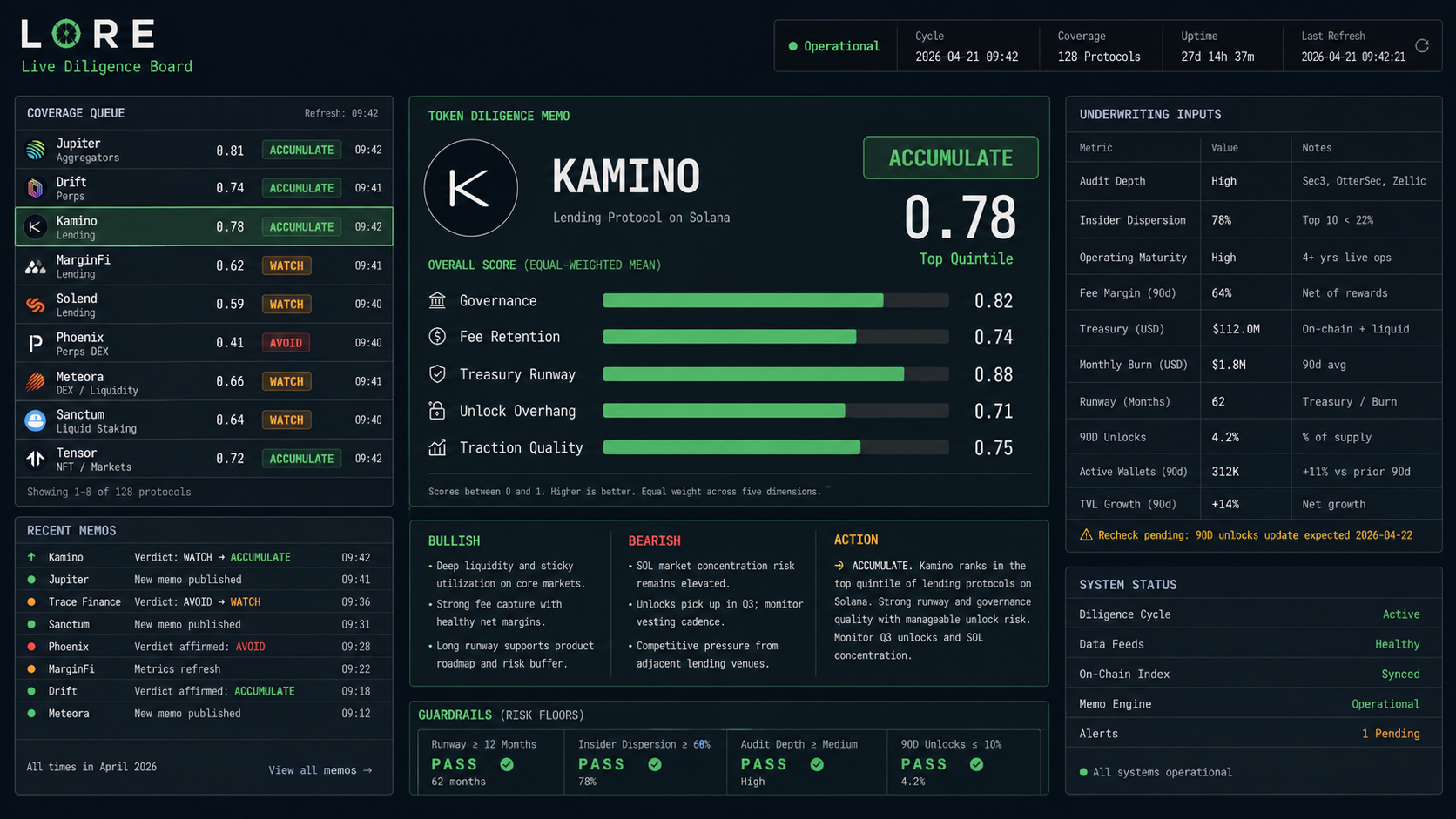
Live operating view for Lore: coverage queue across Solana DeFi protocols, Token Diligence Memo with five-bucket score breakdown, underwriting inputs, Bullish/Bearish/Action narrative, guardrails, and the agent's current ACCUMULATE, WATCH, or AVOID verdict.
Operating Surfaces
Research Board: shows the current memo with governance, runway, and unlock contextComparison Strip: keeps multiple Solana protocols on one allocation planeDiligence Score: compresses five underwriting dimensions into one rankingProtocol Memo: gives a buyer the exact reasons capital should move or wait
What Lore Feels Like To Use
Lore is supposed to read like the first serious pass on a token, not like a tweet thread trying to sound smart.
The board is useful when you already know the protocol name, the narrative, and the rough market interest, but you still need the hard part answered: does the token deserve capital once governance, treasury, unlocks, and fee quality are all put on the same page?
That is the difference between interest and underwriting. Lore is built for the second one.
What Lore Scores
Lore uses a five-part diligence model:
overall = mean(governance, feeRetention, treasuryRunway, unlockOverhang, tractionQuality)
This shifts the question from "is the protocol popular" to "can the token absorb supply and still justify capital".
The Questions Lore Forces
Lore is not trying to replace deep protocol research. It is trying to force the core underwriting questions into one repeatable frame:
- who really controls the token and governance surface
- whether the business is monetizing or only attracting attention
- how long the treasury can keep shipping without leaning on token supply
- whether the next unlock window can be absorbed by real demand
Memo Anatomy
Each Lore output is designed to be decision-ready.
Governance: who controls outcomes and how concentrated that control isRetention: whether protocol usage turns into durable economicsRunway: how long the treasury can operate without stressUnlocks: how much supply is about to hit the marketTraction: whether usage quality actually supports the token
How It Works
Lore is meant to turn raw protocol facts into a memo a buyer can actually use:
- normalize the protocol inputs into governance, economics, runway, unlock, and traction buckets
- score each bucket independently so one strong metric cannot hide another weak one
- compress the five buckets into one allocation view
- compare the memo against nearby protocols so the buyer sees relative quality, not just isolated facts
- print the reasons the token deserves capital, patience, or avoidance
What A Good Lore Memo Surfaces Fast
Governance Reality
If the token is effectively controlled by a small insider circle, Lore should make that obvious. That does not automatically kill the idea, but it changes position sizing and how much trust you place in long-duration narratives.
Treasury Durability
Protocols that need constant token support just to keep operating should not be mistaken for durable businesses. Lore highlights runway because teams with time can ship through bad market structure. Teams without time usually cannot.
Supply Pressure
Unlocks matter most when demand is weak, monetization is shallow, and valuation is already stretched. Lore treats that combination as a serious drag, not a footnote.
Why Lore Is Useful To Buyers
Most repo-level protocol explainers stop at "what this project does." Buyers need more than that. They need to know what makes the token fragile, what makes it durable, and what has to go right for the market to keep rewarding it.
Lore compresses those questions into a format you can compare across multiple Solana names without pretending every protocol should be judged the same way.
Example Output
LORE // TOKEN DILIGENCE MEMO
protocol          JUP overall score     0.76 governance        0.71 fee retention     0.81 runway            0.83 unlock overhang   0.58 traction quality  0.87
allocation note: durable economics are strong, but next unlock window still matters
Technical Spec
Governance
governance = 0.45 auditDepth + 0.35 insiderDispersion + 0.20 * operatingMaturity
Protocols with heavy insider ownership or weak audit posture lose points even if TVL is strong.
Fee Retention
feeRetention = 0.55 feeMargin + 0.45 normalizedFees
Usage only matters when it converts into protocol revenue that can support token value.
Treasury Runway
runwayMonths = treasuryUsd / monthlyBurnUsd
treasuryRunway = clamp(runwayMonths / 24)
Lore favors teams that can keep shipping without relying on immediate token supply overhang.
Unlock Overhang
unlockOverhang = 1 - (0.65 unlockPct90d + 0.35 valuationStretch)
High next-90-day unlocks are treated as a hard drag unless valuation and demand are unusually strong.
Traction Quality
tractionQuality = 0.45 normalizedTVL + 0.30 recentGrowth + 0.25 * activeUsage
Traction is not just TVL size. Growth quality matters.
Why Buyers Use Lore
The point of Lore is not to say a protocol is "good." The point is to say whether the token still deserves capital after governance risk, treasury burn, and supply pressure are put in the same memo.
That turns hype into something underwritable.
Risk Controls
governance concentration penalty: stops insider-heavy structures from hiding behind tractionrunway floor: penalizes protocols that need token support just to keep operatingunlock overhang penalty: treats near-term supply pressure as a first-order riskquality weighting: avoids over-rewarding raw TVL when monetization is weak
Quick Start
git clone https://github.com/LoreResearch/Lore
cd Lore
npm install
cp .env.example .env
npm run dev
Local Audit Docs
Support Docs
License
MIT


